Photo via Al Jazeera

Hormuz oil traffic is down 40 percent: Are Iran’s tanker attacks working?

Read the original at Al Jazeera ↗
Cite

Mohamed, E. (2026, November 24). Hormuz oil traffic is down 40 percent: Are Iran’s tanker attacks working? Al Jazeera. https://www.aljazeera.com/news/2026/11/24/hormuz-oil-traffic-is-down-40-percent-are-irans-tanker-attacks-working?traffic_source=rss

Dated from the outlet's own feed. Check the original for its byline.

Al Jazeera · collected 2026-11-24 · by Edna Mohamed

Quick Summary

Iran has intensified attacks on tankers crossing the Strait of Hormuz, a key oil transit point, leading to a 40 percent decline in oil traffic through the strait. The country’s naval blockade, reinstated after a brief pause, aims to pressure the US over sanctions and other disputes. Attacks on tankers, often involving naval mines, have surged recently, with more than 25 incidents reported in just one week, causing fires and disruptions to oil shipments globally. Iran’s Foreign Ministry spokesperson and military officials have reiterated that the country will use “all available means” to confront what they perceive as US aggression, emphasizing the need for international coordination and safe passage through the strait.
Written by AI on 2026-11-24, from this article's own text only (the story summary below draws on all the coverage).
See how they differ ↓

AI analysis

Story summary

As of November 24, 2026, Iran has amassed more than 14 oil tankers at Kharg Island, a critical export terminal handling up to 90% of the country’s crude exports, in a move seen as a challenge to the US naval blockade. Satellite imagery and ship-tracking data confirm the presence of these tankers, which are now fully crewed and flying Iranian flags. Meanwhile, a 26-mile queue of trucks carrying goods from China is stranded near the Iran border, waiting to enter the country, highlighting the economic strain caused by the blockade. The blockade has reduced commercial traffic through the Strait of Hormuz by 40%, and Iran has vowed to use "all available means" to counter the blockade, which it considers an act of military aggression.

Written for “Iran Vows to Counter US Naval Blockade” on 2026-11-25, grounded in this article and the 13 other(s) covering the same event.
Why this leaning score
The model judged this article politically coded and scored it +0.35, but every quote it verified points left, so the score is not published.
Written under an earlier scoring contract, which gave a paragraph rather than checkable quotes. Re-analysing this article replaces it.
Leaning score withheld for article 176656: score contradicts its own evidence · logged 2026-11-24

How they differ

9 outlets covered “Iran Vows to Counter US Naval Blockade”.

What each outlet says

One AI summary per outlet of its latest article on this story, written from that article alone and checked against it. Open the article for the outlet's own words.

Al JazeeraThis outlet24 Nov

Iran has intensified attacks on tankers crossing the Strait of Hormuz, a key oil transit point, leading to a 40 percent decline in oil traffic through the strait. The country’s naval blockade, reinstated after a brief pause, aims to pressure the US over sanctions and other disputes. Attacks on tankers, often involving naval mines, have surged recently, with more than 25 incidents reported in just one week, causing…

Hormuz oil traffic is down 40 percent: Are Iran’s tanker attacks working? (this article)3 articles from Al Jazeera on this story
Euronews23 Nov

Iran’s foreign ministry spokesman Esmaeil Baghaei strongly condemned the US naval blockade in the Strait of Hormuz as a violation of the UN Charter and an act of aggression, pledging that Iran would use “every means” to counter it. This came after US President Donald Trump threatened on Sunday that Iranian ships trying to break the blockade would “go to the bottom of the sea.” The Iranian foreign ministry also…

Iran vows 'every means' to counter US blockade of Hormuz after Trump threat →2 articles from Euronews on this story
New York Post22 Nov

Euronews reports that Iran has gathered more than 14 oil tankers near Kharg Island, a critical export terminal, in an attempt to circumvent the US naval blockade on Iranian oil exports. The report, based on satellite imagery and ship-tracking data, suggests that Iran might be planning to transfer crude oil between ships at sea to obscure its origin. However, shipping intelligence firm TankerTrackers questions the…

Iran amasses 14 oil tankers at key export hub as Tehran weighs challenge to US blockade: report →
Fox News22 Nov

President Trump warned Iran on Sunday that any attempt to breach the U.S. naval blockade in the Gulf could result in a military confrontation, telling Fox News that Iranian vessels would "all be at the bottom of the sea." Reports suggest Iran is preparing a convoy of 14 oil tankers from Kharg Island, a major export hub, to challenge the blockade imposed in April. Maritime security experts caution that such an…

Trump dares Iran to breach US port blockade as Tehran reportedly readies 14 oil tankers →
The Hindu23 Nov

On November 23, 2026, Iran's Foreign Ministry spokesman Esmaeil Baqaei stated that Iran would use all available means to counter a U.S. naval blockade imposed as retaliation for Iran's efforts to block the Strait of Hormuz. Baqaei claimed that the U.S. actions constitute military aggression and that Iran is entitled to defend itself under Article 51 of the UN Charter. The conflict began on February 28, 2026…

Will use 'all available means' to counter U.S. blockade: Iran →
Show 2 more outlets
Semafor23 Nov

Over the weekend, Iran and Houthi rebels escalated their attacks, including strikes near Oman and a missile and drone attack in Saudi Arabia, raising concerns about further conflict. Iran is considering moving 14 recently loaded oil tankers from Kharg Island to challenge the US naval blockade in the Strait of Hormuz. Diplomatic efforts, such as a meeting between US Secretary of State Marco Rubio and Qatar’s Prime…

Iran signals plans to challenge the US naval blockade →
Daily Mail24 Nov

Trucks carrying goods from China to Iran are stuck in a 26-mile queue near the Kazakhstan-Uzbekistan border, with about 1,200 trucks waiting for days to enter Iran. This situation is a direct result of the US imposing a naval blockade on Iran, forcing cargo to travel overland through countries like Kazakhstan, Uzbekistan, Pakistan, Turkmenistan, and Turkey. The cost of transporting goods by land has surged, with a…

1,200 trucks sit in 26-mile queue waiting to enter Iran for days as Trump's naval blockade hits regime's economy →

Where they agree and split

The full story: what happened, how it changed, and all 14 articles →

Compared with similar articles

This article reads unscored and hedges 20% of its claims. Each row says how that neighbour differs.
The Hindu
Hedges 1 of 12 claims Outlet record 78/100
CBC News
Leans strongly left Hedges 3 of 36 claims Outlet record 60/100
“Article A describes an athlete swimming in the Strait of Hormuz to highlight environmental issues, while Article B discusses Iran's tanker attacks and their impact on oil traffic in the same region.”
CBS News
Hedges 0 of 2 claims Outlet record 66/100
Al Jazeera
Leans right Hedges 0 of 2 claims Outlet record 60/100
“Article A describes the specific incident of two oil tankers catching fire in the Strait of Hormuz, while Article B discusses the broader impact of Iran's attacks on tankers and the reduction in oil traffic through the Strait of Hormuz over time.”
Al Jazeera
Hedges 2 of 21 claims Outlet record 60/100
“While both articles discuss Iran's response to the US naval blockade, they describe different aspects and times within the broader context of the blockade's impact and Iran's reactions.”
Al Jazeera
Leans strongly left Hedges 3 of 24 claims Outlet record 60/100
“The articles discuss related tensions and actions around the Strait of Hormuz but describe different specific events and timeframes.”
Al Jazeera
Hedges 0 of 3 claims Outlet record 60/100
“The articles discuss related events but different specific incidents: the first article focuses on Iran's threat and response to the US naval blockade, while the second article specifically mentions attacks on tankers in the Strait of Hormuz as a response to the blockade.”
Semafor
Leans left Hedges 2 of 6 claims Outlet record 70/100
“While both articles discuss Iran's response to the US naval blockade and its impact on oil traffic, they describe different aspects and timings of the ongoing situation rather than a single specific incident.”
The Daily Wire
Leans right Hedges 3 of 30 claims Outlet record 59/100
“The articles describe different aspects of the conflict in the Strait of Hormuz, with Article A focusing on physical attacks on tankers and Article B on cyberattacks on tankers.”
Euronews
Hedges 4 of 19 claims Outlet record 60/100
“While both articles discuss Iran's threats to close the Strait of Hormuz and attacks on tankers, they describe different aspects and sources of information, suggesting they are covering related but distinct parts of the ongoing situation.”

Story

Iran Vows to Counter US Naval Blockade
Politics · 14 article(s) covering the same event. Compare every outlet's account →
How this article was measured signals, leaning charts, publisher record, byline, topics and claims

Signals How these are calculated →

Claims extracted
35
sentences that state something as happening or true
Uncertain
20%
7 of 35 hedged ("reportedly", "may", "according to")
Leaning
withheld
no quote in the article backed the model's score
Publisher signals
60/100
Al Jazeera's corrections and hedging, across everything collected from it. Not a measure of accuracy.
Outlets on this story
14
Politics
Same framing elsewhere
1
articles that frame the event the way this one does
Analyzed 2026-11-24 · how these are computed

How this is being covered How these are calculated →

Article leaning vs. publisher reliability
Source leaning vs. consistency

Publisher

Al Jazeera · 6514 article(s) · 4 correction(s) detected
Running correction rate · 4 correction(s)

Who wrote this

Edna Mohamed
23 article(s) here · 1 carrying a prediction
Iran has reiterated that it will use “all available means” to confront the United States naval blockade, as it has stepped up attacks on tankers attempting to cross the Strait of Hormuz, a global oil chokepoint, signalling potential escalation.
Authorities had earlier issued an alert that a North Korean plane had made an incursion, which would have been a significant escalation in tensions between the two Koreas, which remain technically at war after the 1950-1953 Korean War ended with an armistice and not a peace treaty.
These could be the contours of how boards of mubil-billion dollar corporations decide on contentious issues.
The vessel will now feature as part of the world’s largest artificial reef, which is expected to become a popular diving destination.
We will work together to take robust action against those we suspect of any criminal activity that could undermine our national security.”
2026-11-11 · assertive framing · US soldier arrested for Russia spying: What we know
But in the phone interview, Trump put on a brave face — and offered an olive branch: He said that he would be willing to work with Democrats.
Hours after results confirmed that the Republican Party had lost control of both the Senate and the House of Representatives in the United States Congress in the midterm elections this week, senior Republicans were hand-wringing over what had gone so badly wrong and whether a major course correction would now be required.
Rashid added that vulnerabilities include “easily guessable” passwords, which would mean anyone could gain access.
Recommended Stories list of 3 items- list 1 of 3How will the Iran war shape the outcome of the US midterm vote? - list 2 of 3How US oil firms profit $130bn from Iran war as household bills surge - list 3 of 3China steps up Middle East diplomacy with Iran and Oman meetings
US Representative Rashida Tlaib and New York City Mayor Zohran Mamdani have opposed the US’s ongoing support for Israel, which has continued since President Donald Trump was re-elected last year.
Also by Edna Mohamed
Nothing else under this byline is closely related to this article, so these are simply their most recent.
All 23 articles by Edna Mohamed →

Topics

3US Iran Iranian Tehran United States

Subjects

Iran GPE · 11× Iranian NORP · 4× 3US GPE · 2× Tehran GPE · 2× Amir Hatami PERSON · 1× Esmaeil Baghaei PERSON · 1× Foreign Ministry ORG · 1× Hatami PERSON · 1× Tasnim ORG · 1× United States GPE · 1×

Narrative

The statement reiterated that the strait would not be opened until Iran’s objectives and demands were met, including halting hostilities, lifting the blockade and waiving sanctions, adding that “owners of oil tankers are required to coordinate with the armed forces to ensure safe passage through this strategic strait.” At the same time, the commander of the Iranian army, Amir Hatami, called for tightening the closure of the Strait of Hormuz on Tuesday, stressing that Tehran needed to make conditions more difficult.
framing: assertive · carried by 1 article(s) · first seen 2026-11-24
Iran has reiterated that it will use “all available means” to confront the United States naval blockade, as it has stepped up attacks on tankers attempting to cross the Strait of Hormuz, a global oil chokepoint, signalling potential escalation.

Claims (35 extracted, 7 hedged)

Iran has reiterated that it will use “all available means” to confront the United States naval blockade, as it has stepped up attacks on tankers attempting to cross the Strait of Hormuz, a global oil chokepoint, signalling potential escalation. asserted
it → reiterate → escalation
Foreign Ministry spokesperson Esmaeil Baghaei said on Monday that they would “definitely not tolerate” the naval blockade, and would use “all our tools to confront this US aggression”. asserted
they → say → aggression
Recommended Stories list of 3 items- list 1 of 3US maritime agency warned Iran blockade was adding to rising Gulf premiums - list 2 of 3US targets Iran’s ship-to-ship transfers: Can Tehran break the blockade? - list 3 of 3Tankers hit in Strait of Hormuz as Iran tightens grip on shipping “ asserted
Iran → warn → shipping
Iran has the right to use any available tool to defend itself in this regard,” he said. asserted
he → have → regard
The naval blockade has largely halted Iranian oil exports. asserted
blockade → halt → exports
It was first imposed in April, but was lifted following the June memorandum of understanding. asserted
It → impose → understanding
The blockade was reinstated weeks later after the agreement collapsed. asserted
agreement → reinstate → ?
As Iran’s economy is increasingly squeezed by the US-led economic sanctions, attacks on tankers have also gone up, affecting the flow of oil through the Strait of Hormuz. asserted
attacks → squeeze → Hormuz
The disruption to the flow of oil has triggered a global energy crisis. asserted
disruption → trigger → crisis
What do we know about the attacks on tankers, and how frequent are they? Attacks on oil tankers and commercial vessels have continued throughout the war, but more recently, a rising number of tankers have erupted in flames after hitting naval mines purportedly placed by Iran. asserted
number → know → Iran
More than 25 tankers have been hit in the past week alone. asserted
tankers → hit → week
According to reports, tankers have continued to make the dangerous journey through the waterway without seeking Iran’s approval, often travelling in the dark and without navigation transponders to avoid alerting Iranian officials. uncertain
tankers → accord → officials
However, this clandestine approach has come with its own problems. asserted
approach → come → problems
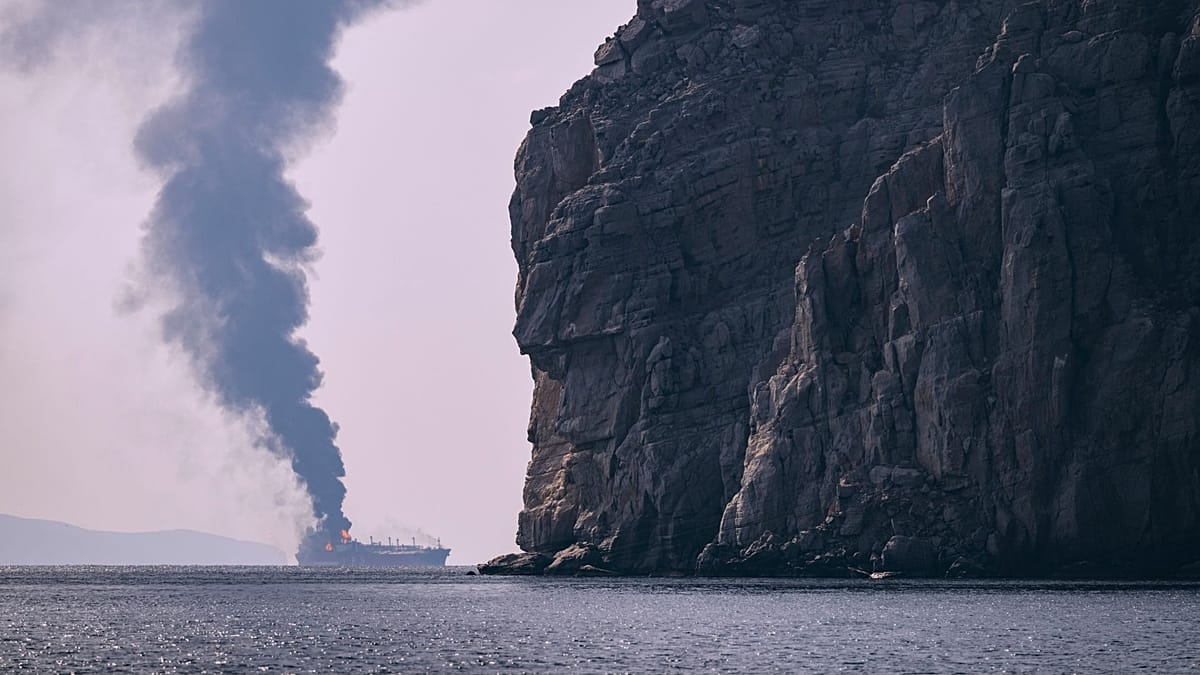
On Tuesday morning, Iran’s navy said two oil tankers had hit mines and caught fire in the waterway, according to a statement reported by Iran’s Tasnim news agency. uncertain
tankers → say → agency
According to the statement, the tankers entered a restricted zone east of the strait after turning off their navigation and identification systems. uncertain
tankers → accord → systems
The statement reiterated that the strait would not be opened until Iran’s objectives and demands were met, including halting hostilities, lifting the blockade and waiving sanctions, adding that “owners of oil tankers are required to coordinate with the armed forces to ensure safe passage through this strategic strait.” At the same time, the commander of the Iranian army, Amir Hatami, called for tightening the closure of the Strait of Hormuz on Tuesday, stressing that Tehran needed to make conditions more difficult. asserted
conditions → reiterate → Tuesday
“We must tighten our control over the Strait of Hormuz, our management of it must be stronger, and conditions must become more difficult for the enemy,” Iranian television quoted Hatami as saying, during a speech to senior army commanders at the Command and Staff University. asserted
television → tighten → University
The head of the Islamic Revolutionary Guard Corps’ (IRGC) navy, Ali Ozmaei, also warned vessels passing through the Strait of Hormuz against using unapproved shipping routes. asserted
head → warn → routes
“The Strait of Hormuz is not a place to test unauthorised routes and ignore maritime warnings,” Ozmaei said, according to the ISNA news agency. uncertain
Ozmaei → test → agency
Is the strategy working? asserted
strategy → work → ?
Despite the attacks, oil prices have fallen, with Brent crude futures at $88.35 per barrel as supplies recover. asserted
supplies → fall → barrel
At one point, oil prices went past $120 per barrel. asserted
prices → go → barrel
So far, according to the AIS ship-tracking platform, in the past 24 hours, 28 ships have crossed the strait: 12 into the Gulf and 16 out of it, carrying an estimated 4.18 million barrels of oil. uncertain
ships → accord → oil
However, because it only collects data from vessels with transponders on, loopholes – including the no-signal bypass routes – mean it is not an accurate count of how many ships are crossing the strait. asserted
ships → collect → strait
Still, it is a huge drop from pre-war numbers, during which 125 to 140 ships used to pass through daily. asserted
ships → use → which
In the past week, Iran has also carried out attacks on US bases in the Gulf, targeting radars. asserted
Iran → carry → radars
On Sunday, US President Donald Trump said in a post on Truth Social that Iran had launched “more drones and missiles in the last week than at any time for over a year”, adding that they had all been downed and had caused no damage. Meanwhile, last week, US Central Command (CENTCOM) said in an advisory that ships receiving cargo from vessels loaded at Iranian ports or along the country’s coastline could be considered to be “evading the blockade”, which had allowed some Iranian petroleum products to reach international markets. uncertain
products → say → markets
But Iran has repeatedly warned against US efforts to hamper its trade. asserted
Iran → warn → trade
Has this impacted oil traffic? asserted
this → impact → traffic
According to data from Marine Traffic, a ship-tracking platform, the number of vessels crossing between November 1 and 23 has dropped as the month goes on. uncertain
month → accord → November
In the first week of November, between the 1st and 7th, 226 vessels entered or exited the Gulf. asserted
vessels → enter → Gulf
In the last week of the month, from the 17th to the 23rd, only 125 vessels crossed the waterway. asserted
vessels → cross → waterway
That’s a drop of more than 40 percent. asserted
That → ’ → percent
Throughout the month, the highest day with 29 vessels exiting took place on November 1, and the highest day entering the Gulf was November 7. asserted
day → exit → Gulf
In contrast, the lowest day for exiting the Gulf was on Sunday, when only one vessel left the waterway; on the same day, only two vessels entered the waterway, the lowest figure for the month. asserted
vessels → exit → month
Give feedback · no sign-in needed

No sign-in needed for now. Your note is sent without a name, so it cannot be answered.

History Support