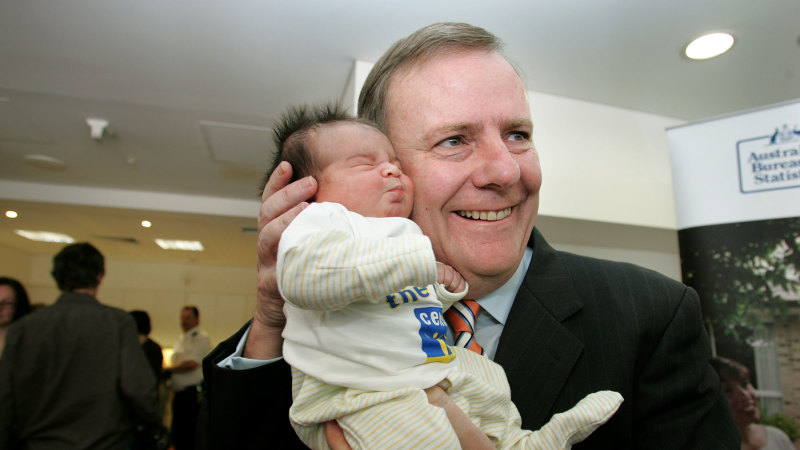
Photo via The Sydney Morning Herald

What six failed predictions taught Australia about its future

Read the original at The Sydney Morning Herald ↗
Cite

Wright, S. (2026, September 18). What six failed predictions taught Australia about its future. The Sydney Morning Herald. https://www.smh.com.au/politics/federal/what-six-failed-predictions-taught-australia-about-its-future-20260918-p60w9i.html?ref=rss&utm_medium=rss&utm_source=rss_feed

Dated when The Aporia collected the article, usually within hours of publication. Check the original for its exact date and byline.

The Sydney Morning Herald · collected 2026-09-18 · by Shane Wright

Quick Summary

The article discusses Australia's history of inaccurate long-term economic predictions through its intergenerational reports, which have consistently failed to foresee major economic events like the global financial crisis and the pandemic. These reports, first introduced in 2002 by Peter Costello, aim to project future budget scenarios based on demographic trends but are inherently limited by unforeseen external factors. Each report has underestimated or overestimated deficits, surpluses, and government debt levels, illustrating the challenges of making reliable long-term economic forecasts.
Written by AI on 2026-09-18, from this article's own text only (the story summary below draws on all the coverage).
See how they differ ↓

AI analysis

Story summary

Treasurer Jim Chalmers is set to release Australia's seventh Intergenerational Report (IGR) on Monday, forecasting that by 2066, Australia’s population will reach nearly 40 million people with longer life expectancies but lower fertility rates. The IGR outlines significant economic challenges due to an aging population and declining birthrates, emphasizing the critical role of migration in maintaining workforce growth.

Chalmers has hinted at potential further tax cuts for workers as part of his plan to address these long-term issues, suggesting that recent budget improvements have created room for additional relief. However, critics argue that while borrowing less than previously expected is positive, it does not equate to having surplus funds available for such measures without sustainable funding from spending restraint or alternative revenue sources.

The report also highlights the need for policy decisions today to prepare future generations for technological advancements like AI and to address geopolitical uncertainties in a more fragmented world. Prime Minister Anthony Albanese has been pushing for global cooperation on AI regulation during his visit to the United States, where he announced Siobhan McKenna as Australia's next Consul-General in New York, despite concerns about her past ties with News Corp. The announcements come amid efforts by the Australian government to secure a two-year term on the UN Security Council.

Written for “Australia's Economic Future Challenges” on 2026-11-21, grounded in this article and the 18 other(s) covering the same event.

How they differ

5 outlets covered “Australia's Economic Future Challenges”.

What each outlet says

One AI summary per outlet of its latest article on this story, written from that article alone and checked against it. Open the article for the outlet's own words.

Sydney Morning HeraldThis outlet18 Sep

The article discusses Australia's history of inaccurate long-term economic predictions through its intergenerational reports, which have consistently failed to foresee major economic events like the global financial crisis and the pandemic. These reports, first introduced in 2002 by Peter Costello, aim to project future budget scenarios based on demographic trends but are inherently limited by unforeseen external…

What six failed predictions taught Australia about its future (this article)7 articles from Sydney Morning Herald on this story
Daily Mail21 Sep

Australia faces a demographic shift where deaths are projected to outnumber births by the 2060s due to falling fertility rates and an aging population. Treasurer Jim Chalmers stated that migration will become crucial as Australia's younger population shrinks and its elderly population grows, noting that new migrants have a median age of 26 compared to residents' median age of 38. The country’s population is still…

Australia's migration dependence set to deepen as birth rate falls and population rapidly ages →4 articles from Daily Mail on this story
ABC News (AU)21 Sep

The article discusses the challenges facing younger Australians over the next four decades based on Australia's seventh Intergenerational Report since 2002. It highlights an aging population due to low fertility rates and higher mortality by 2066, leading to a smaller workforce relative to retirees. This demographic shift will strain the economy with reduced tax income and increased healthcare costs, likely…

Why younger Australians are facing a tough economic future →4 articles from ABC News (AU) on this story
The Guardian22 Sep

Australian experts criticize the government’s seventh intergenerational report for downplaying the severe economic impacts of climate change by 2066. The report acknowledges potential sea level rise, reduced worker productivity due to heat, and damage to agriculture and tourism but dismisses the certainty of these effects as “highly uncertain.” Treasury modelling cited in the report suggests a disorderly transition…

Intergenerational report underplays effect of climate crisis on Australia’s future, experts say →3 articles from The Guardian on this story
Times of India21 Sep

The Australian Treasury released a 2060s Intergenerational Report on Monday that projects deaths will outnumber births starting in the 2060s, contributing to a population growth rate that is expected to average 0.9% annually over the next four decades compared to 1.4% previously. Treasurer Jim Chalmers noted that the number of Australians aged over 85 would triple by 2066, increasing demand for health services and…

Australia ageing population crisis report sparks migration debate →

Where they agree and split

The full story: what happened, how it changed, and all 19 articles →

Compared with similar articles

This article reads unscored and hedges 0% of its claims. Each row says how that neighbour differs.
ABC News (AU)
Hedges 4 of 26 claims Outlet record 67/100
The Guardian
Leans strongly left Hedges 2 of 19 claims Outlet record 64/100
“While both articles discuss the seventh intergenerational report, Article A focuses on its predictive nature and accuracy, whereas Article B critiques it for underplaying climate crisis impacts. They are discussing different aspects of the same report.”
The Sydney Morning Herald
Leans left Hedges 1 of 35 claims Outlet record 61/100
The Sydney Morning Herald
Leans left Hedges 0 of 25 claims Outlet record 61/100
“Both articles discuss Jim Chalmers' intergenerational report but cover different aspects and perspectives on the report.”
The Guardian
Hedges 1 of 24 claims Outlet record 64/100
“Article A discusses the general unreliability of intergenerational reports, while Article B specifically addresses a particular forecast in the most recent report about population trends.”
The Sydney Morning Herald
Hedges 1 of 26 claims Outlet record 61/100
“Article A discusses past failures of intergenerational reports in predicting future trends, while Article B specifically mentions Jim Chalmers' upcoming seventh intergenerational report and its expected contents, indicating a different but related event.”
ABC News (AU)
Hedges 1 of 34 claims Outlet record 67/100
“The articles discuss different aspects of intergenerational reports and do not describe the exact same specific incident.”
Daily Mail
Hedges 4 of 24 claims Outlet record 69/100
“The articles discuss different aspects of the Intergenerational Report; Article A focuses on predictions and their historical accuracy, while Article B discusses life expectancy projections.”
ABC News (AU)
Centre Hedges 5 of 46 claims Outlet record 67/100
“While both articles discuss predictions about Australia's economic and societal future based on a government report, they do not describe the exact same incident or occurrence.”

Story

Australia's Economic Future Challenges
Economy/Business · 19 article(s) covering the same event. Compare every outlet's account →
How this article was measured signals, leaning charts, publisher record, byline, topics and claims

Signals How these are calculated →

Claims extracted
89
sentences that state something as happening or true
Uncertain
0%
0 of 89 hedged ("reportedly", "may", "according to")
Leaning
not political
takes no side on a contested political question
Publisher signals
61/100
The Sydney Morning Herald's corrections and hedging, across everything collected from it. Not a measure of accuracy.
Outlets on this story
19
Economy/Business
Same framing elsewhere
1
articles that frame the event the way this one does
Analyzed 2026-09-18 · how these are computed

How this is being covered How these are calculated →

Article leaning vs. publisher reliability
Source leaning vs. consistency

Publisher

The Sydney Morning Herald · 7770 article(s) · 16 correction(s) detected
Running correction rate · 16 correction(s)

Who wrote this

Shane Wright
30 article(s) here · 1 carrying a prediction
Treasurer Jim Chalmers is promising a “Goldilocks” mid-year budget update that will be focused on savings large enough ease inflation pressures but which will not hurt the overall economy.
The Greens could get in the way of Treasurer Jim Chalmers’ plans to overhaul capital gains tax by the end of the year, backing an inquiry into a separate proposal from independent MP Allegra Spender.
The CEOs of two of the nation’s largest banks have backed cuts in government spending to bring down inflation and make housing more affordable amid warnings the AI building boom could push up the cost of suburban homes as they compete for electricians and plumbers.
The federal government’s budget overhaul of negative gearing and capital gains tax has been blamed for the biggest fall in home loans taken out by investors on record, with warnings the property market will struggle well into next year.
The AI building boom that is powering the global economy could force interest rates to remain higher, the Reserve Bank’s chief economist has warned, while revealing there are few signs the new technology will eat into the job prospects of young Australians.
But it wasn’t accompanied by a surge in unemployment which would peak at 7.4 per cent.
It may not be an official recession, but the Reserve Bank knows it may feel like one for plenty of Australians after it delivered another dose of monetary policy punishment to the country.
The last time the RBA board split was in May when 8 voted in favour of a rate hike with one holding out.
The Reserve Bank is being warned it could drive Australia into a recession and leave tens of thousands of people out of work with a Melbourne Cup Day interest rate rise that will lift pressure on Treasurer Jim Chalmers to cut deeper into government spending.
The nationwide slump in house values has spread to Brisbane and Perth with no signs the property downturn is close to ending, amid fears it could get worse if the Reserve Bank pushes ahead with another interest rate hike this week.
Also by Shane Wright
Chalmers reveals plan for ‘Goldilocks’ budget update
2026-11-16 · The Sydney Morning Herald
Nothing else under this byline is closely related to this article, so these are simply their most recent.
All 30 articles by Shane Wright →

Topics

American Australian Bear Stearns Chalmers Swan

Subjects

Costello PERSON · 6× Chalmers PERSON · 4× Hockey ORG · 4× Swan ORG · 3× Frydenberg PERSON · 2× American NORP · 1× Australian NORP · 1× Bear Stearns ORG · 1× Jim Chalmers’ PERSON · 1× Peter Costello PERSON · 1×

Narrative

Costello and every other treasurer – Wayne Swan, Joe Hockey, Josh Frydenberg and Jim Chalmers – who has released an intergenerational report have warned that the nation would eventually face sizeable budget deficits. Costello’s two reports forecast surpluses before running into deficits that would ultimately hit 5 per cent of GDP.
framing: assertive · carried by 1 article(s) · first seen 2026-09-18
There is one certainty about Jim Chalmers’ upcoming intergenerational report – it will be wrong.
2026-09-18 · The Sydney Morning Herald
What six failed predictions taught Australia about its future · assertive framing

Claims (89 extracted, 0 hedged)

There is one certainty about Jim Chalmers’ upcoming intergenerational report – it will be wrong. asserted
it → be → report
Brimful with huge projections about how the federal budget, the economy and Australian society will look by the mid-2060s, it will outline a future markedly different to what we are experiencing today. asserted
we → look → what
But, like the six previous iterations of this report that was first produced by Peter Costello in 2002, its prognostications are unlikely to be correct. asserted
prognostications → produce → 2002
Costello’s idea was to examine the budget’s long-term demographic pressures by focusing on productivity, participation in the workforce and the nation’s population. asserted
idea → examine → workforce
They remain key to the document. asserted
They → remain → document
That first intergenerational report predicted the budget would remain in surplus until 2017 before a demographic tsunami overwhelmed the nation’s finances. asserted
tsunami → predict → finances
In his second report in 2007, the tsunami had been delayed, with surpluses forecast until at least 2022. asserted
surpluses → delay → 2022
But a year later an American investment bank called Bear Stearns collapsed, precipitating what we now call the global financial crisis and a 15-year string of budget deficits. asserted
we → call → deficits
That’s the danger with making long-term prognostications. asserted
That → ’ → prognostications
Something unforeseen can upend them all. asserted
Something → upend → them
In his first report, Costello noted that it provided plausible insights into the nation’s fiscal future. asserted
it → note → future
“The results indicate a possible future, but within a wide band of uncertainty,” he said. asserted
he → indicate → uncertainty
Costello and every other treasurer – Wayne Swan, Joe Hockey, Josh Frydenberg and Jim Chalmers – who has released an intergenerational report have warned that the nation would eventually face sizeable budget deficits. Costello’s two reports forecast surpluses before running into deficits that would ultimately hit 5 per cent of GDP. asserted
that → release → GDP
Hockey, Frydenberg and Chalmers never forecast a surplus – just a sea of red all the way out to the 2060s. asserted
Hockey → forecast → 2060s
While Swan’s 2010 report missed the current deficit, it was the only one to forecast there would be surpluses in 2022-23 and the following year. asserted
it → miss → 2022
Highlighting just how events can throw out forecasts, Frydenberg’s intergenerational report of 2021, compiled during the pandemic, forecast a deficit of 4.6 per cent of GDP for 2022-23. asserted
report → highlight → 2022
Instead, Chalmers would oversee a surplus of 1 per cent of GDP. asserted
Chalmers → oversee → GDP
Deficits mean debt. asserted
Deficits → mean → debt
And only the Chalmers report of 2023 – largely because it was so recent – has got close to accurately predicting the current level of net debt. asserted
it → get → debt
Swan believed the value of government assets would outweigh its debts to the tune of 5.5 per cent of GDP by 2026-27. asserted
value → believe → 2026
Hockey was a little more circumspect, tipping net debt of 5 per cent of GDP for the same year before a rapid improvement. asserted
Hockey → tip → improvement
But political failure – in Swan’s case, an overhaul of mining taxes, and in Hockey’s case, his unloved 2014 budget – coupled with the hit to the government’s finances by COVID and the financial crisis left debt growing far greater than any treasurer had expected. asserted
treasurer → couple → debt
Getting a grip on the budget’s key spending pressures has also been extremely difficult. asserted
Getting → get → pressures
Every intergenerational report focuses on spending on welfare, the health system, defence, aged care and education. asserted
report → focus → welfare
Since 2015, the National Disability Insurance Scheme has been included. asserted
Scheme → include → 2015
The budget’s single largest expense, outside the GST which flows to the states, is the age pension. asserted
which → flow → states
Here, governments have made unexpected savings. asserted
governments → make → savings
Costello’s first report forecast that by 2032, the age pension would cost 4.4 per cent of GDP, or about $135 billion. asserted
pension → forecast → GDP
Chalmers’ last report forecast the cost of the age pension at 2.4 per cent of GDP, or less than $80 billion. asserted
report → forecast → GDP
The Rudd government’s decision to lift the age pension access age to 67 and the increase in the superannuation guarantee levy to 12 per cent have helped keep a lid on the age pension. asserted
decision → lift → pension
Costello’s first report also expected health spending to reach about $226 billion, or 7.3 per cent of GDP by 2032. asserted
spending → expect → 2032
Hockey’s 2015 report, following on from his contentious 2014 budget, sliced this to 4 per cent. asserted
report → follow → cent
Costello and Wayne Swan didn’t have to account for it in their reports as it did not exist. asserted
it → have → reports
Hundreds of billions of dollars that would have once been counted as health spending are now tied to the scheme. asserted
that → count → scheme
That pressure was finally addressed in this year’s budget with the deep cuts in NDIS spending outlined by Health Minister Mark Butler. asserted
pressure → address → Butler
The other area that has caught treasurers is defence. asserted
that → catch → treasurers
The first three intergenerational reports had defence spending constant at 1.8 per cent of GDP by the early 2030s. asserted
spending → have → 2030s
But the geopolitical turmoil of the past decade has forced all governments to increase their expected spend on defence, which in Chalmers’ 2023 report was pushed up to 2.3 per cent of GDP by 2032. asserted
which → force → 2032
The intergenerational reports do not cover all government spending. asserted
reports → cover → spending
While most reference the nation’s interest bill in passing, Chalmers’ 2023 edition noted the pressure this was putting on the budget. asserted
this → reference → budget
…and 49 more, not listed.
Give feedback · no sign-in needed

No sign-in needed for now. Your note is sent without a name, so it cannot be answered.

History Support