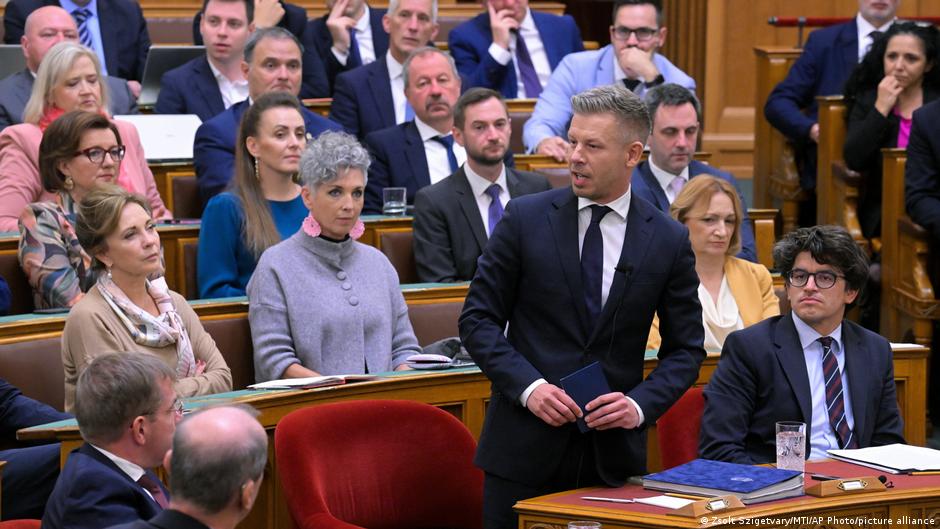
Photo via Deutsche Welle

EU enlargement: Why do some EU member states use their vetoes to block the accession of certain candidate countries?

Read the original at Deutsche Welle ↗
Cite

Verseck, K. (2026, November 24). EU enlargement: Why do some EU member states use their vetoes to block the accession of certain candidate countries? Deutsche Welle. https://www.dw.com/en/eu-enlargement-why-do-some-eu-member-states-use-their-vetoes-to-block-the-accession-of-certain-candidate-countries/a-80034401?maca=en-rss-en-world-4025-rdf

Dated from the outlet's own feed. Check the original for its byline.

Deutsche Welle · collected 2026-11-24 · by Keno Verseck

Quick Summary

The EU enlargement process faces obstacles as Croatia threatens to veto Montenegro's accession unless certain demands are met, including compensation for former prisoners and clarification on missing Croatians from the Yugoslav wars. Croatia is also seeking €2.4 billion for assets of the Yugoslav People's Army, while disputes over maritime boundaries persist. Additionally, the article highlights Hungary's obstructionist stance toward Ukraine's EU candidacy, driven by domestic politics and concerns over Hungarian minorities in Ukraine. This piece examines how EU member states use their veto rights as political leverage, hindering the bloc's expansion.
Written by AI on 2026-11-25, from this article's own text only (the story summary below draws on all the coverage).

AI analysis

Story summary

As of November 24, 2026, Croatia threatens to veto Montenegro's accession to the European Union unless the country meets a series of Croatian demands, causing dismay among EU politicians and MEPs. Montenegro, with a population of just 620,000, is the most advanced EU candidate country, potentially joining the bloc in early 2028. However, EU enlargement has faced hurdles recently, with member states using their veto rights as a political weapon, leading to paralysis within the EU. This is not the first instance of such behavior, as other member states have used vetoes to block the accession of candidate countries in the past.

Written for “EU Enlargement Vetoes” on 2026-11-25, grounded in this article and the 0 other(s) covering the same event.

Compared with similar articles

This article reads leans left and hedges 10% of its claims. Each row says how that neighbour differs.
Deutsche Welle
Leans right further right than this Hedges 3 of 37 claims Outlet record 95/100
“The articles discuss different aspects of EU enlargement and do not focus on the same specific incident or time frame.”
Deutsche Welle
Hedges 3 of 37 claims Outlet record 95/100
“Article A discusses North Macedonia's stalled EU accession and the progress of Montenegro and Albania, while Article B focuses on potential vetoes by Croatia against Montenegro's accession. The articles cover related topics but describe different specific events and concerns.”

Story

EU Enlargement Vetoes
Politics · 1 article(s) covering the same event.
How this article was measured signals, leaning charts, publisher record, byline, topics and claims

Signals How these are calculated →

Claims extracted
40
sentences that state something as happening or true
Uncertain
10%
4 of 40 hedged ("reportedly", "may", "according to")
Leaning
Leans left
of the writing, not the subject · beta estimate
Publisher signals
95/100
Deutsche Welle's corrections and hedging, across everything collected from it. Not a measure of accuracy.
Outlets on this story
1
Politics
Same framing elsewhere
1
articles that frame the event the way this one does
Analyzed 2026-11-25 · how these are computed

How this is being covered How these are calculated →

Article leaning vs. publisher reliability
Source leaning vs. consistency

Publisher

Deutsche Welle · 769 article(s) · 0 correction(s) detected
No corrections detected for this publisher. That may mean careful reporting, or simply that nothing has been checked.

Who wrote this

Keno Verseck
9 article(s) here · 1 carrying a prediction
Instead, his Tuesday afternoon visit began at a place where he could demonstrate his solidarity with Ukraine more clearly than anywhere else.
If everything goes according to plan, another enlargement might soon be on the cards: Montenegro, with a population of just 620,000, could complete accession negotiations in the coming months and join the European Union in early 2028. But no sooner had EU Enlargement Commissioner Marta Kos made this announcement in October than news emerged that Croatia might veto Montenegro's accession unless the country meets a series of Croatian demands. EU politicians and MEPs were dismayed. This is not the first time that something like this has happened: The veto rights that member states have on many EU matters have increasingly been used by individual countries in recent years as a means of blackmail and a political weapon, paralyzing the EU in the process.
The law relevant to the files contained provisions that were open to broad interpretation, which allowed government agencies such as the Ministry of Interior to prevent the transfer of files from the secret police to the Historical Archives of the Hungarian State Security, or ABTL, if they believed it would compromise national security.
But it is also a risky maneuver — if convicted, Magyar could lose his seat in Parliament.
Even after a Russian drone struck a high-rise apartment building in the eastern Romanian city of Galati in late May this year, many EU and NATO representatives hesitated to accuse Russia of intentional action.
2026-09-26 · mixed framing · Russia expected to intensify hybrid war on Europe
Moldova's Defense Minister Anatolie Nosatii said that the deaths of Moldovan citizens could no longer be ruled out in future.
2026-09-12 · assertive framing · Russia's drone war comes to Moldova and Romania
All this came to an end in May, when the new government headed by Peter Magyar took office.
Magyar has talked of a sum of around €60 billion ($70 billion), though other estimates suggest the real amount could be three times that much.
2026-09-06 · assertive framing · Hungary begins hunt for corrupt regime's billions
Also by Keno Verseck
Nothing else under this byline is closely related to this article, so these are simply their most recent.
All 9 articles by Keno Verseck →

Topics

Croatia Montenegro Ukraine Zagreb the Yugoslav People's Army

Subjects

Croatia GPE · 8× Ukraine GPE · 8× Montenegro GPE · 5× Hungary GPE · 3× Hungarian NORP · 2× North Macedonia GPE · 2× Zagreb GPE · 2× the Yugoslav People's Army ORG · 2× Marta Kos PERSON · 1× the European Union GPE · 1×

Narrative

Nevertheless, Magyar's government lifted several temporary blocks on the opening of new negotiating chapters, among other things after the Ukrainian parliament passed a law in early October strengthening the educational rights of national minorities. North Macedonia:
framing: assertive · carried by 1 article(s) · first seen 2026-11-25
If everything goes according to plan, another enlargement might soon be on the cards: Montenegro, with a population of just 620,000, could complete accession negotiations in the coming months and join the European Union in early 2028. But no sooner had EU Enlargement Commissioner Marta Kos made this announcement in October than news emerged that Croatia might veto Montenegro's accession unless the country meets a series of Croatian demands. EU politicians and MEPs were dismayed. This is not the first time that something like this has happened: The veto rights that member states have on many EU matters have increasingly been used by individual countries in recent years as a means of blackmail and a political weapon, paralyzing the EU in the process.

Claims (40 extracted, 4 hedged)

It's been quite a while since the EU's last enlargement: Croatia was the last country to join the bloc back in 2013. asserted
Croatia → join → 2013
If everything goes according to plan, another enlargement might soon be on the cards: Montenegro, with a population of just 620,000, could complete accession negotiations in the coming months and join the European Union in early 2028. But no sooner had EU Enlargement Commissioner Marta Kos made this announcement in October than news emerged that Croatia might veto Montenegro's accession unless the country meets a series of Croatian demands. EU politicians and MEPs were dismayed. This is not the first time that something like this has happened: The veto rights that member states have on many EU matters have increasingly been used by individual countries in recent years as a means of blackmail and a political weapon, paralyzing the EU in the process. uncertain
states → go → process
DW takes a look at some of the most significant cases, the background to them and what are — in some instances — the serious political consequences of them. asserted
what → take → them
It has already provisionally closed several of the EU's 33 negotiating chapters. asserted
It → close → chapters
As of November 23, however, Croatia is blocking the closure of three chapters that have already been negotiated. asserted
that → block → chapters
Zagreb is demanding, among other things, compensation for former prisoners held in Montenegrin camps during the Yugoslav wars of the 1990s, clarification of the fate of Croatians who have been missing since that time, and more rigorous prosecution of war crimes. asserted
who → demand → crimes
In addition, Croatia is demanding payment of about €2.4 billion (about $2.6 billion) for assets that belonged to the Yugoslav People's Army, the army of the former Yugoslavia to which both countries belonged before its breakup in the early 1990s. asserted
countries → demand → 1990s
Montenegro has already responded to some of Croatia's demands, including those concerning compensation for former prisoners. asserted
Montenegro → respond → prisoners
Others, such as the one relating to the assets of the Yugoslav People's Army, are disputed. asserted
Others → relate → Army
It is clear that Croatia's list of demands is also driven by domestic politics. asserted
list → drive → politics
No government in Zagreb can afford to appear compliant on issues relating to the Croatian War of Independence (1991–95). asserted
government → afford → Independence
Moreover, moderate conservative Prime Minister Andrej Plenkovic, who is regularly accused in Croatia of being too pro-EU, can use the dispute to portray himself as a staunch defender of national interests. asserted
who → accuse → interests
After Russia's full-scale invasion of Ukraine, the EU in June 2022 granted Ukraine and the Republic of Moldova EU candidate status through an accelerated procedure as a gesture of solidarity. asserted
EU → grant → solidarity
Many EU member states have reservations about Ukraine joining the bloc quickly. asserted
Ukraine → have → bloc
Nevertheless, only Hungary, under former Prime Minister Viktor Orban, adopted an obstructive stance. asserted
Hungary → adopt → stance
Ostensibly, Hungary's obstruction was about getting Ukraine to improve the rights of the Hungarian minority in Transcarpathia in western Ukraine. asserted
Ukraine → get → Ukraine
Ultimately, however, Orban used the matter for domestic political purposes and as an election campaign issue, portraying Ukraine as a "mafia state." asserted
Orban → use → state
In an effort to appeal to widespread anti-Ukrainian sentiment in Hungary, the country's new prime minister, Peter Magyar, has also adopted a tough stance on Ukraine. asserted
minister → appeal → Ukraine
Nevertheless, Magyar's government lifted several temporary blocks on the opening of new negotiating chapters, among other things after the Ukrainian parliament passed a law in early October strengthening the educational rights of national minorities. North Macedonia: asserted
parliament → lift → Macedonia
The never-ending blockade No EU candidate country has suffered as much or as long from veto politics as North Macedonia: It was granted EU candidate status in 2005 but only began accession negotiations in July 2022. asserted
It → end → July
Greece blocked the start of negotiations for 13 years because it objected to the name "Republic of Macedonia," as the country was previously known, and accused its neighbor of laying territorial claims to the region of Macedonia in northern Greece. uncertain
country → block → Greece
The dispute was settled in 2018 through a compromise that saw the country change its name to the Republic of North Macedonia the following year. asserted
country → settle → Macedonia
But just as the path to accession negotiations seemed clear, Bulgaria blocked the opening of talks in November 2020. asserted
Bulgaria → seem → November
Bulgaria regards the Macedonian language as a dialect of Bulgarian and disputes the existence of a distinct Macedonian nation. asserted
Bulgaria → regard → nation
Former Bulgarian President and current Prime Minister Rumen Radev, for example, fueled the escalation with North Macedonia to enhance his political profile. asserted
Radev → fuel → profile
Croatia is not the only country obstructing progress asserted
Croatia → obstruct → progress
Although Serbia has been negotiating EU accession since 2014, little progress has been made. asserted
progress → negotiate → 2014
In July, when the country was still led by President Aleksandar Vucic, no less than eight EU member states — including Croatia — opposed opening further negotiating chapters with Serbia. asserted
states → lead → Serbia
While the main reservations relate to democratic shortcomings, deficiencies in the rule of law and corruption in Serbia, Croatia also has its own disputes with its eastern neighbor. asserted
Croatia → relate → neighbor
These concern the 1991–95 war, including missing persons, war crimes, minority rights and differing interpretations of history. asserted
These → concern → history
Relations are also strained by nationalist rhetoric on both sides. asserted
Relations → strain → sides
Whether the election victory of the Student List in Belgrade in late October after almost two years of anti-government, anti-corruption protests will change this situation is impossible to say. asserted
change → change → situation
Albania: Greece threatens to use minority rights as leverage The EU opened accession negotiations with Albania, which has been an EU candidate since 2014, in July 2022. asserted
which → threaten → July
Albania could become the bloc's next new member after Montenegro. uncertain
Albania → become → Montenegro
However, Greece has repeatedly threatened (most recently in June) to block the accession process unless the rights of the Greek minority, particularly relating to property rights, are adequately protected. asserted
rights → threaten → rights
In light of all this, Brussels has long been debating a reform of the accession process and the EU veto system. asserted
Brussels → debate → process
In early October, the European Commission proposed that decisions to open negotiations with candidate countries be made by qualified majority rather than unanimously. asserted
decisions → propose → majority
It also proposed that new EU members would be required to give up the right to veto decisions in certain policy areas altogether for a specified period. asserted
members → propose → period
The problem with these proposed reforms is that they would themselves have to be adopted unanimously. asserted
they → propose → reforms
In other words, any member state could veto the reform. uncertain
state → veto → reform

Give feedback · no sign-in needed

No sign-in needed for now. Your note is sent without a name, so it cannot be answered.

History Support