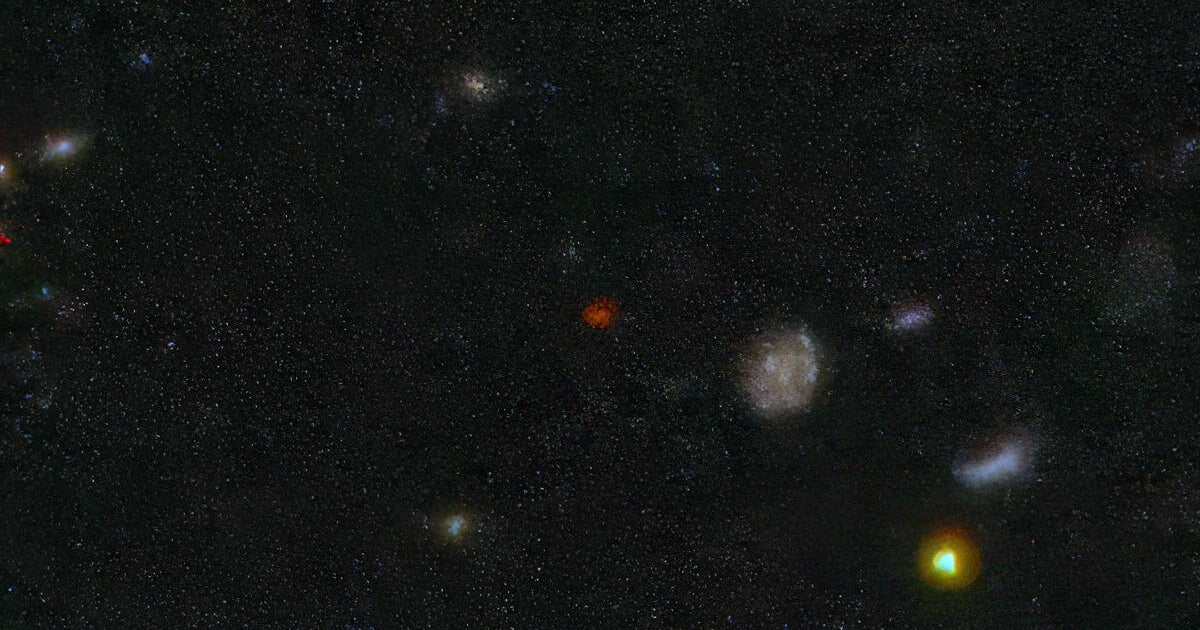
Photo via The Globe and Mail

Astronomers spot record-setting quasar in the early universe

Read the original at The Globe and Mail ↗
Cite

Dunham, W. (2026, November 24). Astronomers spot record-setting quasar in the early universe. The Globe and Mail. https://www.theglobeandmail.com/canada/science/article-astronomers-spot-oldest-known-quasar/

Dated from the outlet's own feed. Check the original for its byline.

The Globe and Mail · collected 2026-11-24 · by Will Dunham

Quick Summary

Astronomers have discovered the oldest known quasar, which dates back to more than 13.1 billion years ago, shortly after the Big Bang. The quasar, named Dún Aonghasa, was identified using the European Space Agency’s Euclid telescope and confirmed with additional observations from ground-based and space telescopes. This quasar, located about 40 million years earlier than the previous record holder, provides evidence that supermassive black holes can grow to enormous sizes very quickly in the early universe.
Written by AI on 2026-11-24, from this article's own text only (the story summary below draws on all the coverage).
See how they differ ↓

AI analysis

Story summary

Scientists have discovered the most distant quasar yet, located within 630 million years of the Big Bang, setting a new record. This quasar, the core of a galaxy with a black hole at its center, is the earliest known quasar, pushing back the cosmic timeline by nearly 40 million years compared to previous records. Led by a German team and using observations from the European Space Agency’s Euclid telescope, the discovery provides insights into the early universe and its development. Launched in 2023, Euclid aims to study dark matter and dark energy, helping scientists understand the expansion of the universe. This significant leap in cosmic time is a major breakthrough in the study of the universe's early history.

Written for “Newly Found Farthest Quasar” on 2026-11-24, grounded in this article and the 4 other(s) covering the same event.

How they differ

5 outlets covered “Newly Found Farthest Quasar”.

What each outlet says

One AI summary per outlet of its latest article on this story, written from that article alone and checked against it. Open the article for the outlet's own words.

The Globe and MailThis outlet24 Nov

Astronomers have discovered the oldest known quasar, which dates back to more than 13.1 billion years ago, shortly after the Big Bang. The quasar, named Dún Aonghasa, was identified using the European Space Agency’s Euclid telescope and confirmed with additional observations from ground-based and space telescopes. This quasar, located about 40 million years earlier than the previous record holder, provides evidence…

Astronomers spot record-setting quasar in the early universe (this article)
Toronto Star24 Nov

Scientists have identified the most distant quasar, located just 630 million years after the Big Bang, according to a report by a German-led team. This discovery sets a new record for the earliest known formation of a quasar, which consists of a supermassive black hole at the center of a galaxy. The finding is significant in the context of the 13.8 billion-year history of the universe, as it indicates the rapid…

Scientists discover quasar formed within a mere 630 million years of the Big Bang, setting a record →
New York Post24 Nov

Scientists have discovered a quasar that formed just 630 million years after the Big Bang, setting a new record. Led by Julien Wolf from the European Southern Observatory, the team identified this quasar using data from the Euclid telescope, which is mapping galaxies to understand dark matter and dark energy. The black hole at the center of this quasar has a mass equivalent to 360 million suns, making it…

Scientists discover quasar formed within a mere 630 million years of the Big Bang, setting a record →
CBS News24 Nov

Scientists have discovered the most distant quasar, dating back to 630 million years after the Big Bang, making it the oldest known quasar. This find, led by Julien Wolf from the European Southern Observatory, breaks previous records by nearly 40 million years. The quasar, named Dun Aonghasa, was identified using data from the Euclid telescope and confirmed by the Hubble and Webb space telescopes. Its central black…

Newly found farthest quasar from Earth is also oldest known to man →
The Straits Times24 Nov

Astronomers have discovered the oldest-known quasar, dating back 13.1 billion years, when the universe was less than 5% of its current age, about 630 million years after the Big Bang. This quasar, named Dún Aonghasa, is powered by a supermassive black hole 360 million times the mass of the sun, setting a new record by 40 million years over the previous oldest quasar. The discovery, published in Astronomy and…

Astronomers spot record-setting quasar in the early universe →

Compared with similar articles

This article reads unscored and hedges 12% of its claims. Each row says how that neighbour differs.
CBS News
Hedges 2 of 20 claims Outlet record 66/100

Story

Newly Found Farthest Quasar
Science · 5 article(s) covering the same event. See how they differ ↑
How this article was measured signals, leaning charts, publisher record, byline, topics and claims

Signals How these are calculated →

Claims extracted
26
sentences that state something as happening or true
Uncertain
12%
3 of 26 hedged ("reportedly", "may", "according to")
Leaning
not political
takes no side on a contested political question
Publisher signals
51/100
The Globe and Mail's corrections and hedging, across everything collected from it. Not a measure of accuracy.
Outlets on this story
5
Science
Same framing elsewhere
2
articles that frame the event the way this one does
Analyzed 2026-11-24 · how these are computed

How this is being covered How these are calculated →

Article leaning vs. publisher reliability
Source leaning vs. consistency

Publisher

The Globe and Mail · 1354 article(s) · 52 correction(s) detected
Running correction rate · 52 correction(s)

Who wrote this

Will Dunham
4 article(s) here · 1 carrying a prediction
Another possibility is that it may have been born big in a formation scenario called direct collapse.
“We were stating tacitly that peoples of all races and creeds, nationalities could not only co-exist but care for each other deeply, and in doing so we were heralding a future that was very optimistic,” Koenig once told a BBC interviewer.
2026-10-26 · assertive framing · Star Trek actor Walter Koenig dies aged 90
Brando played former boxer Terry Malloy, who runs afoul of a corrupt union but defies the odds to become a hero with the help of Saint’s innocent but strong-willed Catholic girl Edie, who sees more good in him than he sees in himself.
Because the statute of limitations had lapsed, Hastert could not be prosecuted directly for the sexual assaults.
Also by Will Dunham
Star Trek actor Walter Koenig dies aged 90
2026-10-26 · The Sydney Morning Herald
Nothing else under this byline is closely related to this article, so these are simply their most recent.

Topics

Astronomy and Astrophysics Big Bang Germany the Big Bang the European Space Agency’s

Subjects

Belladitta PERSON · 2× Germany GPE · 2× Astronomy and Astrophysics ORG · 1× Ireland GPE · 1× Italy GPE · 1× Julien Wolf PERSON · 1× Silvia Belladitta PERSON · 1× Wolf PERSON · 1× the European Space Agency’s ORG · 1× the Max Planck Institute for Astronomy ORG · 1×

Narrative

“As enormous amounts of gas, dust and matter fall toward the black hole, they form a swirling accretion disk that heats up to extreme temperatures and radiates tremendous amounts of energy, outshining the entire rest of the galaxy by factors of hundreds or even thousands,” said astronomer and study co-author Silvia Belladitta of the Max Planck Institute for Astronomy in Germany and the INAF Bologna Observatory of Astrophysics and Space Science in Italy.
framing: assertive · carried by 2 article(s) · first seen 2026-11-24
Another possibility is that it may have been born big in a formation scenario called direct collapse.
2026-11-24 · The Globe and Mail
Astronomers spot record-setting quasar in the early universe · assertive framing
2026-11-24 · The Straits Times
Astronomers spot record-setting quasar in the early universe · assertive framing

Claims (26 extracted, 3 hedged)

A quasar, one of the universe’s most energetic and luminous objects, is the enormously bright core of a galaxy, powered by a central supermassive black hole. asserted
quasar → power → hole
Astronomers have now found the oldest-known quasar, one that formed so early in cosmic history that they are still trying to decipher how it happened. asserted
it → find → history
They identified a quasar dating to more than 13.1 billion years ago when the cosmos was less than 5 per cent of its current age, some 630 million years after the Big Bang event that initiated the universe. asserted
that → identify → universe
The quasar dates to 40 million years earlier than the previous record holder, disclosed in July. asserted
quasar → date → July
“I think it adds to the evidence that some objects in the early universe developed remarkably quickly. asserted
objects → think → universe
Just 630 million years after the Big Bang, this black hole had already grown to about 360 million times the mass of the sun and was shining as a quasar,” said astronomer Julien Wolf of the European Southern Observatory in Germany, lead author of the research published in the journal Astronomy and Astrophysics. asserted
Wolf → grow → journal
Black holes are extraordinarily dense objects with gravity so strong that not even light can escape. asserted
light → escape → gravity
The quasar was first detected by the European Space Agency’s Euclid orbiting telescope and then further characterized using a combination of ground- and space-based telescopes. asserted
quasar → detect → telescopes
The researchers gave the quasar the nickname Dún Aonghasa, the name of an ancient stone fort in Ireland that is perched atop a cliff overlooking the vast expanse of the Atlantic Ocean. asserted
that → give → Ocean
A supermassive black hole that powers a quasar is typically billions of times more massive than the sun. asserted
that → power → sun
“As enormous amounts of gas, dust and matter fall toward the black hole, they form a swirling accretion disk that heats up to extreme temperatures and radiates tremendous amounts of energy, outshining the entire rest of the galaxy by factors of hundreds or even thousands,” said astronomer and study co-author Silvia Belladitta of the Max Planck Institute for Astronomy in Germany and the INAF Bologna Observatory of Astrophysics and Space Science in Italy. asserted
Belladitta → fall → Italy
“This makes quasars visible across billions of light-years, allowing us to observe them from the very early universe. asserted
us → make → universe
Studying quasars helps astronomers understand how the first galaxies formed and evolved, and how the supermassive black holes at their hearts grew to such enormous sizes,” Belladitta said. asserted
Belladitta → study → sizes
A transformative epoch It dates to one of the universe’s most dramatic and transformative epochs. asserted
It → date → epochs
After the Big Bang, the cosmos cooled into a dark and neutral fog of hydrogen gas. asserted
cosmos → cool → gas
The first stars and galaxies then began to ignite, and their intense radiation slowly burned through the fog, making the universe transparent to light for the first time. asserted
universe → begin → time
“This process was still unfolding at the time this quasar and its host galaxy were forming. asserted
quasar → unfold → time
It is a remarkable epoch to find such an object. asserted
It → find → object
The supermassive black hole powering this quasar had already grown to an enormous mass in an extremely short time, which challenges our understanding of how black holes can grow so large so quickly in the early universe,” Belladitta said. asserted
Belladitta → power → universe
One possibility is that this black hole started out small after the demise of a star that was part of the first stellar generation, but the observations indicated it was consuming material at a rate too slow to have achieved its great mass so quickly. asserted
it → start → mass
Another possibility is that it may have been born big in a formation scenario called direct collapse. uncertain
it → bear → scenario
“Normally, a large cloud of gas cools and breaks up into smaller clumps that form stars. asserted
that → cool → stars
Under the right conditions, the gas could stay warm enough to limit that fragmentation, allowing much of it to flow towards the centre. uncertain
much → stay → centre
That gas can build up a single enormous star that quickly collapses into a black hole. asserted
that → build → hole
That black hole would start out far more massive than the remnant of a typical first-generation star,” Wolf said. asserted
Wolf → start → star
The researchers said Euclid may yet spot quasars at farther distances – meaning older – than Dún Aonghasa, with theoretical models suggesting that the first quasars could potentially date to 270 million to 470 million years post-Big Bang. “So in short: this is the furthest quasar we have ever seen, but maybe not the furthest there is to find,” Belladitta said. uncertain
Belladitta → say → years
Give feedback · no sign-in needed

No sign-in needed for now. Your note is sent without a name, so it cannot be answered.

History Support