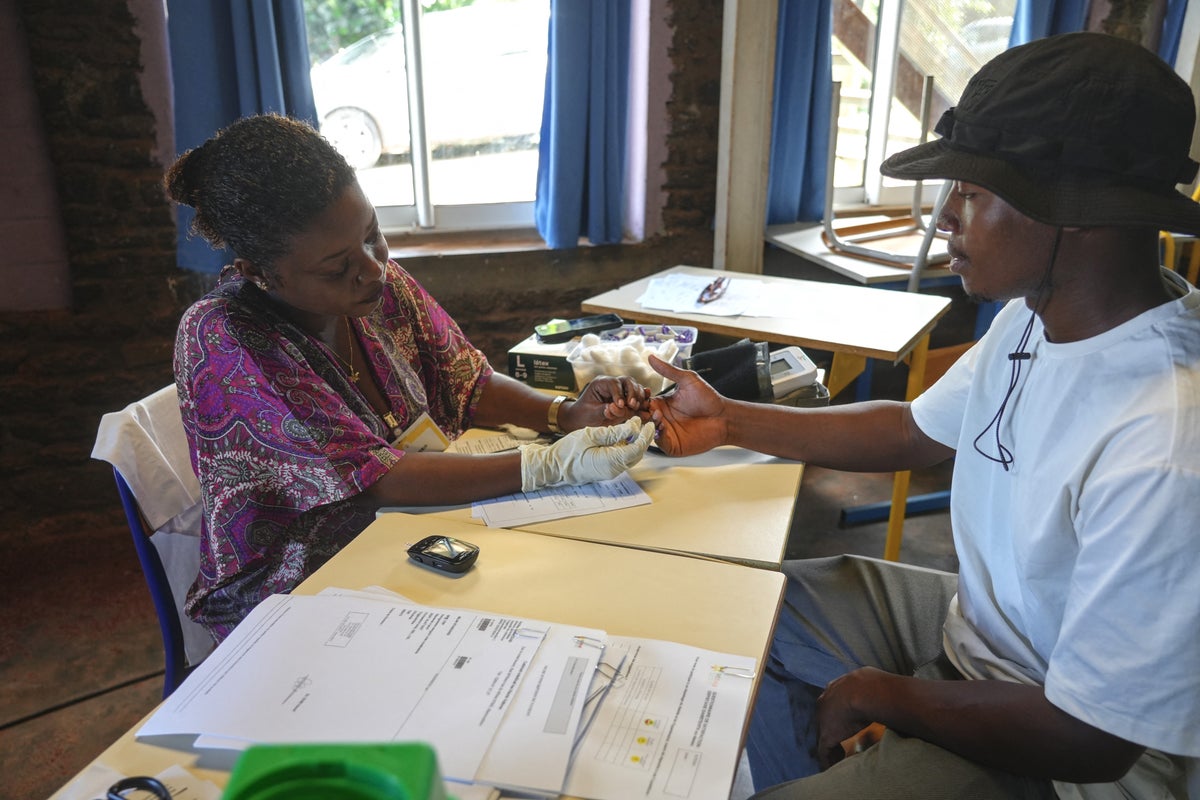
Photo via New York Post

Type 2 diabetes raises Alzheimer’s risk by 53% for millions

Read the original at New York Post ↗
Cite

Fox News. (2026, November 24). Type 2 diabetes raises Alzheimer’s risk by 53% for millions. New York Post. https://nypost.com/2026/11/24/health/type-2-diabetes-raises-alzheimers-risk-by-53-for-millions/

Dated from the outlet's own feed. Check the original for its byline.

New York Post · collected 2026-11-24 · by Fox News

Quick Summary

A new study from Curtin University’s School of Population Health in Australia indicates that people with type 2 diabetes have a 53% higher risk of developing Alzheimer’s disease compared to those without the condition. Analyzing data from 40 observational studies, researchers found that this translates to about 4.7 new Alzheimer’s cases per 1,000 people with type 2 diabetes annually. Dr. Caghan Kizil of Columbia University notes that while the study does not prove causation, it highlights the increased likelihood of Alzheimer’s among individuals with diabetes.
Written by AI on 2026-11-26, from this article's own text only (the story summary below draws on all the coverage).
See how they differ ↓

AI analysis

Story summary

People with type 2 diabetes face a 53% higher risk of developing Alzheimer’s disease compared to those without the condition, according to a new study published in the journal Alzheimer’s Research & Therapy on November 9. Researchers from Curtin University's School of Population Health in Australia analyzed 40 observational studies involving individuals with both Alzheimer’s disease and type 2 diabetes. After adjusting for other health and lifestyle factors, the study found that individuals with type 2 diabetes have about one and a half times more chance of developing Alzheimer’s, with roughly 4.7 new cases for every 1,000 people tracked annually. Dr. Caghan Kizil, a professor at Columbia University Department of Neurology, noted that while the study does not prove causation, it highlights the significant risk faced by people with type 2 diabetes.

Written for “Type 2 Diabetes Alzheimer’s Risk Increase” on 2026-11-28, grounded in this article and the 1 other(s) covering the same event.

How they differ

2 outlets covered “Type 2 Diabetes Alzheimer’s Risk Increase”.

What each outlet says

One AI summary per outlet of its latest article on this story, written from that article alone and checked against it. Open the article for the outlet's own words.

New York PostThis outlet24 Nov

A new study from Curtin University’s School of Population Health in Australia indicates that people with type 2 diabetes have a 53% higher risk of developing Alzheimer’s disease compared to those without the condition. Analyzing data from 40 observational studies, researchers found that this translates to about 4.7 new Alzheimer’s cases per 1,000 people with type 2 diabetes annually. Dr. Caghan Kizil of Columbia…

Type 2 diabetes raises Alzheimer’s risk by 53% for millions (this article)
Fox News24 Nov

Researchers from Curtin University's School of Population Health in Australia found that individuals with type 2 diabetes have a 53% higher risk of developing Alzheimer’s disease compared to those without the condition. The study, published in Alzheimer’s Research & Therapy on November 9, reviewed 40 observational studies and noted approximately 4.7 new Alzheimer’s cases for every 1,000 people with type 2 diabetes…

Alzheimer’s risk jumps 53% for millions living with common blood sugar condition →

Compared with similar articles

This article reads unscored and hedges 17% of its claims. Each row says how that neighbour differs.
Fox News
Hedges 5 of 26 claims Outlet record 67/100
The Independent
Hedges 4 of 17 claims Outlet record 59/100
“The articles discuss different aspects of the relationship between type 2 diabetes and cognitive health, but do not describe the same specific study or event.”

Story

Type 2 Diabetes Alzheimer’s Risk Increase
Health · 2 article(s) covering the same event. See how they differ ↑
How this article was measured signals, leaning charts, publisher record, byline, topics and claims

Signals How these are calculated →

Claims extracted
23
sentences that state something as happening or true
Uncertain
17%
4 of 23 hedged ("reportedly", "may", "according to")
Leaning
not political
takes no side on a contested political question
Publisher signals
66/100
New York Post's corrections and hedging, across everything collected from it. Not a measure of accuracy.
Outlets on this story
2
Health
Same framing elsewhere
1
articles that frame the event the way this one does
Analyzed 2026-11-26 · how these are computed

How this is being covered How these are calculated →

Article leaning vs. publisher reliability
Source leaning vs. consistency

Publisher

New York Post · 23954 article(s) · 46 correction(s) detected
Running correction rate · 46 correction(s)

Who wrote this

Fox News
653 article(s) here · 1 carrying a prediction
Bob Newhart could make millions laugh, but a $6 million lawsuit was no laughing matter.
Some of the crimes committed by inmates who will no longer face the death sentence include slaughtering entire families, torturing and murdering children and killing police officers.
Advertisement Cole added that phone numbers for a similar tip line targeting the state of Jalisco would be released later. Sheinbaum urged Washington to focus on curbing drug use and cartel activity within its own borders, adding that Mexico would continue to confront criminal organizations to prevent drugs from reaching the United States. “The United States has a responsibility to its people to address drug use, as well as to arrest members of the drug cartels operating in the United States,” Sheinbaum said.
“Each of you is playing an essential role to protect not only our country today but future generations of Americans by ensuring that Iran will never have a nuclear weapon.
The latest assault on women’s rights under Taliban rule reportedly extends to medical records and prescriptions in Afghanistan’s Balkh province, raising fears that the restrictions could spread nationwide.
Since being held at the Cook County Jail, Medina-Medina in May was caught with a six-inch shank in his possession, according to the sheriff’s office.
Police said debris blocked the roadway, forcing officers to drive a bleeding, handcuffed detainee to a nearby fire station, where police removed his handcuffs so paramedics could take him to a hospital.
- Winnings from Betr Buck entries may be withdrawn once all requirements are met.
This will take you directly to the BetMGM app or website and automatically apply the promo code.
Edwards thrives in big moments at home, and Minnesota will lean on him from the start.
Wire or desk byline, not an individual reporter.
Also by Fox News
Nothing else under this byline is closely related to this article, so these are simply their most recent.
All 653 articles by Fox News →

Topics

Australia Curtin University’s Fox News Fox News Digital School of Population Health

Subjects

Fox News Digital ORG · 3× Adewuyi PERSON · 2× Kizil PERSON · 2× Palekar PERSON · 2× Australia GPE · 1× Caghan Kizil PERSON · 1× Curtin University’s ORG · 1× Fox News ORG · 1× Melissa Rudy PERSON · 1× School of Population Health ORG · 1×

Narrative

Advertisement Variations in where the studies were conducted, how long patients were tracked and which outside health factors were considered all influenced the outcomes. Alzheimer’s is one of the most prevalent dementia types, comprising almost 70% of all cases, Kizil noted, which is why the studies are heavily focused on that condition. However, as diabetes can deprive the brain of essential nutrients, it can contribute to a wide range of neurological diseases beyond just Alzheimer’s.
framing: assertive · carried by 1 article(s) · first seen 2026-11-26
People living with type 2 diabetes may face a significantly higher risk of developing Alzheimer’s disease compared to those without the condition, a new study suggests.
2026-11-26 · New York Post
Type 2 diabetes raises Alzheimer’s risk by 53% for millions · assertive framing

Claims (23 extracted, 4 hedged)

Type 2 diabetes raises Alzheimer’s risk by 53% for millions By asserted
diabetes → raise → millions
People living with type 2 diabetes may face a significantly higher risk of developing Alzheimer’s disease compared to those without the condition, a new study suggests. uncertain
study → live → condition
Researchers from Curtin University’s School of Population Health in Australia reviewed 40 observational studies including people with Alzheimer’s disease and type 2 diabetes. asserted
Researchers → review → disease
After accounting for other health and lifestyle factors, the researchers found that individuals with this condition have a 53% higher risk of developing Alzheimer’s. asserted
individuals → account → Alzheimer
That translates to roughly 4.7 new cases for every 1,000 people tracked over a year. asserted
That → translate → year
“It doesn’t add newer experiments or show that diabetes directly causes Alzheimer’s disease, but how we should read it is that someone with diabetes has about one and a half times more chance of getting Alzheimer’s disease compared to someone without it,” Dr. Caghan Kizil, professor of neurological sciences at Columbia University Department of Neurology, who was not involved in the study, told Fox News Digital. asserted
who → add → Digital
Unlike earlier reviews that often combined different forms of diabetes and dementia, the new analysis looked specifically at type 2 diabetes and Alzheimer’s disease to calculate the rate of new cases, according to lead study author Dr. Emmanuel Adewuyi, a researcher at the Curtin School of Population Health. uncertain
analysis → combine → Health
Advertisement “Reporting both relative risk and incidence measures helps explain not only whether risk is higher, but how frequently new cases occur,” Adewuyi told Fox News Digital. asserted
Adewuyi → report → Digital
“What stood out was the fuller picture that emerged when we examined how often Alzheimer’s disease developed alongside how risk compared between groups. asserted
risk → stand → groups
Experts point to a few key ways that poor blood sugar control harms brain cells over time. asserted
control → point → time
Advertisement Excess blood sugar can stiffen and narrow blood vessels in the brain, causing a decrease in blood flow and oxygen to brain cells, according to Dr. Nikhil Palekar, director of Stony Brook Medicine’s Center of Excellence for Alzheimer’s Disease in New York. “Insulin resistance prevents the brain cells from utilizing glucose, resulting in reduced cellular energy and neuronal functions,” Palekar, who was not involved in the study, told Fox News Digital. uncertain
who → stiffen → Digital
“GLP-1 agonists have been shown to lower elevated blood sugar levels as well [as] decrease brain inflammation, which is a risk factor for Alzheimer’s disease,” Palekar said. asserted
Palekar → show → disease
Because the individual studies reported vastly different rates — ranging from fewer than one to nearly 30 new cases per 1,000 people each year — the researchers could not pinpoint a single, exact risk rate. uncertain
researchers → report → rate
Additionally, the analysis relied on real-world observational data rather than controlled clinical trials. asserted
analysis → rely → trials
“Importantly, these are population-level findings,” Adewuyi said. asserted
Adewuyi → say → ?
“They cannot predict whether a particular person will develop Alzheimer’s disease.” asserted
person → predict → disease
Advertisement Variations in where the studies were conducted, how long patients were tracked and which outside health factors were considered all influenced the outcomes. Alzheimer’s is one of the most prevalent dementia types, comprising almost 70% of all cases, Kizil noted, which is why the studies are heavily focused on that condition. However, as diabetes can deprive the brain of essential nutrients, it can contribute to a wide range of neurological diseases beyond just Alzheimer’s. asserted
it → conduct → Alzheimer
Advertisement Lowering the risk For people who have diabetes along with an increased risk of developing dementia, Kizil recommends undergoing cognitive screenings much earlier, alongside blood sugar control and other measurements. asserted
Kizil → lower → control
People with diabetes or any type of cardiovascular risk factors, including high blood pressure, should work proactively with their doctors on metabolic control and earlier cognitive monitoring, he advised. asserted
he → include → control
Adewuyi emphasized that the study provides no basis for changing medication or adopting tighter blood glucose targets specifically to prevent Alzheimer’s disease. asserted
study → emphasize → disease
Advertisement “If someone notices persistent changes in memory or thinking – particularly if these are affecting medicines, glucose monitoring or daily activities – they should discuss them with their healthcare team,” he advised. asserted
he → notice → team
Some of those include “short-term memory loss, such as forgetting recent events or conversations, misplacing things routinely, having difficulty managing finances or performing complex daily tasks,” the doctor told Fox News Digital. asserted
doctor → include → Digital
To support brain health, Palekar recommends following a primary care physician’s guidance to closely monitor blood sugar levels alongside key lifestyle modifications — “specifically, moderate-intensity aerobic exercise 150 minutes a week and a balanced diet, such as the Mediterranean diet.“ asserted
Palekar → support → diet
Give feedback · no sign-in needed

No sign-in needed for now. Your note is sent without a name, so it cannot be answered.

History Support