The massive plumes of methane emitted from Chevron’s Gorgon LNG facility on Barrow Island was not a leak and instead were vented deliberately, the environmental regulator has confirmed.
asserted
regulator → emit → Island
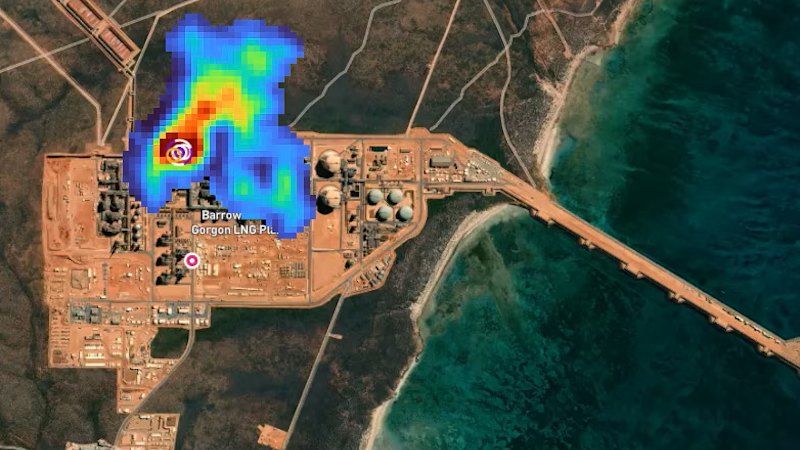
Non-profit Carbon Mapper’s Tanager-1 satellite captured methane plumes from the facility in five consecutive passes of Barrow Island from November 2025.
asserted
satellite → capture → November
The largest release included a massive 7.8 tonne-per-hour plume in August which prompted the United Nations Environmental Programme to report it to the Department of Water and Environmental Protection.
asserted
which → include → Water
A leak that size is deemed a “super emitter” event under the US Environmental Protection Agency definition where the threshold is 100 kilograms-per-hour of methane.
asserted
threshold → deem → methane
The massive plumes were initially characterised as a leak, but during an upper house committee meeting on Wednesday, Environment Minister Matthew Swinbourne said it was a purposeful vent.
asserted
it → characterise → Wednesday
He said a department investigation launched after the August plumes and finalised last week concluded Chevron was deliberately venting the gas because of its struggling carbon capture and storage system.
asserted
Chevron → say → system
“The department’s assessment is that the methane detected was associated with the venting of reservoir carbon dioxide from the facility’s acid gas removal units, resulting from operational constraints affecting the facility’s carbon capture and storage system,” Swinbourne told the committee.
asserted
Swinbourne → detect → committee
The revelation confirmed whistleblower claims tabled in the upper house on Tuesday night by Greens fossil fuels spokeswoman Sophie McNeill that Chevron had been deliberately releasing methane into the atmosphere because of problems with the carbon capture and storage facility.
uncertain
Chevron → confirm → facility
McNeill accused the state government of “covering up” the methane “leak”, which was flatly rejected by Swinbourne in a heated exchange during the committee hearing.
asserted
which → accuse → hearing
Swinbourne said both he and the department were waiting for the investigation to conclude before coming to any conclusions.
asserted
investigation → say → conclusions
“We never drew a conclusion that it was a leak.
asserted
it → draw → conclusion
There was an investigation process that was underway to determine the source of that methane,” he said.
asserted
he → be → methane
In response, McNeill claimed investigators were told by Chevron during a visit on November 5 and 6 that it was deliberate venting, which she said amounted to a cover-up.
asserted
she → claim → up
“How is this not a cover-up when the department has known since the fifth and sixth of November they were told by everyone when they went to Gorgon that this is deliberate venting?” she said.
asserted
she → know → Gorgon
“We don’t have the luxury that you have of jumping to conclusions,” Swinbourne said in response.
asserted
Swinbourne → have → response
“We can’t just get into the chamber at the end of the night and make all these accusations and draw all these conclusions.
asserted
We → get → conclusions
That is your framing of this because it suits your narrative.”
asserted
it → suit → narrative
McNeill said the fact it was a commercial decision was horrifying.
asserted
it → say → ?
“It’s horrifying.
asserted
It → ’ → ?
It’s worse that it’s not a leak.
asserted
it → ’ → ?
I wish it was a leak, Minister.
asserted
it → wish → ?
They are deliberately choosing to do this.
asserted
They → choose → this
It is absolutely gut-wrenching,” she said.
asserted
she → wrench → ?
A department bureaucrat revealed during the hearing that despite having the technology to monitor methane emissions, that was not deployed during the investigation.
asserted
that → reveal → investigation
Swinbourne also revealed he had written to the Environmental Protection Authority to consider whether additional conditions including greater monitoring and reporting requirements on Chevron.
asserted
he → reveal → Chevron
Chevron’s carbon capture and storage system was the largest of its kind when it was first built.
asserted
it → build → kind
The oil and gas sector held hopes it would greatly reduce carbon emissions for the industry.
asserted
it → hold → industry
The system separates carbon dioxide contained in natural gas reservoirs and pumping it back into the ground.
As part of its approval to operate Gorgon, Chevron is required to inject at least 80 per cent of reservoir carbon dioxide back into the ground.
asserted
Chevron → separate → ground
However, the technology has been beset with issues since operations began in 2016.
asserted
operations → beset → 2016
It has come nowhere near meeting its 80 per cent condition, which has forced Chevron to find carbon offsets elsewhere.
asserted
which → come → offsets
Chevron’s carbon capture system also prompted a testy exchange between McNeill and Swinbourne.
asserted
system → prompt → McNeill
McNeill said the system didn’t work to which Swinbourne replied: “What I will say is it does work.
asserted
it → say → What
It is capturing significant amount of carbon.
asserted
It → capture → carbon
It is not, however, meeting what the ambition was when the ministerial conditions were settled originally,” he said.
asserted
he → meet → ?
“They must still offset those emissions.”
asserted
They → offset → emissions
McNeill responded: “I don’t believe in offsets.”
asserted
I → respond → offsets
Swinbourne then said: “Well, then that’s a problem for you.”
asserted
that → say → you
To which McNeill responded: “No, it’s not.
asserted
it → respond → which
It’s actually a problem for the climate, minister.”
asserted
It → ’ → climate
Chevron was approached for comment.
asserted
Chevron → approach → comment
 The Aporia