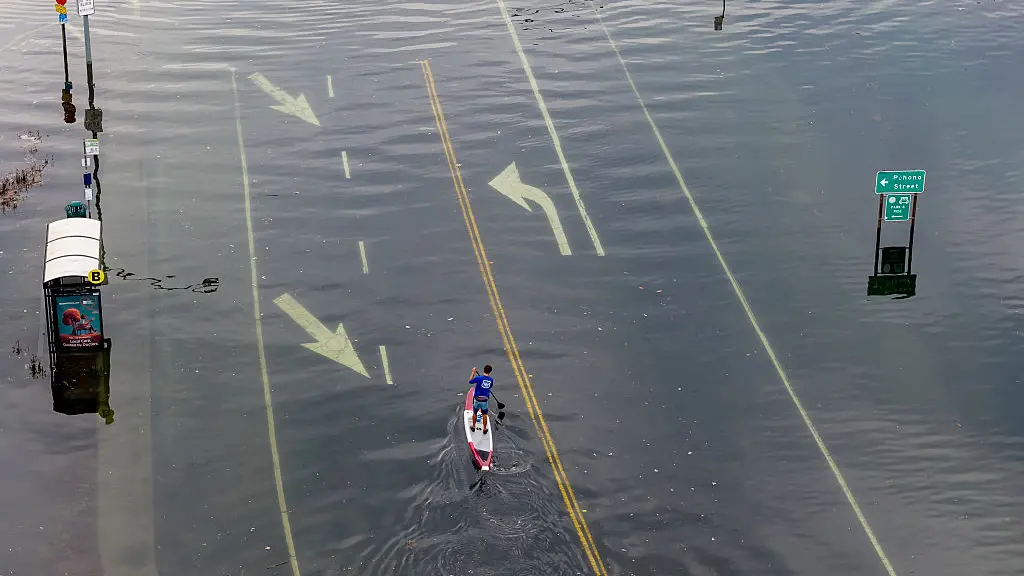
El Niño is getting some monster-sized nicknames.
asserted
Niño → get → nicknames
But is the weather actually getting more extreme?
asserted
weather → get → ?
Scientists weigh in on the increasingly dramatic labels and what this powerful El Niño could mean for Canada
Godzilla has battled giant moths and three-headed dragons.
uncertain
Godzilla → weigh → moths
But even the king of the kaiju might have trouble keeping up with this year's El Niño.
uncertain
king → have → Niño
First came "Super El Niño."
asserted
Niño → come → ?
But has this year's El Niño really been upgraded?
asserted
Niño → upgrade → ?
"As far as I can tell there's no reason to invent a new category above 'very strong' that we have right now," said Emily Becker, a research associate professor of atmospheric sciences at the University of Miami's Rosenstiel School.
asserted
Becker → tell → School
But David Phillips, a climatologist emeritus with Environment and Climate Change Canada (ECCC), was more enthusiastic, given the unprecedented nature of this El Niño.
"Maybe 'Godzilla' is not strong enough for it."
asserted
Godzilla → give → it
A NASA visualization compares Pacific Ocean surface temperatures in 2025 and 2026, showing the dramatic warming associated with El Niño.
asserted
visualization → compare → Niño
Red indicates warmer-than-average water, while blue shows cooler-than-average temperatures.
asserted
blue → indicate → temperatures
The maps use satellite-derived data averaged over seven days to highlight broader temperature patterns.
asserted
maps → use → patterns
El Niño is a climate phenomenon that occurs when unusually warm water in the central and eastern tropical Pacific alters atmospheric circulation patterns, changing the weather around the world, according to ECCC.
uncertain
water → occur → ECCC
Scientists measure the strength of an El Niño by averaging the sea surface temperature over three months in a large section of the Pacific Ocean, as opposed to measuring extreme temperatures in localized areas.
asserted
Scientists → measure → areas
The latest name gained attention after U.S. meteorologist Ryan Maue posted a map on X on Sunday showing what he said were sea surface temperatures as much as 10 C above normal near Peru and the Galápagos Islands.
"This is now a Mega El Niño," he wrote.
asserted
he → gain → Peru
But the U.S. National Oceanic and Atmospheric Administration (NOAA)'s analysis doesn't show temperatures that high at the ocean's surface, said Michelle L'Heureux, its El Niño team lead and a physical scientist with the U.S. National Weather Service.
asserted
L'Heureux → show → Service
Instead, it shows temperature anomalies of roughly 4 C to 6 C in the eastern Pacific, she said.
asserted
she → show → Pacific
NOAA hasn't changed its terminology for classifying El Niño events, said meteorologist Erica Cei, a National Weather Service spokesperson.
asserted
Cei → change → events
The agency's Climate Prediction Center simply classifies El Niño events as weak, moderate, strong or very strong.
asserted
Center → classify → events
NOAA's Nov. 12 update reported extremely high sea surface temperatures in parts of the eastern Pacific.
asserted
update → report → Pacific
However, isolated temperature readings do not necessarily reflect the overall intensity of an El Niño.
asserted
readings → reflect → Niño
Instead, NOAA uses the Relative Oceanic Niño Index (RONI) to measure average sea surface temperature anomalies in the central tropical Pacific over a three-month period, while accounting for warming across other tropical oceans.
asserted
NOAA → use → oceans
By that measure, this year's El Niño has reached NOAA's highest classification: very strong.
asserted
Niño → reach → classification
"This event is running on par with our previous very strong events," Becker said, referring to the El Niños of 1997-'98 and 2015-'16.
asserted
Becker → run → 1997-'98
While "mega El Niño" is not an official category, the term has appeared in the scientific literature.
asserted
term → appear → literature
A 2023 peer-reviewed study used it to describe the very strong El Niño events of 1982-'83, 1997-'98 and 2015-'16.
asserted
study → review → 1982-'83
There is no question this is an unusually powerful event.
asserted
this → be → ?
NOAA's Nov. 12 forecast gave it roughly a 60 per cent chance of surpassing the strength of previous El Niños dating back to 1950.
asserted
forecast → give → 1950
But that remains a forecast, not a record already broken.
asserted
that → remain → ?
Mandy Freund, a climate science lecturer at the University of Melbourne who has written about "Godzilla El Niño," said some ocean temperatures recorded near South America are unprecedented.
asserted
temperatures → write → America
She also defended the dramatic terminology.
asserted
She → defend → terminology
"I believe if the language serves the purpose of raising awareness of a dangerous situation, that’s acceptable," she said in an email to CBC News.
asserted
she → believe → News
But Freund said making bold predictions before forecasts become reliable could undermine public confidence.
uncertain
forecasts → say → confidence
Becker also cautioned against assuming that an exceptionally strong El Niño will always bring extreme weather: "We don't necessarily expect to see extreme impacts from an extreme El Niño."
A skier walks down a patchy ski slope at Whistler, B.C., in December 2023.
asserted
skier → caution → December
A powerful El Niño is expected to bring warmer-than-normal temperatures to much of Canada this winter, potentially affecting snowfall and conditions at ski resorts.
asserted
Niño → expect → resorts
What could a very strong El Niño mean for Canada?
uncertain
Niño → mean → Canada
Western and central Canada typically experience a milder winter during El Niño years, but impacts can be quite variable.
asserted
impacts → experience → years
ECCC's Nov. 1 seasonal forecast also suggests that much of Eastern Canada could experience above-normal temperatures this winter.
uncertain
much → suggest → temperatures
Phillips said the current season could be compared with the very mild winter Canada experienced in 2023-'24.
uncertain
Canada → say → 2023-'24
When it is disrupted and weakens, cold Arctic air can push down into Canada and the United States.
asserted
air → disrupt → Canada
Phillips compared this coming winter to a clash straight out of a Hollywood blockbuster: "It's the Godzilla El Niño meeting the frigid polar vortex," he said.
asserted
he → compare → vortex
…and 7 more, not listed.
 The Aporia