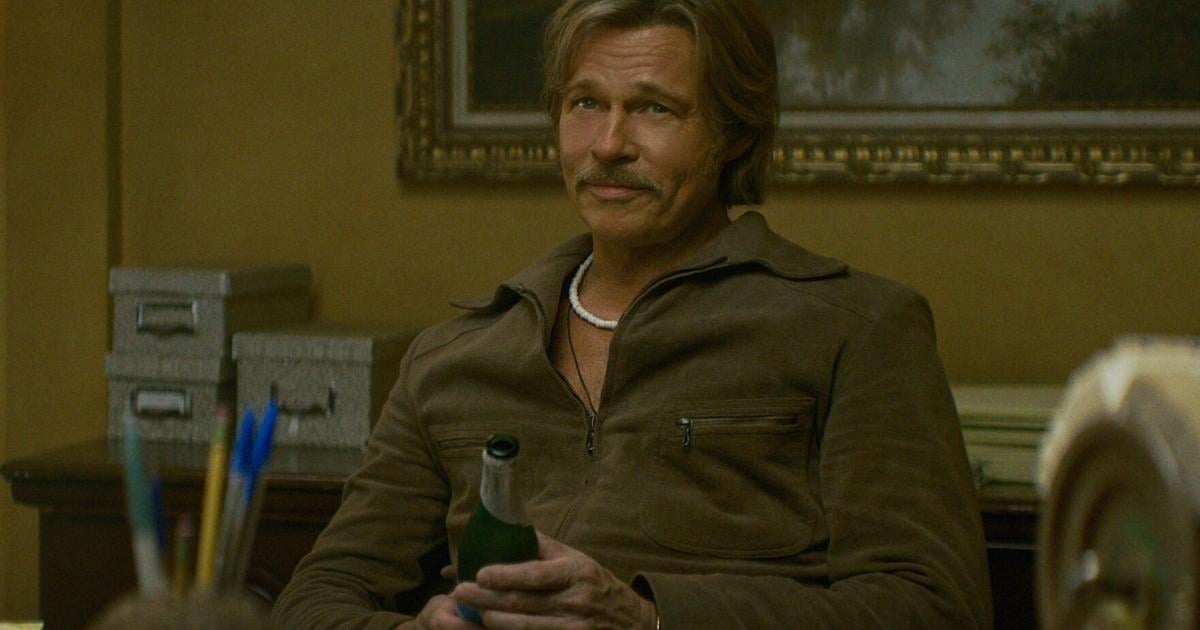
Brad Pitt smirks often in his new film, “The Further Mis-Adventures of Cliff Booth,” as he relishes the escalating violence of his Oscar-winning stuntman character created by Quentin Tarantino.
asserted
he → smirk → Tarantino
Pitt’s Cliff previously had to be provoked into brutality in the filmmaker’s “Once Upon a Time … in Hollywood,” as he tangled with members of the Manson family and martial artist Bruce Lee.
asserted
he → have → family
Pitt, who turns 63 on Dec. 18, clearly enjoys the change.
asserted
who → turn → change
He’s among a group of Hollywood superstars in their 60s and older who are taking considerably darker roles to reinvigorate their careers, a move potentially popular with younger viewers but not without risk.
asserted
who → ’ → risk
Tom Cruise, 64, plays a catastrophically reckless oilman who endangers millions of lives in “Digger,” while Johnny Depp, 63, portrays the classic Christmas misanthrope Scrooge in “Ebenezer.”
asserted
Depp → play → Ebenezer
The characters embodied by Pitt, Cruise and Depp are downright nasty, their stars’ personal charisma notwithstanding.
asserted
charisma → embody → Pitt
Will their fans follow them into the sewer?
asserted
fans → follow → sewer
Fool around and find out
Cruise has already found out the hard way: “Digger” opened last month to some of the worst reviews of his career and abysmal box office.
asserted
Digger → fool → career
Moviegoers, it seems, don’t like seeing the actor who embodies Ethan Hunt, the stoic planet-saving hero of the “Mission: Impossible” franchise, switch to playing a swaggering, planet-threatening jerk.
asserted
who → seem → jerk
Depp had a much better reception, which is crucial for his hoped-for Hollywood comeback.
asserted
which → have → comeback
“Ebenezer” opened atop the box office earlier this month, with 51 per cent of ticket buyers telling the PostTrak polling service they were seeing the film because of the star.
asserted
they → open → star
After making films in Europe, the star is trying for a comeback in director Ti West’s adaptation
Now it’s time to test Pitt’s popularity.
asserted
it → make → popularity
“Cliff Booth,” arriving in theatres Nov. 25 for a brief run before hitting Netflix, is set in the post-Manson L.A. of 1977.
asserted
Booth → arrive → 1977
It’s clear from the start of this crime comedy, written by Tarantino, that the title character is willing to use deadly force to get a job done and to get paid well for it.
asserted
job → ’ → it
Dressed as if he scrounged up his clothes from a bowling alley’s lost and found, Cliff is much more of a determined badass than he was in “Once Upon a Time … in Hollywood,” which was set in 1969.
asserted
which → dress → 1969
Cliff remains a magnetic onscreen presence, but his actions are tough to justify and sometimes difficult to sit through — he disrespects the body of a man he shot dead and describes to a ghoulish inquisitor exactly how, as a soldier during wartime, he killed many people with a knife.
asserted
he → remain → knife
This makes Cliff’s feature return less comic than its predecessor, even with the welcome presence of Elizabeth Debicki as a wily love interest.
asserted
feature → make → interest
It’s not that Pitt hasn’t played rough before — he was a serial killer in “Kalifornia” and a nihilistic scrapper in “Fight Club” — but these roles came early in his career and are generally not the kind popular actors and their audiences gravitate toward later in life.
asserted
actors → ’ → life
Cruise’s titular character in Alejandro González Iñárritu’s black comedy “Digger” is even tougher to root for.
asserted
character → root → comedy
A Texas oil baron with slick cowboy attire, greasy hair and entitled attitude to spare, he’s to blame for an impending global apocalypse caused by his aggressive oil drilling.
asserted
he → spare → drilling
Yet he insists it’s not really his fault, telling an international emergency summit meeting he was simply satisfying greedy politicians, corporations and consumers who wanted cheap and plentiful fossil fuels.
asserted
who → insist → fuels
His malfeasance, he asserts, was for their convenience.
asserted
he → assert → convenience
Cruise has played many arrogant bastards, but his new one risks global destruction.
asserted
one → play → destruction
Audiences and many critics rejected “Digger,” but this is one of Cruise’s better turns as a baddie, right up there with foul-mouthed studio boss Les Grossman from “Tropic Thunder,” contract killer Vincent in “Collateral” and misogynistic self-help guru Frank T.J. Mackey from “Magnolia.”
asserted
this → reject → Magnolia
Depp has likewise gone to the dark side before, notably as crime boss Whitey Bulger in “Black Mass,” but he’s better known for Capt. Jack Sparrow, his lovable buccaneer in the “Pirates of the Caribbean” franchise.
asserted
he → go → franchise
In Ti West’s “Ebenezer,” the latest iteration of Charles Dickens’s evergreen Victorian ghost story “A Christmas Carol,” Depp portrays a dark character in dire need of redemption, which gives the actor an opportunity to persuade audiences that he, too, deserves a second chance.
asserted
he → portray → chance
His Hollywood career has been stalled for at least a decade following allegations of abuse by his now ex-wife, Amber Heard.
asserted
career → stall → wife
Depp largely prevailed against her in a U.S. defamation case heard by a jury, but he lost a British libel case in which a judge ruled abuse had occurred.
asserted
abuse → prevail → which
The Fonda factor
Playing against type is a tactic with a long history.
asserted
Playing → play → history
Pitt, Cruise and Depp aren’t the first Hollywood superstars to turn nasty on screen.
asserted
Pitt → turn → screen
Probably the most famous example of this is Henry Fonda’s role as a cold-blooded killer in Sergio Leone’s “Once Upon a Time in the West,” a spaghetti western that premiered in 1968, the year Fonda turned 63.
asserted
Fonda → premier → 1968
As Frank, a hired gun who massacres a family, Fonda epitomized a beloved leading man transforming his familiar screen presence into something chilling.
asserted
Fonda → hire → something
The actor’s celebrated previous roles had included Abraham Lincoln in “Young Mr. Lincoln,” noble farmer Tom Joad in “The Grapes of Wrath” and principled holdout Juror #8 in “12 Angry Men.”
asserted
roles → include → Men
Fonda arrived on set with facial hair and brown contact lenses for his baby blues, hoping audiences wouldn’t immediately recognize him.
asserted
audiences → arrive → him
Leone rejected the adornments, arguing it was better to shock moviegoers by having them watch an actor famous for portraying virtuous roles become a mass killer.
asserted
actor → reject → roles
The film was a major hit in Europe but received mixed reviews and underperformed at the box office in North America.
asserted
film → receive → America
A more recent example of a star switching from good to bad is also the most extreme one: Harrison Ford in “Captain America: Brave New World.”
asserted
example → switch → America
Ford’s Marvel Cinematic Universe debut had him playing both U.S. President Thaddeus “Thunderbolt” Ross and his monstrous alter ego, Red Hulk.
asserted
him → have → Ross
Are Hollywood stars going dark because hero roles are harder to find or because they just want to do something different?
asserted
they → go → something
It’s difficult to say, but Pitt recently acknowledged the latter, saying he’d love to play a villain opposite Robert Pattinson’s new 007 in the next James Bond movie.
asserted
he → ’ → movie
…and 3 more, not listed.
 The Aporia