Photo via TIME

El Niño Is Strengthening. Here’s Where Its Effects Are Already Showing Up

Read the original at TIME ↗
Cite

Schneid, R. (2026, November 25). El Niño Is Strengthening. Here’s Where Its Effects Are Already Showing Up. TIME. https://time.com/article/2026/11/25/el-ni-o-is-strengthening-here-s-where-its-effects-are-already-showing-up/

Dated from the outlet's own feed. Check the original for its byline.

TIME · collected 2026-11-25 · by Rebecca Schneid

Quick Summary

The National Weather Service’s Climate Prediction Center issued an advisory on Monday stating that El Niño is strengthening, with a 60% chance of surpassing previous historic events since 1950. The advisory notes a 79% probability of El Niño remaining strong to very strong through January–March 2027, already causing above-average temperatures and atmospheric disruptions globally. Thanksgiving week in the U.S. is seeing heavy rain, coastal flooding, and mountain snow, particularly in California and Florida, heightening flood risks.
Written by AI on 2026-11-25, from this article's own text only (the story summary below draws on all the coverage).

AI analysis

Why this leaning score
This article does not take a side on a contested political question, so it has no leaning score. That is an answer rather than a gap: a match report or a rescue can be warmly or critically written without being left or right, and scoring it anyway is how approval of a subject gets recorded as a political position.
No political leaning scored for article 180756 · logged 2026-11-25

Compared with similar articles

This article reads unscored and hedges 21% of its claims. Each row says how that neighbour differs.
CBC News
Hedges 9 of 47 claims Outlet record 70/100
“Article A reports on the strengthening of El Niño and its current impacts globally, while Article B focuses on the nicknaming and perceived severity of El Niño, with no specific mention of the same specific impacts or timing.”
The Globe and Mail
Hedges 1 of 1 claims Outlet record 52/100
“The articles discuss El Niño but describe different aspects of the phenomenon occurring at different times and places.”
Toronto Star
Hedges 1 of 42 claims Outlet record 65/100
“While both articles discuss the strengthening of El Niño, they focus on different aspects and times: Article A predicts winter effects in Canada, while Article B reports on the current strengthening and global impacts as of November 25, 2026.”

Story

El Niño Strengthening Effects Show Up
Environment · 1 article(s) covering the same event.
How this article was measured signals, leaning charts, publisher record, byline, topics and claims

Signals How these are calculated →

Claims extracted
29
sentences that state something as happening or true
Uncertain
21%
6 of 29 hedged ("reportedly", "may", "according to")
Leaning
not political
takes no side on a contested political question
Publisher signals
60/100
TIME's corrections and hedging, across everything collected from it. Not a measure of accuracy.
Outlets on this story
1
Environment
Same framing elsewhere
1
articles that frame the event the way this one does
Analyzed 2026-11-25 · how these are computed

How this is being covered How these are calculated →

Article leaning vs. publisher reliability
Source leaning vs. consistency

Publisher

TIME · 1129 article(s) · 2 correction(s) detected
Running correction rate · 2 correction(s)

Who wrote this

Rebecca Schneid
41 article(s) here · 1 carrying a prediction
The National Weather Service’s Climate Prediction Center sent out an advisory Monday that El Niño continues to strengthen as forecasters record ocean warming and atmospheric disruptions globally.
Candidates will need to sign the newly released Fair Campaign Practices Pledge, denouncing both super PAC spending and “dark money,” which is any political funding from undisclosed sources.
According to the U.S. Centers for Disease Control and Prevention (CDC), it’s estimated that the outbreak began in mid- to late-February, two to three months before the outbreak was detected and declared an emergency by the World Health Organization (WHO) in mid-May.
The President also expressed confidence that the bill would create jobs and help drive the economy, writing: “Importantly, hundreds of thousands of Blue Collar Workers will be positively affected, BIG TIME, by the passage of this Bill.”
He went on to say that the course would close on Nov. 15 to undergo renovations, which would take 15 months to complete.
The incident raised questions about what might have led to the historic event—only the second nationwide ground stop since 9/11—and what authorities were doing to prevent it from happening again.
It’s the first of several steps necessary to determine the next Prime Minister—but a potentially months-long process could leave Benjamin Netanyahu in power for the foreseeable future.
Trump’s unsubstantiated fraud claims come nearly two weeks after he told reporters on Oct. 27 that he would respect the election results “if they’re honest elections.” As results came in throughout Nov. 3 and into Nov. 4, Trump seemed to accept the outcome.
2026-11-09 · mixed framing · Trump Casts Doubt on Midterm Election Results
Experts tell TIME that the threats themselves might be the point—launching a fear campaign meant to disrupt systems and put millions of people on edge.
2026-11-08 · assertive framing · Europe’s Bomb Threats Raise Fears of Hybrid Warfare
Experts weigh in on what may have prompted the shifts.
Also by Rebecca Schneid
Nothing else under this byline is closely related to this article, so these are simply their most recent.
All 41 articles by Rebecca Schneid →

Topics

Climate Prediction Center El Nino El Niño The National Weather Service’s U.S.

Subjects

California GPE · 4× Florida GPE · 2× U.S. GPE · 2× Andrew Kruczkiewicz PERSON · 1× Climate Prediction Center ORG · 1× Columbia University ORG · 1× Risper Nyairo PERSON · 1× TIME ORG · 1× The National Weather Service’s ORG · 1× the International Research Institute for Climate and Society ORG · 1×

Narrative

Andrew Kruczkiewicz, senior researcher at the International Research Institute for Climate and Society at Columbia University, tells TIME that the effects of El Niño are region-dependent—which is why it is both associated with warmer, drier winters in the North, and wetter winters in the South, ice storms across the southern Plains.
framing: mixed · carried by 1 article(s) · first seen 2026-11-25
The National Weather Service’s Climate Prediction Center sent out an advisory Monday that El Niño continues to strengthen as forecasters record ocean warming and atmospheric disruptions globally.

Claims (29 extracted, 6 hedged)

The National Weather Service’s Climate Prediction Center sent out an advisory Monday that El Niño continues to strengthen as forecasters record ocean warming and atmospheric disruptions globally. asserted
forecasters → send → warming
“Chances for a historic event exceeding previous El Niños dating back to 1950 … are now ~60%,” it said. asserted
it → exceed → 1950
In an update on a weekly report from Nov. 12, the advisory showed more than a 79% chance of remaining strong to very strong through January–March 2027. asserted
advisory → show → January
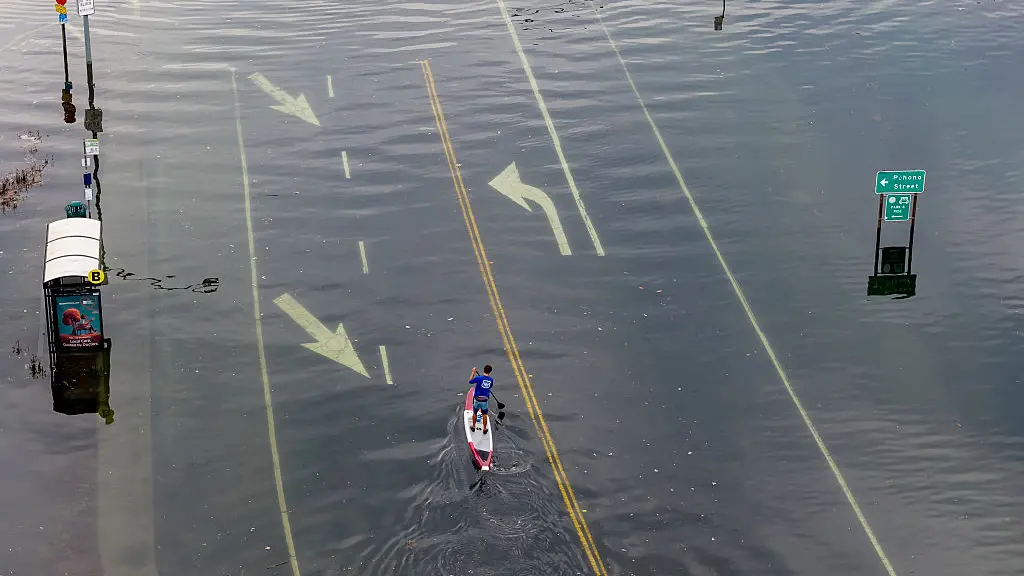
The advisory comes as Thanksgiving week brings heavy rain, coastal flooding, and mountain snow to both coasts, elevating flood risks in California and Florida. asserted
week → come → California
What is El Niño and how is it affecting the U.S.? asserted
it → affect → U.S.
El Niño refers to the warm phase of the El Niño-Southern Oscillation (ENSO) cycle, and it occurs every two to seven years when surface waters in the eastern and central tropical Pacific become unusually warm, reaching at least 0.5 degrees Celsius above average. asserted
waters → refer → average
This ocean heat is released eventually into the atmosphere, and influences atmospheric circulation, temperatures, precipitation and other weather events around the globe. asserted
heat → release → globe
Though the phenomenon is relatively common, this year’s El Niño has earned headlines for being among the strongest of its kind on record, partially because it's arriving on top of an ocean that is already warmer than it used to be. asserted
it → earn → ocean
Andrew Kruczkiewicz, senior researcher at the International Research Institute for Climate and Society at Columbia University, tells TIME that the effects of El Niño are region-dependent—which is why it is both associated with warmer, drier winters in the North, and wetter winters in the South, ice storms across the southern Plains. asserted
it → tell → Plains
“The impacts from El Nino across the U.S. are not uniform—El Nino does not lead to everyone seeing above average temperatures for winter or everybody seeing above average rainfall or everybody seeing below average rainfall,” he says. asserted
he → lead → rainfall
Risper Nyairo, assistant professor of environmental studies at Davidson College, calls it a “seesaw system” that depends on the pressure systems in each region. asserted
that → call → region
“The whole idea behind this is really the pressure—pressure changes with the temperatures of our waters,” she says. asserted
she → say → waters
“So if you are in a low-pressure zone, those tend to be warmer areas, which encourage air to rise and condense and form clouds and precipitation. asserted
air → tend → clouds
If you are on the opposite side of it, which is a high-pressure zone, then your winds are sort of sinking, which means precipitation is not forming, and you get a drought. asserted
you → sink → drought
But some of these impacts are already rearing their heads, showing how the systems are strengthening and could ripple across the world. uncertain
systems → rear → world
Near Ecuador’s Galápagos Islands, off the coast of Peru, sea surface temperatures show an anomaly of +10 degrees Celsius, according to meteorologist Ryan Maue, meaning the ocean surface at that specific location and time of year is 10 degrees warmer than the long-term historical average. uncertain
surface → show → average
High tides in California and Florida The effects of El Niño are being seen in California, where a mixture of seasonal “king tides” combined with an unusually strong El Niño and large Pacific swells are driving near-record to record coastal water levels and flooding across California this week. asserted
mixture → see → California
King tides are unusually high tides caused by the alignment and positions of the moon and sun. asserted
tides → cause → moon
El Niño has raised coastal water levels, increasing the risk of flooding when those tides arrive. asserted
tides → raise → flooding
It also predicted “numerous road closures” in San Francisco on Wednesday, claiming there could be up to 2.7 feet of flooding above ground level in coastal regions. uncertain
It → predict → regions
In Central California, Santa Cruz temporarily closed its beaches and wharf, and local officials issued evacuation warnings covering roughly 200 coastal homes. asserted
officials → close → homes
NOAA’s Los Angeles tide gauge recorded more high-tide flooding days than in any previous year in its record. asserted
gauge → record → record
Potential drought relief in the South El Niño's strengthening, according to NOAA, is likely to bring a wetter-than-average winter to parts of the southern United States, particularly the Southeast, which has been plagued by drought throughout 2026. uncertain
which → accord → 2026
NOAA said in mid-November that much of the Southeast has a 50% chance or greater for above-normal precipitation during winter—a probability that could increase with a strengthening El Niño. uncertain
that → say → Niño
This relief is already beginning, with coastal storms developing off the coast of Florida, Georgia, and South Carolina this week. asserted
storms → begin → Florida
“We are expected to have more precipitation, and we are seeing some of that in Florida, where some locations have reported receiving precipitation that is greater than a year's worth of rain within a day or two,” Nyairo says. asserted
Nyairo → expect → day
She says that this drought relief in some regions is a rare “positive” to El Niño this year. asserted
relief → say → Niño
But with drought relief comes elevated risk of flooding over the winter—one people in low-lying regions should take seriously. asserted
people → come → regions
“I would say you know if you've seen the map and you are in a location where you think there might be above-average precipitation, you should be taking the warning seriously, especially with flooding,” she adds. uncertain
she → say → flooding

Give feedback · no sign-in needed

No sign-in needed for now. Your note is sent without a name, so it cannot be answered.

History Support