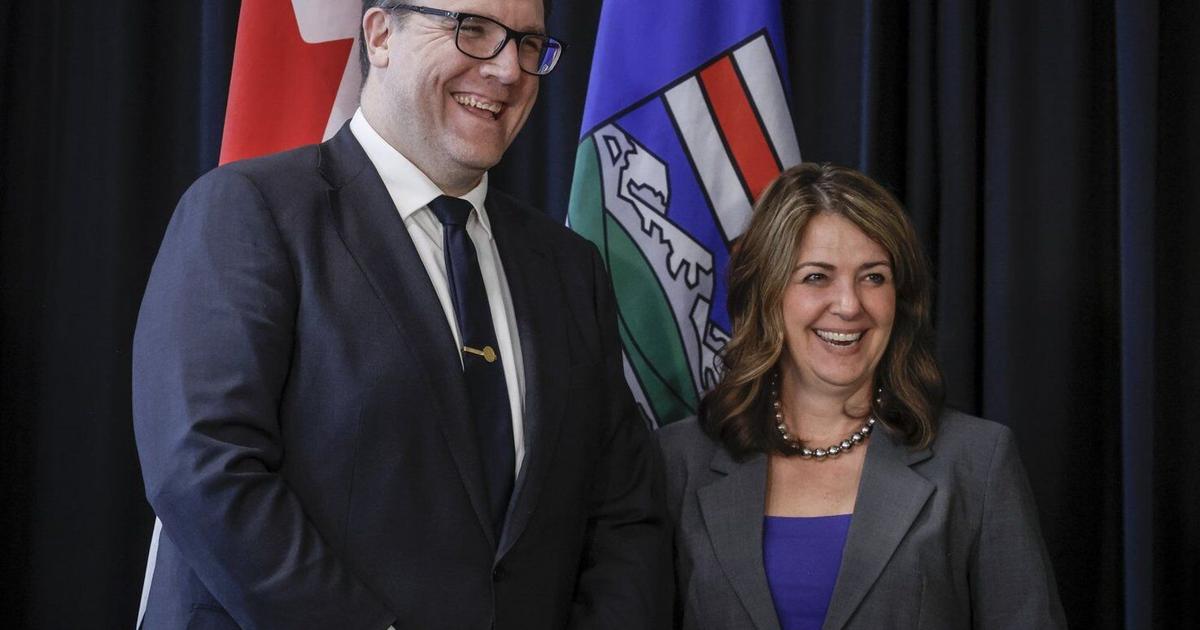
Alberta’s government says the oil-rich province is on track to reach record-high non-renewable resource revenues this year.
asserted
province → say → revenues
Its second quarterly update of the year, released Thursday, predicts an $8.5-billion surplus — a wild swing from the $9.4-billion deficit originally expected for 2026-27.
asserted
update → release → 2026
Alberta’s finances are tethered to global energy prices, which surged earlier this year after the conflict between the United States and Iran began.
asserted
conflict → tether → States
In February, the province was predicting West Texas Intermediate – the North American benchmark oil price — would average US$60.50 a barrel this year.
asserted
Intermediate → predict → 60.50
It’s now forecasting that price to be US$83.50 per barrel, driven by disruptions in the Strait of Hormuz, a vital shipping lane at the mouth of the Persian Gulf.
asserted
price → forecast → Gulf
Finance Minister Jason Nixon said global energy prices can change quickly, so the United Conservative Party government still needs to exercise caution and be disciplined in its spending.
asserted
government → say → spending
“That means resisting the temptation to treat a sudden increase in resource revenue as permanent,” he said.
asserted
he → mean → revenue
In the 2022-23 fiscal year, the province took in a record $25 billion in resource revenues, but the province expects to break that with almost $29 billion this year.
asserted
province → take → billion
Nixon noted that between July and September, the WTI price was pushed as high as US$106 per barrel and as low as US$68.50 per barrel.
asserted
price → note → barrel
With every dollar increase in the average price, Alberta’s treasury stands to gain $680 million.
asserted
treasury → stand → million
The latest outlook frees up $3.9 billion in surplus cash the government plans to spend before the end of the fiscal year.
asserted
government → free → year
By law, at least half must go to the Heritage Saving Trust Fund, which is now expected to reach $36 billion by March.
asserted
which → go → March
The government’s goal is to see the rainy day fund’s net assets reach $250 billion by 2050, so the province can get off what’s long been characterized as a roller-coaster of royalty revenue.
asserted
what → see → revenue
Nixon said the money will also go toward one-time infrastructure spending on things such as roadway construction, but specifics won’t be decided until the province has more actual budget numbers.
asserted
province → say → numbers
“I do hear one thing and one thing all the time, which is concerns about roads.
asserted
which → hear → roads
So we’ll start with that,” he said.
asserted
he → start → that
Despite the expected windfall, overall spending this year is only going up by $646 million.
asserted
spending → expect → million
Nixon said headlines don’t always match kitchen-table concerns, and he acknowledged the pressure Albertans are under due to inflation and the cost of living.
asserted
Albertans → say → living
However, he said the government is focused on maintaining existing affordability programs, including the province’s comparably low tax rates.
asserted
government → say → rates
Nixon didn’t announce any new rebates or relief Thursday, but said cabinet would consider targeted ways to help.
asserted
cabinet → announce → ways
In October, high gas prices that had battered consumers for months pushed the government to cut the gas tax for at least three months, saving most drivers 13 cents per litre.
asserted
that → batter → litre
That replaced a $100 fuel tax rebate program that began in July, but the application process was criticized as invasive and onerous.
asserted
process → replace → July
On Thursday, the Canadian Automobile Association pegged the national average price of regular gas at $1.42 per litre.
asserted
Association → peg → litre
The gas price tracking website GasBuddy estimated Alberta’s average to be $1.23 per litre — the lowest in the country.
asserted
average → track → country
Nixon said low gas prices are lowering the inflation rate and the cost of other commodities, including groceries.
asserted
prices → say → groceries
Opposition NDP finance critic Court Ellingson told reporters that the UCP government has been given the gift of higher oil prices, but Albertans aren’t feeling it.
asserted
Albertans → tell → it
“They’re feeling that the costs of living are exceeding wage growth,” he said.
asserted
he → feel → growth
“Albertans can’t afford to buy groceries.
asserted
Albertans → afford → groceries
Albertans can’t afford to pay their rent.”
asserted
Albertans → afford → rent
He pointed to the NDP’s affordability proposals.
asserted
He → point → proposals
They include increasing the minimum wage predictably to $18 per hour from the current $15 per hour then tying it to inflation.
asserted
They → include → inflation
 The Aporia