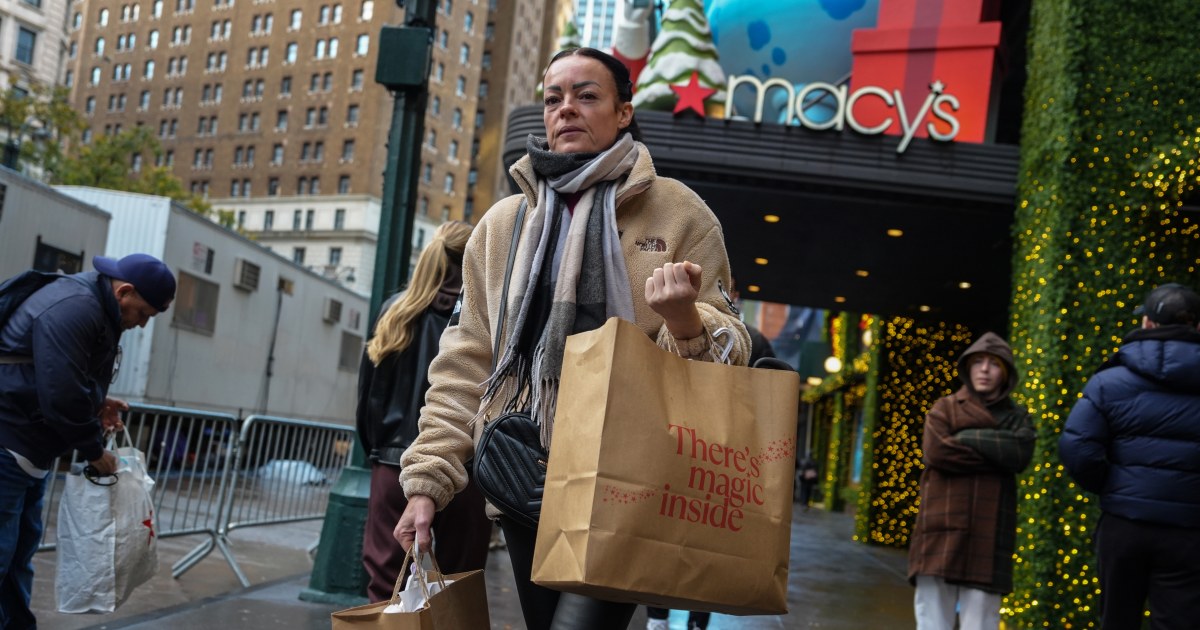
Across the United States, retailers are gearing up for some of their biggest sales of the year on Black Friday and Cyber Monday, enticing bargain hunters with slashed prices and promises of hefty savings.
asserted
retailers → gear → savings
For some shoppers, the Thanksgiving leftovers will barely have made it into the fridge before they bundle up in their coats and head to big-box store car parks, queuing in the predawn darkness in hopes of snapping up a bargain on a pair of jeans, a doll, a toy truck or a new laptop.
asserted
they → make → jeans
rising cost of Thanksgiving
- list 2 of 4Storms push Macy’s Thanksgiving Day Parade in New York City to Saturday
- list 3 of 4Thanksgiving and National Day of Mourning: What is the history?
- list 4 of 4Thanksgiving dinner costs rise, putting pressure on US households
The day after Thanksgiving has become known as Black Friday and is the unofficial start of the holiday shopping season, though many retailers began rolling out their discounts weeks ago.
This year, however, the annual shopping frenzy comes against a backdrop of economic uncertainty.
asserted
frenzy → rise → uncertainty
Household budgets are increasingly stretched and Americans have to weigh their holiday wish lists against the rising cost of everyday necessities.
asserted
Americans → stretch → necessities
So, how did Black Friday evolve into a global retail phenomenon, how much are shoppers expected to spend this year and are the bargains really as good as they seem?
asserted
they → evolve → much
The marriage of Thanksgiving and holiday shopping in the United States stretches back more than a century.
asserted
marriage → stretch → century
In 1924, Macy’s launched its Thanksgiving Day Parade, transforming the streets of Midtown Manhattan into a spectacle of festive fanfare to entice shoppers into its department store.
asserted
Macy → launch → store
This year is the 100th edition of the parade, which was suspended during World War II.
asserted
which → suspend → II
However, inclement weather forced the retailer to postpone this year’s festivities until Saturday, the first time in 55 years.
asserted
weather → force → years
By 1939, the Christmas shopping season had become so economically significant that President Franklin D Roosevelt moved Thanksgiving from November 30 to November 23.
asserted
Roosevelt → become → November
That gave retailers an extra week to ring up sales and stimulate consumer spending amid an economic downturn.
asserted
That → give → downturn
The change, however, was short-lived.
asserted
change → live → ?
In 1941, Congress established the fourth Thursday of November as the permanent date for the Thanksgiving holiday.
asserted
Congress → establish → holiday
But the term Black Friday has considerably darker origins, dating back to the 1860s, when it had nothing to do with shopping or the Thanksgiving holiday.
asserted
it → have → shopping
In September 1869, financiers Jay Gould and James Fisk attempted to corner the US gold market.
asserted
Gould → attempt → market
Their scheme unravelled spectacularly, sending gold prices tumbling and plunging Wall Street into financial turmoil.
asserted
prices → unravel → turmoil
The term resurfaced in the 1950s, this time on the streets of Philadelphia, Pennsylvania.
asserted
term → resurface → Philadelphia
Police officers began using it to describe the gridlocked streets and general chaos brought on by the hordes of shoppers and football fans descending on the City of Brotherly Love following Thanksgiving, ahead of the annual Army-Navy football game.
asserted
officers → begin → game
By the 1980s, retailers had found a way to turn the once-unflattering moniker into a marketing tool.
asserted
retailers → find → tool
In accounting, being “in the black” means turning a profit.
asserted
being → mean → profit
Retailers capitalised on that association, recasting Black Friday as a lucrative shopping event and distancing it from its more chaotic origins.
asserted
Retailers → capitalise → origins
While Black Friday is a distinctly US invention, the shopping frenzy has long since transcended US borders, becoming a global phenomenon at shopping centres and digital storefronts around the world.
asserted
frenzy → transcend → world
How has Cyber Monday fared against Black Friday?
asserted
Monday → fare → Friday
Despite the rise of Cyber Monday – when online retailers slash prices – Black Friday remains the main event.
asserted
Friday → slash → prices
Some 126 million Americans are expected to shop on Friday, compared with 66.1 million on Monday, according to the National Retail Federation (NRF).
uncertain
Americans → expect → Federation
After years of shoppers swapping crowded malls and long checkout lines for virtual shopping baskets, the pendulum appears to be swinging somewhat back in favour of physical retail.
asserted
pendulum → swap → retail
While online shopping remains the most popular option for holiday shoppers, 53 percent say they plan to shop online this season, the lowest proportion since 2015.
asserted
they → remain → 2015
Americans also expect to complete 52 percent of their holiday shopping online, down from 56 percent last year and a pandemic-era peak of 60 percent in 2020.
asserted
Americans → expect → 2020
While the bustle of malls and festive window displays are regaining some of their appeal, the digital marketplace is far from losing its dominance among consumers.
asserted
marketplace → regain → consumers
Some 55 percent of holiday shopping will be online, compared with 45 percent in physical stores, according to accountancy firm Deloitte.
uncertain
percent → compare → Deloitte
What is the projected holiday spending this year?
asserted
spending → project → ?
Brightly wrapped gifts may look much the same this holiday season, but behind the holiday cheer Americans are keeping a closer eye on their wallets.
uncertain
Americans → wrap → wallets
A tighter economy is forcing consumers to be more selective about what goes into their shopping baskets.
asserted
what → force → baskets
A survey by research firm Gartner found that nearly 60 percent of Americans have less money to spend on the holidays this year than last.
asserted
percent → find → last
To stretch their budgets, many got a head start on ticking off their gift lists, with 57 percent of consumers doing at least some of their holiday shopping in October or earlier.
asserted
percent → stretch → October
Americans are not abandoning the tradition of gift-giving altogether, however.
asserted
Americans → abandon → giving
Spending on presents is expected to dip by just 2 percent from last year, with millennials making the deepest cuts of any generation, scaling back by 10 percent, according to an analysis by PwC.
Meanwhile, the National Retail Federation expects overall holiday spending to surpass $1 trillion.
How much consumers spend may largely depend on the size of their paycheques.
uncertain
consumers → expect → paycheques
The Conference Board forecasts that consumers earning less than $125,000 a year will rein in their spending on gifts, while those earning more than that plan to spend 3.6 percent more.
asserted
those → forecast → percent
A sliver of that holiday spending may be fuelled by the growing popularity of buy now, pay later (BNPL) services offered by financial technology companies such as Klarna and Affirm.
uncertain
sliver → fuel → Klarna
The proportion of US consumers using those services climbed from 10 percent in 2020 to 16 percent in 2025, according to the Federal Reserve.
uncertain
proportion → use → Reserve
…and 8 more, not listed.

 The Aporia