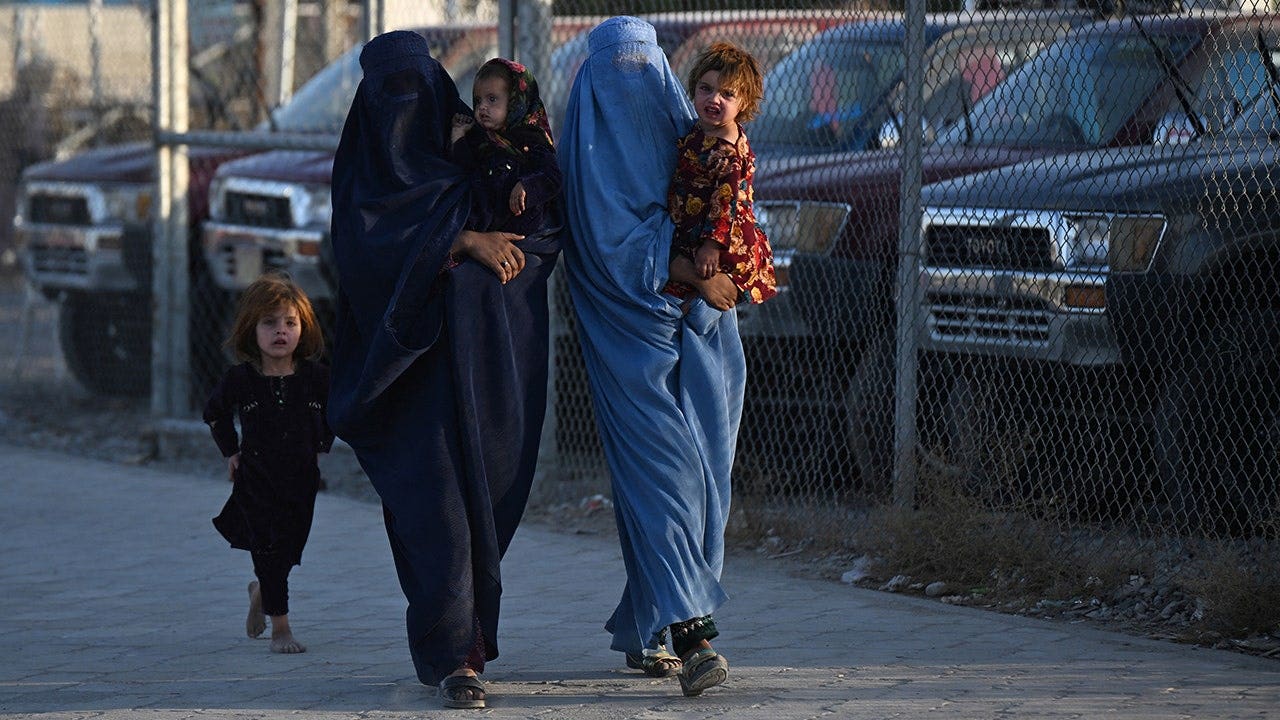
The Taliban is continuing its crackdown on women's rights in Afghanistan by stripping women of their names and replacing them with 'granny' or 'goat.'
asserted
Taliban → continue → granny
A joint investigation by Zan News and The Guardian found that healthcare workers in the Balkh province have been instructed to refer to women as 'bibi,' meaning 'granny.'
asserted
workers → find → granny
Officials said this instruction must be observed even on medical prescriptions.
asserted
instruction → say → prescriptions
Lalah Osmany, an Afghan activist living in Germany, told El Pais that the Taliban are also referring to women as 'goats' and 'cows.'
asserted
Taliban → live → goats
Other times, she says women are presented in official documents as the 'wife' or 'daughter' of a male relative.
asserted
women → say → relative
And in many parts of Afghanistan, speaking or displaying a woman's name publicly is considered an affront to her husband's or family's honour, meaning their names are often omitted from tombstones.
asserted
names → speak → tombstones
This is just the latest blow to women's rights in the Taliban controlled country, where women are barred from education and the workforce.
asserted
women → control → education
Women and girls must adhere to strict dress codes, even during summer months when temperatures can reach up to 50°C, and they must always be accompanied by a male chaperone.
asserted
they → adhere → chaperone
Healthcare workers in the Balkh province have been instructed to refer to women as 'bibi,' meaning 'granny' (Pictured: an Afghan woman in hospital)
Women and girls must adhere to strict dress codes even during summer months, when temperatures can reach up to 50°C
Earlier this year, the group passed a new law allowing husbands to beat their wives as long as there is no serious bodily harm in a new criminal code published by the group.
asserted
husbands → instruct → group
The 90-page penal code, signed by Hibatullah Akhundzada, the Taliban's supreme leader, sets out different levels of punishments for people depending on their standing in society.
asserted
code → sign → society
Article 9 of the code divides Afghan society into four categories: religious scholars (ulama), the elite (ashraf), the middle class, and the lower class.
asserted
Article → divide → categories
It appears to create a caste system in which offenders are categorised as either 'free' or 'a slave,' with women being placed on the same level as slaves.
asserted
women → appear → slaves
Disturbing clauses state that 'slave masters,' or husbands, can give out physical punishments to their wives or subordinates.
asserted
masters → state → wives
Meanwhile, if a religious scholar or member of the elite commit an offense, the consequence is limited to advice or a court summons.
asserted
consequence → commit → advice
For the middle class the same crime can result in imprisonment, while the 'lower class' faces both corporal punishment and imprisonment.
asserted
class → result → punishment
According to the code, corporal punishment for serious crimes will be carried out by Islamic clerics, but encourages husbands to give out 'discretionary punishments' to their wives for less serious misdemeanors.
uncertain
punishment → accord → misdemeanors
Regarding violence against women, Article 32 states that only if the husband beats the woman with a stick and this act results in severe injury such as 'a wound or bodily bruising', and the woman can prove it before a judge, will the husband be sentenced to fifteen days' imprisonment.
asserted
husband → regard → imprisonment
However, the contradiction lies in that a woman must remain fully covered while simultaneously proving her injuries to a judge.
asserted
woman → lie → judge
She is also required to be accompanied by a male chaperone, which is usually the husband himself.
asserted
which → require → chaperone
The new code also does not condemn or prohibit sexual or psychological violence against women.
asserted
code → condemn → women
In addition, the code stops women from seeking refuge with their family to escape violence at home.
asserted
code → stop → home
In May, the group formally recognised child marriage under a new family law regulation that set out rules for marriages involving minors and established specific guidelines governing 'virgin girls'.
uncertain
that → recognise → girls
The 31-article regulation called 'Principles of Separation Between Spouses' outlined rules governing the dissolution of marriages under an endless list of religious and legal conditions.
asserted
regulation → call → conditions
Girls are barred from education after the sixth grade
In May, the group formally recognised child marriage under a new family law regulation
These include child marriage, breastfeeding relations, forced separation, missing husbands, apostasy and accusations of adultery.
uncertain
These → bar → adultery
According to Article 5, if a child's marriage is arranged by relatives other than their father or grandfather, it is legally valid provided the spouse is socially compatible and the dowry is appropriate.
uncertain
dowry → accord → father
The regulation states that the child may later seek annulment after reaching puberty, but only through a court order, according to independent Afghan outlet Amu TV.
uncertain
child → state → TV
The document states that the silence of a 'virgin girl' is interpreted as consent to marriage, whereas the same silence from a male or previously married woman is not.
asserted
silence → state → woman
Meanwhile, women are disproportionately bearing the brunt of a worsening humanitarian crisis, with fathers resorting to selling their young daughters simply to afford food.
asserted
fathers → bear → food
The practice of selling daughters to older men for financial gain has become an unfortunately normalised response to deepening poverty in Afghanistan.
This trend is expected to rise as the economic crisis worsens, with a staggering three in four Afghans unable to meet their basic daily needs.
asserted
Afghans → sell → needs

 The Aporia