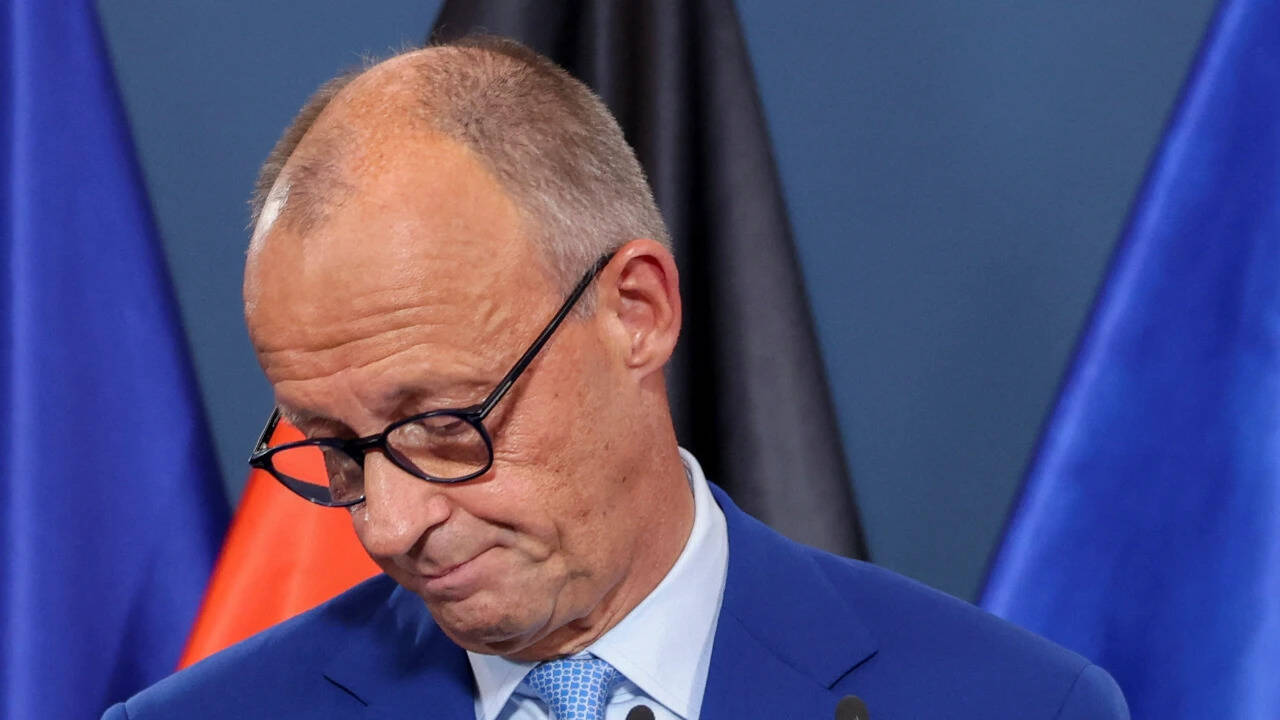
Photo via The Guardian

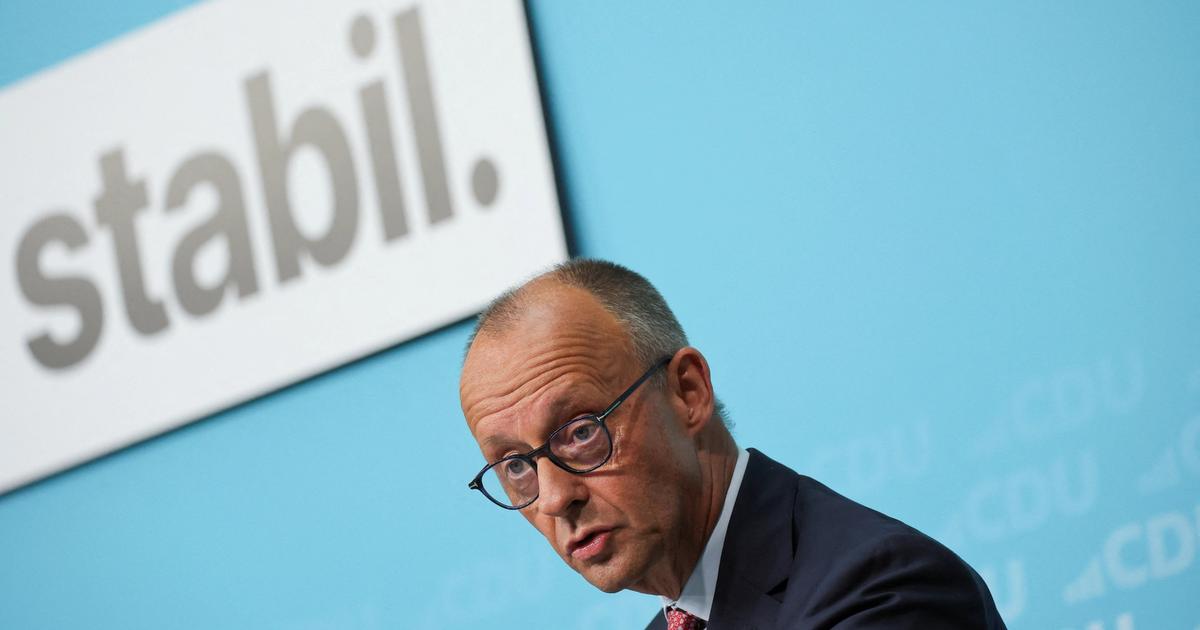
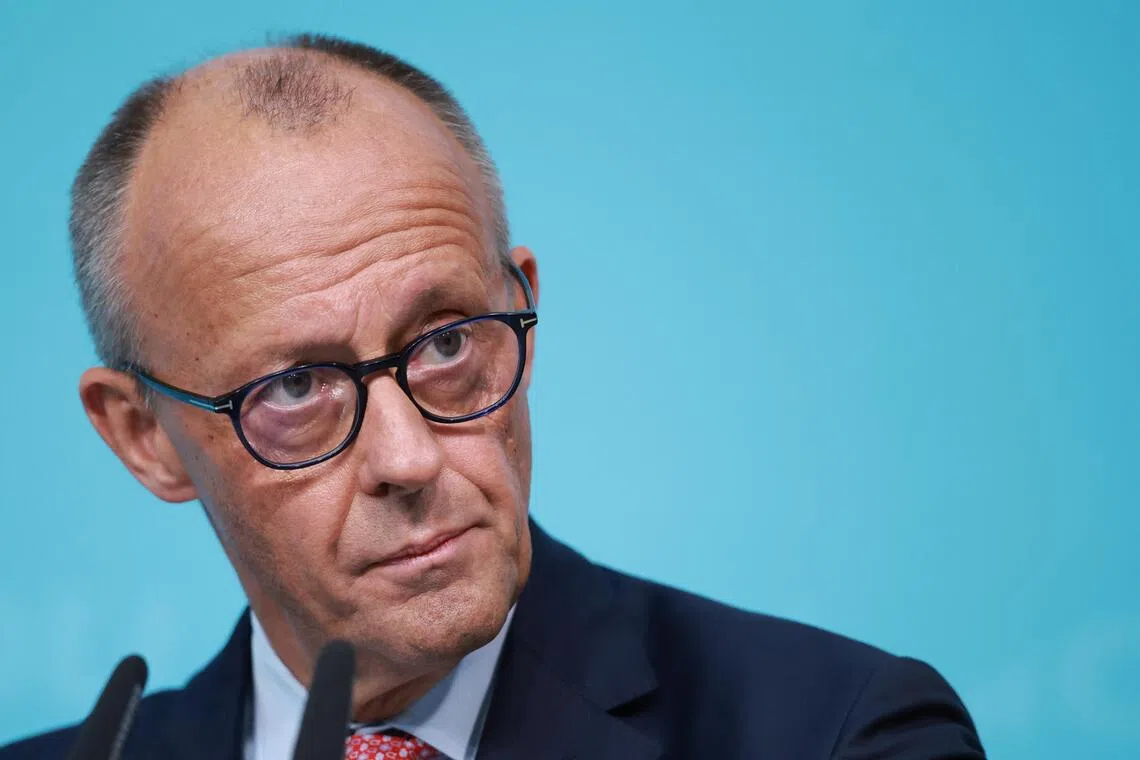
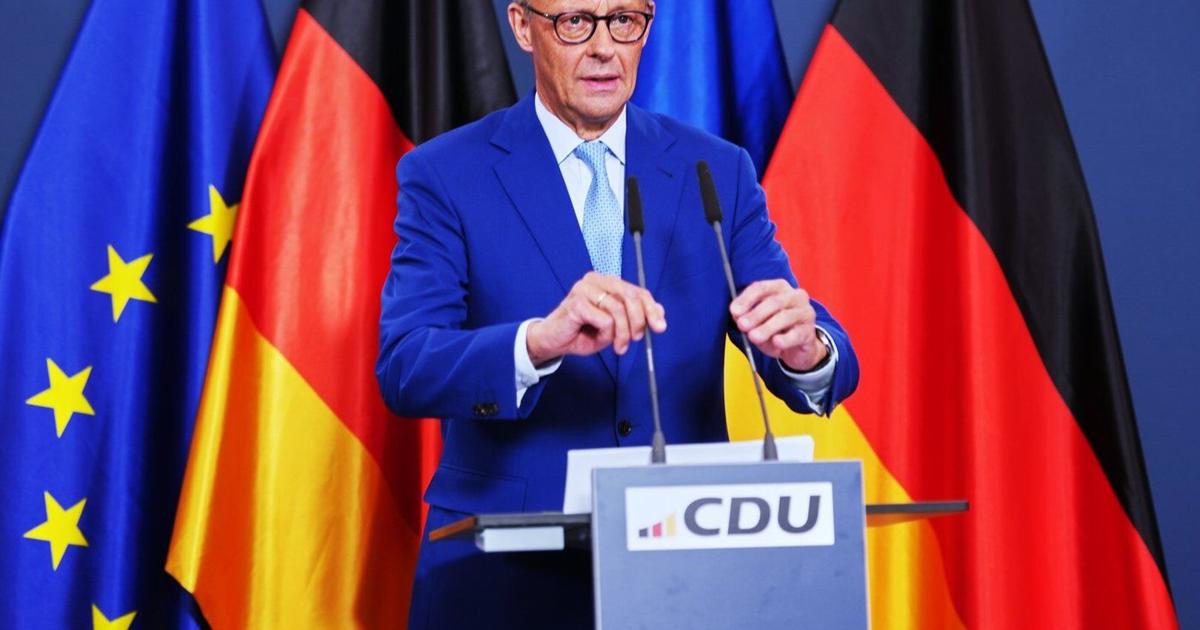
German chancellor meets CDU leaders to shore up support after more defeats

Read the original at The Guardian ↗
Cite

Berlin, K. C. i. (2026, September 21). German chancellor meets CDU leaders to shore up support after more defeats. The Guardian. https://www.theguardian.com/world/2026/sep/21/germany-chancellor-freidrich-merz-cdu-christian-democratic-union-state-election-defeats-mecklenburg-western-pomerania-berlin

Dated when The Aporia collected the article, usually within hours of publication. Check the original for its exact date and byline.

The Guardian · collected 2026-09-21 · by Kate Connolly in Berlin

Quick Summary

German Chancellor Friedrich Merz met with senior members of his Christian Democratic Union (CDU) party in Berlin following significant election defeats in two states. The meetings come after the CDU lost control of Mecklenburg-Western Pomerania for the first time and saw a strong showing from far-right and far-left parties, particularly the Alternative für Deutschland (AfD), which won 38% in Mecklenburg. These losses are seen as weakening Merz's position, with AfD leaders predicting his resignation within months before the next federal election in 2029.
Written by AI on 2026-09-21, from this article's own text only (the story summary below draws on all the coverage).
See how they differ ↓

AI analysis

Story summary

Chancellor Friedrich Merz faces significant pressure as voters in Berlin and Mecklenburg-Western Pomerania go to the polls on Sunday, following the far-right AfD's major victory in Saxony-Anhalt just two weeks prior where it won nearly 44% of the vote compared to the CDU’s 17%. With about 3.8 million voters eligible across both states, the AfD is expected to make substantial gains at Merz’s expense, potentially undermining his ability to push through promised economic reforms. Polls indicate that Merz's approval ratings have fallen to around 14%, and his CDU party risks losing its status as the largest party in Berlin and falling below the threshold for representation in Mecklenburg-Western Pomerania. These outcomes could further jeopardize Merz’s leadership, especially given the CDU’s recent struggles with unpopular reforms and low public approval.

Written for “German Chancellor Merz Faces Election Defeats” on 2026-11-20, grounded in this article and the 40 other(s) covering the same event.

How they differ

20 outlets covered “German State Elections”.

What each outlet says

One AI summary per outlet of its latest article on this story, written from that article alone and checked against it. Open the article for the outlet's own words.

The GuardianThis outlet21 Sep

German Chancellor Friedrich Merz met with senior members of his Christian Democratic Union (CDU) party in Berlin following significant election defeats in two states. The meetings come after the CDU lost control of Mecklenburg-Western Pomerania for the first time and saw a strong showing from far-right and far-left parties, particularly the Alternative für Deutschland (AfD), which won 38% in Mecklenburg. These…

German chancellor meets CDU leaders to shore up support after more defeats (this article)4 articles from The Guardian on this story
The Straits Times23 Sep

Chancellor Friedrich Merz faces pressure to revise his reform agenda following recent losses by his conservative party in German state elections in eastern Germany and Berlin. The Social Democrats, who are coalition partners with the CDU, have pushed for a more economically supportive policy approach due to voter concerns over rising inflation and living standards. This includes potential modifications to proposed…

German state election losses risk snarling Merz's reform agenda →5 articles from The Straits Times on this story
BBC21 Sep

German Chancellor Friedrich Merz stated his commitment to maintaining the coalition between his Christian Democratic Unionist (CDU) party and the Social Democratic Party (SPD) despite recent electoral setbacks. Following two state elections where the far-right Alternative for Germany (AfD) made significant gains, Merz described these results as a "profound turning point" but denied that his personal unpopularity was…

Merz vows to keep coalition together for Germany's 'democratic future' →3 articles from BBC on this story
Daily Mail22 Sep

Ruth Sunderland discusses the recent political setbacks Chancellor Friedrich Merz faced in Germany with two regional election defeats where left-wing parties and the far-right Alternative für Deutschland (AfD) performed strongly. She highlights economic challenges such as high energy costs, industrial decline, and competition from China, warning that these issues mirror broader European concerns and could deter…

Germany's political and economic problems are sounding a warning for the UK: RUTH SUNDERLAND →3 articles from Daily Mail on this story
South China Morning Post20 Sep

German Chancellor Friedrich Merz faced a significant electoral defeat when his Christian Democratic Union received only 5% of the vote in the state election of Mecklenburg-Western Pomerania, marking its lowest result since World War II. Despite this setback, Merz vowed to continue pushing for economic reforms, dismissing calls for retreat and emphasizing the need for persistence and patience in addressing Germany's…

Germany’s Merz vows to press ahead with reforms after historic state election defeat →2 articles from South China Morning Post on this story
Semafor20 Sep

In German regional elections on Sunday, Chancellor Friedrich Merz's CDU experienced its worst performance in 80 years, described by Merz as a "disaster." The far-right AfD also saw an increase in support, suggesting potential success for far-right parties in upcoming European elections. Meanwhile, other countries like Italy and Denmark are responding to right-wing pressures with stricter policies on issues such as…

Merz's CDU collapses in German regional elections 'disaster' →2 articles from Semafor on this story
Show 14 more outlets
The Independent20 Sep

German Chancellor Friedrich Merz faced significant political challenges after Sunday's state elections where his Christian Democratic Union (CDU) received record-low support of 5% in Mecklenburg-Western Pomerania and came second with 20% in Berlin, behind the Left party. Meanwhile, the anti-migration AfD made notable gains, securing 37% in Mecklenburg-Western Pomerania and 15.7% in Berlin. Despite these setbacks…

Germany’s Merz vows to press on with reforms after historic state election defeat →2 articles from The Independent on this story
Toronto Star21 Sep

German Chancellor Friedrich Merz is struggling to maintain his position after his Christian Democratic Union (CDU) suffered significant defeats in regional elections in Berlin and Mecklenburg-Western Pomerania, dropping below the 5% threshold needed for representation in one of these regions. This loss marks the first time since Germany’s federal republic was established that the CDU has failed to secure seats in a…

Germany's Merz struggles to stay on track after humiliating regional election defeat →2 articles from Toronto Star on this story
Washington Examiner21 Sep

In Sunday's regional election, Alternative for Germany (AfD) won 38% of the vote in Mecklenburg-Western Pomerania, significantly ahead of Chancellor Friedrich Merz’s Christian Democratic Union, which received only 4.9%. This follows a previous AfD victory in Saxony-Anhalt earlier this year, further undermining Merz's position despite his assertion that he will remain steadfast as chancellor. Merz described the…

Friedrich Merz says he will stay in power despite another loss to AfD: ‘Disaster’ →2 articles from Washington Examiner on this story
NPR21 Sep

German Chancellor Friedrich Merz remained steadfast after his party suffered significant losses in state elections for Mecklenburg-Western Pomerania and Berlin. The CDU received only 4.9% of the vote in Mecklenburg-Western Pomerania, failing to clear the parliamentary threshold, while in Berlin it placed third with just 18.2%. Meanwhile, the far-right AfD made substantial gains, securing 38.2% in Mecklenburg-Western…

German chancellor stands his ground after his party loses in state elections →2 articles from NPR on this story
Times of India21 Sep

In state elections held on Sunday, the far-right Alternative for Germany (AfD) secured first place with 37% of votes in Mecklenburg-Western Pomerania, outperforming Chancellor Friedrich Merz’s conservative party which received only 5.5%. This marked a significant loss for Merz's party, as it is their worst performance since 1949 at the state level. Meanwhile, in Berlin, the AfD gained strength with 16% of the votes…

Far-right tops another German state vote, Merz party routed →2 articles from Times of India on this story
CBC23 Sep

Germany's recent regional elections have seen significant gains for far-right and socialist parties, with the Christian Democratic Union (CDU) experiencing historic losses. In Mecklenburg-Western Pomerania, the far-right Alternative für Deutschland (AfD) won first place, while in Berlin, the democratic socialist Die Linke unseated the CDU. This shift signals growing political polarization and a crisis for Germany's…

Germany is electing far-right and socialist parties. What does it mean for the country's floundering centre? →2 articles from CBC on this story
ABC News (AU)21 Sep

Chancellor Friedrich Merz has vowed to continue leading Germany despite a poor showing by his Christian Democratic Union party in local elections in Mecklenburg-Vorpommern. The CDU failed to secure at least 5% of the vote, preventing it from entering the state parliament. Despite this setback, Mr Merz's position remains stable for now as the Social Democrats have indicated they want to maintain their coalition with…

German leader Merz clings on after election 'disaster' →2 articles from ABC News (AU) on this story
The Hindu23 Sep

On September 20, 2026, the far-right Alternative for Germany (AfD) won 38.2% of the vote in Mecklenburg-Western Pomerania, marking its second major victory after Saxony-Anhalt earlier that month. The Christian Democratic Union (CDU), led by Chancellor Friedrich Merz, failed to win a sufficient share of votes and was barred from representation in the regional parliament for the first time since modern German history…

ANALYSIS | Merz faces pressure after AfD’s recent electoral wins →2 articles from The Hindu on this story
Al Jazeera20 Sep

Voters in Berlin and Mecklenburg-Western Pomerania are set to cast ballots on Sunday amid concerns over rising support for far-right parties like the Alternative for Germany (AfD). Chancellor Friedrich Merz faces mounting pressure as his approval ratings dropped to 14%, following the AfD's strong performance in Saxony-Anhalt two weeks prior. In Mecklenburg-Western Pomerania, the CDU’s potential drop below the 5%…

Two German states go to the polls after far-right gains →
New York Post20 Sep

Voters in Mecklenburg-Western Pomerania and Berlin cast their ballots on Sunday in state elections where the far-right AfD party is expected to make significant gains. Chancellor Friedrich Merz faces challenges from these results, which could affect his ability to push reforms in Germany’s economy. The AfD's success might lead to its forming a regional government for the first time since World War II in…

German state elections open voting as Chancellor Friedrich Merz aims to keep far-right in power →
CBS News20 Sep

In recent German state elections, Chancellor Merz's Christian Democratic Union (CDU) faced a significant defeat, receiving only 5% of the vote in Mecklenburg-Western Pomerania—its lowest result since World War II. Meanwhile, the far-right AfD saw substantial gains with 37% and 15.7% in Mecklenburg-Western Pomerania and Berlin respectively. Despite the losses, Merz vowed to continue pushing for economic reforms…

Germany's Merz remains defiant after historic state elections defeat →
Sydney Morning Herald20 Sep

Friedrich Merz, the German chancellor, faces another electoral setback as his party, the Christian Democratic Union (CDU), lost ground to the far-right Alternative for Germany (AfD) in Mecklenburg-Vorpommern state elections on Sunday. The AfD secured 37% of the vote, while Merz’s approval ratings stand at a low 10%, with voters criticizing his leadership style and failure to curb the rise of the AfD and implement…

Merz stumbles on after another big election defeat. But for how long? →
Persuasion21 Sep

In recent German state elections, the far-right Alternative for Germany (AfD) performed strongly, securing representation while the Christian Democrats led by Chancellor Friedrich Merz failed to meet the five percent threshold required for parliamentary seats in Mecklenburg-Vorpommern. This outcome marks a historic decline for the Christian Democrats and signals growing support for extremist parties across…

The Last Nail in the Coffin for Friedrich Merz →
The Globe and Mail21 Sep

German Chancellor Friedrich Merz announced that despite significant losses in recent state elections, he intends to continue pushing forward with economic reform initiatives for Germany. He reaffirmed his commitment to the current government's agenda aimed at reviving Europe’s largest economy.

Merz vows to press ahead with reforms after historic state election defeat →

Where they agree and split

Agreed

AI · cited, from two or more outlets

  • Merz's CDU party suffered a historic defeat in Mecklenburg-Western Pomerania with just 5% of the vote, its lowest result since World War II.45
Quoted from the coverage (4)

The strong showing of AfD in the Saxony-Anhalt election has further weakened the chancellor's standing on the national level as well, and in the past two weeks there have been calls even from within his own party to replace him as chancellor.

6 outlets

Despite the strong headwinds, he has repeatedly said that he’s determined to stay on and finish his term as chancellor.

6 outlets

The state elections are taking place in Mecklenburg-Western Pomerania, a largely rural region in the formerly communist and less prosperous east, and in the capital, Berlin.

6 outlets

Merz acknowledged the CDU's result as a "disaster" but struck a defiant note, rejecting any retreat from his government's reform agenda.

6 outlets

Disputed

Picked by our model, which is sometimes wrong

  • The Independent reports that Merz’s leadership was hit hard by his party’s heavy defeat in Saxony-Anhalt on September 6th, while the Washington Examiner attributes this to a broader context of political fragmentation and left-right polarization.12

Framing

How the first headlines put it

  • The Independent frames the event as a test for Chancellor Friedrich Merz ahead of state elections, whereas The Washington Examiner presents it as an arrival of Götterdämmerung for political parties under a Marmalade sky.12
  • The Daily Mail headlines predict the imminent fall of Chancellor Merz due to election defeats, while NPR focuses on Merz’s defiant stance despite losses.76
Words to watch (5)

Friedrich Merz vows to stay in office after CDU ‘disaster’ in German state elections The Guardian

Friedrich Merz says he will stay in power despite another loss to AfD: ‘Disaster’ Washington Examiner

Germany's Merz struggles to stay on track after humiliating regional election defeat Toronto Star

Chancellor Merz schedules crisis meeting as German voters go to the polls in state elections amid EU fears of another AfD victory Daily Mail

German leader Merz clings on after election 'disaster' ABC News (Australia)

The full story: what happened, how it changed, and all 41 articles →

Compared with similar articles

This article reads leans left and hedges 4% of its claims. Each row says how that neighbour differs.
Semafor
Leans left Hedges 0 of 5 claims Outlet record 64/100
“The articles describe different stages of an ongoing situation — Article A discusses pressure on Merz before state elections, while Article B reports on Merz meeting CDU leaders after election defeats.”
The Straits Times
Hedges 3 of 14 claims Outlet record 64/100
“The articles describe different events: one is about Merz's comments on US-Europe relations, and the other is about him meeting CDU leaders to shore up support after election defeats.”
BBC News
Leans left Hedges 5 of 33 claims Outlet record 65/100
“Article A describes local elections taking place on Sunday, while Article B reports Chancellor Merz's reaction to those election results in a meeting held on Monday.”
NPR
Hedges 1 of 13 claims Outlet record 60/100
“The articles describe different meetings and actions by Chancellor Merz on separate days following election defeats.”
Toronto Star
Leans right further right than this Hedges 2 of 21 claims Outlet record 64/100
NPR
Hedges 1 of 23 claims Outlet record 60/100
The Guardian
Leans left Hedges 0 of 15 claims Outlet record 64/100
Daily Mail
Leans left Hedges 4 of 27 claims Outlet record 69/100
“Article A describes Merz scheduling a crisis meeting before election results are known, while Article B reports on an actual meeting after election defeats.”
Times of India
Leans right further right than this Hedges 2 of 14 claims Outlet record 59/100
“While both articles discuss recent electoral setbacks for Chancellor Merz and his party, they describe different events: one is about the election results themselves, while the other is about a subsequent meeting to address those results.”
BBC News
Hedges 6 of 19 claims Outlet record 65/100
“Article A discusses support from eight German state premiers, while Article B covers an internal meeting with CDU leadership to address recent electoral defeats.”

Story

German Chancellor Merz Faces Election Defeats
Politics · 41 article(s) covering the same event. Compare every outlet's account →
How this article was measured signals, leaning charts, publisher record, byline, topics and claims

Signals How these are calculated →

Claims extracted
27
sentences that state something as happening or true
Uncertain
4%
1 of 27 hedged ("reportedly", "may", "according to")
Leaning
Leans left
of the writing, not the subject · beta estimate
Publisher signals
64/100
The Guardian's corrections and hedging, across everything collected from it. Not a measure of accuracy.
Outlets on this story
41
Politics
Same framing elsewhere
1
articles that frame the event the way this one does
Analyzed 2026-09-21 · how these are computed

How this is being covered How these are calculated →

Article leaning vs. publisher reliability
Source leaning vs. consistency

Publisher

The Guardian · 3712 article(s) · 8 correction(s) detected
Running correction rate · 8 correction(s)

Who wrote this

Kate Connolly in Berlin
8 article(s) here · 1 carrying a prediction
Nearly 40% of the 4,000 women who responded to the survey said they had been addressed with suggestive comments and sexualised remarks, while 15% reported being harassed with mobile phone pictures taken against their will and in some cases altered using AI.
Kuznetsov, who will be identified in the trial opening on Wednesday just as Serhii K due to German privacy laws, was referenced by his full name in an extradition order.
Five politicians from the BSW, a small leftwing party that echoes the AfD’s stances on Russia and immigration, had already said they would vote for Rausch.
“The world could learn a thing or two from a sports changing room …
Elif Eralp launched her election bid last autumn with the blunt statement: “People like me are actually not supposed to become mayor in this country.”
Merz, who has vowed his fractious coalition government will plough ahead with an unpopular reform agenda, held an early meeting in Berlin with the Christian Democratic Union (CDU)’s leadership on Monday.
Siegmund, 35, said it would not engage in “games” such as a minority government.
Polls have opened in the east German state of Saxony-Anhalt, where the populist, far-right, anti-immigration Alternative für Deutschland (AfD) is predicted to emerge on top in an election that could have a groundbreaking effect on Germany’s political landscape.
Also by Kate Connolly in Berlin
Nothing else under this byline is closely related to this article, so these are simply their most recent.
All 8 articles by Kate Connolly in Berlin →

Topics

AfD Berlin CDU Germany Mecklenburg

Subjects

CDU ORG · 9× Merz PERSON · 8× AfD ORG · 6× Mecklenburg PERSON · 5× Berlin GPE · 4× Germany GPE · 3× SPD ORG · 2× Alternative für Deutschland ORG · 1× Friedrich Merz PERSON · 1× the Christian Democratic Union ( ORG · 1×

Narrative

Labour minister Bärbel Bas, also of the SPD, said the plans needed a “reality check”, but said “nothing would be more lethal than letting this coalition break apart over some technicality”. Rubbing salt into Merz’s wounds, the Kremlin on Monday waded into the election analysis, calling the AfD’s win in Mecklenburg a response to Berlin’s refusal to buy cheap Russian gas, which has jolted the economy and caused prices to soar, contributing to voter dissatisfaction.
framing: assertive · carried by 1 article(s) · first seen 2026-09-21
Merz, who has vowed his fractious coalition government will plough ahead with an unpopular reform agenda, held an early meeting in Berlin with the Christian Democratic Union (CDU)’s leadership on Monday.
2026-09-21 · The Guardian
German chancellor meets CDU leaders to shore up support after more defeats · assertive framing

Claims (27 extracted, 1 hedged)

Germany’s beleaguered leader, Friedrich Merz, has sought to shore up support for his flagging chancellorship among senior members of his conservative party after its drubbing at the polls in two state elections. asserted
leader → seek → elections
Merz, who has vowed his fractious coalition government will plough ahead with an unpopular reform agenda, held an early meeting in Berlin with the Christian Democratic Union (CDU)’s leadership on Monday. asserted
government → vow → Monday
Germany faces political uncertainty as Merz, 70, clings to power in the aftermath of three hefty defeats this month, which saw the CDU ousted from a state parliament for the first time ever and the far-right and far-left making strong gains at its expense. asserted
right → face → expense
The embattled Merz vowed to keep on fighting on Sunday, election day in Berlin and the coastal northern state of Mecklenburg-Western Pomerania. asserted
Merz → vow → Pomerania
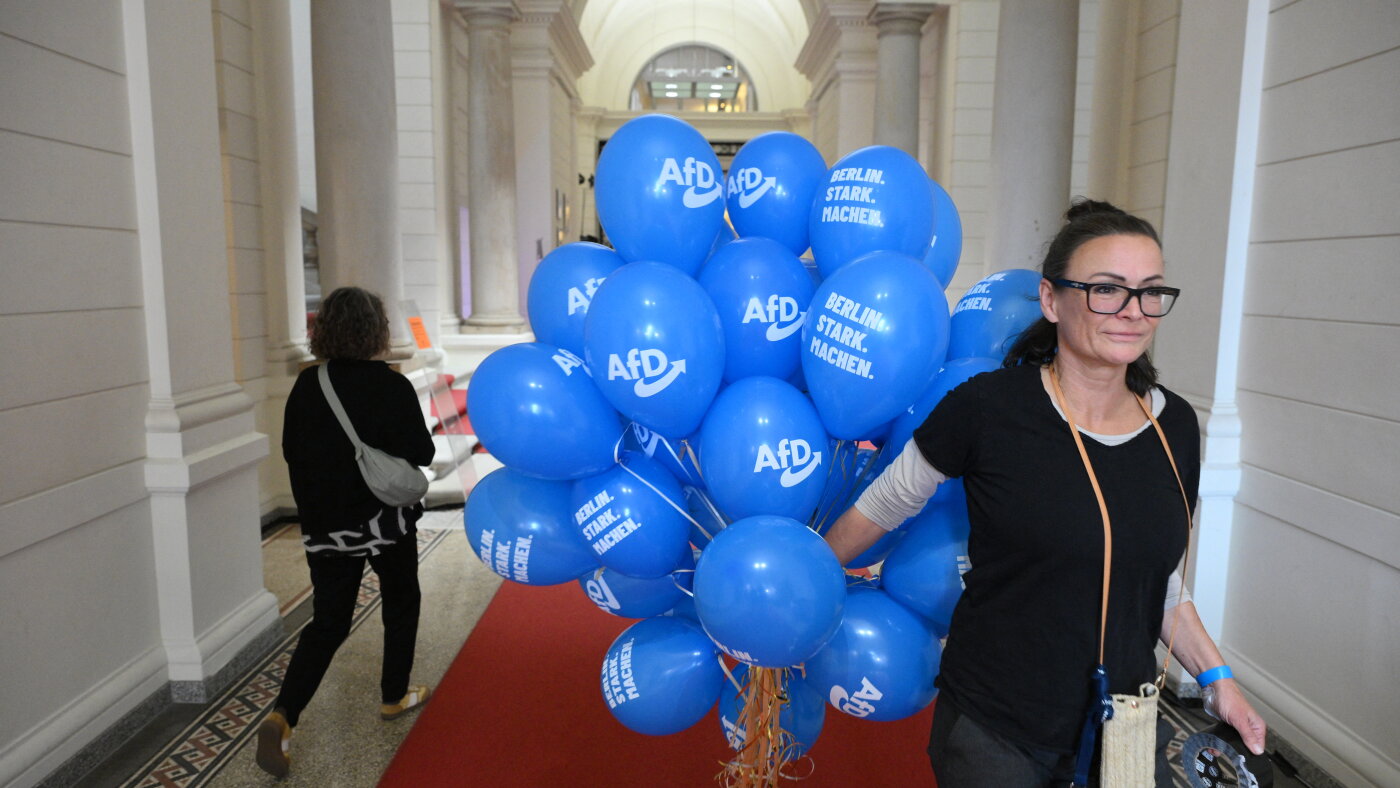
But after the far-right Alternative für Deutschland (AfD) emerged victorious in Mecklenburg for the third time in a German state, securing 38%, his position looked increasingly fragile. asserted
position → emerge → %
The anti-immigration, pro-Russia AfD’s leaders on Monday predicted that Merz would be out of office in months, as they set their sights on securing victory at the next federal election in 2029. asserted
they → predict → 2029
“The chancellor certainly won’t make it to the end of the year,” Leif-Erik Holm, the AfD’s top candidate in Mecklenburg, said. asserted
Holm → make → Mecklenburg
“I think the twilight of the chancellor’s era has begun.” asserted
twilight → think → era
Merz described the results as a “disaster”, in particular the CDU’s ejection from the state parliament of Mecklenburg-Western Pomerania where it failed to reach the 5% barrier needed, after losing more than half of its voters to the far-right AfD and centre-left Social Democrats. asserted
it → describe → AfD
In Berlin, the CDU fell to second place behind the far-left Linke party, which is on track to lead the next government in the city-state and could give Berlin its first Turkish-born mayor in its lead candidate, Elif Eralp. uncertain
which → fall → candidate
In Mecklenburg, the SPD under its existing state leader, Manuela Schwesig, is expected to lead a three-party coalition government. asserted
SPD → exist → government
Her campaign had focused almost wholly on presenting herself as a buttress against the AfD, as well as distancing herself from the federal government’s reform agenda. asserted
campaign → focus → agenda
Although the CDU’s poor performance had been predicted, Sunday’s outcomes only added to the extreme pressure on Merz already after the CDU’s crushing defeat to the AfD in the state of Saxony-Anhalt two weeks ago, which triggered the first serious speculation over his future as leader. asserted
which → predict → leader
Last week, the CDU’s powerful regional leaders governing in eight states gave their backing to Merz, but questions remain as to how sustained their support will be. asserted
support → govern → Merz
At the same time there appear to be few candidates willing to step up to the post, which is increasingly being viewed as a poisoned chalice. asserted
which → appear → chalice
Karin Prien, education minister and deputy CDU leader, accepted accusations that the government was failing to take voters’ fears seriously enough. asserted
government → accept → fears
But she said the government had no choice other than to continue trying to reform Germany from within, at a time of chronic economic weakness and global instability. asserted
government → say → weakness
“Without support and steadfastness we will not be able to achieve the necessary reforms, which are by no means a given. asserted
which → achieve → means
Nevertheless, not everything can remain as it is,” she told broadcaster Deutschlandfunk. asserted
she → remain → Deutschlandfunk
“The chancellor knows he will have to change, at least in how he addresses the people … asserted
he → know → people
We are a strong country, we have every chance of mastering this challenge together, but I believe that cooperating with each other will be crucial for this, and for the party it means we must broaden our appeal.” asserted
we → have → appeal
Doubts over the efficacy and fairness of the government’s reform agenda – which includes an overhaul of the pension system, a reduction in overbearing bureaucracy and cuts to income tax for the less well-off – played heavily into both election campaigns. asserted
which → include → campaigns
On Monday, SPD leaders said they remained confident in their coalition with the CDU, but said that changes to the agenda were necessary. asserted
changes → say → agenda
Lars Klingbeil, deputy chancellor and finance minister, said: “Saying we will ignore what the voters said to us in three state polls won’t work.” asserted
voters → say → polls
While the country needed reforms, he said, they ”must be fair and they need support in the population.” asserted
they → need → population
Labour minister Bärbel Bas, also of the SPD, said the plans needed a “reality check”, but said “nothing would be more lethal than letting this coalition break apart over some technicality”. Rubbing salt into Merz’s wounds, the Kremlin on Monday waded into the election analysis, calling the AfD’s win in Mecklenburg a response to Berlin’s refusal to buy cheap Russian gas, which has jolted the economy and caused prices to soar, contributing to voter dissatisfaction. asserted
prices → say → dissatisfaction
Kremlin spokesperson Dmitry Peskov said: “Naturally, Germans, or at least some of them, are looking for an alternative to the current authorities in order to improve their situation. asserted
Germans → say → situation
Give feedback · no sign-in needed

No sign-in needed for now. Your note is sent without a name, so it cannot be answered.

History Support