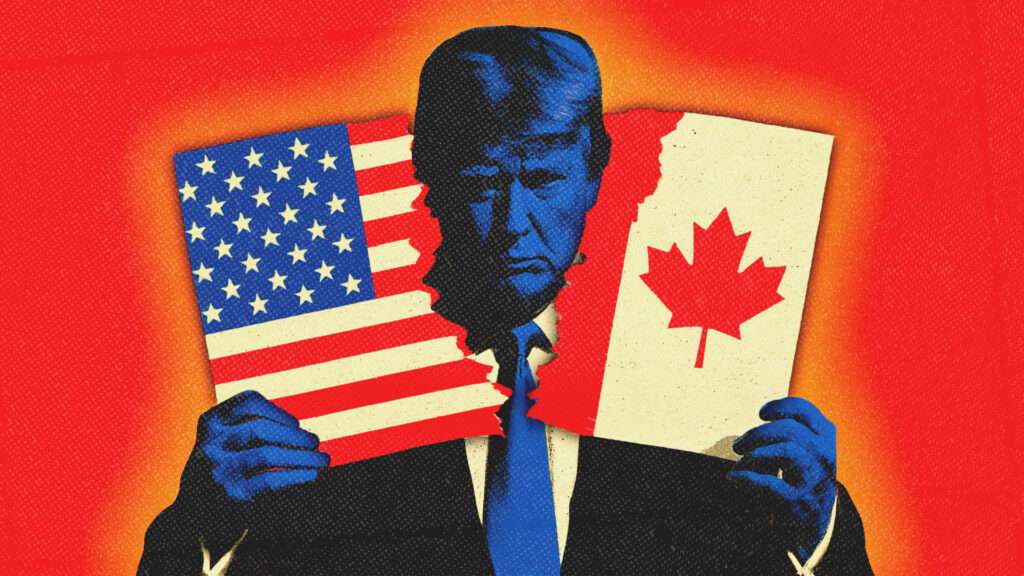
My New Lawfare Article on Why "The President Doesn't Have Unlimited Power to Impose Import Bans"

Read the original at Reason ↗
Cite

Somin, I. (2026, October 5). My New Lawfare Article on Why "The President Doesn't Have Unlimited Power to Impose Import Bans". Reason. https://reason.com/volokh/2026/10/05/my-new-lawfare-article-on-why-the-president-doesnt-have-unlimited-power-to-impose-import-bans/

Dated when The Aporia collected the article, usually within hours of publication. Check the original for its exact date and byline.

Reason · collected 2026-10-05 · by Ilya Somin

Quick Summary

The author discusses a recent Lawfare article titled "The President Doesn't Have Unlimited Power to Impose Import Bans." The piece addresses President Trump's attempt to use Section 338 of the Smoot-Hawley Tariff Act to ban Canadian imports and impose tariffs, which raised concerns about presidential overreach. The author argues that such actions are unconstitutional without congressional approval, citing legal precedents like Learning Resources, Inc. v. Trump. The article emphasizes that while some statutes grant the president authority to restrict imports, this power is limited and cannot be interpreted as a blanket authorization for import bans.
Written by AI on 2026-10-05, from this article's own text only (the story summary below draws on all the coverage).

AI analysis

Story summary

Lawfare published Ilya Somin's article arguing that President Trump did not have unlimited power to impose import bans using Section 338 of the Smoot-Hawley Tariff Act of 1930, which he attempted to use against Canadian imports. Some feared this act would give Trump broad authority over imports, but courts have already constrained similar presidential actions on tariffs, as seen in the Supreme Court's decision in Learning Resources, Inc. v. Trump. This case struck down Trump’s tariffs imposed under the International Emergency Economic Powers Act of 1977 (IEEPA). Despite this, Trump claimed he had the power to impose devastating trade embargoes. However, Somin asserts that just like tariffs, import bans fall under congressional authority rather than executive powers, thus preventing the president from having unchecked control over imports.
Written for “President's Trade Powers Debate” on 2026-11-21, grounded in this article and the 0 other(s) covering the same event.

Compared with similar articles

This article reads unscored and hedges 17% of its claims. Each row says how that neighbour differs.
The Sydney Morning Herald
Leans left Hedges 8 of 34 claims Outlet record 61/100
“The articles discuss different legal challenges and attempts by President Trump regarding tariffs; Article A focuses on a specific court hearing about tariffs imposed in July, while Article B discusses an article arguing against the president's power to impose import bans.”
The Guardian
Leans strongly left Hedges 3 of 40 claims Outlet record 64/100
“Article A describes Trump's statements about trade and AI, while Article B discusses a legal article addressing Trump's attempts to impose import bans under Section 338 of the Smoot-Hawley Tariff Act.”

Story

President's Trade Powers Debate
Politics · 1 article(s) covering the same event.
How this article was measured signals, leaning charts, publisher record, byline, topics and claims

Signals How these are calculated →

Claims extracted
12
sentences that state something as happening or true
Uncertain
17%
2 of 12 hedged ("reportedly", "may", "according to")
Leaning
withheld
no quote in the article backed the model's score
Publisher signals
67/100
Reason's corrections and hedging, across everything collected from it. Not a measure of accuracy.
Outlets on this story
1
Politics
Same framing elsewhere
1
articles that frame the event the way this one does
Analyzed 2026-10-05 · how these are computed

How this is being covered How these are calculated →

Article leaning vs. publisher reliability
Source leaning vs. consistency

Publisher

Reason · 1464 article(s) · 4 correction(s) detected
Running correction rate · 4 correction(s)

Who wrote this

Ilya Somin
39 article(s) here · 1 carrying a prediction
As I explained previously, Republican candidate Dan J. Sullivan can potentially be confused with Dan S. Sullivan (the incumbent GOP senator), and some voters might have accidentally chosen Dan J. even though they intended to back Dan S. Today, as reported by prominent election law scholar Rick Hasen, DOJ filed a brief in the US Court of Appeals for the 9th Circuit seeking to dismiss the case.
Among other things, it would allow the federal government to suspend the writ of habeas corpus (and thereby detain people - including US citizens - without due process) at any time.
Just months ago, the Supreme Court in Learning Resources applied those fundamental principles to hold that the President may not use a general grant of authority to "regulate … importation" to impose tariffs, because the power to "regulate" is not the power to tax and Congress did not clearly delegate its taxing power.
A few of my own experiences with Posner and his work may shed some small additional light on the man and his achievements.
2026-11-12 · assertive framing · Judge Richard Posner, RIP
The Republicans may be able to effectively bottle up the impeachment in committee for the rest of the current Congress (which ends on January 3, 2027).
2026-11-11 · mixed framing · The Hegseth Impeachment is Far From Over
Even if they don't pass in the narrowly Republican-controlled lame duck Congress, they will almost certainly do so in the incoming Democratic one.
2026-11-09 · assertive framing · Andrew McCarthy on the Hegseth Impeachment
That makes it very likely it will happen.
2026-11-08 · assertive framing · Impeach Pete Hegseth
In each case, he illegally tried to transform relatively narrow delegations to the executive into a blank check to impose tariffs at will.
I address a variety of counterarguments, including claims that voting for a lesser evil makes you morally complicit in that candidate's wrongdoing, arguments that it's better to cast a "protest vote" for a candidate that has no chance of winning, arguments based on the very low probability that your vote will be decisive, and more.
If Section 338 is still valid and does grant the kind of nearly unlimited authority Trump claims, that would violate the constitutional "nondelegation" doctrine, which restricts delegation of legislative power to the executive…
Also by Ilya Somin
Nothing else under this byline is closely related to this article, so these are simply their most recent.
All 39 articles by Ilya Somin →

Topics

Canadian Lawfare Section 338 Smoot-Hawley Tariff Act the Supreme Court's

Subjects

Trump PERSON · 7× Canadian NORP · 1× Lawfare ORG · 1× Learning Resources, Inc. ORG · 1× The Volokh PERSON · 1× the Supreme Court's ORG · 1×

Narrative

Courts have thus far constrained Trump's efforts to impose sweeping tariffs, most notably in the Supreme Court's decision in Learning Resources, Inc. v. Trump (a case I helped litigate), which struck down Trump's massive imposition of tariffs under the International Emergency Economic Powers Act of 1977 (IEEPA).
framing: assertive · carried by 1 article(s) · first seen 2026-10-05
And, as with tariffs, interpreting these authorities in a way that gives the president a blank check to impose import bans would run afoul of the major questions doctrine and constitutional nondelegation.

Claims (12 extracted, 2 hedged)

Today, Lawfare published my new article "The President Doesn't Have Unlimited Power to Impose Import Bans." asserted
President → publish → Bans
President Trump recently tried to use Section 338 of the notorious Smoot-Hawley Tariff Act of 1930 to ban several categories of Canadian imports outright, as well as to impose tariffs on others. asserted
Trump → try → others
This led some to fear that Trump has discovered a largely unlimited power for the president to restrict imports. asserted
president → lead → imports
Courts have thus far constrained Trump's efforts to impose sweeping tariffs, most notably in the Supreme Court's decision in Learning Resources, Inc. v. Trump (a case I helped litigate), which struck down Trump's massive imposition of tariffs under the International Emergency Economic Powers Act of 1977 (IEEPA). asserted
which → constrain → 1977
Trump himself said after the IEEPA decision that "I can destroy the trade. asserted
I → say → trade
I'm even allowed to impose a foreign country destroying embargo. asserted
I → allow → embargo
Thus, the president cannot impose import bans without congressional authorization. asserted
president → impose → authorization
While some statutes delegate import restriction authority to the president, that power is strictly limited. asserted
power → delegate → president
And, as with tariffs, interpreting these authorities in a way that gives the president a blank check to impose import bans would run afoul of the major questions doctrine and constitutional nondelegation. asserted
that → interpret → doctrine
It remains to be seen whether Trump or a future president might decide to claim sweeping authority to impose import bans at will. uncertain
Trump → remain → will
But when and if such an effort materializes, courts should strike it down. asserted
courts → materialize → it
The rest of the article goes into the relevant issues in greater detail, including considering several statutes that might potentially be used in any effort to institute sweeping executive-imposed import bans. uncertain
that → go → bans
Give feedback · no sign-in needed

No sign-in needed for now. Your note is sent without a name, so it cannot be answered.

History Support