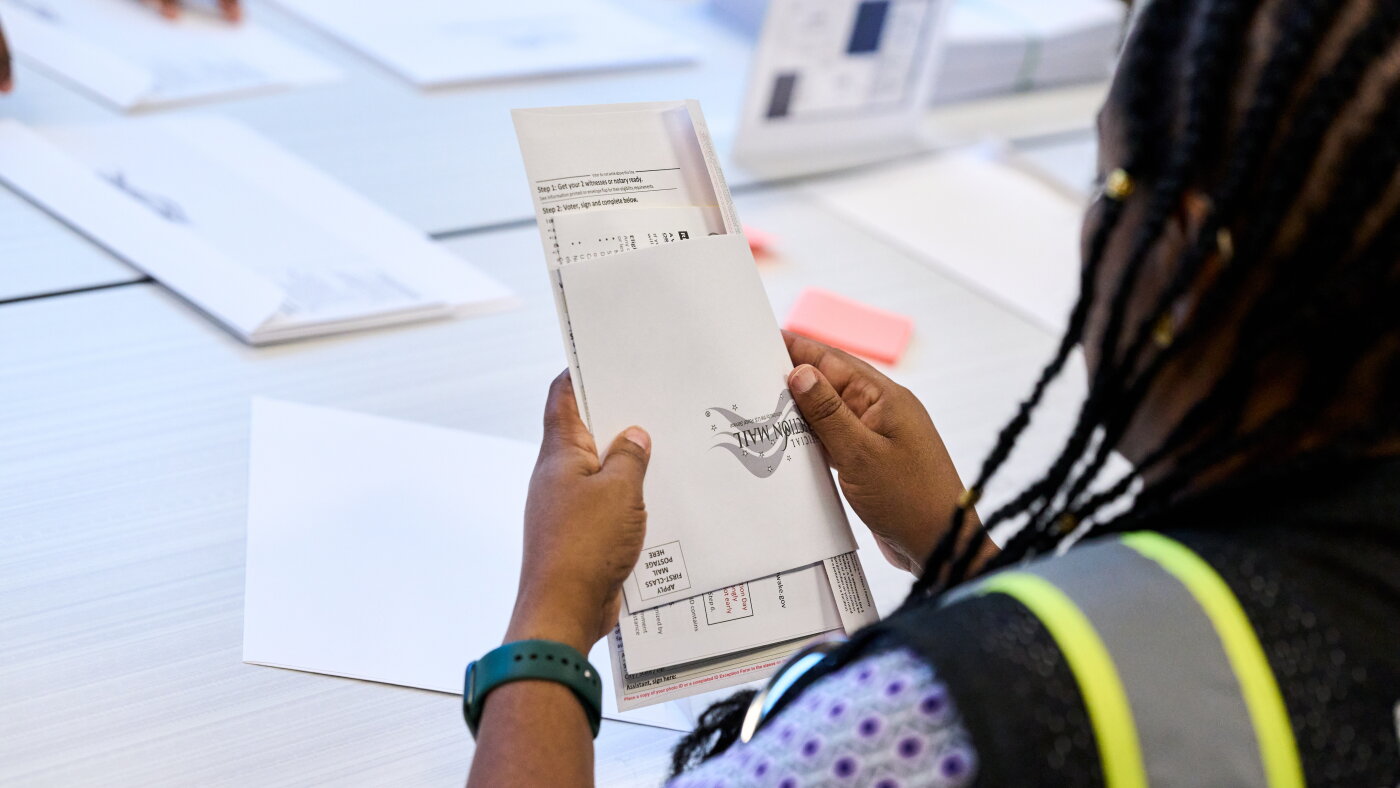
Photo via Mother Jones

California’s Mail Ballot System Excludes Disabled Voters, Court Rules

Read the original at Mother Jones ↗
Cite

Hurwitz, S. (2026, October 6). California’s Mail Ballot System Excludes Disabled Voters, Court Rules. Mother Jones. https://www.motherjones.com/politics/2026/10/californias-mail-ballot-system-excludes-disabled-voters-court-rules/

Dated when The Aporia collected the article, usually within hours of publication. Check the original for its exact date and byline.

Mother Jones · collected 2026-10-06 · by Sophie Hurwitz

Quick Summary

A federal court ruled on October 3 that California's requirement for voters to sign and return mail ballots on paper violates the rights of disabled voters who cannot do so independently. The case, California Council of the Blind v. Weber, highlights how current rules exclude blind or low-vision individuals from voting privately and confidentially. Plaintiffs like Christopher Gray, a San Francisco resident, argue that they need alternative methods to return their ballots without assistance. The court did not mandate immediate changes but gave California until October 19 to propose new protocols, likely delaying implementation until the next election cycle.
Written by AI on 2026-10-06, from this article's own text only (the story summary below draws on all the coverage).

AI analysis

Story summary

A federal court ruled on October 3 that California’s requirement for voters with print disabilities to sign and return mail ballots on paper violated their rights. The ruling in California Council of the Blind v. Weber benefits disabled voters but won’t likely affect current elections until the next election cycle, as ballots have already been mailed out. Since 2021, California has sent ballots to all registered voters for statewide and local elections; however, those with print disabilities must request an electronic link to fill out their ballot online, then print it, place it in an envelope, seal it, and return it non-electronically—often impractical for many blind individuals who lack printers. Christopher Gray, a plaintiff from San Francisco County, stated he cannot vote independently under the current system due to his blindness. The court has given California until October 19 to propose new voting protocols that accommodate disabled voters more effectively.

Written for “Mail Ballot Access Dispute” on 2026-11-20, grounded in this article and the 0 other(s) covering the same event.

Compared with similar articles

This article reads leans left and hedges 14% of its claims. Each row says how that neighbour differs.
NPR
Leans left Hedges 5 of 26 claims Outlet record 60/100
“Article A discusses a court ruling regarding California's mail ballot system and disabled voters, while Article B addresses concerns about postmark dates affecting the validity of mailed ballots. These are different topics within the broader context of election systems.”

Story

Mail Ballot Access Dispute
Politics · 1 article(s) covering the same event.
How this article was measured signals, leaning charts, publisher record, byline, topics and claims

Signals How these are calculated →

Claims extracted
21
sentences that state something as happening or true
Uncertain
14%
3 of 21 hedged ("reportedly", "may", "according to")
Leaning
Leans left
of the writing, not the subject · beta estimate
Publisher signals
60/100
Mother Jones's corrections and hedging, across everything collected from it. Not a measure of accuracy.
Outlets on this story
1
Politics
Same framing elsewhere
1
articles that frame the event the way this one does
Analyzed 2026-10-06 · how these are computed

How this is being covered How these are calculated →

Article leaning vs. publisher reliability
Source leaning vs. consistency

Publisher

Mother Jones · 595 article(s) · 1 correction(s) detected
Running correction rate · 1 correction(s)

Who wrote this

Sophie Hurwitz
67 article(s) here · 1 carrying a prediction
The explosion will send a plume of lead-contaminated dust across a hundred-mile swath of the Midwest.
Times Square was blanketed in advertisements for the AI company Anthropic November 19, bearing images of bright, lush landscapes and the (Claude-inflected) slogan “What we make of this moment [sic], will make this moment.”
It would be understandable to wonder whether these things are all connected as part of some grand conspiracy.
2026-11-17 · assertive framing · Trump On All Those Outages: “It’s Fine”
States will not be forced to implement new Medicaid work requirements until mid-2027, the administration announced Friday.
The National Security Agency can continue operating under the law until March 2027, but a renewal would extend that timeline.
Van Hollen, at 67, is only eight years younger than Schumer—but his backers see him as a candidate that will, as Van Hollen put it in a speech in Denver on Friday, “shake things up.”
When Coloradans voted last week to reject an amendment that would have enshrined a right to natural gas in their state constitution, they also rebuffed a legal maneuver by a dark money group to keep Colorado reliant on deceptively dirty natural gas.
Ahmed Moor, a Philadelphia foreign policy analyst and writer, is the first candidate to announce his entry into what will likely be a crowded primary field.
With Democrats set to take control of the House and Senate, Himes is suggesting that his Republican colleagues “get this thing done in the lame-duck because it’s, you know, it’s going to be a very different 702 that gets reauthorized in the first quarter of next year,” as The Hill reported.
The $1.5 trillion defense budget proposed by Pete Hegseth may be cut down in the 120th Congress.
2026-11-12 · assertive framing · Alex Karp Wants to Be Friends With Democrats Again
Also by Sophie Hurwitz
Nothing else under this byline is closely related to this article, so these are simply their most recent.
All 67 articles by Sophie Hurwitz →

Topics

Braille California California Council of the Blind Democracy Docket San Francisco County

Subjects

California GPE · 4× Gray PERSON · 3× California Council of the Blind ORG · 1× Christopher Gray PERSON · 1× Democracy Docket ORG · 1× Sallie Kim PERSON · 1× San Francisco County GPE · 1× Weber PERSON · 1×

Narrative

The state of California now has until October 19 to propose a new vote-by-mail protocol, and since California ballots have already been mailed out, any changes made likely will not take effect until the next election cycle.
framing: assertive · carried by 1 article(s) · first seen 2026-10-06
And that’s only one of the obstacles they might face under the current vote-by-mail rules.
2026-10-06 · Mother Jones
California’s Mail Ballot System Excludes Disabled Voters, Court Rules · assertive framing

Claims (21 extracted, 3 hedged)

A federal court struck down a California rule that required voters to sign and return vote-by-mail ballots on paper, rather than doing so electronically. asserted
that → strike → paper
The ruling in California Council of the Blind v. Weber, announced October 3, is a victory for disabled voters—but it probably won’t change things much until the next election cycle. asserted
it → announce → cycle
Since 2021, California has mailed ballots to all registered voters for all statewide and local elections. asserted
California → mail → elections
Voters with print disabilities—those who are blind or low-vision, or whose physical disabilities prevent them from marking a paper ballot—can request a link to vote electronically. asserted
disabilities → prevent → link
After filling out their ballot on a computer, they must print it, put it in an envelope, seal the envelope, and return it “through non-electronic means.” asserted
they → fill → means
This is complicated by the fact that many blind people don’t own printers, because they have no use for them. asserted
they → complicate → them
And that’s only one of the obstacles they might face under the current vote-by-mail rules. uncertain
they → ’ → rules
Under the current system, as he wrote in a 2024 court declaration, he is unable to vote without assistance. asserted
he → write → assistance
He could theoretically vote using a virtual vote-by-mail ballot, which he can fill out unassisted using his own assistive technology, including a Braille-equipped computer. uncertain
he → vote → computer
But printing the ballot, finding where to sign it, signing it, putting it in an envelope, sealing it, and returning it without assistance is not possible for him. asserted
printing → print → him
“Because of the lack of an accessible method of returning my ballot by mail, when I vote I must forgo my right to vote confidentially and privately,” Gray wrote. asserted
Gray → return → right
During the 2022 general elections, Gray ended up paying an assistant to help him fill out his ballot—but in doing so, he was forced to give up that privacy and independence. asserted
he → end → privacy
He also gave up his certainty that his ballot had been submitted at all. asserted
ballot → give → certainty
“Though I trusted my reader, I could not independently confirm they accurately marked my ballot and mailed it on my behalf,” he said. uncertain
he → trust → behalf
The vote-by-mail program, as it stands, discriminates against voters who cannot return their ballots without assistance, he and the other plaintiffs argued. asserted
he → vote → assistance
“I want to vote in a private and independent manner just as voters without print disabilities are able to do in my state,” Gray wrote. asserted
Gray → want → state
“I will be able to do so only if alternative accessible options for returning a vote-by-mail ballot are available to me.” asserted
options → do → me
The court ruled that the current vote-by-mail system does exclude some disabled voters, and “denies them meaningful access to the vote by mail program,” as Magistrate Judge Sallie Kim wrote. asserted
Kim → rule → program
The court, however, did not specify a resolution. asserted
court → specify → resolution
The state of California now has until October 19 to propose a new vote-by-mail protocol, and since California ballots have already been mailed out, any changes made likely will not take effect until the next election cycle. asserted
changes → have → cycle
As Democracy Docket has reported, “32 states allow for electronic absentee ballot return for certain voters, with 13 of these states providing a specific carveout for voters with disabilities.” asserted
13 → report → disabilities

Give feedback · no sign-in needed

No sign-in needed for now. Your note is sent without a name, so it cannot be answered.

History Support