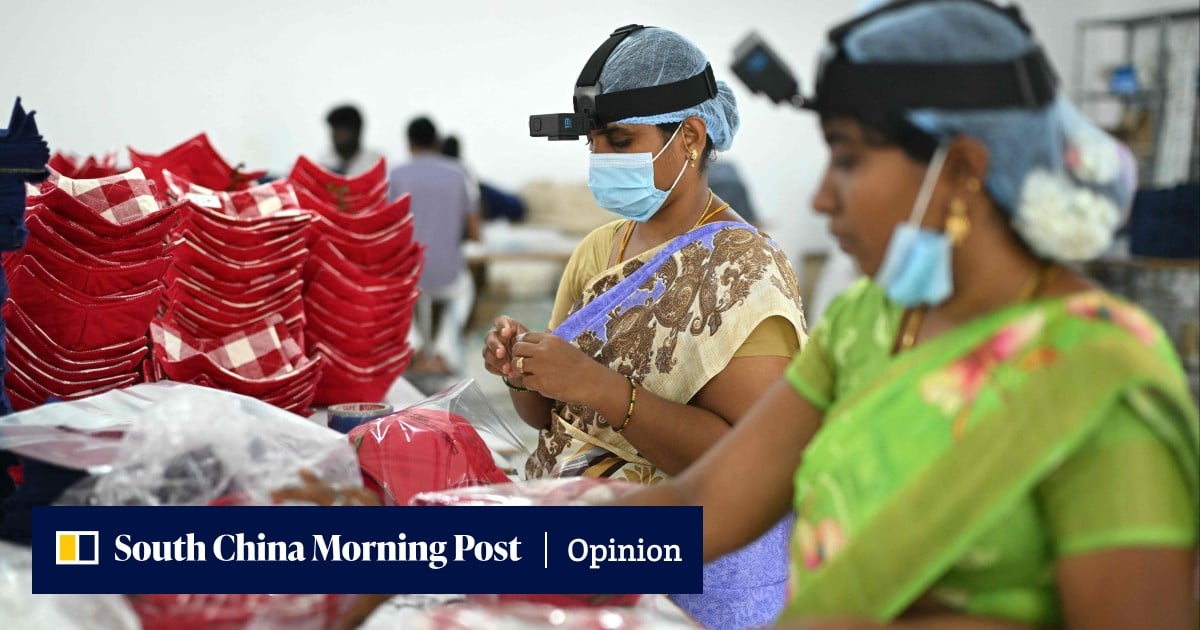
Photo via Dawn

AI 'widening economic inequality', IMF chief warns

Read the original at Dawn ↗
Cite

AFP. (2026, October 7). AI 'widening economic inequality', IMF chief warns. Dawn. https://www.dawn.com/news/2035379/ai-widening-economic-inequality-imf-chief-warns

Dated when The Aporia collected the article, usually within hours of publication. Check the original for its exact date and byline.

Dawn · collected 2026-10-07 · by AFP

Quick Summary

IMF chief Kristalina Georgieva warned on Wednesday that the rapid growth of artificial intelligence is widening global economic inequality as advanced nations like the United States, China, and India lead in AI investment while others are left behind. She emphasized the need for international cooperation to ensure widespread access to AI technology, noting that without it, the gap between developed and developing economies will continue to grow. Georgieva also called for decisive fiscal policy measures from heavily indebted nations to address rising debt levels exacerbated by high borrowing costs and large-scale corporate bond issuance for AI investments.
Written by AI on 2026-10-07, from this article's own text only (the story summary below draws on all the coverage).

AI analysis

Story summary

Kristalina Georgieva, chief of the International Monetary Fund (IMF), issued a warning on Wednesday about the potential for artificial intelligence to widen global economic inequality. She noted that AI is becoming a key driver in economies like those of the United States, China, and India, where significant investment is being made into data centers and other infrastructure. Georgieva stated during a speech ahead of the IMF’s annual meetings, scheduled for next week in Singapore, that AI investment as a percentage of GDP will soon surpass spending on major economic sectors such as railroads, electricity grids, or telecommunications networks. She emphasized that while some nations are benefiting from AI advancements and trade growth, others are being left behind, posing an increasing risk of global economic inequality.

Written for “AI and Economic Inequality” on 2026-11-21, grounded in this article and the 0 other(s) covering the same event.

Compared with similar articles

This article reads unscored and hedges 12% of its claims. Each row says how that neighbour differs.
Fox News
Leans left Hedges 1 of 46 claims Outlet record 66/100
“The articles discuss different aspects related to AI but do not describe the same specific incident or happening.”
South China Morning Post
Leans left Hedges 2 of 13 claims Outlet record 62/100
“The articles discuss different aspects of AI's impact on global economics and technology policies, not a single specific incident.”

Story

AI and Economic Inequality
Economy/Business · 1 article(s) covering the same event.
How this article was measured signals, leaning charts, publisher record, byline, topics and claims

Signals How these are calculated →

Claims extracted
24
sentences that state something as happening or true
Uncertain
12%
3 of 24 hedged ("reportedly", "may", "according to")
Leaning
withheld
no quote in the article backed the model's score
Publisher signals
66/100
Dawn's corrections and hedging, across everything collected from it. Not a measure of accuracy.
Outlets on this story
1
Economy/Business
Same framing elsewhere
1
articles that frame the event the way this one does
Analyzed 2026-10-07 · how these are computed

How this is being covered How these are calculated →

Article leaning vs. publisher reliability
Source leaning vs. consistency

Publisher

Dawn · 3515 article(s) · 6 correction(s) detected
Running correction rate · 6 correction(s)

Who wrote this

AFP
1318 article(s) here · 1 carrying a prediction
England captain Harry Brook’s quickfire 65 had guided the visitors to 187-9 – the highest T20I score at the Melbourne Cricket Ground – but Australia’s response had already begun prior to the chase when their bowlers restricted the end of the tourists’ innings that had looked set to comfortably pass 200.
Usman Khawaja and David Warner were taken off television commentary duties on Saturday until the “Sandpapergate” storm passes, with both set to miss Australia’s entire Twenty20 series against England.
It came after Josh Hazlewood earlier Saturday suggested he could quit if any action was taken against his longtime bowling partner.
Each country has one vote with 211 members, and the winner will need to secure at least 106 votes in the ballot scheduled for March 18 in Rabat.
The hackers may use the payments system as a backdoor to access more sensitive material, the former officials told NBC.
The group warned “all airlines that Saudi airspace is unsafe, as it will be the theatre of our operations in the coming hours, except for the holy airspace over Makkah and Madina”.
It came after Josh Hazlewood earlier Saturday suggested he could quit if any action was taken against his long-time bowling partner.
“If they persist, the international majority must decide how it will achieve AI weapons controls.”
2026-11-21 · assertive framing · Talks on ‘killer robots’ in race against the clock
“I would love to see him be back.
A full written argument would be extremely long, he said, adding that he had not yet mastered all of the mathematics involved and planned to write it up properly.
Wire or desk byline, not an individual reporter.
Also by AFP
Nothing else under this byline is closely related to this article, so these are simply their most recent.
All 1318 articles by AFP →

Topics

China IMF International Monetary Fund Singapore the United States

Subjects

Georgieva PERSON · 5× IMF ORG · 2× China GPE · 1× India GPE · 1× International Monetary Fund ORG · 1× Iran GPE · 1× Kristalina Georgieva PERSON · 1× Nvidia ORG · 1× Singapore GPE · 1× the United States GPE · 1×

Narrative

The spike in inflation has been largely driven by a surge in oil prices since the start of the Middle East war, but Georgieva said the shock, though large, had been contained by access to stockpiles, energy efficiency and contingency planning, among others.
framing: assertive · carried by 1 article(s) · first seen 2026-10-07
Georgieva said in a speech ahead of the IMF’s annual meetings in Singapore next week that AI investment-to-GDP will likely top the cash pumped into railroads, the electricity grid or the telecommunications network.
2026-10-07 · Dawn
AI 'widening economic inequality', IMF chief warns · assertive framing

Claims (24 extracted, 3 hedged)

The global AI boom is fast becoming the key driver of economies around the world but the boom is risking wider global inequality by leaving some nations behind, International Monetary Fund (IMF) chief Kristalina Georgieva warned on Wednesday. asserted
Georgieva → become → Wednesday
She also lamented a lack of “decisive action” in heavily indebted advanced nations and called for “very tough policy choices” to restore the health of their public finances. asserted
She → lament → finances
Georgieva said in a speech ahead of the IMF’s annual meetings in Singapore next week that AI investment-to-GDP will likely top the cash pumped into railroads, the electricity grid or the telecommunications network. asserted
investment → say → railroads
Growth in AI-related trade was being seen most in the United States, China and India, where companies splashed out on data centres and other infrastructure, while others were benefitting from the manufacture of chips and robotics. asserted
others → relate → chips
“Love it, hate it, or fear it, AI is here, rapidly becoming a key driver of countries’ relative fortunes in the world economy,” Georgieva said. asserted
Georgieva → love → economy
“Yet as this drives forward today’s AI economies, it largely bypasses most others, increasing the risk of widening economic inequality across the globe,” she warned. asserted
she → drive → globe
“Success requires everybody be taken along to harvest the transformative power of AI, which is why it will be so important to deliver AI access around the globe. asserted
it → require → globe
“And that, of course, calls for cooperation. asserted
that → call → cooperation
In our interconnected world, countries cooperate not out of charity but out of self-interest. asserted
countries → cooperate → interest
The speech comes amid growing concern about the vast sums pumped into the sector, and when investors will see returns, after the boom fuelled a market rally to record levels over the past two years. asserted
boom → come → years
Tech firms continue to rise even after a summer rout, with chipmaker Nvidia hitting a record high on Tuesday to push its market capitalisation to almost $5.7 trillion. asserted
Nvidia → continue → trillion
“Should earnings fall short, however, hyperscaler leverage and large and growing global holdings of US equities could turn a disappointment into a far-reaching shock,” Georgieva said. uncertain
Georgieva → fall → shock
Tough choices ahead She also addressed rising debt levels among governments, as borrowing costs fuelled by rising inflation and interest rates are compounded by massive bond issuance by companies to fund their AI investments. asserted
costs → address → investments
“Elevated yields are inflating the interest bill at a time of tight budget constraints and competing spending priorities, including defence,” she said. asserted
she → inflate → defence
“Higher policy rates then lift the short end, feeding directly into the cost of short-term debt. asserted
rates → lift → debt
“And yet we don’t see decisive action in high-debt advanced economies where the need of the hour is for credible medium-term fiscal consolidation plans, supported in some cases by upfront fiscal measures.” asserted
need → see → measures
The spike in inflation has been largely driven by a surge in oil prices since the start of the Middle East war, but Georgieva said the shock, though large, had been contained by access to stockpiles, energy efficiency and contingency planning, among others. asserted
shock → drive → others
However, she pointed out that oil was still above $100, with diesel at record highs and natural gas supplies from the Gulf still severely impaired, affecting Asia and Europe particularly hard. asserted
supplies → point → Asia
And she warned that, even with a swift end to the Iran war, “the problem of high energy prices will likely persist for some time”. asserted
problem → warn → time
She praised some central banks for moving to fight inflation by lifting interest rates, saying that “now may be a good time for a prudently hawkish bias in many countries’ monetary policy”. uncertain
She → praise → policy
Emerging markets, she said, faced higher borrowing rates and more volatile capital flows, while low-income countries could be forced to cut crucial development spending. “My message to the world’s economic policymakers next week will be this: we cannot keep delaying necessary policy action — you have the tools, now have the wisdom to use them,” Georgieva said. uncertain
Georgieva → say → them
“Some very tough political choices stare us in the face.” asserted
choices → stare → face
She said policymakers needed to “explain to people why consolidation is needed, why it is in their interest. asserted
it → say → interest
Secondly, they had to “make plans to limit the cost to future growth to the extent possible, and to protect the most vulnerable in society”, and also “pursue complementary structural reforms”. asserted
they → have → reforms

Give feedback · no sign-in needed

No sign-in needed for now. Your note is sent without a name, so it cannot be answered.

History Support