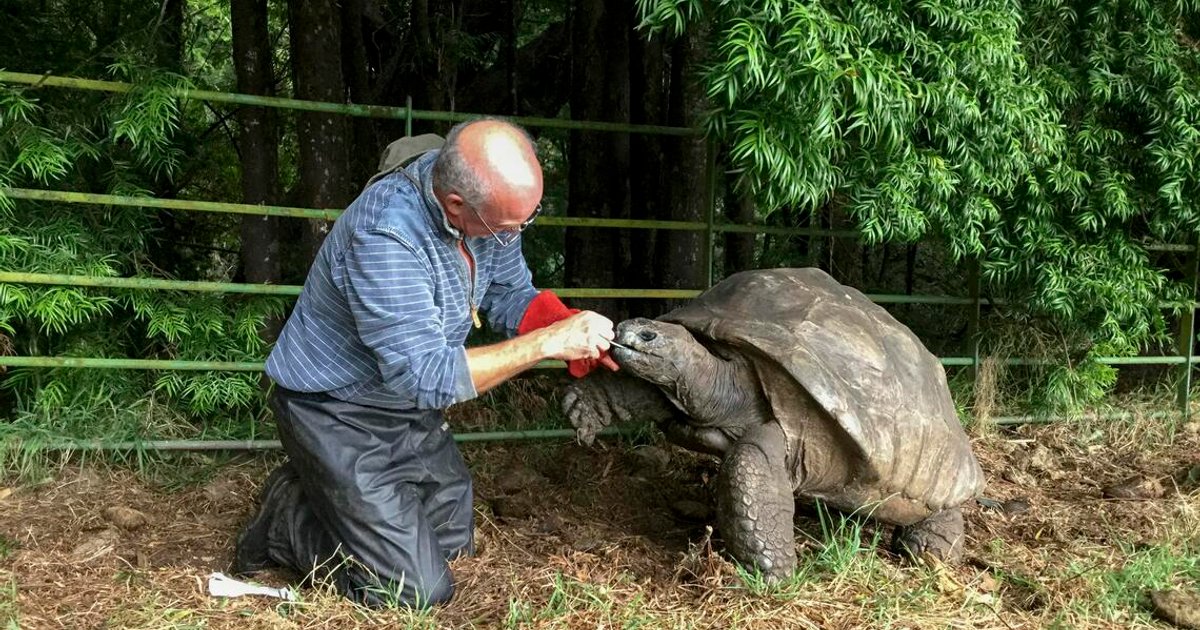
Photo via 404 Media

‘Jonathan’ Is the Oldest Land Animal on Earth. He Could Hold the Secrets to Defying Death

Read the original at 404 Media ↗
Cite

Ferreira, B. (2026, October 7). ‘Jonathan’ Is the Oldest Land Animal on Earth. He Could Hold the Secrets to Defying Death. 404 Media. https://www.404media.co/oldest-living-land-animal-jonathan-the-tortoise/

Dated when The Aporia collected the article, usually within hours of publication. Check the original for its exact date and byline.

404 Media · collected 2026-10-07 · by Becky Ferreira

Quick Summary

Researchers have sequenced the genome of Jonathan, the world’s oldest living land animal at approximately 194 years old, revealing unique gene variants linked to DNA repair and insulin regulation. The study, published in Science Advances, compared Jonathan's genetic makeup to other tortoises, identifying pristine mitochondrial processes or "low entropy" methylation that might contribute to his extraordinary longevity. Scientists obtained Jonathan’s cheek swabs rather than risking a blood draw due to the delicate nature of working with such an ancient specimen.
Written by AI on 2026-10-07, from this article's own text only (the story summary below draws on all the coverage).
See how they differ ↓

AI analysis

Story summary

Jonathan, an Aldabra giant tortoise, is recognized as the world's oldest living land animal, estimated to be around 194 years old. Born in the Seychelles archipelago around 1832, Jonathan was brought to the remote South Atlantic island of St Helena by the British colonial governor in the 1880s and has resided there ever since. Researchers have recently sequenced his genome, comparing it with other tortoises like a 36-year-old named Tank, to uncover genetic traits linked to longevity. The study, published in Science Advances, revealed unique gene variants in Jonathan related to DNA repair, insulin regulation, and mitochondrial function, which could hold clues for understanding the aging process. These findings may provide insights into how some animals resist age-related decline, potentially aiding human longevity research.

Written for “Oldest Land Animal Secrets” on 2026-11-21, grounded in this article and the 2 other(s) covering the same event.

How they differ

3 outlets covered “Oldest Land Animal Secrets”.

What each outlet says

One AI summary per outlet of its latest article on this story, written from that article alone and checked against it. Open the article for the outlet's own words.

404 MediaThis outlet7 Oct

Researchers have sequenced the genome of Jonathan, the world’s oldest living land animal at approximately 194 years old, revealing unique gene variants linked to DNA repair and insulin regulation. The study, published in Science Advances, compared Jonathan's genetic makeup to other tortoises, identifying pristine mitochondrial processes or "low entropy" methylation that might contribute to his extraordinary…

‘Jonathan’ Is the Oldest Land Animal on Earth. He Could Hold the Secrets to Defying Death (this article)
The Straits Times8 Oct

Scientists studying Jonathan, the world’s oldest known terrestrial animal at 194 years old, have found clues to his extraordinary longevity in his genome and epigenome. Researchers from Kallel and collaborators published their findings on October 7 in Science Advances, identifying genetic traits associated with DNA repair, mitochondrial function, insulin regulation, and telomere maintenance that could contribute to…

A 194-year-old tortoise, world’s oldest land animal, may hold clues to longer life →
Daily Mail8 Oct

Jonathan, the world's oldest known living land animal at 195 years old, resides on St Helena in the South Atlantic. Researchers studying Jonathan’s genome discovered that parts of his cellular machinery appear much younger than expected, particularly his mitochondria, which are crucial for cell energy and often decline with age. This finding could provide insights into longevity, as it suggests mechanisms to resist…

How Jonathan the giant tortoise can offer clues on helping humans live longer... as he's set to celebrate his 195th birthday →

Where they agree and split

Framing

How the first headlines put it

Stated as fact3
The headlines (3)

‘Jonathan’ Is the Oldest Land Animal on Earth. He Could Hold the Secrets to Defying Death 404 Media · stated as fact

A 194-year-old tortoise, world’s oldest land animal, may hold clues to longer life The Straits Times · stated as fact

How Jonathan the giant tortoise can offer clues on helping humans live longer... as he's set to celebrate his 195th birthday Daily Mail · stated as fact

The full story: what happened, how it changed, and all 3 articles →

Compared with similar articles

This article reads unscored and hedges 10% of its claims. Each row says how that neighbour differs.
The Straits Times
Hedges 5 of 37 claims Outlet record 64/100

Story

Oldest Land Animal Secrets
Science · 3 article(s) covering the same event. Compare every outlet's account →
How this article was measured signals, leaning charts, publisher record, byline, topics and claims

Signals How these are calculated →

Claims extracted
30
sentences that state something as happening or true
Uncertain
10%
3 of 30 hedged ("reportedly", "may", "according to")
Leaning
not political
takes no side on a contested political question
Publisher signals
95/100
404 Media's corrections and hedging, across everything collected from it. Not a measure of accuracy.
Outlets on this story
3
Science
Same framing elsewhere
1
articles that frame the event the way this one does
Analyzed 2026-10-07 · how these are computed

How this is being covered How these are calculated →

Article leaning vs. publisher reliability
Source leaning vs. consistency

Publisher

404 Media · 223 article(s) · 0 correction(s) detected
No corrections detected for this publisher. That may mean careful reporting, or simply that nothing has been checked.

Who wrote this

Becky Ferreira
18 article(s) here · 1 carrying a prediction
This approach will have to change as lakes approach global synchrony, rendering them more vulnerable to heatwaves, droughts, and the encroachment of urban development, all of which contribute to the phenomenon, according to the study.
“Participants were instructed to watch the movie as they would normally watch a movie,” the team said.
By running more than 100,000 advanced simulations of comet impacts, the team found that key prebiotic molecules found in comets, such as hydrogen cyanide, would be smashed to smithereens during impacts with Earth’s ancient surface in most cases.
“In general, we're really lacking any evidence and data beyond what exists in the underground world, if you will, for psychedelic therapy.”
First, an ancient viral pandemic that afflicted many of our primate relatives—but somehow missed humans—may help explain how we got so smart (relatively speaking).
First, scientists have spotted a mysterious radio signal from the primordial universe that could illuminate cosmic evolution (it’s not aliens… sorry).
The results showed that Jonathan had many gene variants the team expected to see, based on studies of other long-lived individuals and populations.
Now, scientists suggest that animals may have appeared on Earth a whopping 800 million years ago, during the ancient Tonian era, according to a new estimate of the dawn of animals.
First, scientists make the case that Saturn’s moon Enceladus could resolve one of humanity’s greatest questions—are we alone in the universe?—if only we would just send a spacecraft there already.
The removal of the magnetic field’s effect extended the lifespan of the Pink1 group by 20 percent but reduced their mobility, whereas the healthy flies experienced just the opposite—reduced lifespan, but improved mobility. “We had an idea that there would be a difference just based on the fact that we know that every organism has developed under a magnetic field,” said Jacob Reed, a PhD student in bioscience at the University of Nottingham who co-led the study, in a call with 404 Media.
Also by Becky Ferreira
Nothing else under this byline is closely related to this article, so these are simply their most recent.
All 18 articles by Becky Ferreira →

Topics

404 Media British Kallel Foundation Science Advances Tank

Subjects

Jonathan PERSON · 16× Clark PERSON · 4× 404 Media ORG · 1× British NORP · 1× Charles Darwin PERSON · 1× Florida GPE · 1× Kallel Foundation ORG · 1× Saint Helena GPE · 1× Science Advances ORG · 1× Stephen Clark PERSON · 1×

Narrative

To better understand his extreme lifespan, researchers evaluated Jonathan’s genome based on swabs of his cheeks and compared it with the genomes of several other tortoises, including a 36-year-old named Tank.
framing: assertive · carried by 1 article(s) · first seen 2026-10-07
The results showed that Jonathan had many gene variants the team expected to see, based on studies of other long-lived individuals and populations.

Claims (30 extracted, 3 hedged)

Jonathan the tortoise, the world’s oldest living land animal, is still chugging along at the ripe age of roughly 194. asserted
Jonathan → live → 194
Now, scientists have discovered some of the secrets to Jonathan’s longevity by sequencing his genome for the first time, according to a study published Wednesday in Science Advances. uncertain
scientists → discover → Advances
Jonathan, a Aldabra giant tortoise (Aldabrachelys gigantea), hatched around 1832 in the Seychelles archipelago, and he was already in his twenties when Charles Darwin published On the Origin of Species. asserted
Darwin → hatch → Species
In his fifties, Jonathan was brought to the remote island of Saint Helena, along with three other tortoises, as a gift to the British colonial governor in the 1880s. asserted
Jonathan → bring → 1880s
He has lived there ever since. asserted
He → live → ?
Aldabra giant tortoises often become centenarians, but Jonathan is a major outlier even for his species as he approaches nearly 200 years on this planet. asserted
he → become → planet
To better understand his extreme lifespan, researchers evaluated Jonathan’s genome based on swabs of his cheeks and compared it with the genomes of several other tortoises, including a 36-year-old named Tank. asserted
researchers → understand → old
The results revealed that Jonathan has “unique gene variants in most aging pathways” including DNA repair, insulin regulation, mitochondrial function, and “low entropy” methylation, reports the study. asserted
study → reveal → repair
“Aging is very complicated, and there's all these different hallmarks,” said Stephen Clark, an aging researcher at the non-profit Kallel Foundation and an author of the study, in a call with 404 Media. asserted
Clark → complicate → Media
We're still just at the very beginning of trying to understand aging.” asserted
We → try → aging
Clark first reached out to Jonathan’s caretakers in 2017, but it took some negotiating to figure out the best way to obtain the tortoise’s genetic information. asserted
it → reach → information
A blood draw was deemed too risky, so Jonathan was coaxed into opening his mouth for a swab. asserted
Jonathan → deem → swab
The results were delayed by incomplete early samples, the Covid pandemic, and new regulations governing access to Jonathan. asserted
results → delay → Jonathan
After years of back and forth, the samples were delivered from Saint Helena to Florida by the U.S. Space Force. asserted
samples → deliver → Force
The results showed that Jonathan had many gene variants the team expected to see, based on studies of other long-lived individuals and populations. asserted
team → show → individuals
These included variants associated with DNA repair, maintenance of aging-related sequences called telomeres, and the process of cellular recycling known as autophagy. asserted
These → include → autophagy
But the researchers found a surprise in Jonathan’s “methylome,” which is a set of methyl-based modifications involved in gene expression. asserted
which → find → expression
The subset of Jonathan’s methylome related to mitochondrial processes was unusually pristine, or “low entropy.” asserted
subset → relate → processes
“Jonathan's really the first of his kind to have this analysis, and we were also able to do the methylome for the younger tortoises,” Clark said. asserted
Clark → have → tortoises
“We actually compared him to a five-year-old tortoise, so we had 189 years of difference between the methylomes. asserted
we → compare → methylomes
No one's ever done that, even in humans, because no humans live that long. asserted
humans → do → humans
That was one of the main things we were excited about: how does this methylome change with age?” asserted
methylome → change → age
Whereas most of Jonathan’s genome showed signs of entropy commensurate with his age, his mitochondrial methylome seemed on par with that of the five-year-old tortoise, signaling that these pathways may play a special role in his advanced age. uncertain
pathways → show → age
However, Clark said it would take more research to follow up on that lead, and to untangle the complicated web of genetic components that influence aging and lifespan. asserted
that → say → aging
“We're interested in long-lived species like Jonathan because we can hopefully find other targets,” Clark said of his team’s work at Kallel Labs. asserted
Clark → live → Labs
“The ultimate goal of the company is to affect human healthspan and lifespan.” asserted
goal → affect → healthspan
As for Jonathan, he continues to live out his voluminous days at the governor’s residence, Plantation House, where he and his fellow tortoises have become one of the island’s tourist attractions. asserted
he → continue → attractions
Saint Helena is also known for the exile of Napoleon Bonaparte, who died there a mere decade before Jonathan is thought to have been hatched. asserted
Jonathan → know → Bonaparte
It’s amazing to think about just how much the world has changed in Jonathan’s lifetime. asserted
world → ’ → lifetime
Long may he graze. uncertain
he → graze → ?
Give feedback · no sign-in needed

No sign-in needed for now. Your note is sent without a name, so it cannot be answered.

History Support