Photo via The Sydney Morning Herald

Emergency doctors warn of ‘terrifying’ crisis Australia is not prepared for

Read the original at The Sydney Morning Herald ↗
Cite

Rasker, R., & Aubusson, K. (2026, October 12). Emergency doctors warn of ‘terrifying’ crisis Australia is not prepared for. The Sydney Morning Herald. https://www.smh.com.au/healthcare/emergency-doctors-warn-of-terrifying-crisis-australia-is-not-prepared-for-20261013-p613ts.html?ref=rss&utm_medium=rss&utm_source=rss_feed

Dated when The Aporia collected the article, usually within hours of publication. Check the original for its exact date and byline.

The Sydney Morning Herald · collected 2026-10-12 · by Rachel Rasker, Kate Aubusson

Quick Summary

Australia’s health system is facing a crisis due to an increasing number of elderly patients in emergency departments, according to a report by the Australasian College of Emergency Medicine. The report reveals that there will be a 411% increase in patients aged 85 and over by 2050, with older people currently accounting for one quarter of emergency department attendances. Emergency physicians warn that hospitals are ill-prepared to handle this surge, leading to issues like bed shortages and delayed care, which put elderly patients at risk. The report calls for increased funding for hospital beds and improved patient flow into wards.
Written by AI on 2026-10-12, from this article's own text only (the story summary below draws on all the coverage).

AI analysis

Story summary

Emergency doctors in Australia are warning of a "terrifying" crisis due to an expected 411 percent increase in elderly patients aged 85 and over by 2050, according to the Australasian College of Emergency Medicine’s State of Emergency 2026 report. Released on Tuesday at Parliament House in Canberra, the report highlights that older patients are frequently left waiting in hospital corridors without proper care, increasing their risk of death within seven days of presentation. Dr. Peter Allely, president of the college, emphasized the unpreparedness of the healthcare system for this surge, stating it was "downright embarrassing" when elderly patients wait overnight in plastic chairs for treatment. Despite these concerns, Victorian Health Minister Ingrid Stitt defended current measures, mentioning investments in services like hospital at home and virtual EDs to prevent unnecessary hospital stays.

Written for “Health Crisis Warning Australia” on 2026-11-21, grounded in this article and the 0 other(s) covering the same event.

Compared with similar articles

This article reads leans strongly left and hedges 3% of its claims. Each row says how that neighbour differs.
The Sydney Morning Herald
Leans left further right than this Hedges 0 of 32 claims Outlet record 61/100
“The articles discuss different aspects of healthcare and aged care in Australia but do not describe the same specific incident or event.”
ABC News (AU)
Hedges 6 of 25 claims Outlet record 67/100
“The articles discuss related issues but different specific reports and findings.”

Story

Health Crisis Warning Australia
Health · 1 article(s) covering the same event.
How this article was measured signals, leaning charts, publisher record, byline, topics and claims

Signals How these are calculated →

Claims extracted
34
sentences that state something as happening or true
Uncertain
3%
1 of 34 hedged ("reportedly", "may", "according to")
Leaning
Leans strongly left
of the writing, not the subject · beta estimate
Publisher signals
61/100
The Sydney Morning Herald's corrections and hedging, across everything collected from it. Not a measure of accuracy.
Outlets on this story
1
Health
Same framing elsewhere
1
articles that frame the event the way this one does
Analyzed 2026-10-12 · how these are computed

How this is being covered How these are calculated →

Article leaning vs. publisher reliability
Source leaning vs. consistency

Publisher

The Sydney Morning Herald · 7770 article(s) · 16 correction(s) detected
Running correction rate · 16 correction(s)

Who wrote this

Rachel Rasker
19 article(s) here · 1 carrying a prediction
The NSW Coroner’s Court on Wednesday was told the parents of the newborn, known as Baby DH, saw signs that “something was seriously wrong” from the first minutes of his life and would have called Triple Zero “almost straight away” if their doula Amy Lou Smith had not been with them.
A Byron doula did not know a woman was carrying twins and could only sense or feel that she was pregnant with one child after “constant mapping” of the mother, a coronial inquest has heard.
As opposed to a planned midwife-led homebirth, a free birth mother may be alone, with a partner or unaccredited support person such as a doula or birth keeper.
This will implement around-the-clock security at 27 hospitals.
A GLP-1 weight-loss tablet has been approved in Australia for the first time, expected to lead to a surge in demand for the sought-after peptide that could hit the market by the end of this year.
Senior doctors at a NSW hospital have demanded the government intervene before an imminent takeover by a Catholic provider they fear will lead to widespread service cuts for expectant mothers and cancer patients.
“Gradually [the writing] will come off, symbolising letting go of your worries.”
About $600 million a year would be needed to fix the state’s shortfall of frontline public mental health staff, a confidential ministerial briefing note says, a figure NSW Health warned could cause reputational damage to the Minns government if revealed.
Emergency departments will brace for a 411 per cent increase in patients aged 85 and over by 2050, the latest Australasian College of Emergency Medicine’s State of Emergency 2026 report revealed.
Most of the studies included in the review were US-based because of the availability of vast amounts of detailed data, with pharmaceutical companies publicly reporting all payments to prescribers that could be compared with individual doctors’ prescribing data.
Also by Rachel Rasker
Nothing else under this byline is closely related to this article, so these are simply their most recent.
All 19 articles by Rachel Rasker →
Kate Aubusson
5 article(s) here · 1 carrying a prediction
The first analysis of the trial suggests thousands more men with prostate cancer could benefit from the medication.
Emergency departments will brace for a 411 per cent increase in patients aged 85 and over by 2050, the latest Australasian College of Emergency Medicine’s State of Emergency 2026 report revealed.
Under Section 19b of the Mental Health and Cognitive Impairment Forensic Provisions Act, magistrates can send people who may be mentally ill or impaired to public hospitals where they are detained and undergo psychiatric assessment.
She could not record Joe’s heart rate, but recorded an abnormally fast respiratory rate of 57.
Also by Kate Aubusson
Nothing else under this byline is closely related to this article, so these are simply their most recent.

Topics

Australasian College of Emergency Medicine Australia Australians College State of Emergency 2026

Subjects

Australia GPE · 3× Allely PERSON · 2× Australians NORP · 2× NSW GPE · 2× ACEM Victoria ORG · 1× Australasian College of Emergency Medicine ORG · 1× Canberra GPE · 1× College ORG · 1× Mark Putland PERSON · 1× Peter Allely PERSON · 1×

Narrative

Victorian Health Minister Ingrid Stitt said the government was investing in hospitals and services that helped people receive care at home and avoid unnecessary hospital stays, and were already delivering many of the approaches identified in the report, including hospital in the home, the Victorian virtual ED, urgent care clinics, residential in-reach and specialist frailty programs.
framing: assertive · carried by 1 article(s) · first seen 2026-10-12
Emergency departments will brace for a 411 per cent increase in patients aged 85 and over by 2050, the latest Australasian College of Emergency Medicine’s State of Emergency 2026 report revealed.
2026-10-12 · The Sydney Morning Herald
Emergency doctors warn of ‘terrifying’ crisis Australia is not prepared for · assertive framing

Claims (34 extracted, 1 hedged)

Australia’s health system is unprepared for the growing number of older patients arriving in emergency departments as elderly and frail patients are left in hospital corridors to deteriorate as they wait for a bed, emergency physicians warn. asserted
physicians → grow → bed
Emergency departments will brace for a 411 per cent increase in patients aged 85 and over by 2050, the latest Australasian College of Emergency Medicine’s State of Emergency 2026 report revealed. asserted
report → brace → Emergency
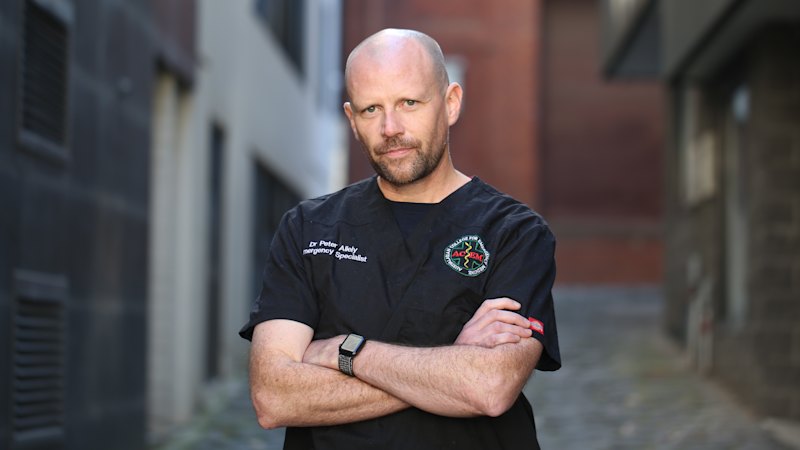
College president Dr Peter Allely said it was terrifying: “We’re only at the beginning of the exponential curve. asserted
We → say → curve
We are not prepared for this.” asserted
We → prepare → this
As EDs contend with rapidly rising numbers of older patients with complex conditions, bed block is delaying too many from being admitted to full hospital wards. asserted
block → contend → wards
The result is older patients being put at greater risk of death within seven days of presentation, and adding flow-on pressure throughout hospitals, according to the report released at Parliament House in Canberra on Tuesday. uncertain
patients → put → Tuesday
“When you’ve got a 97-year-old sitting in a plastic chair overnight waiting for care, we’re failing, and it’s downright embarrassing that this is happening every day,” Allely said. asserted
Allely → get → care
The latest intergenerational report projected that by 2030 one in five Australians will be aged 65 and older. asserted
Australians → project → 2030
Older people aged 65 and over accounted for one quarter of the 9 million people who presented to EDs in 2023-24. asserted
who → age → 2023
This marked a 16 per cent jump in attendances compared to 2018-19, compared with a 4 per cent increase among younger people. ACEM Victoria branch chair Associate Professor Mark Putland said: “Our health system is at a tipping point. asserted
system → mark → point
We can expect things to get much worse in the coming years unless we act.” asserted
we → expect → years
The NSW spokesperson, Dr Clare Skinner, said the fact people were living longer showed the success of the healthcare system in Australia. asserted
people → say → Australia
“But the problem we’ve got now, as the first of the Baby Boomers hit 80 this year, is our health system hasn’t kept up,” she said. asserted
she → get → 80
“Our entire healthcare system is geared towards acute care of younger patients, and we need to collectively shift that to being able to provide safe, effective and compassionate care to older Australians,” Skinner said. asserted
Skinner → gear → Australians
More than 53,500 older people spent longer than 24 hours in an ED waiting for an inpatient bed on a ward in 2023-24, an approximately 250 per cent rise from the 15,084 in 2018-19. asserted
people → spend → 2018
Allely said it was a myth that emergency departments were busy because they were full of people who did not genuinely need to be there. asserted
who → say → people
The report found more than half of older patients in 2023-24 arrived by ambulance, and nearly seven in 10 were triaged as needing more urgent care. asserted
10 → find → care
One in two were admitted to hospital, and were more than twice as likely to be admitted as younger patients. asserted
two → admit → patients
The report recommended increased funding for inpatient bed capacity to match population demographics, and to improve patient flow from emergency departments into wards. asserted
report → recommend → wards
Victoria had the lowest number of public hospital beds per person nationally, with 2.33 beds per 1000 people, compared to 2.52 nationally. asserted
Victoria → have → 2.52
In NSW, just 14 public inpatient beds were added between 2018-19 and 2023-24. asserted
beds → add → 2018
The report also recommended strengthening alternative pathways to acute medical care for older patients, such as hospital-in-the-home programs, and expanding prevention mechanisms to reduce ED attendance, such as investment in aged and primary care. asserted
report → recommend → care
By the government’s projections, Australia needs about 10,600 new aged care beds a year to keep up with current demand, while just 802 new places were added in 2024-25. asserted
places → need → 2024
Last month, state and territory health leaders met with Health Minister Mark Butler to demand urgent investment in aged care to ease pressure on hospitals, including a short-term stopgap funding increase to home care packages. asserted
leaders → meet → packages
Butler said it was difficult to increase the number of packages further without running into labour supply constraints. asserted
it → say → constraints
“We don’t have enough workers in this country,” he said in September. asserted
he → have → September
When asked if migration would help with labour shortages, Butler said it was “ultimately a question of balance”. asserted
it → ask → balance
“It’s [about] the ability of our country to absorb greater numbers of people in terms of housing and transport and other infrastructure, but also recognising that significant parts of our economy are substantially staffed by migrants, and aged care is right up there.” asserted
care → ’ → migrants
Butler said the federal government had made historic investments to ease pressure on hospitals, including increased funding, more aged care beds, more bulk-billing, and 137 Medicare urgent care clinics. asserted
government → say → funding
“There are real pressures facing the aged care system right now and we continue to work with states and territories in good faith,” he said in a statement. asserted
he → be → statement
NSW Health Minister Ryan Park said the state government had invested $35.7 million into an aged care response package, which included early intervention pilots, and this year announced the largest increase to the health budget in the state’s history, totalling $10.3 billion over four years. asserted
which → say → years
A spokesperson for NSW Health also highlighted a $500 million expansion in the availability of non-hospital alternatives and care models, including virtual and urgent care. asserted
spokesperson → highlight → care
Victorian Health Minister Ingrid Stitt said the government was investing in hospitals and services that helped people receive care at home and avoid unnecessary hospital stays, and were already delivering many of the approaches identified in the report, including hospital in the home, the Victorian virtual ED, urgent care clinics, residential in-reach and specialist frailty programs. asserted
people → say → home
“We’ll consider the report’s recommendations and keep working with the Commonwealth, clinicians and health services to improve access to timely care,” she said in a statement. asserted
she → consider → statement

Give feedback · no sign-in needed

No sign-in needed for now. Your note is sent without a name, so it cannot be answered.

History Support