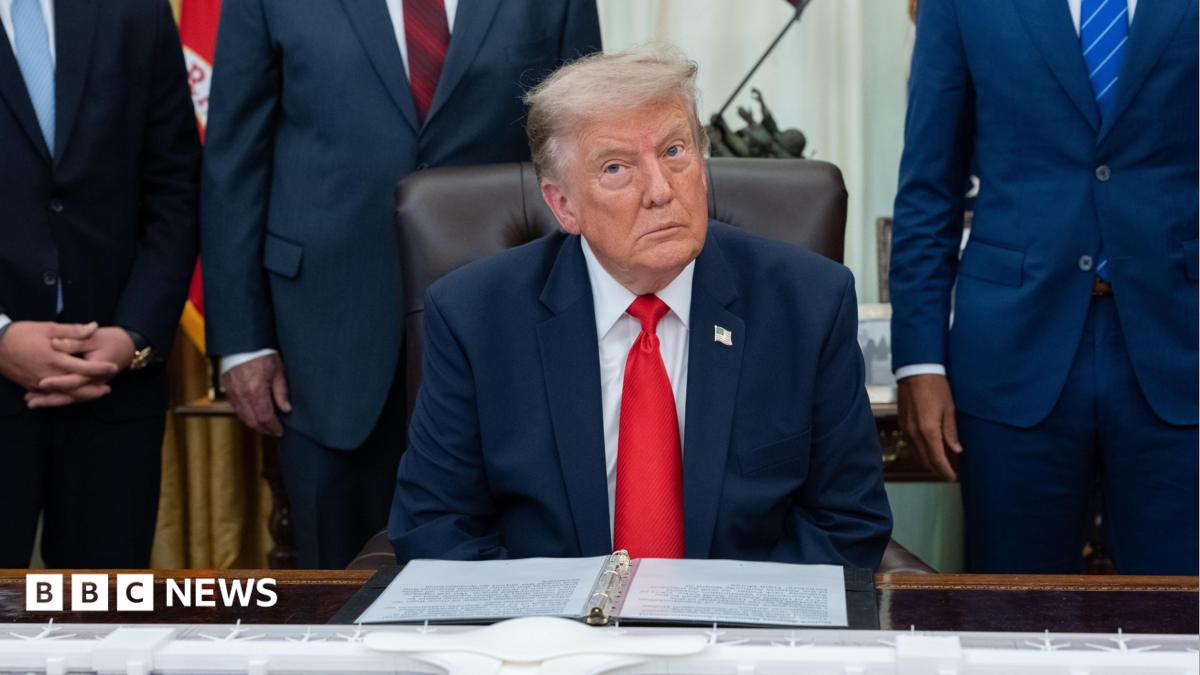
Photo via BBC News

Trump administration bans new Chinese humanoid robots

Read the original at BBC News ↗
Cite

Chia, O. (2026, July 30). Trump administration bans new Chinese humanoid robots. BBC News. https://www.bbc.co.uk/news/articles/cp9e2ex3ekyo?at_medium=RSS&at_campaign=rss

Dated when The Aporia collected the article, usually within hours of publication. Check the original for its exact date and byline.

BBC News · collected 2026-07-30 · by Osmond Chia

Quick Summary

The Trump administration announced a ban on new foreign-made humanoid robots, including those from China, citing concerns over national security. The Federal Communications Commission added advanced robotic devices and power inverters to its Covered List, which poses risks to US national security. According to the FCC, the use of foreign-made inverters could allow for data theft and cyberattacks, while foreign-made robots could enable surveillance and remote control by "foreign government actors". China's embassy in Washington has responded with criticism, calling on the US to abandon its "hegemonic mindset" and accusing it of politicizing trade issues.
Written by AI on 2026-08-21, from this article's own text only (the story summary below draws on all the coverage).
See how they differ ↓

AI analysis

Story summary

The U.S. Federal Communications Commission (FCC) has banned imports of new foreign-made humanoid robots, quadruped robots, and power inverters, citing national security risks, in a move targeting China. The ban aims to protect the country's supply chains from potential disruptions and cybersecurity threats. China, which dominates the global market for humanoid robots with an estimated 85% market share, quickly accused the U.S. of protectionism. The ban is likely to test relations between the two countries ahead of a planned visit by Chinese leader Xi Jinping to meet with U.S. President Donald Trump in September. The FCC also banned imports of power inverters, which are used in renewable energy systems and household appliances, due to concerns over potential risks to the U.S. economy.

Written for “U.S. Ban on Humanoid Robots” on 2026-11-20, grounded in this article and the 1 other(s) covering the same event.

How they differ

2 outlets covered “U.S. Ban on Humanoid Robots”.

What each outlet says

One AI summary per outlet of its latest article on this story, written from that article alone and checked against it. Open the article for the outlet's own words.

BBCThis outlet30 Jul

The Trump administration announced a ban on new foreign-made humanoid robots, including those from China, citing concerns over national security. The Federal Communications Commission added advanced robotic devices and power inverters to its Covered List, which poses risks to US national security. According to the FCC, the use of foreign-made inverters could allow for data theft and cyberattacks, while foreign-made…

Trump administration bans new Chinese humanoid robots (this article)
CBC30 Jul

The US Federal Communications Commission has banned imports of new foreign-made humanoid robots and power inverters from countries including China, citing national security risks. The ban targets China's dominance in the global market for humanoid robots, which holds an estimated 85% market share. According to FCC chair Brendan Carr, the bans are intended to "secure America's critical supply chains" by preventing…

U.S. ban on foreign-made humanoid robots targets China over security risks →

Compared with similar articles

This article reads unscored and hedges 20% of its claims. Each row says how that neighbour differs.
CBC News
Leans right Hedges 5 of 29 claims Outlet record 60/100
BBC News
Leans right Hedges 2 of 21 claims Outlet record 65/100
“The articles describe different actions taken by the Trump administration on the same day, with one related to AI controls and the other a ban on foreign-made humanoid robot imports”

Story

U.S. Ban on Humanoid Robots
Politics · 2 article(s) covering the same event. See how they differ ↑
How this article was measured signals, leaning charts, publisher record, byline, topics and claims

Signals How these are calculated →

Claims extracted
20
sentences that state something as happening or true
Uncertain
20%
4 of 20 hedged ("reportedly", "may", "according to")
Leaning
withheld
no quote in the article backed the model's score
Publisher signals
65/100
BBC News's corrections and hedging, across everything collected from it. Not a measure of accuracy.
Outlets on this story
2
Politics
Same framing elsewhere
1
articles that frame the event the way this one does
Analyzed 2026-07-30 · how these are computed

How this is being covered How these are calculated →

Article leaning vs. publisher reliability
Source leaning vs. consistency

Publisher

BBC News · 6289 article(s) · 9 correction(s) detected
Running correction rate · 9 correction(s)

Who wrote this

Osmond Chia
46 article(s) here · 1 carrying a prediction
Sensor Tower said GTA 6 will be so popular that it will reduce the time gamers spend on other single-player titles by 10%.
- Published Anthropic, the company behind AI chatbot Claude, has raised a record $81bn (£62bn) in a stock market debut that will make it one of the most valuable companies in the world.
On Monday, Washington announced new interim rules that will increase scrutiny of data centre operators in Singapore, Malaysia, Thailand, Indonesia and Brazil.
A proposed class action lawsuit in San Jose, California said Intel was too late to alert shareholders about how slowing sales could impact its earnings, allegedly artificially inflating its stock price.
2026-11-16 · assertive framing · Investors sue chip giant Intel after 29% stock plunge
Since 2022, when the US restricted advanced American semiconductors from being exported to China or acquired by Chinese companies, US officials have been concerned that other countries such as Singapore could be used by Chinese companies to gain access to the chips.
- Published Nvidia is facing a scenario few would have considered until very recently - a future without Jensen Huang.
Fears this will lead to more regulation of AI appear to have sparked fear among investors.
2026-11-06 · assertive framing · Could the US midterms put a pin in the AI bubble?
The new recipes mean cereal packaging will now include a "contains wheat gluten" warning.
The company said it has covered around 95% of the assets stolen in the breach, but that the remaining amount may take longer to source.
The company said as part of a series of alerts online that all deposits and withdrawals are temporarily suspended while its teams conduct security checks and that the firm will "cover all losses".
Also by Osmond Chia
Nothing else under this byline is closely related to this article, so these are simply their most recent.
All 46 articles by Osmond Chia →

Topics

America China Chinese FCC Washington

Subjects

Chinese NORP · 7× China GPE · 5× FCC ORG · 5× America GPE · 3× Beijing GPE · 3× Washington GPE · 3× American NORP · 2× Americans NORP · 1× Brendan Carr PERSON · 1× The Federal Communications Commission ORG · 1×

Narrative

Despite being the world's biggest exporter of electric vehicles, China has been effectively shut out of the American market by a steep tariff. Washington has also blocked the sale of cutting-edge US semiconductors to China in a bid to protect national security, slow Beijing's military modernisation and maintain America's lead in AI.
framing: assertive · carried by 1 article(s) · first seen 2026-07-30
The Federal Communications Commission (FCC) also banned imports of power inverters - devices used in data centres and solar panels - which it said could also pose a risk to the US economy.
2026-07-30 · BBC News
Trump administration bans new Chinese humanoid robots · assertive framing

Claims (20 extracted, 4 hedged)

- Published The Trump administration on Tuesday announced a ban on new foreign-made humanoid robot imports to the US over "unacceptable risks" to America's national security. asserted
administration → publish → security
The move applies to advanced robots - including humanoid and four-legged machines. asserted
move → apply → machines
Many of them are made in China, which is competing with the US to develop robotics and artificial intelligence (AI). asserted
which → make → robotics
The Federal Communications Commission (FCC) also banned imports of power inverters - devices used in data centres and solar panels - which it said could also pose a risk to the US economy. uncertain
it → ban → economy
The Chinese embassy in Washington said Beijing has long opposed the US' "politicising" of trade issues and sanctions based on "groundless pretexts". asserted
Beijing → say → pretexts
FCC chairman Brendan Carr said the agency was doing its part "to secure America's critical supply chains". asserted
agency → say → chains
The FCC has added the items to its Covered List - a register of goods and services that are deemed a risk to US national security. asserted
that → add → security
The ban applies to new foreign-produced advanced robotic devices and power inverters and does not prevent the sale or import of any existing models that had been previously authorised by the FCC. asserted
that → apply → FCC
The FCC cited concerns that the use of foreign-made inverters could allow overseas firms to turn them off, steal data, facilitate remote access and surveillance by "foreign government actors, or be otherwise exploited through a cyberattack". uncertain
firms → cite → cyberattack
It added that the use of robots made outside the US could allow "malign actors to surveil Americans, enhance the capabilities of foreign intelligence services, or to remotely commandeer the robots". uncertain
actors → add → robots
The Chinese embassy in Washington also said Beijing will "take all necessary measures" in response to any moves that harm its interests, urging all countries to work together to develop AI "for the positive and for good". asserted
that → say → good
It called on the US to "abandon its hegemonic mindset, and stop smearing Chinese companies and threatening them with sanctions". asserted
It → call → sanctions
The BBC has contacted major Chinese robot manufacturers Unitree, UBTech and AgiBot for comment. asserted
BBC → contact → comment
China's exports have come under intense scrutiny by the US as the Trump administration attempts to address trade imbalances with the world's second largest economy. asserted
administration → come → economy
Despite being the world's biggest exporter of electric vehicles, China has been effectively shut out of the American market by a steep tariff. Washington has also blocked the sale of cutting-edge US semiconductors to China in a bid to protect national security, slow Beijing's military modernisation and maintain America's lead in AI. asserted
Washington → shut → AI
US Treasury Secretary Scott Bessent has also warned that Chinese AI firms could face sanctions over allegations that they have stolen American intellectual property. uncertain
they → warn → property
In response the Chinese government has said its country's development of AI was "the result of its own dedication and effort as well as international cooperation". asserted
development → say → dedication
The US will be keen to avoid a repeat of the squeeze on supply chains that was triggered last year when China tightened export controls on rare earths - critical for electronics. asserted
China → avoid → electronics
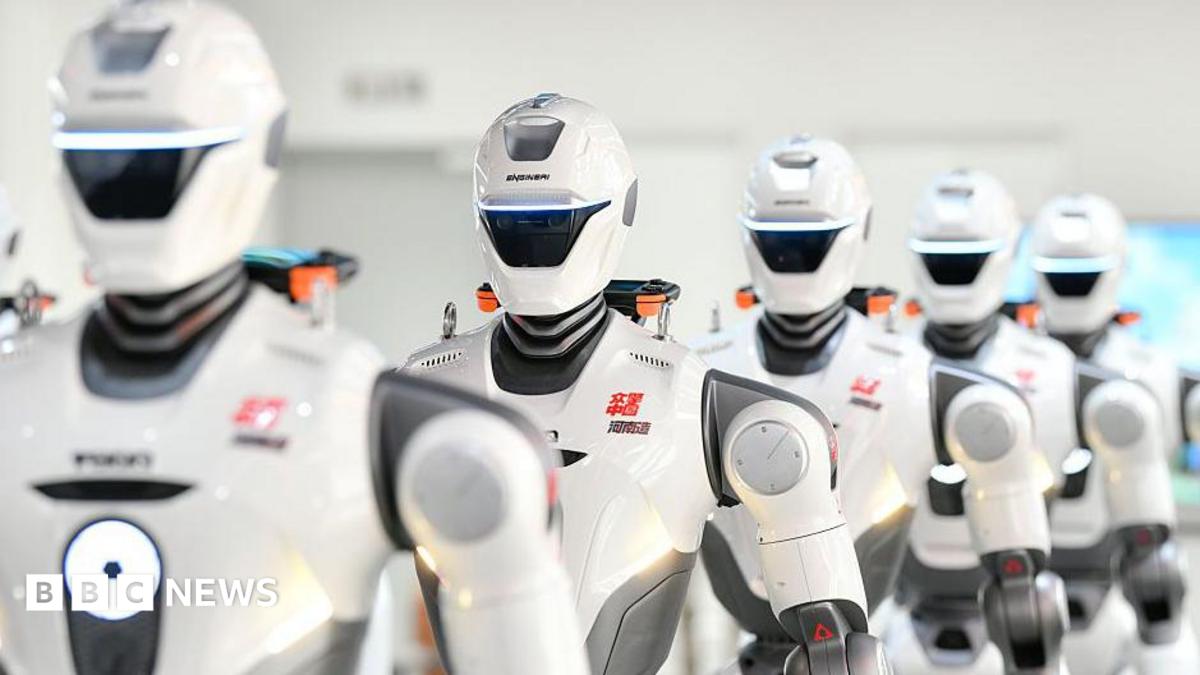
Chinese technology firms have rapidly developed humanoid robots to be used in settings including factories and homes. asserted
firms → develop → factories
Companies have also been quick to market their machines to businesses and the public ahead of US humanoid robot rivals like Elon Musk's Tesla and Boston Dynamics. asserted
Companies → market → Tesla
Give feedback · no sign-in needed

No sign-in needed for now. Your note is sent without a name, so it cannot be answered.

History Support