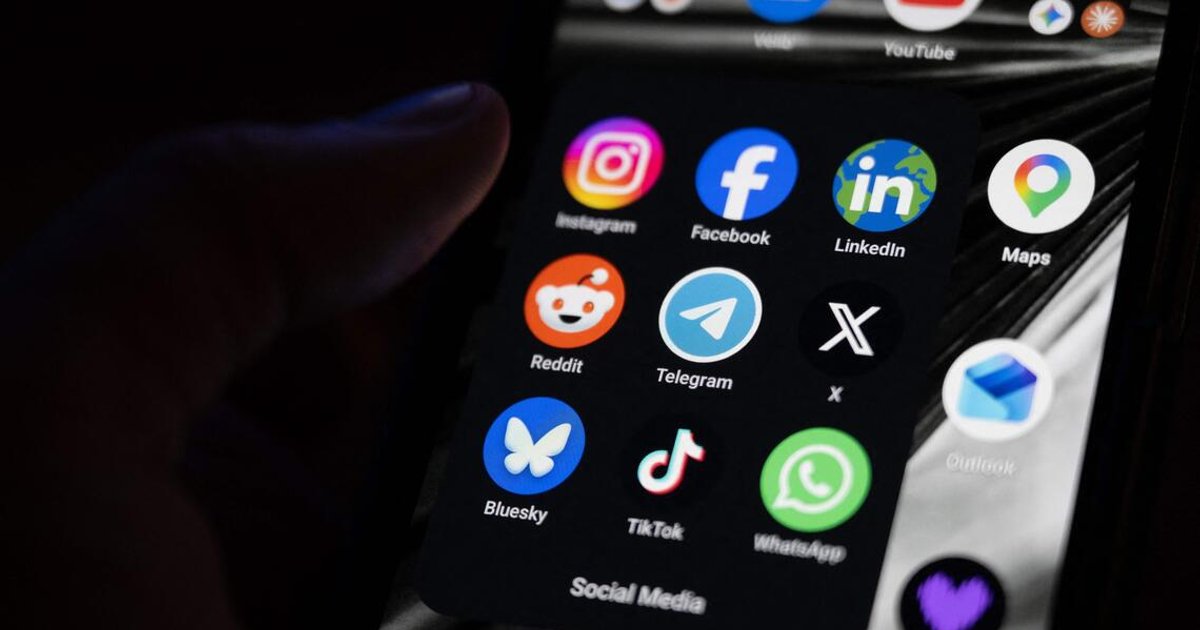
Florida "Addictive Features" Social Media Restrictions on Minors Likely Constitutional, Eleventh Circuit Holds

Read the original at Reason ↗
Cite

Volokh, E. (2026, October 14). Florida "Addictive Features" Social Media Restrictions on Minors Likely Constitutional, Eleventh Circuit Holds. Reason. https://reason.com/volokh/2026/10/14/florida-addictive-features-social-media-restrictions-on-minors-likely-constitutional-eleventh-circuit-holds/

Dated from the outlet's own feed. Check the original for its byline.

Reason · collected 2026-10-14 · by Eugene Volokh

Quick Summary

The Eleventh Circuit Court ruled that Florida's social media restrictions on minors are likely constitutional under the First Amendment. The court upheld Florida’s argument that social-media companies use "addictive features" like push notifications and auto-play to overstimulate users' reward centers, making these platforms particularly harmful for developing brains. HB3 requires social-media platforms to prohibit anyone under 14 from creating an account and mandates parental consent for those aged 14 to 16 to create or maintain accounts. The court determined that while the law regulates commercial transactions, it also burdens protected First Amendment activities by restricting how platforms communicate with minors.
Written by AI on 2026-10-14, from this article's own text only (the story summary below draws on all the coverage).
See how they differ ↓

AI analysis

Story summary

On October 14, 2026, a three-judge panel from the Eleventh Circuit Court of Appeals in Atlanta ruled unanimously to allow Florida to enforce its state law (H.B. 3) barring children under 14 from accessing social media platforms such as Instagram and TikTok. The appeals court rejected arguments by tech industry groups that the law violates the First Amendment, stating that it is a content-neutral regulation designed to protect minors from potential harmful effects of social media addiction. According to Florida's argument, social media companies use "addictive features" like push notifications and auto-play that can overstimulate the reward center in children’s developing brains, leading to compulsive overuse and mental health issues such as depression and anxiety. The court held that H.B. 3 advances important governmental interests unrelated to suppressing free speech and does not burden substantially more speech than necessary. Industry groups like NetChoice have expressed intent to continue legal challenges, aiming to protect Floridians' rights to free expression online.

Written for “Florida Social Media Law Ruling” on 2026-11-22, grounded in this article and the 2 other(s) covering the same event.

How they differ

3 outlets covered “Florida Social Media Law Ruling”.

What each outlet says

One AI summary per outlet of its latest article on this story, written from that article alone and checked against it. Open the article for the outlet's own words.

ReasonThis outlet14 Oct

The Eleventh Circuit Court ruled that Florida's social media restrictions on minors are likely constitutional under the First Amendment. The court upheld Florida’s argument that social-media companies use "addictive features" like push notifications and auto-play to overstimulate users' reward centers, making these platforms particularly harmful for developing brains. HB3 requires social-media platforms to prohibit…

Florida "Addictive Features" Social Media Restrictions on Minors Likely Constitutional, Eleventh Circuit Holds (this article)
The Straits Times15 Oct

On October 14, a federal appeals court in Atlanta allowed Florida to enforce a state law prohibiting children under 14 from accessing social media platforms like Instagram and TikTok. The ruling overturned a lower court’s preliminary injunction that had blocked the law, which targets social media features deemed addictive. Tech industry groups opposing the law argue it violates free speech protections but lost their…

Florida can enforce state law barring young kids from social media, appeals court rules →
New York Post15 Oct

A Florida court has ruled that the state can enforce its social media law which restricts children under 14 from using social media platforms and requires parental consent for those aged 14 or 15. The 11th U.S. Circuit Court of Appeals upheld this ruling, stating that while the First Amendment is implicated, the law does so in a content-neutral manner aimed at protecting minors from excessive social media use. This…

Florida wins key ruling allowing it to enforce social media law targeting young teens →

Where they agree and split

Framing

How the first headlines put it

Stated as fact3
The headlines (3)

Florida "Addictive Features" Social Media Restrictions on Minors Likely Constitutional, Eleventh Circuit Holds Reason · stated as fact

Florida can enforce state law barring young kids from social media, appeals court rules The Straits Times · stated as fact

Florida wins key ruling allowing it to enforce social media law targeting young teens New York Post · stated as fact

The full story: what happened, how it changed, and all 3 articles →

Compared with similar articles

This article reads unscored and hedges 9% of its claims. Each row says how that neighbour differs.
The Straits Times
Leans right Hedges 1 of 18 claims Outlet record 64/100
New York Post
Leans right Hedges 0 of 14 claims Outlet record 66/100
Reason
Hedges 2 of 27 claims Outlet record 67/100
“The articles discuss different laws in Florida and Georgia, rather than a single specific event.”

Story

Florida Social Media Law Ruling
Politics · 3 article(s) covering the same event. Compare every outlet's account →
How this article was measured signals, leaning charts, publisher record, byline, topics and claims

Signals How these are calculated →

Claims extracted
53
sentences that state something as happening or true
Uncertain
9%
5 of 53 hedged ("reportedly", "may", "according to")
Leaning
withheld
no quote in the article backed the model's score
Publisher signals
67/100
Reason's corrections and hedging, across everything collected from it. Not a measure of accuracy.
Outlets on this story
3
Politics
Same framing elsewhere
1
articles that frame the event the way this one does
Analyzed 2026-10-14 · how these are computed

How this is being covered How these are calculated →

Article leaning vs. publisher reliability
Source leaning vs. consistency

Publisher

Reason · 1473 article(s) · 4 correction(s) detected
Running correction rate · 4 correction(s)

Who wrote this

Eugene Volokh
226 article(s) here · 1 carrying a prediction
The investigation—which had lasted more than a year and whose report was already overdue—could not "last forever" without threatening Woodcock's First Amendment rights.
This is true for the same reason that the right to speak would be largely ineffective if it did not include the right to engage in financial transactions that are the incidents of its exercise.
Shilling was not given the opportunity to contest the allegations before his license was revoked, but he could request reconsideration of the decision.
2026-11-20 · mixed framing · Gun Rights and Guilt by Association
According to a Foundation for Individual Rights in Education survey, 9% of Americans have full confidence that the Democratic Party will protect their free speech rights, and a statistically indistinguishable 10% have full confidence that the Republican Party will do so.
A party moving to proceed pseudonymously thus "bears the weighty burden of both demonstrating a concrete need for such secrecy[] and identifying the consequences that would likely befall it if forced to proceed in its own name."
{[N]otwithstanding the ordinary meaning and usage of "actual malice," "allegations of ill-will, improper motive or personal animosity play no role in determining whether a defendant acted with actual malice," which "does not concern ill-will, improper motive, or personal animosity," a conclusion which appears correct, in law if not elsewhere in the English language or in the common understanding.
She may "[d]iscuss [her] religious beliefs with interested colleagues," "[s]hare why [her] faith is meaningful to [her]," "[p]olitely invite coworkers to religious services or events," "[e]xpress religious viewpoints during appropriate conversations."
Under Maryland law, an individual may not carry a firearm in public demonstrations, mass transit, places of amusement, healthcare facilities, locations that sell alcohol for onsite consumption, and tens of thousands of acres of state park and forest land.
I would have granted certiorari to clarify the government-speech doctrine.
"In the limited circumstance where a business requires nudity as a central purpose of the business," the addition reads, "such business may maintain a rule that entry to spaces where nudity is required be based on genital characteristics."
Also by Eugene Volokh
Open Thread
2026-11-21 · Reason
Nothing else under this byline is closely related to this article, so these are simply their most recent.
All 226 articles by Eugene Volokh →

Topics

Computer & Comm. Indus. First Amendment Florida the First Amendment the State of Florida

Subjects

Florida GPE · 3× CCIA ORG · 2× Computer & Comm. Indus. ORG · 1× Gerald Bard Tjoflat PERSON · 1× Instagram ORG · 1× Kevin Newsom PERSON · 1× Robert Luck PERSON · 1× Truth Social ORG · 1× Uthmeier PERSON · 1× the State of Florida GPE · 1×

Narrative

And it held that HB3 likely passed the "intermediate scrutiny" applicable to content-neutral speech restrictions, because the law "advances important governmental interests unrelated to the suppression of free speech and does not burden substantially more speech than necessary to further those interests": CCIA doesn't dispute that HB3 advances an important state interest; it acknowledges that "protecting minors is certainly a laudable goal."
framing: assertive · carried by 1 article(s) · first seen 2026-10-14
It would hold up only if websites have an inherent expressive value that differs from the expressive value inherent in all books.

Claims (53 extracted, 5 hedged)

One of the most pressing is how and in what ways social-media use affects minors. asserted
use → affect → minors
According to the State of Florida, social-media companies seed their platforms with "addictive features"—push notifications, auto-play, infinite scrolling, etc.—in order to make them, well, addictive. uncertain
them → accord → features"—push
These features, the state says, are "psychological hooks" that "overstimulate the reward center in the brain" and "foster compulsive overuse." asserted
that → say → overuse
Florida insists that children are particularly susceptible to these "addictive features" because their brains are still developing. asserted
brains → insist → features
In particular, the state contends, the features contribute to "[c]ompulsive or uncontrollable" social-media use among children and threaten a "youth mental health crisis." asserted
features → contend → crisis
Children face "'sleep problems, attention problems, and feelings of exclusion,' all of which put [them] at risk of 'depression, anxiety, and neuroticism.' asserted
all → face → depression
In an effort to protect children from social-media addiction and its ensuing effects, Florida passed HB3, which imposes age-restriction requirements on platforms that use "addictive features." asserted
that → protect → features
In particular, HB3 requires platforms within its ambit to prohibit anyone under the age of 14 from creating an account, and to prohibit anyone else under 16 from doing so without parental consent…. [W]e hold that HB3 likely passes First Amendment muster because it is a content-neutral speech regulation that satisfies intermediate scrutiny…. asserted
that → require → scrutiny
The court held that HB3 was a speech restriction and thus implicated the First Amendment: asserted
HB3 → hold → Amendment
Florida contends that HB3 "regulates product design, not children's speech," and, accordingly, doesn't even implicate the First Amendment. asserted
HB3 → contend → Amendment
In particular, the state says, HB3 restricts only the creation of accounts, not social-media access writ large, and thus regulates only "commercial transaction[s]"—namely, a platform's ability to "enter[ ] into a contract" with children of a certain age. asserted
state → say → age
Even accepting the state's characterization, it seems clear enough to us that HB3 "disproportionate[ly] burden[s]" CCIA's member platforms' "protected First Amendment activities"—namely, "compiling and curating others' speech" for their users. asserted
it → accept → users
In particular, HB3 burdens platforms' ability to communicate with their users by requiring them (1) to prohibit minors under 14 years of age from creating or maintaining accounts and (2) to secure parental consent before communicating with 14- and 15-year-olds. asserted
HB3 → burden → olds
But it concluded that HB3 was content-neutral: asserted
HB3 → conclude → ?
HB3 is facially content neutral: It regulates social-media platforms based on their functional capabilities and features, not the content they communicate. asserted
they → regulate → capabilities
The law neither references the substance of the speech on any platform nor draws distinctions based on it. asserted
law → reference → it
Put differently, HB3 applies to platforms wholly without regard to the topics discussed or the ideas or messages conveyed on them. asserted
HB3 → Put → them
Truth Social is just as likely as Instagram to be affected by HB3 so long as (1) a proportion of minors under 16 spend an average of at least two hours a day on it; (2) it uses infinite scrolling, push notifications, auto-play, or livestreaming, or displays user-engagement metrics; and (3) it selects content algorithmically for users. asserted
it → affect → users
And tellingly, neither a platform nor a user can "avoid or mitigate" the effects of HB3 by "altering" the substance of any posted expression. asserted
platform → avoid → expression
HB3's justification is also content neutral: to "protect[ ] children from [social-media] addiction and associated mental-health harms." asserted
justification → protect → addiction
That purpose is "unrelated to the content of expression" on any given platform, and it doesn't "reflect[ ] disagreement with the message such speech conveys." asserted
speech → give → message
CCIA contends that HB3 is content based because it applies only to so-called "social" speech: The law, CCIA asserts, targets websites "based on the 'social' subject matter 'of the material they disseminate.'" … asserted
they → contend → material
Put simply, "social" speech, as CCIA seems to be using the term, is simply speech that occurs between users on social-media platforms, wholly without regard to "the topic discussed or the idea or message expressed." asserted
that → put → topic
Users can engage in so-called "social" speech about any topic, from the sublime (religion, philosophy, etc.) to the ridiculous (celebrity gossip, cat videos, etc.)…. asserted
Users → engage → ridiculous
And it held that HB3 likely passed the "intermediate scrutiny" applicable to content-neutral speech restrictions, because the law "advances important governmental interests unrelated to the suppression of free speech and does not burden substantially more speech than necessary to further those interests": CCIA doesn't dispute that HB3 advances an important state interest; it acknowledges that "protecting minors is certainly a laudable goal." asserted
protecting → hold → minors
Even so, it says, HB3 fails intermediate scrutiny's first element because Florida's interest "is plainly related to the suppression of expression." asserted
interest → say → expression
In particular, CCIA emphasizes that HB3 prohibits addictive features only on websites, not on other "services that disseminate speech"—like, for instance, "books that end in cliffhangers." asserted
that → emphasize → cliffhangers
Florida singles out social-media platforms, CCIA insists, because they host speech that Florida "distrusts." asserted
Florida → single → that
CCIA's argument doesn't necessarily follow. asserted
argument → follow → ?
It would hold up only if websites have an inherent expressive value that differs from the expressive value inherent in all books. asserted
that → hold → books
But both books and websites communicate content that spans the full range of expressive values; they just do so in different formats. asserted
they → communicate → formats
Absent a restriction on the substance of the topics, ideas, or messages communicated by websites as compared to those communicated by books, HB3's "singling out" of websites is not, as CCIA argues, "plainly related to the suppression of expression." asserted
CCIA → communicate → expression
… HB3 [is] also likely … appropriately tailored to advancing Florida's interest in protecting minors. asserted
HB3 → tailor → minors
In particular, HB3 doesn't "burden substantially more speech than necessary" because it (1) calibrates its restrictions by age, (2) regulates minors' creation of social-media accounts, not necessarily their access to the platforms themselves, (3) covers only those platforms that have been determined to induce heavy use by children, and (4) applies only to platforms that use both algorithms and one of several addictive features. asserted
that → burden → features
First, HB3 is age delimited. asserted
HB3 → delimit → ?
It prohibits minors under 14 from creating accounts, and it requires 14- and 15-year-olds to obtain parental consent before doing so. asserted
it → prohibit → consent
Notably, it imposes no limitations for those 16 years of age and older. asserted
it → impose → age
The law thus applies only to younger minors and recognizes the fine-grained distinctions even among those to whom it applies—namely, that 13-year-olds (in general, middleschoolers) are different from 14- and 15-year-olds (those starting high school), who, in turn, are different from those 16 and up (budding adults). asserted
who → apply → those
Second, even among those to whom HB3 does apply, the law restricts only their ability to create their own accounts, not their ability to access social-media platforms per se. asserted
law → apply → platforms
Even a minor—indeed, even a young child—may continue to use the platforms provided he either (1) uses his parents' (or someone else's) account or (2) gains access without an account. uncertain
he → continue → account
…and 13 more, not listed.

Give feedback · no sign-in needed

No sign-in needed for now. Your note is sent without a name, so it cannot be answered.

History Support