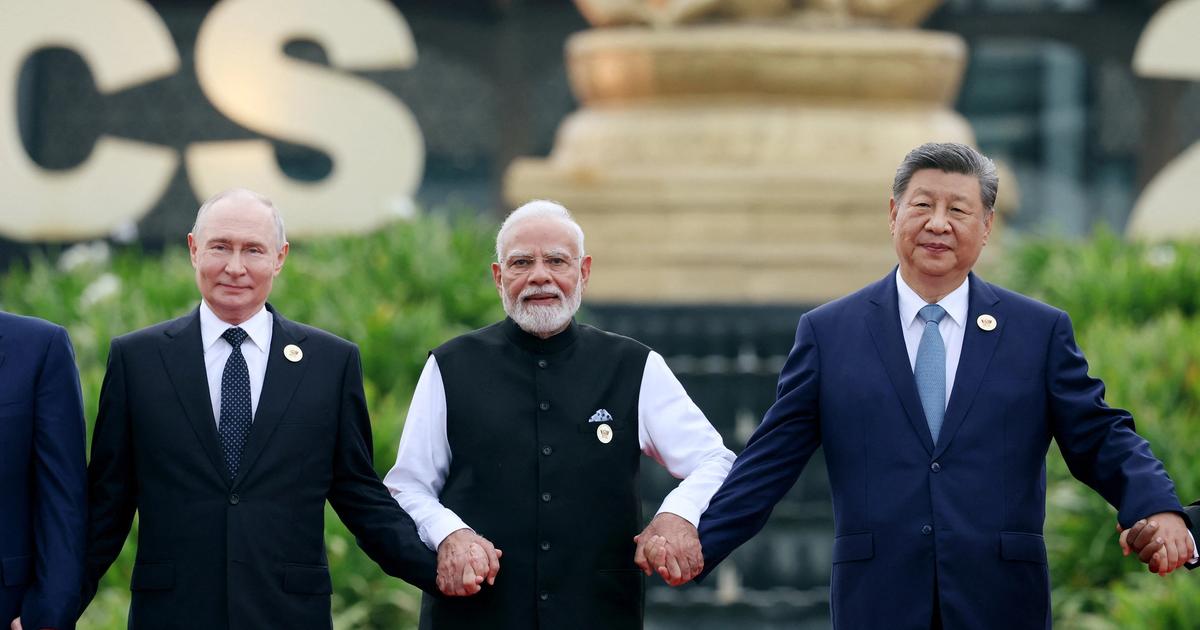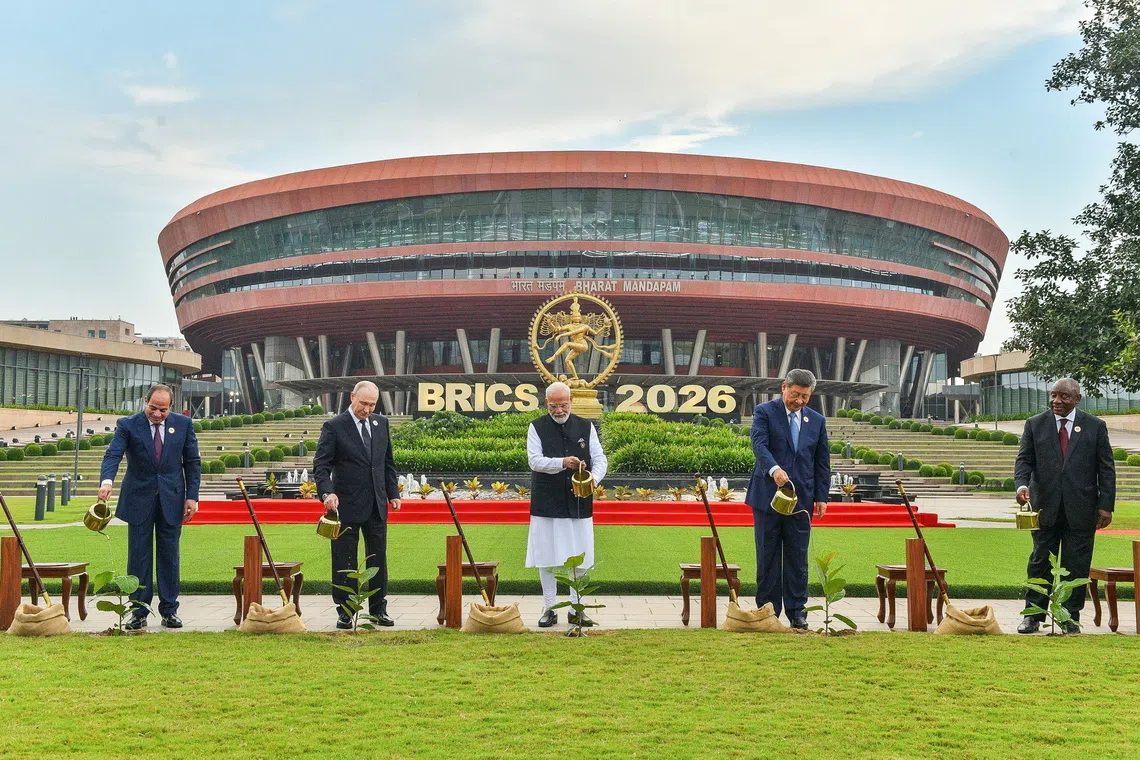
Photo via The Straits Times

Beyond hugs and goodwill, leaders of Russia and Iran return home from BRICS empty-handed

Read the original at The Straits Times ↗
Cite

Eyal, J. (2026, September 13). Beyond hugs and goodwill, leaders of Russia and Iran return home from BRICS empty-handed. The Straits Times. https://www.straitstimes.com/world/beyond-hugs-and-goodwill-leaders-of-russia-and-iran-return-home-from-brics-empty-handed

Dated when The Aporia collected the article, usually within hours of publication. Check the original for its exact date and byline.

The Straits Times · collected 2026-09-13 · by Jonathan Eyal

Quick Summary

This article is a news analysis discussing the BRICS summit and highlights that despite Russia and Iran's participation, they returned without significant concrete achievements. The BRICS group, consisting of Brazil, Russia, India, China, and South Africa, collectively represents 40% of global economic output. Indian Prime Minister Narendra Modi emphasized transforming the current system dominated by Western nations into one focused on partnership among BRICS countries.
Written by AI on 2026-09-13, from this article's own text only (the story summary below draws on all the coverage).
See how they differ ↓

AI analysis

Story summary

The 18th BRICS Summit was held in New Delhi, India from September 9-10, bringing together leaders from an expanded group of eleven nations. The summit aimed to counterbalance the influence of the G7 and advocate for a "multipolar world," but faced internal divisions over issues like Middle East conflicts and economic governance. Despite these challenges, India managed to secure a unified joint declaration, prioritizing trade and technological cooperation while avoiding assigning blame for contentious geopolitical issues. This diplomatic achievement highlighted India's role as a bridge between competing global powers. However, experts note that BRICS remains constrained by differing national interests among its members, with key cracks in institutional modernization hindering its effectiveness compared to the G7.

Written for “BRICS Summit India” on 2026-11-20, grounded in this article and the 28 other(s) covering the same event.

How they differ

12 outlets covered “BRICS Summit India”.

What each outlet says

One AI summary per outlet of its latest article on this story, written from that article alone and checked against it. Open the article for the outlet's own words.

The Straits TimesThis outlet13 Sep

This article is a news analysis discussing the BRICS summit and highlights that despite Russia and Iran's participation, they returned without significant concrete achievements. The BRICS group, consisting of Brazil, Russia, India, China, and South Africa, collectively represents 40% of global economic output. Indian Prime Minister Narendra Modi emphasized transforming the current system dominated by Western nations…

Beyond hugs and goodwill, leaders of Russia and Iran return home from BRICS empty-handed (this article)

The Hindu15 Sep

The Hindu’s foreign affairs experts discuss India's strategic balancing act during the 18th BRICS summit hosted by Prime Minister Narendra Modi in Delhi from September 12-13. The summit took place amid tensions caused by ongoing conflicts in West Asia, particularly the U.S.-Israel war on Iran and Israel's actions against Lebanon and Palestine. Diplomatic editor Suhasini Haidar highlights that despite these…

BRICS: A strategic balancer? →9 articles from The Hindu on this story
Al Jazeera13 Sep

During the first day of the two-day BRICS summit in New Delhi, India, leaders adopted a joint declaration that emphasized global trade concerns and called for restraint amid regional conflicts but avoided naming specific countries. The participating nations—Brazil, Russia, India, China, and South Africa, along with several observer states—comprise nearly half of the world’s population and approximately 40% of global…

BRICS summit 2026: What are the key takeaways? →4 articles from Al Jazeera on this story
South China Morning Post15 Sep

During the 18th BRICS summit in New Delhi, India managed to secure a joint declaration that prioritized trade and technology despite existing geopolitical differences among member countries. Analysts suggest that while New Delhi's approach of avoiding contentious issues helped maintain focus on economic priorities, it also meant that underlying conflicts were merely glossed over rather than resolved.

India scores Brics win with joint declaration despite divides →4 articles from South China Morning Post on this story
Dawn13 Sep

Chinese President Xi Jinping announced initiatives at the Brics summit in New Delhi to enhance cooperation among "Greater Brics" nations, focusing on areas like artificial intelligence and trade. The expanded Brics group now includes Iran, Indonesia, Egypt, Ethiopia, and the United Arab Emirates, along with its original members Brazil, Russia, India, China, and South Africa. Xi emphasized the need for pragmatic…

China's Xi pushes 'Greater Brics' economic ties to give bloc larger global role →3 articles from Dawn on this story
Semafor15 Sep

At the recent BRICS summit, opposition to US tariffs emerged as a common theme among member countries despite their other divergent interests. Indian Prime Minister Narendra Modi emphasized India's growing influence within the group, while Chinese leader Xi Jinping’s visit marked improved relations between China and India. Although not explicitly named in the joint statement, trade tensions influenced discussions…

BRICS highlights opposition to tariffs →2 articles from Semafor on this story
Show 6 more outlets
ABC News (AU)11 Sep

Vladimir Putin has arrived in India for talks ahead of an 11-member BRICS summit, which is set to focus on economic challenges, conflict in the Middle East and Ukraine, and global trade turbulence. The summit will also feature leaders from China, Iran, and other Gulf countries, including Saudi Arabia and the UAE, who are expected to discuss their differing positions on the war launched by the US and Israel in…

Putin and Iranian president arrive in India for summit focusing on war →
Euronews11 Sep

Russian President Vladimir Putin arrived in New Delhi on Friday ahead of the two-day BRICS summit, which will discuss global conflicts, including wars in Ukraine and the Middle East, as well as economic challenges such as oil and trade. Chinese President Xi Jinping is also expected to attend, marking his first visit to India since 2019. The summit features leaders from 11 countries, including Brazil, China, Russia…

BRICS leaders arrive in India ahead of two-day summit as global conflicts set to take centre stage →
Time12 Sep

The leaders of BRICS countries are meeting in New Delhi for their 18th summit on Saturday, including representatives from 11 nations after recent expansions. The primary focus is on how BRICS can challenge the American-led global order, though internal divisions among member states—particularly between India and China—limit their cohesion. While China seeks to expand its influence by promoting alternatives to the US…

Why a Divided BRICS Poses No Challenge to America →
Deutsche Welle12 Sep

India's Prime Minister Narendra Modi will host the 18th BRICS summit this weekend in New Delhi, welcoming Chinese President Xi Jinping for the first time since 2019. The event also includes a visit from Russian President Vladimir Putin. As India steps up its engagement with China and Russia while facing difficulties with the U.S., diplomats are cautious about the potential diplomatic gains from the summit due to…

India's BRICS strategy tested with Xi, Putin set to visit →
The Guardian14 Sep

Chinese President Xi Jinping received a ceremonial welcome in India for the annual Brics summit, marking a diplomatic thaw between India and China after years of tension following a deadly military clash in 2020. The summit, which includes leaders from Brazil, Russia, India, China, and South Africa as well as newer members like Iran, reflects the growing influence of emerging economies while highlighting internal…

Xi Jinping gets red carpet at Brics summit amid thaw in India-China relations →
Washington Examiner15 Sep

The article discusses the 18th BRICS Summit held in New Delhi, focusing on the organization's shortcomings compared to the G7. It highlights three main issues: inadequate institutions within member countries, a lack of mutual trust and unity among members, and an inability to create a stable customer base independent of Western markets. The author argues that despite economic potential, BRICS lacks the foundational…

Eleven nations, zero trust: The great BRICS delusion →

Where they agree and split

Framing

How the first headlines put it

  • Hindu highlights Russia's stance on India's efforts for peace in Ukraine, while ABC News focuses on Putin and Pezeshkian's arrival.12
Attributed to a source1
Stated as fact1
The headlines (2)

Russia will welcome India’s efforts toward peaceful resolution of Ukraine conflict: Peskov The Hindu · attributed to a source

BRICS summit may be the only place another Iran ceasefire can be built Al Jazeera · stated as fact

The full story: what happened, how it changed, and all 29 articles →

Compared with similar articles

This article reads leans left and hedges 0% of its claims. Each row says how that neighbour differs.
Al Jazeera
Hedges 4 of 50 claims Outlet record 60/100
Semafor
Leans left Hedges 0 of 4 claims Outlet record 64/100
ABC News (AU)
Leans left Hedges 1 of 21 claims Outlet record 67/100
“Article A describes the arrival and setup of leaders for the BRICS summit in India focusing on war and trade, while Article B provides an analysis and conclusion about the outcome of the summit after it has concluded.”
Semafor
Hedges 1 of 3 claims Outlet record 64/100
Al Jazeera
Hedges 0 of 3 claims Outlet record 60/100
Deutsche Welle
Hedges 4 of 39 claims Outlet record 95/100
Euronews
Leans left Hedges 1 of 14 claims Outlet record 60/100
“Article A describes the arrival and initial welcoming ceremony for BRICS leaders in India, while Article B provides an analysis after the summit about its outcomes.”
The Hindu
Hedges 1 of 23 claims Outlet record 60/100
“The articles discuss different aspects of the BRICS forum and do not describe the same specific incident or occurrence.”
Dawn
Hedges 3 of 30 claims Outlet record 67/100
“While both articles discuss the BRICS summit, Article A focuses on President Xi Jinping's call for opposing sovereignty violations and rejecting protectionism during the summit, while Article B provides a broader analysis of the BRICS grouping and its leaders returning home without concrete outcomes.”
Dawn
Leans left Hedges 3 of 34 claims Outlet record 67/100
“The articles discuss different aspects and analyses of the BRICS summit but do not describe the same specific incident or outcome.”

Story

BRICS Summit India
Politics · 29 article(s) covering the same event. Compare every outlet's account →
How this article was measured signals, leaning charts, publisher record, byline, topics and claims

Signals How these are calculated →

Claims extracted
3
sentences that state something as happening or true
Uncertain
0%
0 of 3 hedged ("reportedly", "may", "according to")
Leaning
Leans left
of the writing, not the subject · beta estimate
Publisher signals
64/100
The Straits Times's corrections and hedging, across everything collected from it. Not a measure of accuracy.
Outlets on this story
29
Politics
Same framing elsewhere
1
articles that frame the event the way this one does
Analyzed 2026-09-13 · how these are computed

How this is being covered How these are calculated →

Article leaning vs. publisher reliability
Source leaning vs. consistency

Publisher

The Straits Times · 5594 article(s) · 7 correction(s) detected
Running correction rate · 7 correction(s)

Who wrote this

Jonathan Eyal
14 article(s) here · 1 carrying a prediction
Chips do not stop shipping because a chief executive leaves, so Nvidia will continue to be a key global player in its industrial sector.
Israeli President Isaac Herzog has tasked opposition leader Gadi Eisenkot with forming a new government, thereby starting a process that could lead to the removal of Benjamin Netanyahu as Israel’s long-serving prime minister.
Trump has been fairly explicit that, the moment the Nov 3 midterm elections are over, shooting time in the Gulf may re-start.
While Netanyahu’s right-wing Likud party remains Israel’s biggest political formation and is projected to get 25 seats in the next 120-seat parliament, the opposition parties grouped around Gadi Eisenkot, a former top Israeli military commander, are expected to win more seats overall, and therefore seem better placed to form the next government.
2026-10-28 · assertive framing · The true net winners in Israel’s election - so far
Why a ‘killer switch’ to tackle Europe’s trade issues with China may not be so straightforward AI generated BRUSSELS –
“I suggest they get a new leader who can make a deal because he could have made many deals and for some reason he never does,” Trump said.
Maros Sefcovic, the EU’s trade commissioner, concluded two days of intense talks in the Chinese capital on Oct 9 with a commitment that Chinese exports of hybrid and plug-in hybrid cars to the European trading bloc will be cut by more than half over four years, measured against this year’s volumes.
But what would EU associate membership mean?
Beyond hugs and goodwill, leaders of Russia and Iran return home from BRICS empty-handed AI generated BRUSSELS – The BRICS grouping was designed as an alternative to a world dominated by a handful of powerful Western nations led by the United States.
With his characteristic preference for boasting, US President Donald Trump announced what he called “the most crushing economic operation ever taken” against Iran, vowing on Aug 20 that the Islamic Republic would suffer “economic warfare and isolation on an unprecedented scale” and threatening any state whose “financial institutions, businesses, airports, or government entities” offered Iran “any type of lifeline” with “TREMENDOUS Economic Consequences”.
Also by Jonathan Eyal
Nothing else under this byline is closely related to this article, so these are simply their most recent.
All 14 articles by Jonathan Eyal →

Topics

BRICS BRUSSELS Iran Russia Western

Subjects

BRICS NORP · 2× BRUSSELS GPE · 1× Indian NORP · 1× Iran GPE · 1× Narendra Modi PERSON · 1× Russia GPE · 1× Western NORP · 1× the United States GPE · 1×

Narrative

Beyond hugs and goodwill, leaders of Russia and Iran return home from BRICS empty-handed AI generated BRUSSELS – The BRICS grouping was designed as an alternative to a world dominated by a handful of powerful Western nations led by the United States.
framing: assertive · carried by 1 article(s) · first seen 2026-09-13
Beyond hugs and goodwill, leaders of Russia and Iran return home from BRICS empty-handed AI generated BRUSSELS – The BRICS grouping was designed as an alternative to a world dominated by a handful of powerful Western nations led by the United States.

Claims (3 extracted, 0 hedged)

Beyond hugs and goodwill, leaders of Russia and Iran return home from BRICS empty-handed AI generated BRUSSELS – The BRICS grouping was designed as an alternative to a world dominated by a handful of powerful Western nations led by the United States. asserted
grouping → return → States
Its member states account for a combined 40 per cent of the world’s total economic output compared with the G-7 Western-dominated 29 per cent. asserted
states → account → cent
They are pledged to transform the old “pyramid of privilege” – as Indian Prime Minister Narendra Modi, the host of this year’s summit, put it – “into a platform of partnership”. asserted
Modi → pledge → partnership
Give feedback · no sign-in needed

No sign-in needed for now. Your note is sent without a name, so it cannot be answered.

History Support