Photo via Reason

Steve Vladeck's "Hard Questions About Court Expansion"

Read the original at Reason ↗
Cite

Somin, I. (2026, October 16). Steve Vladeck's "Hard Questions About Court Expansion". Reason. https://reason.com/volokh/2026/10/16/steve-vladecks-hard-questions-about-court-expansion/

Dated from the outlet's own feed. Check the original for its byline.

Reason · collected 2026-10-16 · by Ilya Somin

Quick Summary

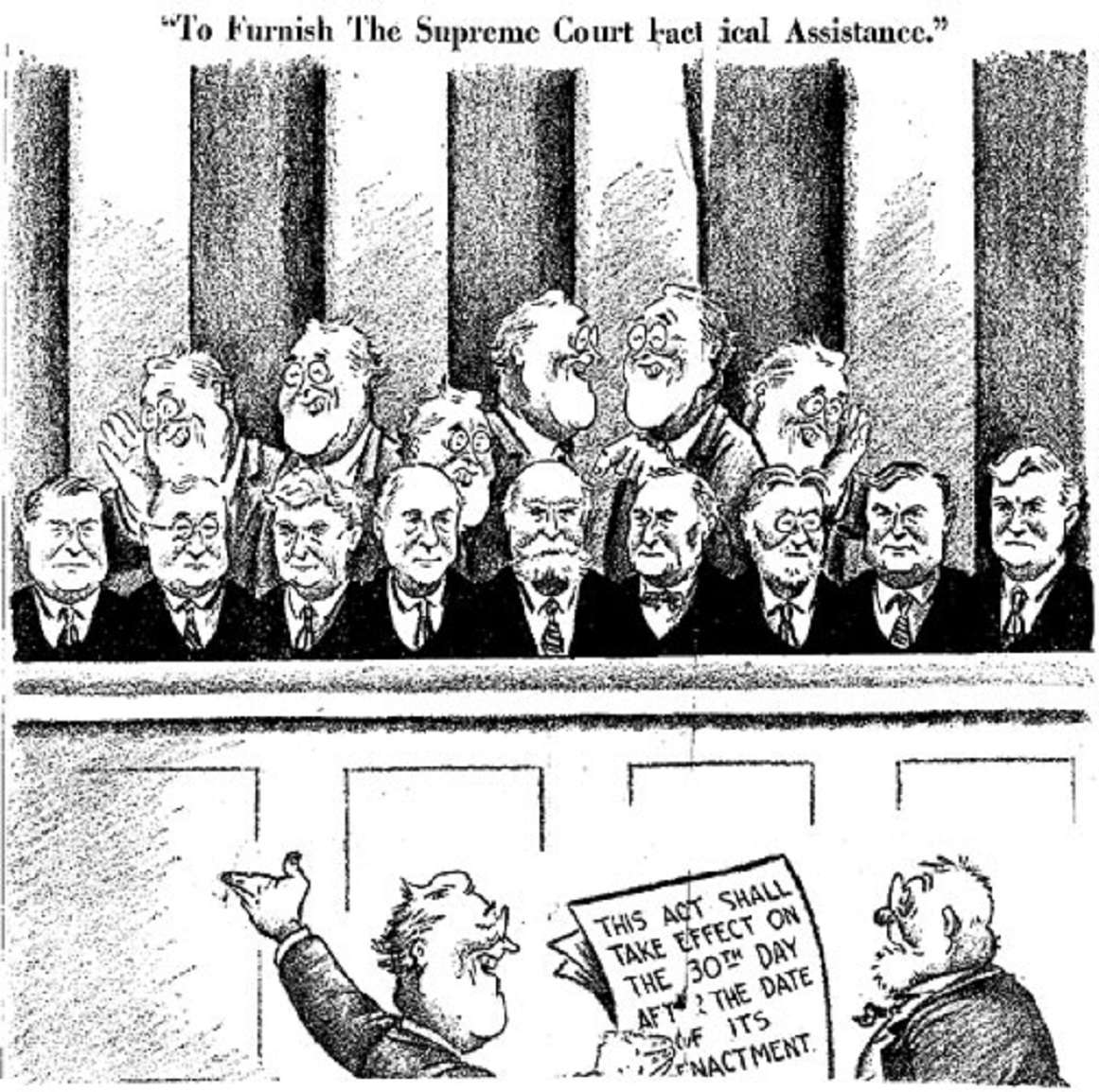
Georgetown law professor Steve Vladeck criticizes proposals to expand the Supreme Court in a recent Substack post, arguing that adding new justices could undermine public trust and judicial independence. He poses four critical questions about court expansion, including how to prevent ideological control and erosion of confidence in lower courts. Vladeck warns that expanding the Court might permanently damage its ability to provide effective judicial review.
Written by AI on 2026-10-17, from this article's own text only (the story summary below draws on all the coverage).

AI analysis

Story summary

Georgetown law professor Steve Vladeck criticizes proposals to expand the Supreme Court, arguing that adding four new Democratic appointees by 2029 would likely cause more harm than good. In his recent Reason Magazine post, he raises key questions about how such expansion could lead to a "race to the bottom," where each party in power seeks to increase the number of justices to ensure an ideologically aligned majority. Vladeck also highlights potential erosion of public confidence in the Court if it becomes perceived as a political tool rather than an impartial arbiter. The critique is part of broader debates over the Court's conservative tilt and possible reforms, with some advocates pushing for expansion to counteract perceived injustices without providing adequate answers to these critical concerns raised by Vladeck.

Written for “Court Expansion Debate” on 2026-11-21, grounded in this article and the 0 other(s) covering the same event.

Compared with similar articles

This article reads unscored and hedges 23% of its claims. Each row says how that neighbour differs.
Reason
Leans right Hedges 2 of 23 claims Outlet record 67/100
“The articles discuss different topics within constitutional law and do not describe the same specific incident.”
The Guardian
Hedges 2 of 16 claims Outlet record 64/100
“Article A discusses Steve Vladeck's critique of court expansion, while Article B reports on Elena Kagan's criticism of recent Supreme Court rulings. These are different events involving distinct viewpoints and speakers.”

Story

Court Expansion Debate
Crime & Law · 1 article(s) covering the same event.
How this article was measured signals, leaning charts, publisher record, byline, topics and claims

Signals How these are calculated →

Claims extracted
22
sentences that state something as happening or true
Uncertain
23%
5 of 22 hedged ("reportedly", "may", "according to")
Leaning
withheld
no quote in the article backed the model's score
Publisher signals
67/100
Reason's corrections and hedging, across everything collected from it. Not a measure of accuracy.
Outlets on this story
1
Crime & Law
Same framing elsewhere
1
articles that frame the event the way this one does
Analyzed 2026-10-17 · how these are computed

How this is being covered How these are calculated →

Article leaning vs. publisher reliability
Source leaning vs. consistency

Publisher

Reason · 1464 article(s) · 4 correction(s) detected
Running correction rate · 4 correction(s)

Who wrote this

Ilya Somin
39 article(s) here · 1 carrying a prediction
As I explained previously, Republican candidate Dan J. Sullivan can potentially be confused with Dan S. Sullivan (the incumbent GOP senator), and some voters might have accidentally chosen Dan J. even though they intended to back Dan S. Today, as reported by prominent election law scholar Rick Hasen, DOJ filed a brief in the US Court of Appeals for the 9th Circuit seeking to dismiss the case.
Among other things, it would allow the federal government to suspend the writ of habeas corpus (and thereby detain people - including US citizens - without due process) at any time.
Just months ago, the Supreme Court in Learning Resources applied those fundamental principles to hold that the President may not use a general grant of authority to "regulate … importation" to impose tariffs, because the power to "regulate" is not the power to tax and Congress did not clearly delegate its taxing power.
A few of my own experiences with Posner and his work may shed some small additional light on the man and his achievements.
2026-11-12 · assertive framing · Judge Richard Posner, RIP
The Republicans may be able to effectively bottle up the impeachment in committee for the rest of the current Congress (which ends on January 3, 2027).
2026-11-11 · mixed framing · The Hegseth Impeachment is Far From Over
Even if they don't pass in the narrowly Republican-controlled lame duck Congress, they will almost certainly do so in the incoming Democratic one.
2026-11-09 · assertive framing · Andrew McCarthy on the Hegseth Impeachment
That makes it very likely it will happen.
2026-11-08 · assertive framing · Impeach Pete Hegseth
In each case, he illegally tried to transform relatively narrow delegations to the executive into a blank check to impose tariffs at will.
I address a variety of counterarguments, including claims that voting for a lesser evil makes you morally complicit in that candidate's wrongdoing, arguments that it's better to cast a "protest vote" for a candidate that has no chance of winning, arguments based on the very low probability that your vote will be decisive, and more.
If Section 338 is still valid and does grant the kind of nearly unlimited authority Trump claims, that would violate the constitutional "nondelegation" doctrine, which restricts delegation of legislative power to the executive…
Also by Ilya Somin
Nothing else under this byline is closely related to this article, so these are simply their most recent.
All 39 articles by Ilya Somin →

Topics

Court Democratic Georgetown Lawfare the Supreme Court

Subjects

Court ORG · 9× the Supreme Court ORG · 3× Callais PERSON · 2× Lawfare ORG · 2× Democratic NORP · 1× Georgetown GPE · 1× House ORG · 1× Senate ORG · 1× Steve Vladeck PERSON · 1× the Supreme Court's ORG · 1×

Narrative

If nothing else, proponents of expansion should have to answer the following four questions: - How do we avoid touching off a race to the bottom, where each time one party controls the House, Senate, and presidency, it expands the Court to ensure an ideologically and politically sympathetic majority? - If a race to the bottom is unavoidable, how do we avoid further (and potentially fatal) erosion of public confidence in the Court—which will quite transparently be little more than a lever of power for whichever party last had such a trifecta?
framing: mixed · carried by 1 article(s) · first seen 2026-10-17
[I]t seems to me that those who are fully onboard the expansion-or-bust train should have to do more than simply assert that having four new Democratic appointees on the Court in 2029 would be a self-evidently "good" thing.
2026-10-17 · Reason
Steve Vladeck's "Hard Questions About Court Expansion" · mixed framing

Claims (22 extracted, 5 hedged)

Georgetown law Professor Steve Vladeck is one of the leading critics of the conservative majority on the Supreme Court. asserted
Vladeck → lead → Court
But in an insightful recent post on his substack, he outlines key reasons why "court expansion" is a bad response to its flaws. asserted
expansion → outline → flaws
[I]t seems to me that those who are fully onboard the expansion-or-bust train should have to do more than simply assert that having four new Democratic appointees on the Court in 2029 would be a self-evidently "good" thing. asserted
having → seem → 2029
If nothing else, proponents of expansion should have to answer the following four questions: - How do we avoid touching off a race to the bottom, where each time one party controls the House, Senate, and presidency, it expands the Court to ensure an ideologically and politically sympathetic majority? - If a race to the bottom is unavoidable, how do we avoid further (and potentially fatal) erosion of public confidence in the Court—which will quite transparently be little more than a lever of power for whichever party last had such a trifecta? asserted
party → have → trifecta
- If eroding public confidence in the Court is a feature, and not a bug, how do we insulate against the same erosion of public confidence in lower federal courts? - What is the case for why expansion is a better way to achieve the desired reforms than alternatives that would (or, at least, should) avoid many of these forward-looking concerns? asserted
that → erode → concerns
He adds that court-packing could easily "permanently undermine judicial review as an institution." uncertain
packing → add → institution
The rest of his piece (which is behind a paywall) offers far from reassuring answers to these questions. asserted
which → offer → questions
I have offered similar criticisms of court-packing in a long series of articles and blog posts, most recently in a June Lawfare article where I explained (among other things) why the Supreme Court's recent decision in Louisiana v. Callais doesn't justify packing, and in a July UnPopulist article critiquing a court-packing proposal advanced by Andy Craig. asserted
decision → offer → Craig
In these pieces, I explain why the Court's record of checking dangerous abuses of government power - though not without serious flaws - is considerably better than many critics claim. uncertain
critics → explain → flaws
In addition, I argue that court-packing is likely to undermine effective judicial review - not only by the Supreme Court, but also by lower courts. asserted
packing → argue → courts
Like Vladeck, I think some of the issues that concern critics of the Court can be more effectively addressed in other ways. asserted
that → think → ways
For example, in the Lawfare article, I explain how Congress can fix the flaws of the Callais decision by banning or restricting gerrymandering. asserted
Congress → explain → gerrymandering
It could also enact a binding ethics code for the justices. uncertain
It → enact → justices
Justice Alito was wrong to suggest otherwise, back in 2023. asserted
Alito → suggest → 2023
That said, if your main goal is a sweeping reversal of much of the Court's recent jurisprudence, there may be no easy way to achieve that quickly without court-packing or something like it. uncertain
goal → say → it
I would argue that any benefits that might achieve are outweighed by the enormous costs of destroying judicial review. uncertain
that → argue → review
In addition, if your objection to the Court's recent decisions is that they often don't do enough to constrain unconstitutional actions by other branches of government or by the states, court-packing is likely to make that problem worse, not better. asserted
problem → do → states
Destroying judicial review won't impose tighter constraints on the executive or bring back Roe v. Wade. asserted
Destroying → destroy → Wade
To the contrary, it would largely destroy any hope of doing so. asserted
it → destroy → hope
In another recent piece, I assessed "non-packing" rationales for increasing the size of the Supreme Court. asserted
I → assess → Court
There, I argue that these rationales are mostly weak; and, to the extent they have merit, there are better ways to address them than an expansion that amounts to court-packing. asserted
that → argue → packing
I even outline possible ways to increase the size of the Court without creating an opportunity for court-packing (this would require allowing the party that doesn't hold the White House to pick some of the new justices). asserted
that → outline → justices

Give feedback · no sign-in needed

No sign-in needed for now. Your note is sent without a name, so it cannot be answered.

History Support