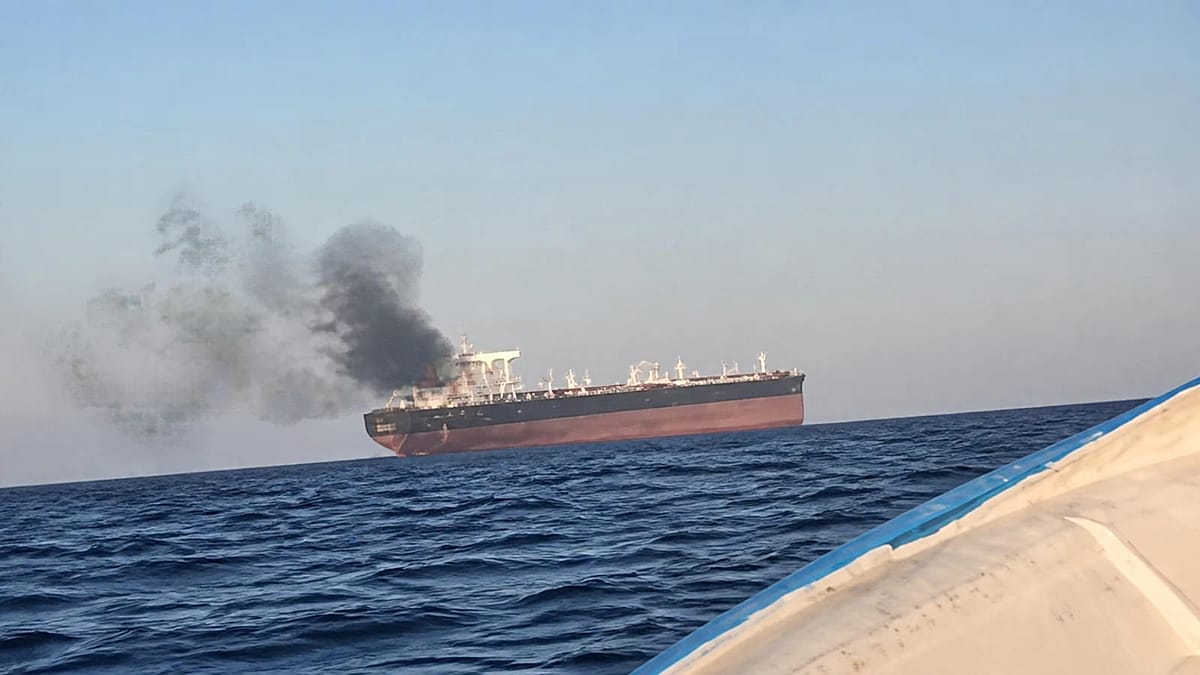
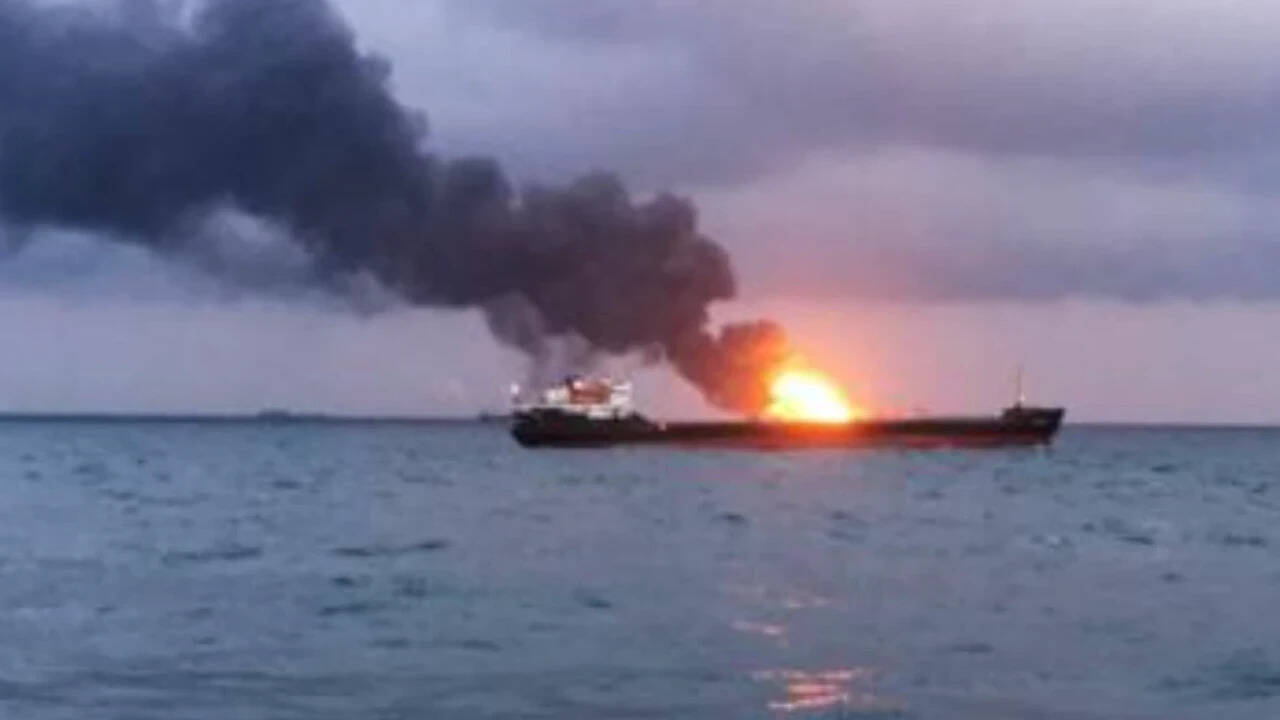
Photo via New York Post

Ship attacks in Strait of Hormuz hit record high since Iran war began

Read the original at New York Post ↗
Cite

Fahmy, G. (2026, October 17). Ship attacks in Strait of Hormuz hit record high since Iran war began. New York Post. https://nypost.com/2026/10/17/world-news/ship-attacks-in-strait-of-hormuz-hit-record-high-since-iran-war-began/

Dated from the outlet's own feed. Check the original for its byline.

New York Post · collected 2026-10-17 · by Gabrielle Fahmy

Quick Summary

Ship attacks in and around the Strait of Hormuz have hit a record high this month, surpassing March's peak during the Iran war. In just one week ending October 13, twelve vessels were attacked—ten in the Strait itself—with eight being oil tankers and four container ships. The Islamic Revolutionary Guard Corps (IRGC) claimed control over these waters and warned they were "closed," while also asserting that attacks are unauthorized if ships do not travel close to Iran's shores. US Central Command countered by stating it had removed mines from the strait, indicating ongoing tension and conflict over maritime security in the region.
Written by AI on 2026-10-17, from this article's own text only (the story summary below draws on all the coverage).
See how they differ ↓

AI analysis

Story summary

As of October 22, 2026, attacks on ships near the Strait of Hormuz have reached unprecedented levels, with at least 15 vessels targeted over the past 10 days, according to the UK Maritime Trade Operations (UKMTO). The number of attacks for the week ending October 16 was the highest on record, with 12 ships affected. The US military claims that despite the attacks, 400 ships and 100 million barrels of oil passed through the strait last week, asserting control over the waterway. However, the attacks have led to thousands of sailors being trapped near the strait, with 6,000 sailors remaining stranded due to the ongoing conflict, as warned by the UN's top maritime official. The crisis has also raised environmental concerns, with people searching for spilled cargo from the attacked container ships. The situation has caused a significant drop in maritime traffic, with commercial traffic falling by 90% since the conflict began, leading to safety concerns and reluctance among seafarers to navigate the strait.

Written for “Strait Of Hormuz Crisis” on 2026-11-20, grounded in this article and the 7 other(s) covering the same event.

How they differ

6 outlets covered “Strait Of Hormuz Crisis”.

What each outlet says

One AI summary per outlet of its latest article on this story, written from that article alone and checked against it. Open the article for the outlet's own words.

New York PostThis outlet17 Oct

Ship attacks in and around the Strait of Hormuz have hit a record high this month, surpassing March's peak during the Iran war. In just one week ending October 13, twelve vessels were attacked—ten in the Strait itself—with eight being oil tankers and four container ships. The Islamic Revolutionary Guard Corps (IRGC) claimed control over these waters and warned they were "closed," while also asserting that attacks…

Ship attacks in Strait of Hormuz hit record high since Iran war began (this article)2 articles from New York Post on this story
Al Jazeera17 Oct

In October, at least 12 ships were attacked in or near the Strait of Hormuz, with UK Maritime Trade Operations noting many more unconfirmed incidents. The attacks come amid increased competition between the US and Iran for control over this strategic waterway, which sees about a fifth of global oil transit. While the US claims to maintain control with support from Arab allies, enabling 400 ships and 100 million…

US and Iran both claim control of Strait of Hormuz amid attacks on vessels →2 articles from Al Jazeera on this story
BBC16 Oct

The BBC reports that ship attack incidents near the Strait of Hormuz have reached a record high, with twelve ships attacked between October 5 and 11. This surpasses the previous week’s ten reported attacks. Experts attribute these incidents to Iran's efforts to assert control over maritime routes as US military presence increases in the region. Additionally, oil exports through the strait are slowing, dropping from…

Ship attack reports near Hormuz reach record high as oil exports slow →
Fox News19 Oct

Arsenio Dominguez, the UN's top maritime official, warned Sunday that around 6,000 sailors are stranded near the Strait of Hormuz due to escalating attacks on commercial ships. The IMO secretary-general cited reports from the Financial Times indicating 24 ship attacks over two weeks and urged vessels not to transit the strait until safety is assured. Iran accused the U.S. military of using an international distress…

Strait of Hormuz crisis traps 6,000 sailors as attacks on ships mount, UN maritime chief says →
The Guardian19 Oct

People are searching the Strait of Hormuz for spilled cargo following recent attacks by Iran on at least 15 container ships over the past ten days. Attacks include drones, mines, and a rocket-propelled grenade. The incidents pushed Brent crude oil prices close to $108 per barrel. One ship carrying 2,500 containers sunk after hitting a mine; some reports suggest iPhones were among the cargo, though Iranian officials…

Strait of Hormuz scoured for spilt cargo after Iran attacks container ships →
Euronews22 Oct

Euronews reports on the risks faced by seafarers navigating the Strait of Hormuz, a crucial waterway for global energy trade. The article features interviews with a crew member from a cargo vessel anchored off Pakistan due to safety concerns and an Iranian maritime manager. Since conflict began, traffic through the strait has dropped by 90%, and at least 95 seafarers have died in commercial roles. Crew members are…

Refusing to cross, unable to escape: Seafarers recount Hormuz dangers to Euronews →

Where they agree and split

The full story: what happened, how it changed, and all 8 articles →

Compared with similar articles

This article reads unscored and hedges 21% of its claims. Each row says how that neighbour differs.
BBC News
Hedges 6 of 34 claims Outlet record 65/100
The Hindu
Hedges 0 of 6 claims Outlet record 78/100
“Article A describes a single sinking incident involving one cargo ship on October 14, while Article B discusses a broader trend and multiple attacks over several days.”
Euronews
Hedges 3 of 19 claims Outlet record 60/100
“Article A describes a specific tanker fire incident, while Article B discusses a broader trend and multiple incidents over time.”
Al Jazeera
Hedges 10 of 36 claims Outlet record 60/100
Al Jazeera
Hedges 10 of 36 claims Outlet record 60/100
Times of India
Hedges 0 of 13 claims Outlet record 59/100
The Guardian
Leans left Hedges 5 of 25 claims Outlet record 64/100
“While both articles discuss attacks on ships near the Strait of Hormuz, they describe different time periods and specific incidents.”
The Independent
Hedges 3 of 17 claims Outlet record 59/100
“Article A describes a specific incident with the sinking of the GFS Pride, while Article B discusses a broader trend and higher number of attacks without mentioning the specific incident in Article A.”
Daily Mail
Leans right Hedges 4 of 16 claims Outlet record 69/100
“Article A describes a specific incident where a container ship was blown up by a mine and sank, leading to Iranians scavenging for floating cargo. Article B discusses a broader trend of increased ship attacks in the Strait of Hormuz without mentioning the same specific sinking event.”
Al Jazeera
Leans left Hedges 0 of 3 claims Outlet record 60/100
“The articles cover related incidents but different specific events, with Article A focusing on ship strikes generally and Article B reporting a specific tanker fire in the Sea of Oman and another in the Strait of Hormuz.”

Story

Strait Of Hormuz Crisis
World · 8 article(s) covering the same event. Compare every outlet's account →
How this article was measured signals, leaning charts, publisher record, byline, topics and claims

Signals How these are calculated →

Claims extracted
24
sentences that state something as happening or true
Uncertain
21%
5 of 24 hedged ("reportedly", "may", "according to")
Leaning
not political
takes no side on a contested political question
Publisher signals
66/100
New York Post's corrections and hedging, across everything collected from it. Not a measure of accuracy.
Outlets on this story
8
World
Same framing elsewhere
1
articles that frame the event the way this one does
Analyzed 2026-10-17 · how these are computed

How this is being covered How these are calculated →

Article leaning vs. publisher reliability
Source leaning vs. consistency

Publisher

New York Post · 21382 article(s) · 41 correction(s) detected
Running correction rate · 41 correction(s)

Who wrote this

Gabrielle Fahmy
37 article(s) here · 1 carrying a prediction
Until last month, Iranians could fill up with a gas station’s own “emergency card” after they ran out of their monthly ration, at a higher price of 100,000 rials.
That’s despite both having backed DSA candidates — Jeffries endorsed Mayor Zohran Mamdani last year and Schumer gave a speech at a 2023 re-election fundraiser for City Councilwoman Tiffany Cabán in Astoria, where they were serving up $14 cocktails with names like “The Spirited Socialist.”
Officials reportedly said they could use heavy hypersonic weapons to target bunkers and motorcades carrying Ukrainian leaders and top army commanders.
“The Americans raised the question: ‘What if Ukraine joins NATO? Would Ukraine withdraw from Donbas?’
Peltola, 53, is challenging incumbent Sen. Dan Sullivan (R-Alaska) in a critical and controversial race that could determine the balance of power on Capitol Hill.
“I didn’t go outside at all … where we were, where we lived, we couldn’t get any food.
“If the enemies once again launch military attacks, it is the armed forces of the Islamic Republic and the Iranian nation that will determine the time and conditions for ending them,” he said in a statement on his official social media accounts and broadcast on state media.
Charles E. Williams II, Michigan chapter president of Sharpton’s National Action Network, lambasted El-Sayed’s lack of cultural credibility in undercover footage that lays bare the dilemma facing black leaders torn between their aversion toward El-Sayed — and the community’s expectation they vote blue no matter what. “You can’t pluck the heart strings of people selling them all of the pie in the sky, that’s not realistic,” Williams said in a video taken outside a meeting at his historic King Solomon Missionary Baptist Church last Saturday and obtained by The Midwesterner.
The far-left group that began with the 2018 election of Rep. Alexandria Ocasio-Cortez is set to be a substantial block whose members are itching to leverage their newfound power to try to turn their sprawling agenda — abolishing ICE, Medicare for All, expanding gender-affirming care, and government-run supermarkets — into action.
Also by Gabrielle Fahmy
Nothing else under this byline is closely related to this article, so these are simply their most recent.
All 37 articles by Gabrielle Fahmy →

Topics

IRGC Iran Iranian UKMTO the Islamic Revolutionary Guard Corps

Subjects

Iran GPE · 7× IRGC ORG · 3× UKMTO ORG · 3× Iranian NORP · 2× Nicaragua GPE · 1× Oman GPE · 1× Tehran GPE · 1× US Central Command ORG · 1× the Islamic Revolutionary Guard Corps ORG · 1× the United Kingdom Maritime Trade Operations ORG · 1×

Narrative

The agency noted it was “struggling to accurately report true number of attacks” and that the number of attacks in the Strait of Hormuz was likely even higher “with a majority of vessels attacked refusing to report.” What’s especially worrying about last week’s attacks is that most occurred near the coast of Oman rather than Iran — along an alternative route the US had increasingly relied on to avoid Iranian strikes.
framing: mixed · carried by 1 article(s) · first seen 2026-10-17
The IRGC’s navy said strikes would not be “limited to the Strait of Hormuz,” announcing a “new deployment formation” across the area, according to Iranian state media.
2026-10-17 · New York Post
Ship attacks in Strait of Hormuz hit record high since Iran war began · mixed framing

Claims (24 extracted, 5 hedged)

Ship strikes in and around the Strait of Hormuz have reached a record high this month, already surpassing attacks recorded during the entire month of March — at the height of the Iran war — according to maritime data. uncertain
strikes → reach → data
The latest attacks come as the Islamic Revolutionary Guard Corps warned Saturday that the Strait of Hormuz was “closed,” amid reports of at least five more tanker attacks in the previous 24 hours. asserted
Strait → come → hours
“We maintain full control and intelligence oversight over the area east of the Strait of Hormuz, the Arabian Sea and the Gulf of Oman,” the IRGC said in a statement. asserted
IRGC → maintain → statement
The fresh wave of attacks included a tanker struck by a rocket-propelled grenade fired from a small boat — a type of attack not previously reported in the current wave of incidents, according to the United Kingdom Maritime Trade Operations (UKMTO). uncertain
wave → include → Operations
A supertanker carrying more than two million barrels of crude oil also caught fire Saturday. asserted
supertanker → carry → fire
The IRGC claimed the vessel had struck a mine while traveling along an “unauthorized” route. asserted
vessel → claim → route
US Central Command, meanwhile, said vessels were being struck by projectiles and said it had demined the strait. asserted
it → say → strait
Iran’s navy separately reported that an oil tanker had caught fire and become immobilized in the Gulf of Oman. asserted
tanker → report → Oman
Two other tankers attempting to transit the Strait of Hormuz were attacked Friday, according to UKMTO. uncertain
tankers → attempt → UKMTO
Over the past week that ended on Friday, 12 vessels were attacked, making it the largest number of weekly strikes reported to the UKMTO since the start of the war in Iran on Feb. 28. asserted
it → end → Feb.
Ten of the attacks occurred in the Strait of Hormuz, one in the Persian Gulf and one in the Gulf of Oman. asserted
Ten → occur → Oman
Of the attacks, one ship sunk, nine were reported damaged, three crew members were injured. asserted
members → sink → attacks
Another two people were reported missing, after a drone strike struck a Nicaragua-flagged vessel on Thursday. asserted
strike → report → Thursday
Six attacks over the past week occurred in a single day — Oct. 11. asserted
attacks → occur → day
The agency noted it was “struggling to accurately report true number of attacks” and that the number of attacks in the Strait of Hormuz was likely even higher “with a majority of vessels attacked refusing to report.” What’s especially worrying about last week’s attacks is that most occurred near the coast of Oman rather than Iran — along an alternative route the US had increasingly relied on to avoid Iranian strikes. asserted
US → note → strikes
Iran claimed the route was “unauthorized” and insisted vessels travel close to its own shores, as it seeks to exert control of the critical waterway. asserted
it → claim → waterway
The IRGC’s navy said strikes would not be “limited to the Strait of Hormuz,” announcing a “new deployment formation” across the area, according to Iranian state media. uncertain
strikes → say → media
According to one expert, Tehran has “evolved its strategy,” targeting ships near the coast of Gulf Arab states and in the Gulf of Oman, and has been carrying out “near daily or multiple attacks every single day”. “The aim here is to stop the ships going through and to deter others,” Martin Kelly, CEO of Orbital Risk Intelligence, told the BBC. uncertain
Kelly → accord → Intelligence
“If America leaves the region, the Strait of Hormuz will reopen and collective security will be established with the participation of the region’s countries, and the global economy will improve. asserted
economy → leave → countries
If it doesn’t leave, we’ll expel it,” threatened Iranian Army spokesperson Mohammad Akraminia on X. Iran has threatened to expel US forces from the region while claiming control over the critical shipping lane, setting up a direct challenge to Washington’s assertion that the waterway remains secure. asserted
waterway → leave → assertion
“Let me be clear — the Strait of Hormuz is controlled by the United States and our regional partners, not Iran,” US CENTCOM Chief Brad Cooper said in a video message late Friday. asserted
Cooper → let → message
Cooper said 400 ships had transited the strait and 100 million barrels of oil had moved through it over the past week, despite the attacks. asserted
barrels → say → attacks
But the data shows oil exports have fallen this month. asserted
exports → show → ?
An average of just under 12 million barrels of oil a day flowed through the strait during the seven days ending Oct. 13 — below the 15 million barrels reported at the end of September and the pre-war baseline of 17 million barrels a day. asserted
average → flow → barrels
Give feedback · no sign-in needed

No sign-in needed for now. Your note is sent without a name, so it cannot be answered.

History Support