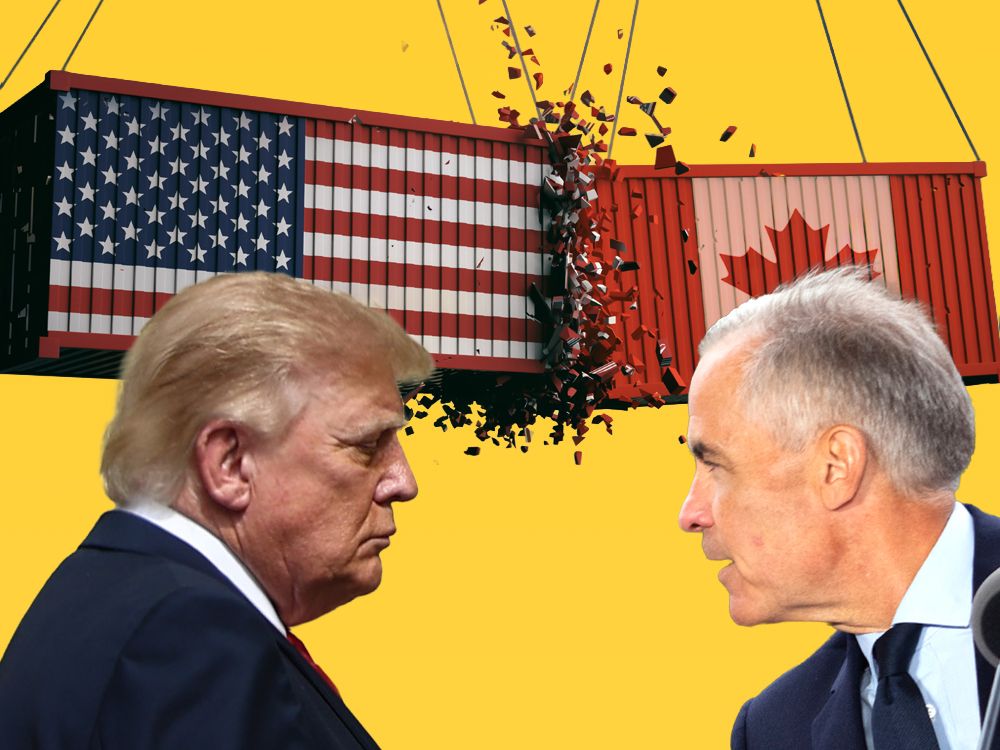
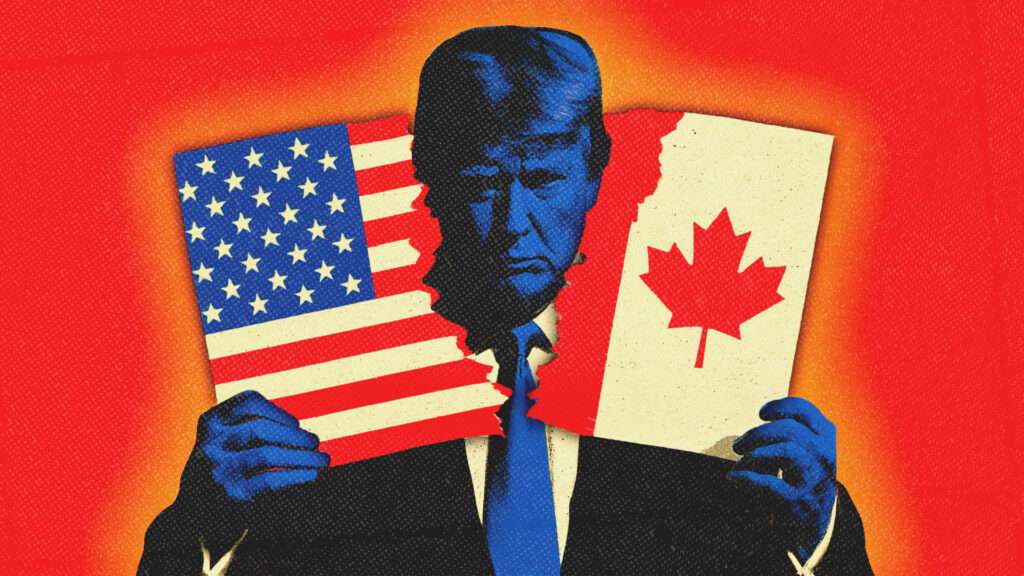
Photo via Reason

Major Questions, Nondelegation, and the Section 338 Tariffs Against Canada

Read the original at Reason ↗
Cite

Somin, I. (2026, September 14). Major Questions, Nondelegation, and the Section 338 Tariffs Against Canada. Reason. https://reason.com/volokh/2026/09/13/major-questions-nondelegation-and-the-section-338-tariffs-against-canada/

Dated when The Aporia collected the article, usually within hours of publication. Check the original for its exact date and byline.

Reason · collected 2026-09-14 · by Ilya Somin

Quick Summary

Law professors discuss how President Trump's use of Section 338 tariffs against Canadian imports may be illegal based on the major questions and nondelegation doctrines. The article argues that Section 338, which has never been used before, could allow for unlimited presidential discretion in imposing tariffs, violating principles of clear congressional authorization for significant economic decisions. This critique is bolstered by recent cases where similar expansive interpretations of executive power were struck down due to lack of clear legislative mandate and excessive delegation of authority.
Written by AI on 2026-09-14, from this article's own text only (the story summary below draws on all the coverage).
See how they differ ↓

AI analysis

Story summary

In September 2025, U.S. President Donald Trump imposed new tariffs and bans on Canadian imports as part of an escalating trade war between the two nations. The measures included a 50% tariff on goods like metal and paper products, representing about 0.6% of total U.S. imports from Canada, while lifting tariffs on items such as salt, cement, and toilet paper. Trump also banned Canadian alcoholic drinks, whey, molasses, furniture, and other products effective September 29. In retaliation for these actions, Canada imposed its own tariffs on about $20 billion worth of American goods in October. These moves have prompted China to court Canada more closely, with Prime Minister Mark Carney making state visits to China and India to diversify trade relations. The legal validity of Trump's tariff measures under Section 338 is being challenged based on the major questions doctrine, which limits executive overreach without clear statutory authorization.

Written for “US Tariff Policy Against Canada” on 2026-11-20, grounded in this article and the 10 other(s) covering the same event.

How they differ

8 outlets covered “US Tariff Policy Against Canada”.

What each outlet says

One AI summary per outlet of its latest article on this story, written from that article alone and checked against it. Open the article for the outlet's own words.

ReasonThis outlet14 Sep

Law professors discuss how President Trump's use of Section 338 tariffs against Canadian imports may be illegal based on the major questions and nondelegation doctrines. The article argues that Section 338, which has never been used before, could allow for unlimited presidential discretion in imposing tariffs, violating principles of clear congressional authorization for significant economic decisions. This critique…

Major Questions, Nondelegation, and the Section 338 Tariffs Against Canada (this article)
CBC15 Sep

New 50% tariffs on 110 Canadian products including cheese and ATVs took effect in the United States after midnight on Tuesday, as part of ongoing trade disputes between the two nations. Concurrently, some existing tariffs were lifted on items like salt and toilet paper to mitigate economic impact. Experts estimate that both new additions and removals are nearly equal in economic value, affecting approximately $2.41…

Trump's latest round of 50% tariffs on Canadian goods now in effect →2 articles from CBC on this story
The Globe and Mail15 Sep

President Trump plans to impose bans on certain Canadian exports including liquor, some dairy products, motorcycles, whey, cheese, and molasses, effective September 29. However, several other products like toilet paper, road salt, cement, and fishing rods will receive tariff exemptions starting September 15. This decision comes as Ottawa and Washington engage in a trade war over retaliatory tariffs, with Canadian…

U.S. to ban imports of some Canadian products as trade war escalates →2 articles from The Globe and Mail on this story
Semafor15 Sep

Canada will implement retaliatory tariffs on $27.6 billion worth of US goods starting Tuesday in response to US actions. The White House has indicated it may retaliate with bans on certain Canadian products, including a potential ban by President Trump on sales from a Montreal plane manufacturer that could halve its customer base. Despite the tensions, some view this as part of an ongoing negotiation rather than an…

Canada’s retaliatory tariffs against the US to take effect →2 articles from Semafor on this story
Washington Examiner15 Sep

Trade tensions between the United States and Canada escalated this week as Canada imposed retaliatory tariffs on about $20 billion worth of American goods in response to earlier U.S. tariffs. Canadian Prime Minister Mark Carney initiated efforts to diversify trade by negotiating with China and India, aiming to double two-way trade between Canada and India to an annual $70 billion by 2030 through a Comprehensive…

Trump is making Canada worth courting — and China has noticed →
Show 2 more outlets
NPR15 Sep

Montana farmers are facing economic challenges due to escalating trade tensions between the U.S. and Canada, including retaliatory tariffs on farm equipment and supplies. Steve Sheffels and Lee Dahlman, among other wheat farmers in north-central Montana, express concerns over rising costs and uncertainty caused by fluctuating tariffs and commodity prices. With Canada being Montana's largest trading partner for $1…

Geopolitics and grain don't mix, say these Montana farmers →
Global News15 Sep

The United States implemented new tariffs on Tuesday affecting specific Canadian goods like outboard motorboats and metal products, imposing a 50% tariff on approximately $1 billion worth of these items. Concurrently, the U.S. removed tariffs on other Canadian imports such as cement and toilet paper, valued at around $800 million. These actions are part of an ongoing trade conflict between the two nations following…

Latest U.S. tariffs on Canadian goods take effect, with some changes →

Where they agree and split

Framing

How the first headlines put it

Attributed to a source1
Stated as fact1
The headlines (2)

Ice wine producer in Ontario's Niagara region says U.S. buyers 'flabbergasted' by Trump's booze ban order CBC · attributed to a source

Major Questions, Nondelegation, and the Section 338 Tariffs Against Canada Reason · stated as fact

The full story: what happened, how it changed, and all 11 articles →

Compared with similar articles

This article reads leans strongly left and hedges 7% of its claims. Each row says how that neighbour differs.
The Globe and Mail
Hedges 0 of 11 claims Outlet record 51/100
“The articles discuss different aspects of the tariffs issue; Article A focuses on legal analysis of Section 338 tariffs, while Article B reports on Ontario's response to new U.S. tariff announcements affecting Canadian businesses.”
National Post
Leans right further right than this Hedges 5 of 33 claims Outlet record 60/100
“The articles discuss different aspects of U.S.-Canada trade relations and do not describe the same specific incident.”
National Post
Hedges 2 of 5 claims Outlet record 60/100
“The articles discuss different aspects of the trade conflict between Canada and the U.S., with Article A focusing on broader economic realities and emotions in dealing with Trump, while Article B focuses specifically on legal analysis of Section 338 tariffs.”
Reason
Hedges 2 of 25 claims Outlet record 67/100
“Article A discusses legal doctrines against Section 338 tariffs, while Article B announces a new amicus brief regarding Section 301 tariffs. Though both involve tariff-related legal challenges initiated by Trump, they describe distinct events.”
The Globe and Mail
Leans right further right than this Hedges 1 of 41 claims Outlet record 51/100
Semafor
Leans right further right than this Hedges 0 of 6 claims Outlet record 64/100
Semafor
Leans right further right than this Hedges 1 of 3 claims Outlet record 64/100
“Article A discusses the legality and background of tariffs imposed by Trump against Canada, while Article B reports on Canada's retaliatory tariffs taking effect in response to US actions.”
Global News
Leans right further right than this Hedges 10 of 114 claims Outlet record 63/100
“The articles discuss different aspects of the trade conflict between Canada and the U.S., with Article A focusing on legal arguments against Trump's tariffs, while Article B discusses the impact of these tariffs on a specific Texas manufacturer.”
CBC News
Leans right further right than this Hedges 0 of 3 claims Outlet record 72/100
“While both articles discuss actions by Trump regarding Canadian imports, Article A focuses on legal issues and previous tariff expansions, while Article B reports a new memorandum signed to remove Canadian products from U.S. federal procurement.”
The Straits Times
Leans right further right than this Hedges 0 of 9 claims Outlet record 64/100
“While both articles discuss Trump's actions against Canadian goods, Article A focuses on legal issues regarding Section 338 tariffs and nondelegation doctrines, whereas Article B reports on a specific presidential memorandum directing agencies to remove Canadian goods from US government purchases.”

Story

US Tariff Policy Against Canada
Politics · 11 article(s) covering the same event. Compare every outlet's account →
How this article was measured signals, leaning charts, publisher record, byline, topics and claims

Signals How these are calculated →

Claims extracted
28
sentences that state something as happening or true
Uncertain
7%
2 of 28 hedged ("reportedly", "may", "according to")
Leaning
Leans strongly left
of the writing, not the subject · beta estimate
Publisher signals
67/100
Reason's corrections and hedging, across everything collected from it. Not a measure of accuracy.
Outlets on this story
11
Politics
Same framing elsewhere
1
articles that frame the event the way this one does
Analyzed 2026-09-14 · how these are computed

How this is being covered How these are calculated →

Article leaning vs. publisher reliability
Source leaning vs. consistency

Publisher

Reason · 1449 article(s) · 4 correction(s) detected
Running correction rate · 4 correction(s)

Who wrote this

Ilya Somin
39 article(s) here · 1 carrying a prediction
As I explained previously, Republican candidate Dan J. Sullivan can potentially be confused with Dan S. Sullivan (the incumbent GOP senator), and some voters might have accidentally chosen Dan J. even though they intended to back Dan S. Today, as reported by prominent election law scholar Rick Hasen, DOJ filed a brief in the US Court of Appeals for the 9th Circuit seeking to dismiss the case.
Among other things, it would allow the federal government to suspend the writ of habeas corpus (and thereby detain people - including US citizens - without due process) at any time.
Just months ago, the Supreme Court in Learning Resources applied those fundamental principles to hold that the President may not use a general grant of authority to "regulate … importation" to impose tariffs, because the power to "regulate" is not the power to tax and Congress did not clearly delegate its taxing power.
A few of my own experiences with Posner and his work may shed some small additional light on the man and his achievements.
2026-11-12 · assertive framing · Judge Richard Posner, RIP
The Republicans may be able to effectively bottle up the impeachment in committee for the rest of the current Congress (which ends on January 3, 2027).
2026-11-11 · mixed framing · The Hegseth Impeachment is Far From Over
Even if they don't pass in the narrowly Republican-controlled lame duck Congress, they will almost certainly do so in the incoming Democratic one.
2026-11-09 · assertive framing · Andrew McCarthy on the Hegseth Impeachment
That makes it very likely it will happen.
2026-11-08 · assertive framing · Impeach Pete Hegseth
In each case, he illegally tried to transform relatively narrow delegations to the executive into a blank check to impose tariffs at will.
I address a variety of counterarguments, including claims that voting for a lesser evil makes you morally complicit in that candidate's wrongdoing, arguments that it's better to cast a "protest vote" for a candidate that has no chance of winning, arguments based on the very low probability that your vote will be decisive, and more.
If Section 338 is still valid and does grant the kind of nearly unlimited authority Trump claims, that would violate the constitutional "nondelegation" doctrine, which restricts delegation of legislative power to the executive…
Also by Ilya Somin
Nothing else under this byline is closely related to this article, so these are simply their most recent.
All 39 articles by Ilya Somin →

Topics

Canadian Section 338 Smoot-Hawley Trump the Great Depression

Subjects

Trump PERSON · 9× Canadian NORP · 3× Harrell PERSON · 2× Hillman PERSON · 2× Congress ORG · 1× Georgetown University ORG · 1× Hoover Institution ORG · 1× Jennifer Hillman PERSON · 1× Peter Harrell PERSON · 1× Philip Zelikow PERSON · 1×

Narrative

Since the Supreme Court issued that decision, Trump has repeatedly tried to use other legislation to achieve the same sweeping power: Section 122 of the Trade Act of 1974 (invalidated by the US Court of International Trade, though the case is on appeal), Section 301 of that same act (the issue is now being litigated), and now Section 338.
framing: assertive · carried by 1 article(s) · first seen 2026-09-14
In this post, I will explain how the legal case against these actions is bolstered by the major questions and nondelegation doctrines.

Claims (28 extracted, 2 hedged)

Mostly law professors | Sometimes contrarian | Often libertarian | Always independent I have previously written about Trump's harmful and illegal imposition of Section 338 tariffs against various Canadian imports, and his recent expansion of those actions to include categorical bans on some Canadian products. asserted
I → write → products
In this post, I will explain how the legal case against these actions is bolstered by the major questions and nondelegation doctrines. asserted
case → explain → questions
Section 338 was part of the infamous Smoot-Hawley tariff act of 1930, which gravely exacerbated the Great Depression. asserted
which → exacerbate → Depression
There is a strong case that Trump's Section 338 tariffs are illegal both because Section 338 (which has never been used previously) was superseded by later legislation, and because Trump's tariffs do not meet the textual requirements of Section 338. asserted
tariffs → be → Section
But assume it is unclear whether Section 338 has been superseded and whether the Trump tariffs on Canadian imports meet the requirements emphasized by Harrell and Hillman: that Section 338 tariffs must be in response to foreign trade polices that "discriminate" against US goods, and must "offset" those discriminatory policies. uncertain
that → assume → policies
In that event, the major questions doctrine (MQD) weighs against Trump's position. asserted
doctrine → weigh → position
MQD requires Congress to "speak clearly" when authorizing the executive to make decisions of "vast economic and political significance." asserted
MQD → require → significance
It played a major role in litigation against Trump's massive International Emergency Economic Powers Act (IEEPA) tariffs. asserted
It → play → tariffs
Bot the US Court of Appeals for the Federal Circuit (which has jurisdiction over all US tariff cases), and three Supreme Court justices struck down those tariffs in large part based on MQD. asserted
justices → have → MQD
Under the administration's interpretation of Section 338, it can be used to impose virtually unlimited tariffs against goods from almost any trading partner, so long as that government imposes any restrictions at all on American imports. asserted
government → use → imports
They would not have to be meaningfully discriminatory, and the Section 338 tariffs would not have to be "offsetting" in the sense of closely calibrated to the trading-partner restrictions they are supposed to be countering. asserted
they → have → restrictions
That kind of sweeping discretion over tariffs creates an obvious major question, inasmuch as it gives the president vast power over the US and world economies. asserted
it → create → US
And that power would not be limited to just US-Canada trade, though even the latter is extremely important, given that Canada is one of our biggest trading partners and the two economies are closely intertwined in many ways. asserted
economies → limit → ways
Trump's recent expansion of Section 338 restrictions further accentuates the "major" nature of the issues at stake. asserted
expansion → accentuate → stake
He has now used Section 338 to ban some imports entirely, as opposed to "merely" imposing tariffs. asserted
He → use → tariffs
Under the administration's interpretation of Section 338, the power to embargo goods would also be nearly unlimited, so long as the trading partner in question imposes at least some constraints on US imports, and doesn't lift them in response to initial Section 338 actions. asserted
partner → embargo → actions
And, as the analyses by Zelikow and Harrell and Hillman show, it is at the very least far from clear that Section 338 is still in force, and that it gives Trump the sweeping power he claims. uncertain
he → show → power
If courts conclude that Section 338 does somehow authorize Trump's actions, even in spite of MQD, they should strike it down under the nondelegation doctrine, which limits delegation of legislative power to the executive. asserted
which → conclude → executive
As the Supreme Court emphasized in the IEEPA case, tariffs are a congressional power, not an executive one. asserted
tariffs → emphasize → case
The power to ban imports entirely is also a congressional power, part of the authority to regulate international commerce. asserted
power → ban → commerce
But last year's decision in FCC v. Consumers' Research held that delegations of the power to impose taxes (including, presumably, tariffs) must have a clear floor and ceiling and that "[t]he guidance needed is greater when an agency action will affect the entire national economy than when it addresses a narrow, technical issue." asserted
it → hold → issue
And the authority claimed by the administration is obviously one that affects the "entire national economy." asserted
that → claim → economy
As the Supreme Court emphasized in the IEEPA case, the president is not supposed to have the power to "impose tariffs on imports from any country, of any product, at any rate, for any amount of time." asserted
president → emphasize → time
Trump's approach to Section 338 would give him exactly that. asserted
approach → give → that
Since the Supreme Court issued that decision, Trump has repeatedly tried to use other legislation to achieve the same sweeping power: Section 122 of the Trade Act of 1974 (invalidated by the US Court of International Trade, though the case is on appeal), Section 301 of that same act (the issue is now being litigated), and now Section 338. asserted
issue → issue → act
Courts should continue to reject these power grabs. asserted
Courts → continue → grabs
I hope that will soon change. asserted
that → hope → ?
And, when it does, the plaintiffs should make sure to make major questions and nondelegation arguments, in addition to other points. asserted
plaintiffs → do → points
Give feedback · no sign-in needed

No sign-in needed for now. Your note is sent without a name, so it cannot be answered.

History Support