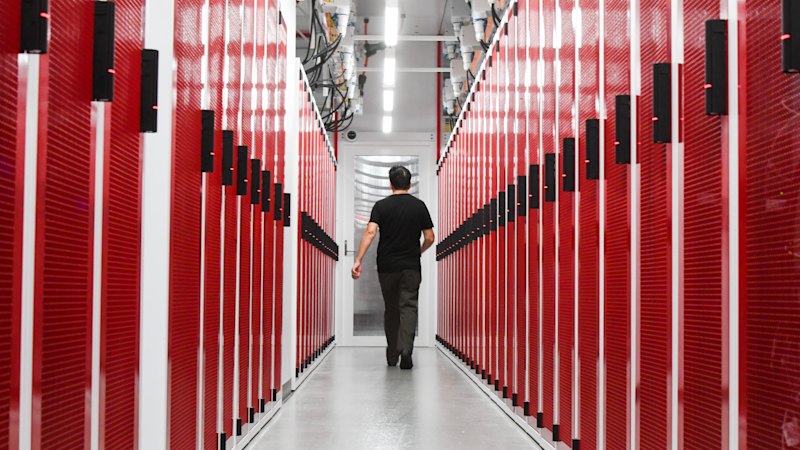
Photo via Global News

Ottawa ‘not responsible’ for regulating AI data centre power use: minister

Read the original at Global News ↗
Cite

Rana, U. (2026, October 22). Ottawa ‘not responsible’ for regulating AI data centre power use: minister. Global News. https://globalnews.ca/news/12113481/ottawa-not-responsible-for-regulating-ai-data-centre-electricity-use-minister/

Dated from the outlet's own feed. Check the original for its byline.

Global News · collected 2026-10-22 · by Uday Rana

Quick Summary

Artificial Intelligence Minister Evan Solomon told a Senate committee on Thursday that the federal government does not regulate power usage by AI data centers because such regulation falls under provincial jurisdiction. He noted that while Canada has received over 160 proposals for new data center projects, which could require significant electricity capacity, the responsibility to create specific regulations lies with provinces like Saskatchewan and Nova Scotia, both of which are developing their own laws regarding data centers.
Written by AI on 2026-10-22, from this article's own text only (the story summary below draws on all the coverage).

AI analysis

Story summary

The Canadian federal government is not responsible for regulating power usage by artificial intelligence (AI) data centres, according to Artificial Intelligence Minister Evan Solomon. Speaking at a Senate committee on Thursday, Solomon stated that provincial regulators handle power regulation, not Ottawa. Provinces like Saskatchewan and Nova Scotia are developing their own data centre laws. While the federal government views both information technology and electricity grids as critical infrastructure, it does not have direct oversight over power usage regulations for these centres. Doubling Canada’s energy grid capacity is seen as crucial for implementing the country's AI strategy.

Written for “Ottawa AI Regulation Policy” on 2026-11-21, grounded in this article and the 0 other(s) covering the same event.

Compared with similar articles

This article reads unscored and hedges 8% of its claims. Each row says how that neighbour differs.
The Sydney Morning Herald
Leans left Hedges 3 of 41 claims Outlet record 61/100
“The articles discuss different contexts for AI data center regulation, with Article A focusing on a federal minister's statement in Canada and Article B discussing voter opinions and concerns about AI regulations in Australia.”

Story

Ottawa AI Regulation Policy
Politics · 1 article(s) covering the same event.
How this article was measured signals, leaning charts, publisher record, byline, topics and claims

Signals How these are calculated →

Claims extracted
26
sentences that state something as happening or true
Uncertain
8%
2 of 26 hedged ("reportedly", "may", "according to")
Leaning
not political
takes no side on a contested political question
Publisher signals
63/100
Global News's corrections and hedging, across everything collected from it. Not a measure of accuracy.
Outlets on this story
1
Politics
Same framing elsewhere
1
articles that frame the event the way this one does
Analyzed 2026-10-22 · how these are computed

How this is being covered How these are calculated →

Article leaning vs. publisher reliability
Source leaning vs. consistency

Publisher

Global News · 3539 article(s) · 13 correction(s) detected
Running correction rate · 13 correction(s)

Who wrote this

Uday Rana
47 article(s) here · 1 carrying a prediction
Industry Minister Melanie Joly and Ontario Premier Doug Ford are set to announce new supports for Canada’s auto manufacturing sector, which is reeling from U.S. President Donald Trump’s tariffs.
In exchange, Ottawa said it would expand what is called remissions coverage to 32 more steel and aluminum items from China.
As Ottawa looks to intensify its trade relationship with Beijing after a meeting between Prime Minister Mark Carney and Chinese President Xi Jinping, Canada’s auto industry is sounding the alarm over the question of whether those talks could open the door to Chinese “knock-down kits” or “kit cars,” warning of their impact on domestic jobs. “We see no evidence in markets around the world that China will do anything but knock-down kits,” said Brian Kingston, president and CEO of the Canadian Vehicle Manufacturers’ Association President.
More details can be found in the Microsoft 365 admin center under EX1550543,” Microsoft said in a statement on X. “While we’re working to mitigate impact, we’ve confirmed the issue may affect Microsoft 365 service connectivity for users in any region, more information will be provided in the Microsoft 365 admin center under EX1550543.
The Canadian economy is forecast to grow at one per cent in 2026, with GDP growth ramping up to 1.8 per cent in 2027 and two per cent in 2028, KPMG’s Fall 2026 Economic Outlook said.
The ceremony will begin with a veterans’ march, followed by the arrival of various dignitaries including the Speakers of the House of Commons and the Senate, the minister of veterans affairs, the chief of the defence staff, the Silver Cross Mother and the governor general, who will receive the vice-regal salute and inspect the assembled troops for the commemoration.
“The big question going forward is how much farther will the Bank have to go to keep a lid on inflation next year?
Many Canadians will soon be able to move money between bank accounts faster and get paid more quickly with the launch of a new payment system for Canadian financial platforms.
In her letter to the commissioner, Joly said she cited remarks by Cleveland-Cliffs CEO Lourenco Goncalves, who said he “bought Stelco because I could not afford anymore having Stelco flooding the market here in the United States to the determinant of my own company.”
It is unclear when the shots will be available for Canadians over 50 to get, but Moderna said it “will engage with Canadian health authorities and immunization partners as it advances plans for the future availability of mFLUSIVA and mCOFLU in Canada.”
Also by Uday Rana
Nothing else under this byline is closely related to this article, so these are simply their most recent.
All 47 articles by Uday Rana →

Topics

Canada Canadian Nova Scotia Ottawa U.S.

Subjects

Canada GPE · 6× Solomon PERSON · 4× Canadian NORP · 3× Nova Scotia GPE · 3× EverWind ORG · 2× Ottawa GPE · 2× U.S. GPE · 2× Evan Solomon PERSON · 1× Senate ORG · 1× the Senate Committee on Social Affairs, Science and Technology ORG · 1×

Narrative

“We work very closely with best practices around the world to develop very high standards on water use, energy use, investment in the community, strategic importance, consultation, and most importantly, transparency on the promises so you can actually hold them to account,” he said.
framing: assertive · carried by 1 article(s) · first seen 2026-10-22
While large data centre projects will require around 100 megawatts of power per building, there “may be some smaller ones” as well, he added.

Claims (26 extracted, 2 hedged)

The federal government is “not responsible” for power regulation and cannot regulate power usage by AI data centres, Artificial Intelligence Minister Evan Solomon told a Senate committee on Thursday. asserted
Solomon → regulate → Thursday
Solomon spoke to the Senate Committee on Social Affairs, Science and Technology on Thursday, where he was asked about power usage by data centres in Canada. asserted
he → speak → Canada
So, we can’t put federal obligations on the power regulation,” he said, adding that provinces like Saskatchewan and Nova Scotia are in the process of creating their own data centre laws. asserted
provinces → put → laws
At the same time, however, both information technology and electricity grids are considered critical infrastructure by the federal government, giving Public Safety Canada the ability to “manage risks and reduce vulnerabilities,” according to the National Strategy for Critical Infrastructure. uncertain
technology → consider → Infrastructure
Doubling the capacity of Canada’s energy grid was “absolutely critical” to rolling out Canada’s AI strategy, Solomon said. asserted
Solomon → double → strategy
“We work very closely with best practices around the world to develop very high standards on water use, energy use, investment in the community, strategic importance, consultation, and most importantly, transparency on the promises so you can actually hold them to account,” he said. asserted
he → work → account
The federal government’s recently released ‘Responsible Data Centre Development Principles’ require that companies building new data centre projects “do not shift electricity costs onto Canadians” and “minimize water use and environmental impacts. asserted
companies → release → use
” 160 data centre proposals Solomon was also asked how many data centres Canada was looking to build. asserted
Canada → ask → centres
Get daily National news “We received proposals for… over 160,” he said. asserted
he → get → 160
While large data centre projects will require around 100 megawatts of power per building, there “may be some smaller ones” as well, he added. uncertain
he → require → building
“We have MOUs with about four (data center companies) so far,” he said. asserted
he → have → four
- 3 arrested after Toronto marketplace sellers targeted in violent robberies: police asserted
sellers → arrest → robberies
Toronto Crime Stoppers pauses tips after cyber breach affects 176K submissions - asserted
breach → pause → submissions
Ottawa gives Stelco 15 days to reverse Hamilton layoffs or face lawsuit Ottawa is “supporting the building of Canadian data that are Canadian-owned,” asserted
that → give → data
Solomon said, however, some major projects in Canada are being helmed by U.S. tech giants. asserted
projects → say → giants
A company pursuing a wind and hydrogen development in Nova Scotia says it has plans for a $10-billion AI data centre in Cape Breton that it describes as the largest private investment in provincial history. asserted
it → pursue → history
EverWind Fuels announced last week that U.S. AI company Anthropic has signed a 20-year lease for a 18,600-square metre data centre in Point Tupper, N.S., that would draw 95 megawatts of electricity during its first phase. asserted
that → announce → phase
The data centre is scheduled to come online late next year. asserted
centre → schedule → ?
A 325-megawatt expansion is expected in mid-2028, which would bring the development’s total energy demand to 420 megawatts, the company said. asserted
company → expect → megawatts
Nova Scotia Premier Tim Houston said the data centre project was a major vote of confidence in the rural area about 200 kilometres east of Halifax. asserted
project → say → Halifax
He said Canada does not have enough secure data infrastructure to meet the requirements of its businesses, governments and health-care institutions. asserted
Canada → say → businesses
Data centres are typically massive operations that require immense amounts of electricity to run and cool off computer servers. asserted
that → require → servers
Water from nearby Landrie Lake will be used to cool the Point Tupper data centre’s servers, and the company stressed it will safeguard the water supply. asserted
it → use → supply
EverWind said the cooling system will be closed-loop, similar to a car’s radiator, with cooling fluid recycled or disposed of off site, not in local waterways. asserted
system → say → waterways
The system will use an average of 100,000 litres of water per day in the first phase, which EverWind said is about the same as a large shopping mall. asserted
EverWind → use → mall
That will expand to an average draw of 500,000 litre per day when the expansion is complete, about one per cent of the lake’s safe daily yield of 34 million litres. asserted
expansion → expand → litres

Give feedback · no sign-in needed

No sign-in needed for now. Your note is sent without a name, so it cannot be answered.

History Support