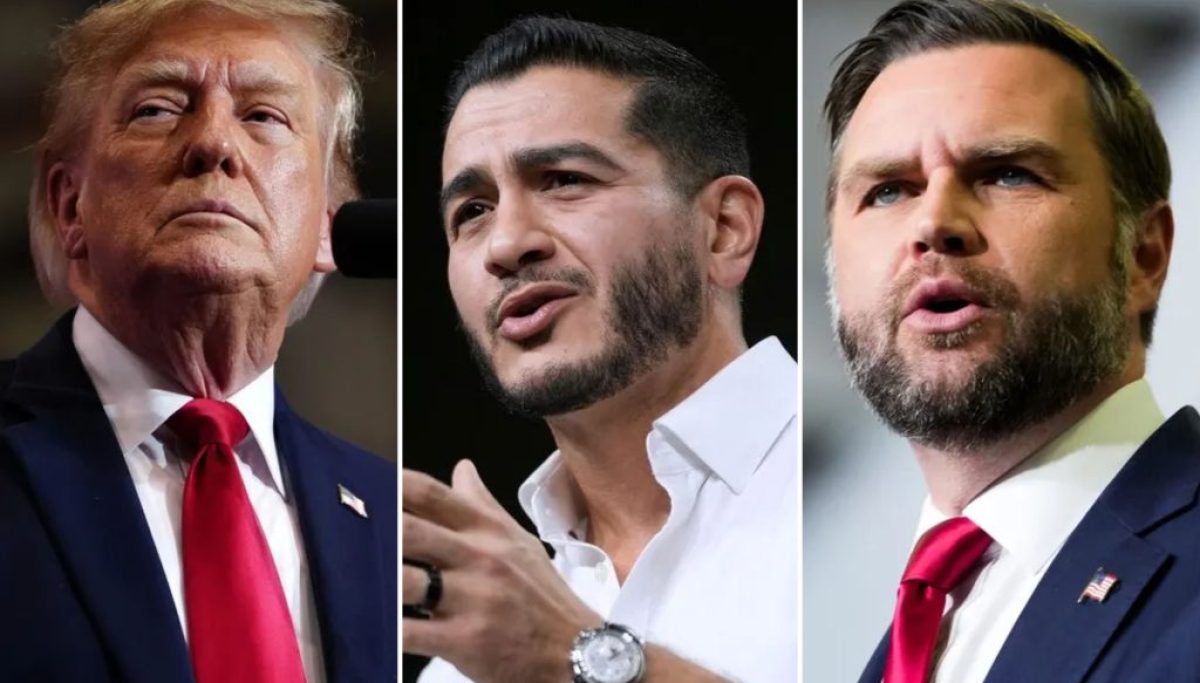
Photo via New York Post

Abdul El-Sayed parlayed his race-obsessed medical research to fast-track, fund journey to Congress: critics

Read the original at New York Post ↗
Cite

Fahmy, G. (2026, October 24). Abdul El-Sayed parlayed his race-obsessed medical research to fast-track, fund journey to Congress: critics. New York Post. https://nypost.com/2026/10/24/us-news/abdul-el-sayed-parlayed-his-race-obsessed-medical-research-to-fast-track-fund-his-journey-to-congress-critics/

Dated from the outlet's own feed. Check the original for its byline.

New York Post · collected 2026-10-24 · by Gabrielle Fahmy

Quick Summary

Critics argue that Michigan Democratic Senate candidate Abdul El-Sayed used race-focused medical research to advance his political career and secure funding. His studies include a 2011 paper funded by NIH grants suggesting lower suicide rates among Arab Americans due to Islamic Sharia law, which critics view as pseudoscience. In 2012, El-Sayed received a $90,000 Paul and Daisy Soros Fellowship for New Americans, supporting his PhD in epidemiology at Columbia University. This fellowship was instrumental in advancing his career before he became the executive director of the Detroit Health Department in 2015.
Written by AI on 2026-10-24, from this article's own text only (the story summary below draws on all the coverage).

AI analysis

Story summary

Abdul El-Sayed, a Michigan Democratic Senate candidate, has faced criticism for his past medical research, which some view as exploiting identity politics. According to critics and the New York Post, El-Sayed's 2011 study on suicide rates among Arab Americans in Michigan suggested that lower suicide rates among Arab Muslims could be attributed to Islamic Sharia law. The study found that Arab men had roughly half the suicide rate of white men, while Arab women had a rate 24% lower than white women. El-Sayed's research was partially funded by National Institutes of Health grants and published in the Public Library of Science journal.

Critics argue that this type of research has helped fast-track his political career with funding from left-leaning donors like billionaire George Soros, contributing to a perception that his work aligns with specific political agendas rather than purely scientific inquiry. Senator Ted Cruz (R-TX) highlighted these concerns on X, criticizing El-Sayed’s approach as potentially leading to racist and eugenics outcomes.

Written for “Abdul El-Sayed Criticized For Politics” on 2026-11-05, grounded in this article and the 0 other(s) covering the same event.

Story

📰 Abdul El-Sayed Criticized For Politics
Politics · 1 article(s) covering the same event.

Compared with similar articles

This article reads unscored and hedges 21% of its claims. Each row says how that neighbour differs.
New York Post
⚖️ Leans right Hedges 4 of 26 claims Outlet record 66/100
“The articles discuss different aspects of Abdul El-Sayed's career and background, not a single specific incident.”
The Guardian
⚖️ Leans strongly right Hedges 3 of 17 claims Outlet record 66/100
“The articles discuss different aspects of Abdul El-Sayed's campaign, with Article A focusing on his past research and its political implications, while Article B focuses on JD Vance's attacks during the election period.”
The Guardian
⚖️ Leans strongly left Hedges 5 of 32 claims Outlet record 66/100
“The articles discuss different aspects of Abdul El-Sayed's political career and criticisms against him, but do not describe the same specific incident or occurrence.”
New York Post
Hedges 5 of 37 claims Outlet record 66/100
“The articles discuss different aspects of Abdul El-Sayed's academic work and political stance rather than describing a single specific incident.”
Washington Examiner
Hedges 3 of 76 claims Outlet record 69/100
“Article A discusses Abdul El-Sayed's background and research, while Article B reports on President Trump's comments about El-Sayed during a visit to Michigan. Although related, they describe different specific events.”
How this article was measured signals, leaning charts, publisher record, byline, topics and claims

Signals How these are calculated →

Claims extracted
24
sentences that state something as happening or true
Uncertain
21%
5 of 24 hedged ("reportedly", "may", "according to")
Leaning
withheld
no quote in the article backed the model's score
Publisher signals
66/100
New York Post's corrections and hedging, across everything collected from it. Not a measure of accuracy.
Outlets on this story
1
Politics
Same framing elsewhere
1
articles that frame the event the way this one does
Analyzed 2026-10-24 · how these are computed

How this is being covered How these are calculated →

Article leaning vs. publisher reliability
Source leaning vs. consistency

Publisher

New York Post · 17197 article(s) · 36 correction(s) detected
Running correction rate · 36 correction(s)

Who wrote this

Gabrielle Fahmy
33 article(s) here · 1 carrying a prediction
🔮 Peltola, 53, is challenging incumbent Sen. Dan Sullivan (R-Alaska) in a critical and controversial race that could determine the balance of power on Capitol Hill.
🔮 “I didn’t go outside at all … where we were, where we lived, we couldn’t get any food.
🔮 “If the enemies once again launch military attacks, it is the armed forces of the Islamic Republic and the Iranian nation that will determine the time and conditions for ending them,” he said in a statement on his official social media accounts and broadcast on state media.
🔮 Charles E. Williams II, Michigan chapter president of Sharpton’s National Action Network, lambasted El-Sayed’s lack of cultural credibility in undercover footage that lays bare the dilemma facing black leaders torn between their aversion toward El-Sayed — and the community’s expectation they vote blue no matter what. “You can’t pluck the heart strings of people selling them all of the pie in the sky, that’s not realistic,” Williams said in a video taken outside a meeting at his historic King Solomon Missionary Baptist Church last Saturday and obtained by The Midwesterner.
🔮 The far-left group that began with the 2018 election of Rep. Alexandria Ocasio-Cortez is set to be a substantial block whose members are itching to leverage their newfound power to try to turn their sprawling agenda — abolishing ICE, Medicare for All, expanding gender-affirming care, and government-run supermarkets — into action.
🔮 Police changed the approved route at the eleventh hour Friday night, saying the original one, meant to go from Place de La Bastille through Place de la Nation in central Paris, would be too difficult to secure.
🔮 A 2011 study, for example, suggested white people could take a lesson from Muslims who have lower suicide rates — thanks to Sharia law.
🔮 The evidence is expected to go before a federal grand jury in Minnesota, to determine whether Omar and her family lied when they immigrated to the US in 1995.
🔮 “Both are strong-willed, charismatic, charming — and both are uncompromising, not only in their beliefs, but also in their approaches to life and their way of doing things,” he wrote of his mom and dad.
Also by Gabrielle Fahmy
Nothing else under this byline is closely related to this article, so these are simply their most recent.
All 33 articles by Gabrielle Fahmy →

Topics

Arab Congress Democratic Michigan Senate

Subjects

El-Sayed PERSON · 4× Arab NORP · 3× Michigan GPE · 3× Democratic NORP · 2× Islamic NORP · 2× Abdul El-Sayed PERSON · 1× Congress ORG · 1× Muslims NORP · 1× Post ORG · 1× Senate ORG · 1×

Narrative

“This is ‘science’ with “a pre-ordained racist & eugenics outcome,” Sen. Ted Cruz (R-Tx.) wrote on X. “Scary stuff.” But his research at the time apparently got the attention of the family of far-left billionaire and Democratic mega-donor George Soros — which stepped in to bankroll his rising career.
framing: mixed · carried by 1 article(s) · first seen 2026-10-24
🔮 A 2011 study, for example, suggested white people could take a lesson from Muslims who have lower suicide rates — thanks to Sharia law.

Claims (24 extracted, 5 hedged)

Michigan Democratic Senate candidate Abdul El-Sayed turned his weird science into a stepping stone, exploiting identity politics in academia to fast-track and fund his journey to Congress, according to critics and a Post review of his research. uncertain
Sayed → turn → research
A 2011 study, for example, suggested white people could take a lesson from Muslims who have lower suicide rates — thanks to Sharia law. uncertain
who → suggest → law
The study, titled “Suicide among Arab Americans” and funded in part with National Institutes of Health grants, looked at suicide deaths in Michigan between 1990 and 2007. asserted
study → title → 1990
The research, published in the Public Library of Science journal, found that Arab men had roughly half the suicide rate of white men, while Arab women had a rate 24% lower than white women. “According to traditional interpretations of Islamic Sharia law, suicide is considered haram or forbidden, and families of suicide victims can face ostracism within the Muslim community,” El-Sayed boasted in the paper’s conclusion. uncertain
Sayed → publish → conclusion
Some of his race-obsessed studies include “Birth outcomes among Arab Americans in Michigan before and after the terrorist attacks of September 11, 2001,” in 2008; and “Ethnic Inequalities in Mortality: The Case of Arab Americans” in 2011. asserted
Some → obsess → 2011
Others tackled “Racial and insurance-based disparities in the treatment of carotid artery stenosis: A study of the Nationwide Inpatient Sample” in 2015 and “The Color of Debt: Racial Disparities in Anticipated Medical Student Debt in the United States” in 2013. asserted
Others → tackle → 2013
“Our findings suggest that interethnic mating may be associated with increased risk for adverse birth outcomes among Arab ethnicity mothers,” he wrote at the time, back then going by the name Abdulrahman M. El-Sayed. uncertain
he → suggest → name
Critics panned the paper as pseudoscience. asserted
Critics → pan → pseudoscience
“This is ‘science’ with “a pre-ordained racist & eugenics outcome,” Sen. Ted Cruz (R-Tx.) wrote on X. “Scary stuff.” But his research at the time apparently got the attention of the family of far-left billionaire and Democratic mega-donor George Soros — which stepped in to bankroll his rising career. asserted
which → write → career
In 2012, El-Sayed received the $90,000 Paul and Daisy Soros Fellowship for New Americans to pursue a PhD in epidemiology at Columbia University. asserted
Sayed → receive → University
He graduated in 2014 and became executive director of the Detroit Health Department in 2015. asserted
He → graduate → 2015
That information comes courtesy of Jeffrey Soros, the Hollywood producer nephew of the family patriarch, who hosted El-Sayed at his home in September for a celebrity-filled fundraiser in Los Angeles. asserted
who → come → Angeles
“I just wanted to welcome you here and express my appreciation for coming. asserted
I → want → appreciation
And it’s been a privilege,” said Jeff Soros while standing alongside El-Sayed, according to video of his remarks obtained by Fox News Digital. uncertain
Soros → say → Digital
“Speaking of privilege, I’ve had the pleasure of knowing Abdul since 2012. asserted
I → speak → 2012
I got to interview him as a finalist for my parents. asserted
I → get → parents
Morning Report delivers the latest news, videos, photos and more. asserted
Report → deliver → news
“We already knew he was a bigot, but this is over the top,” said Julian Epstein, former chief counsel for the Democratic House Judiciary Committee. asserted
Epstein → know → Committee
“In the same way he used his antisemitic hate to try to win the primary, now we see he’s used his half-baked pseudo intellectual eugenics science to fatten out what looks like a pretty thin research record and perhaps persuade his more radical supporters that is really down with racial separatism.” asserted
that → use → separatism
He added: “How much more evidence do moderate Democrats need in order to switch.” asserted
Democrats → add → evidence
Kyle Shideler, director of Homeland Security and Counterterrorism at the Center for Security Policy, previously told The Post the brotherhood’s goal is to “prevent Muslim Americans from assimilating into American culture” — a recurring theme that emerges throughout El Sayed’s research. asserted
that → tell → research
“The brotherhood wants to use political power in the United States to support activities abroad,” said Shideler. asserted
Shideler → want → activities
“At the end of the day, its big picture goal is to impose Islamic law on all nations everywhere and establish a caliphate.” asserted
goal → impose → caliphate
El Sayed’s campaign did not return The Post’s request for comment. asserted
campaign → return → comment

💬Give feedback · no sign-in needed

No sign-in needed for now. Your note is sent without a name, so it cannot be answered.

🕘History 🎫Support