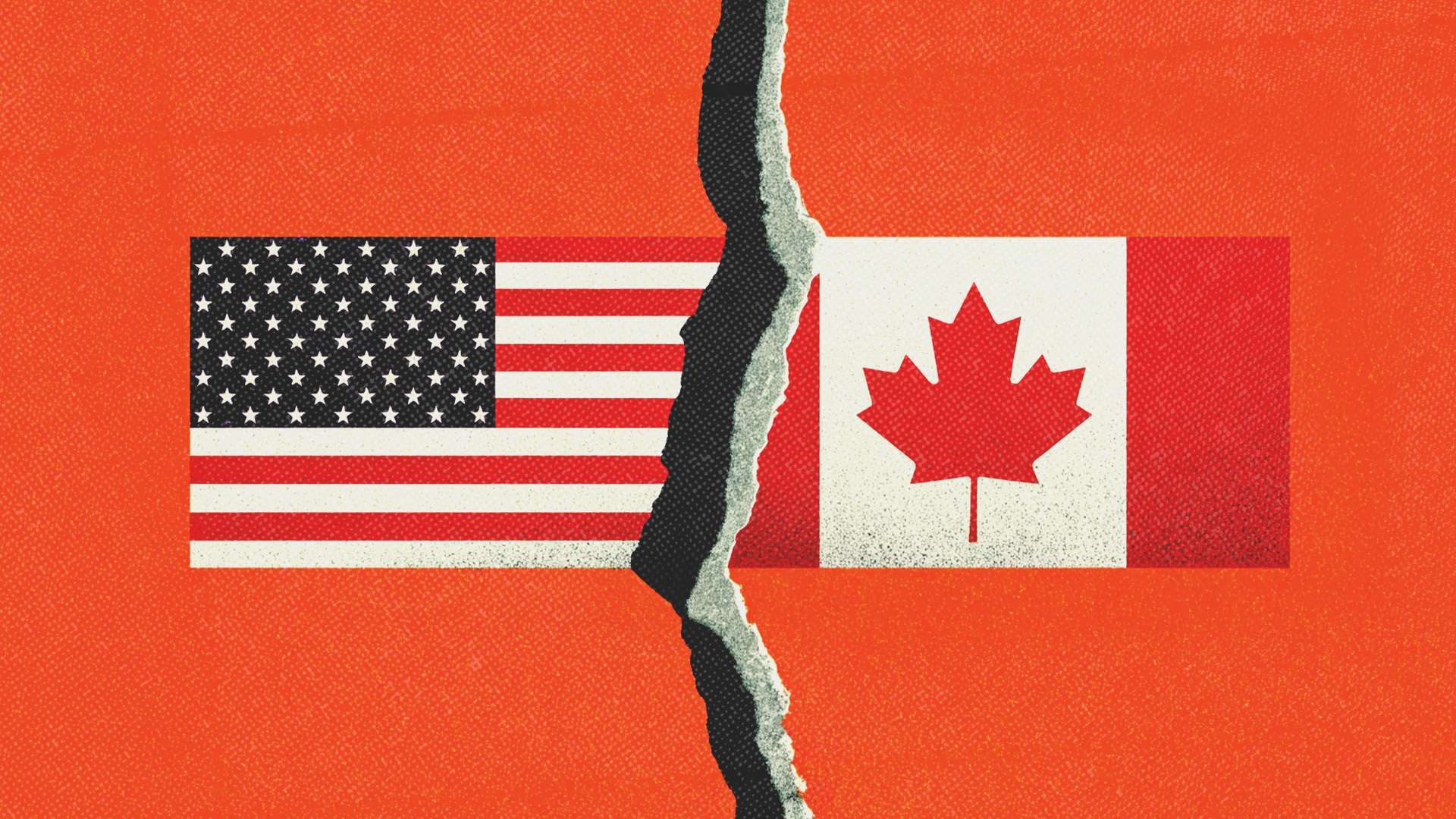
Photo via Semafor

Canada’s retaliatory tariffs against the US to take effect

Read the original at Semafor ↗
Cite

Ruberry, B. (2026, September 15). Canada’s retaliatory tariffs against the US to take effect. Semafor. https://www.semafor.com/article/09/07/2026/canadas-retaliatory-tariffs-against-the-us-to-take-effect

Dated when The Aporia collected the article, usually within hours of publication. Check the original for its exact date and byline.

Semafor · collected 2026-09-15 · by Brendan Ruberry

Quick Summary

Canada will implement retaliatory tariffs on $27.6 billion worth of US goods starting Tuesday in response to US actions. The White House has indicated it may retaliate with bans on certain Canadian products, including a potential ban by President Trump on sales from a Montreal plane manufacturer that could halve its customer base. Despite the tensions, some view this as part of an ongoing negotiation rather than an irrevocable break between the two countries.
Written by AI on 2026-09-16, from this article's own text only (the story summary below draws on all the coverage).

AI analysis

Story summary

In September 2025, U.S. President Donald Trump imposed new tariffs and bans on Canadian imports as part of an escalating trade war between the two nations. The measures included a 50% tariff on goods like metal and paper products, representing about 0.6% of total U.S. imports from Canada, while lifting tariffs on items such as salt, cement, and toilet paper. Trump also banned Canadian alcoholic drinks, whey, molasses, furniture, and other products effective September 29. In retaliation for these actions, Canada imposed its own tariffs on about $20 billion worth of American goods in October. These moves have prompted China to court Canada more closely, with Prime Minister Mark Carney making state visits to China and India to diversify trade relations. The legal validity of Trump's tariff measures under Section 338 is being challenged based on the major questions doctrine, which limits executive overreach without clear statutory authorization.

Written for “US Tariff Policy Against Canada” on 2026-10-31, grounded in this article and the 10 other(s) covering the same event.

Story

📰 US Tariff Policy Against Canada
Politics · 11 article(s) covering the same event. Compare every outlet's account →

Compared with similar articles

This article reads leans right and hedges 33% of its claims. Each row says how that neighbour differs.
The Globe and Mail
Hedges 0 of 36 claims Outlet record 52/100
“The articles refer to different points in time regarding the trade war: one mentions Canada studying retaliation, while the other reports on the actual implementation of tariffs.”
Reason
⚖️ Leans strongly left further left than this Hedges 2 of 28 claims Outlet record 67/100
“Article A discusses the legality and background of tariffs imposed by Trump against Canada, while Article B reports on Canada's retaliatory tariffs taking effect in response to US actions.”
Washington Examiner
⚖️ Leans left further left than this Hedges 3 of 39 claims Outlet record 70/100
The Globe and Mail
Hedges 0 of 11 claims Outlet record 52/100
“Article A discusses Ontario's support program expansion for businesses affected by new U.S. tariffs, while Article B focuses on Canada's retaliatory tariffs taking effect against U.S. goods.”
The Globe and Mail
⚖️ Leans right Hedges 1 of 41 claims Outlet record 52/100
“The articles describe different aspects of an escalating trade war, but not the exact same incident or timing.”
The Bulwark
⚖️ Leans left further left than this Hedges 0 of 14 claims
“Article A describes Canada's implementation of retaliatory tariffs against US goods on a specific date, while Article B provides a broader commentary on the deteriorating relationship between Canada and the United States without referencing the same specific event or date.”
CBC News
⚖️ Leans right Hedges 3 of 28 claims Outlet record 74/100
“Article A discusses the looming trade war and Alberta referendum during a cabinet meeting, while Article B reports on the implementation of retaliatory tariffs effective at a specific time.”
The Bulwark
⚖️ Leans strongly left further left than this Hedges 1 of 19 claims
“The articles describe different aspects of a trade conflict between the US and Canada; Article A discusses the impact on American workers while Article B focuses on the implementation of Canadian retaliatory tariffs.”
CBC News
⚖️ Leans left further left than this Hedges 8 of 30 claims Outlet record 60/100
“Article A discusses potential impacts of U.S. midterm election results on Trump's tariffs, while Article B describes Canada implementing retaliatory tariffs effective a specific date.”
CBC News
Hedges 6 of 32 claims Outlet record 60/100
“While both articles discuss tariffs between Canada and the US, Article A focuses on Trump's latest round of tariffs on Canadian goods, while Article B discusses Canada's retaliatory tariffs against U.S. goods.”
How this article was measured signals, leaning charts, publisher record, byline, topics and claims

Signals How these are calculated →

Claims extracted
3
sentences that state something as happening or true
Uncertain
33%
1 of 3 hedged ("reportedly", "may", "according to")
Leaning
Leans right
of the writing, not the subject · beta estimate
Publisher signals
60/100
Semafor's corrections and hedging, across everything collected from it. Not a measure of accuracy.
Outlets on this story
11
Politics
Same framing elsewhere
1
articles that frame the event the way this one does
Analyzed 2026-09-16 · how these are computed

How this is being covered How these are calculated →

Article leaning vs. publisher reliability
Source leaning vs. consistency

Publisher

Semafor · 1393 article(s) · 1 correction(s) detected
Running correction rate · 1 correction(s)

Who wrote this

Brendan Ruberry
141 article(s) here · 1 carrying a prediction
🔮 Though oil prices retreated this week as Washington and Tehran pursued tentative diplomacy, refining capacity remains limited, and the White House has signaled it could resume strikes on Iran after midterms.
2026-10-29 · mixed framing · US economy grows faster than expected
🔮 Both Kyiv and Moscow praised US first lady Melania Trump for helping secure the truce in Oleshky, which some warned Russia would use for military resupply and propaganda efforts, as the conflict’s death toll mounts elsewhere.
🔮 Benjamin Netanyahu is now oddsmakers’ favorite to stay on as Israel’s prime minister in its next government, which could take weeks or months to form, as the broader region braced for a period of prolonged uncertainty.
🔮 “If it happens again around the US elections, the havoc would reach a whole new level.”
🔮 The projected results delivered a rebuke to Prime Minister Benjamin Netanyahu, whose coalition finished behind that of challenger Gadi Eisenkot, who has offered himself as a hawkish alternative to the scandal-dogged Netanyahu.
🔮 US gas prices are 40% higher than one year ago, driven by energy pressures resulting from the Iran war, which has spiked shipping costs and the price of many household items; the Federal Reserve is expected to hit pause on interest rates this week, but not for long, investors predicted.
2026-10-27 · assertive framing · US consumer confidence ticks up in October
🔮 Coming days before the Communist Party’s Fifth Plenum, the intervention may have helped “prop up the market,” a Chinese financial commentator said, but “it couldn’t prop up investors’ confidence.”
🔮 Bolsonaro’s loss comes as the Trump administration’s “Donroe Doctrine” to reassert hegemony over Latin America is being tested elsewhere: The US is charting a path toward Venezuelan elections, but the return of the country’s popular opposition leader could complicate that process, analysts noted, risking hardliner backlash.
🔮 France’s far-right presidential favorite Marine Le Pen said new Ukraine funding before April elections would be a “democratic scandal,” as Ukraine hunkers down for winter: Kyiv has attempted to harden its grid as Moscow intensifies strikes on energy infrastructure, but delayed regulatory reforms have put it on the back foot.
2026-10-27 · assertive framing · EU lobbies G7 nations to increase Ukraine funding
🔮 Waiving tariffs on some Canadian agricultural products could presage similar efforts in Michigan and New Hampshire, where Republican candidates facing uphill election fights have spoken out against tariffs on Canada.
Also by Brendan Ruberry
Nothing else under this byline is closely related to this article, so these are simply their most recent.
All 141 articles by Brendan Ruberry →

Topics

Canada Canadian Montreal Ottawa The White House

Subjects

Canada GPE · 1× Canadian NORP · 1× Donald Trump PERSON · 1× Financial Times ORG · 1× Montreal GPE · 1× Ottawa GPE · 1× The White House ORG · 1×

Narrative

No negotiations are currently scheduled, underscoring the stark deterioration in ties between the two allies, though the dispute is best seen “as part of an ongoing negotiation,” a Financial Times columnist argued: “It’s not an irrevocable break at this moment, and it’s not likely to become one.”
framing: mixed · carried by 1 article(s) · first seen 2026-09-16
🔮 Canada’s retaliatory tariffs against $27.6 billion worth of US goods will kick in after midnight on Tuesday, as the prospects for averting a tit-for-tat trade war appeared dim.
2026-09-16 · Semafor
Canada’s retaliatory tariffs against the US to take effect · mixed framing

Claims (3 extracted, 1 hedged)

Canada’s retaliatory tariffs against $27.6 billion worth of US goods will kick in after midnight on Tuesday, as the prospects for averting a tit-for-tat trade war appeared dim. asserted
prospects → kick → war
The White House has vowed to respond with fresh measures against Ottawa, possibly by banning certain Canadian goods, and US President Donald Trump on Monday threatened to bar sales from a Montreal plane manufacturer, potentially halving its customer base. uncertain
Trump → vow → base
No negotiations are currently scheduled, underscoring the stark deterioration in ties between the two allies, though the dispute is best seen “as part of an ongoing negotiation,” a Financial Times columnist argued: “It’s not an irrevocable break at this moment, and it’s not likely to become one.” asserted
it → schedule → moment
💬Give feedback
🕘History 🎫Support