Photo via Times of India

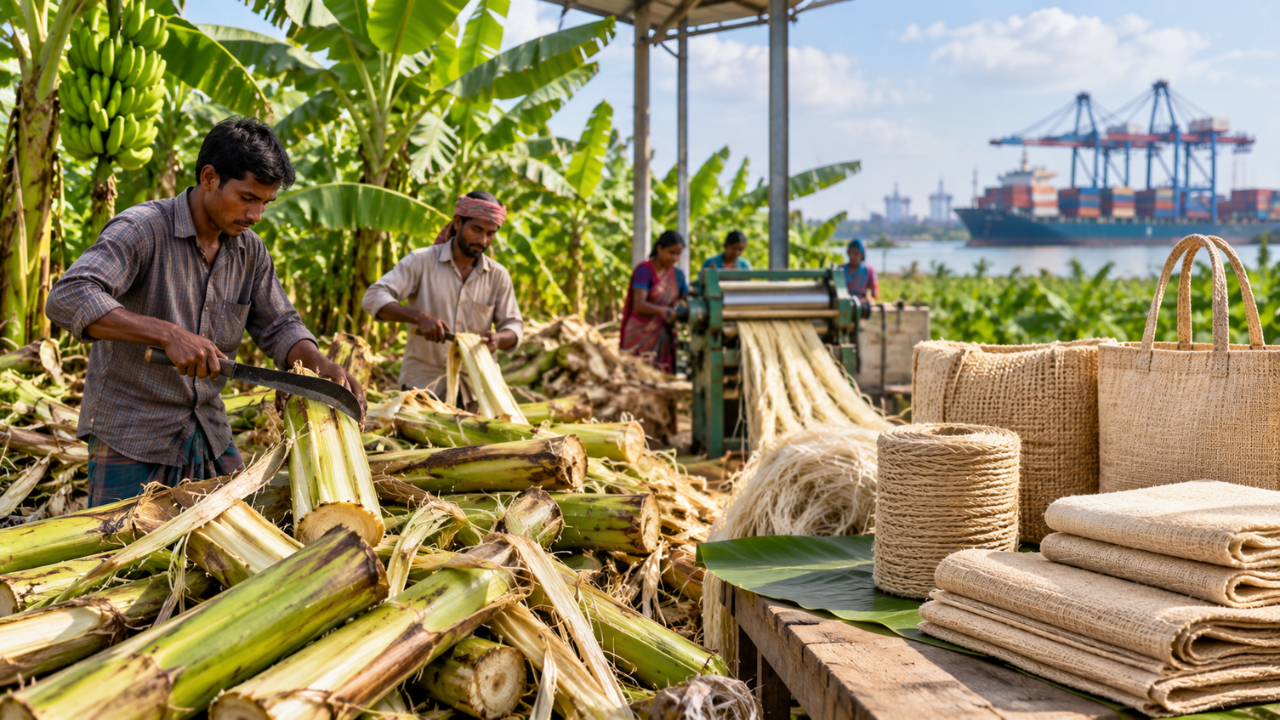
Bangladesh's discarded banana stems could yield 37,778 tonnes of fibre and $94M in exports

Read the original at Times of India ↗
Cite

TOI World Desk. (2026, September 15). Bangladesh's discarded banana stems could yield 37,778 tonnes of fibre and $94M in exports. Times of India. https://timesofindia.indiatimes.com/world/rest-of-world/bangladeshs-banana-farmers-once-discarded-the-stems-the-waste-can-now-produce-37778-tonnes-of-fibre-a-year-and-a-94-million-export-opportunity/articleshow/134257016.cms

Dated when The Aporia collected the article, usually within hours of publication. Check the original for its exact date and byline.

Times of India · collected 2026-09-15 · by TOI World Desk

Quick Summary

Researchers estimate that Bangladesh’s discarded banana stems could produce nearly 37,778 tonnes of banana fibre annually, potentially generating $94 million in exports if sold at $2.50 per kilogram. This opportunity arises from global demand for sustainable materials and the versatility of banana fibre, which can be used in textiles, packaging, and paper products. However, realizing this potential requires significant investment in processing, quality control, research, and international marketing to scale up current small-scale operations.
Written by AI on 2026-09-15, from this article's own text only (the story summary below draws on all the coverage).

AI analysis

Story summary

Bangladesh's discarded banana stems, which are typically waste from extensive banana cultivation, could be turned into 37,778 tonnes of fibre each year, according to a study published in the Journal of Hunan University. This transformation could generate an export opportunity worth over $94 million annually, at a price of $2.50 per kilogram. The potential for banana fibre lies in its suitability for textiles, packaging, and paper production, aligning with global demand for sustainable materials. However, developing this industry requires significant investment in processing infrastructure, quality control, research, and international marketing to ensure commercial viability.

Written for “Bangladesh Banana Stem Fibre” on 2026-11-03, grounded in this article and the 0 other(s) covering the same event.

Story

📰 Bangladesh Banana Stem Fibre
Economy/Business · 1 article(s) covering the same event.

Compared with similar articles

Nothing to compare against. No article is close enough to this one for the pipeline to have linked or judged the pair.
How this article was measured signals, leaning charts, publisher record, byline, topics and claims

Signals How these are calculated →

Claims extracted
25
sentences that state something as happening or true
Uncertain
36%
9 of 25 hedged ("reportedly", "may", "according to")
Leaning
not political
takes no side on a contested political question
Publisher signals
59/100
Times of India's corrections and hedging, across everything collected from it. Not a measure of accuracy.
Outlets on this story
1
Economy/Business
Same framing elsewhere
1
articles that frame the event the way this one does
Analyzed 2026-09-15 · how these are computed

How this is being covered How these are calculated →

Article leaning vs. publisher reliability
Source leaning vs. consistency

Publisher

Times of India · 3984 article(s) · 3 correction(s) detected
Running correction rate · 3 correction(s)

Who wrote this

TOI World Desk
1381 article(s) here · 1 carrying a prediction
🔮 The restored property will take time to develop into a mature habitat, but the project offers an example of how privately owned agricultural land can contribute to biodiversity recovery.
🔮 The return of these mammals is therefore expected to benefit more than just the animals themselves.
🔮 Origins of the emergency relief campaign The project started in early 2020 when Dozier realised that federal emergency support money could take months to reach low-income workers who were at immediate risk of losing their homes.
🔮 Before that, visitors could participate in organised activities such as guided hikes, birdwatching, educational programmes and public hunts.
🔮 While their decision to buy an abandoned French hamlet might appear like an unexpected adventure, Yip and Paul's official website reveals that their story together began decades earlier.
🔮 Hundreds of polar bears are expected to gather near the Canadian town of Churchill in Manitoba as temperatures fall and the animals wait for Hudson Bay to freeze.
🔮 Together they would support the reforestation of Mutuba trees in Uganda for three years.
🔮 In the letter, he apologised for forgetting to send his greetings earlier and expressed hope that they would meet the following year again.
🔮 Meeker told Signal Akron that the sculpture contained details that people could continue discovering over time.
🔮 The possibility that the farm could eventually reach another generation now seems less remote.
Wire or desk byline, not an individual reporter.
Also by TOI World Desk
Nothing else under this byline is closely related to this article, so these are simply their most recent.
All 1381 articles by TOI World Desk →

Topics

Bangladesh Bangladeshi Modern Banana Fibre Company Ltd Musa Banana Fibre the Journal of Hunan University

Subjects

Bangladesh GPE · 8× Bangladeshi NORP · 1× Modern Banana Fibre Company Ltd ORG · 1× Musa Banana Fibre ORG · 1× the Journal of Hunan University ORG · 1×

Narrative

Their study estimates that the global banana fibre market grew at a 5% compound annual growth rate from 2019 to 2023, while stressing that Bangladesh’s $94 million opportunity depends on developing the production, processing, quality and export infrastructure needed to turn agricultural waste into a commercially viable fibre industry.
framing: mixed · carried by 1 article(s) · first seen 2026-09-15
🔮 Bangladesh’s banana farmers could turn discarded banana stems into a source of income, as researchers estimate the waste could produce nearly 37,778 tonnes of banana fibre each year, creating a potential $94 million export opportunity.

Claims (25 extracted, 9 hedged)

Bangladesh’s banana farmers could turn discarded banana stems into a source of income, as researchers estimate the waste could produce nearly 37,778 tonnes of banana fibre each year, creating a potential $94 million export opportunity. uncertain
waste → turn → opportunity
According to the study published in the Journal of Hunan University, titled ‘Unlocking the Potential of Banana Fibre Exports from Bangladesh: A Comprehensive Marketing Strategy Analysis’, the country’s extensive banana cultivation leaves large quantities of pseudo-stems largely unused, even though they can be processed into fibre for textiles, packaging and paper. uncertain
they → accord → textiles
With global demand for sustainable materials growing, banana fibre could offer Bangladesh a new export product while creating employment in rural areas. uncertain
fibre → grow → areas
But reaching this potential will require investment in processing, quality control, research and international marketing. asserted
reaching → reach → processing
Banana waste offers Bangladesh a $94 million export opportunity The fibre estimate becomes particularly significant when its potential export value is considered. asserted
value → offer → opportunity
The study’s findings state that Bangladesh could earn “over $94 million annually” by exporting banana fibre at a price of $2.50 per kilogram. uncertain
Bangladesh → state → kilogram
At the study’s estimated production of 37,778 tonnes, that price works out to about $94.4 million in potential annual revenue, which is why the opportunity can be rounded to $94 million. asserted
opportunity → estimate → million
The researchers are careful to present this as potential rather than money Bangladesh is already earning from banana fibre exports. asserted
Bangladesh → present → exports
Their conclusion says the country is “capable of producing approximately 37,778 tons of banana fibre each year from banana plant waste”, with export potential based on production capacity and an export price of $2.50 per kilogram. asserted
country → say → kilogram
Existing Bangladeshi exporters operate on a much smaller scale, meaning substantial expansion would be required before the estimated opportunity could become actual export revenue. uncertain
opportunity → exist → scale
Banana fibre can be used in many products asserted
fibre → use → products
Banana fibre’s appeal comes not only from the quantity of available waste but also from the range of products it can be used to make. asserted
it → come → products
The study describes banana fibre as a biodegradable natural material composed primarily of cellulose, hemicellulose and lignin. asserted
study → describe → cellulose
It says fibres from different parts of the pseudo-stem can have different characteristics, with inner sheaths producing softer fibres and outer sheaths producing thicker, more robust material. asserted
sheaths → say → material
Banana fibre can be used in textiles, packaging and pulp and paper, as well as for products including yarn, fabric, apparel, handicrafts, paper, security-printing materials and plywood. asserted
fibre → use → yarn
The researchers also point to its strength, moisture absorption and breathability as characteristics that could make it suitable for apparel, home furnishings and technical textiles. uncertain
it → point → apparel
Bangladesh needs investment to expand banana fibre exports Bangladesh already has some foundations for a banana fibre trade. asserted
Bangladesh → need → trade
The study identifies companies including Musa Banana Fibre and Modern Banana Fibre Company Ltd among the country’s manufacturers and exporters, with existing markets in Eastern Europe, South America, Oceania and Central America. asserted
study → identify → Europe
However, the researchers say Bangladesh is “not currently able to export large volumes of banana fibres”, highlighting the gap between the country’s theoretical production potential and its present export capacity. asserted
Bangladesh → say → potential
Closing that gap would require investment in machinery, extraction technology, quality control, worker training, transport and storage, alongside stronger international marketing. asserted
Closing → close → marketing
The study recommends finding new overseas buyers, appointing agents in target markets, investing in research and development and building closer relationships with customers. asserted
study → recommend → customers
It also calls for internationally recognised quality standards and says government support through measures such as subsidies, tax incentives and export-promotion schemes could help the industry develop. uncertain
industry → call → subsidies
Banana waste could create rural jobs Image AI generated uncertain
waste → create → jobs
They argue that using discarded pseudo-stems could help Bangladesh diversify its export basket, create rural employment and participate in the growing market for sustainable materials. uncertain
Bangladesh → argue → materials
Their study estimates that the global banana fibre market grew at a 5% compound annual growth rate from 2019 to 2023, while stressing that Bangladesh’s $94 million opportunity depends on developing the production, processing, quality and export infrastructure needed to turn agricultural waste into a commercially viable fibre industry. asserted
opportunity → estimate → industry

💬Give feedback
🕘History 🎫Support