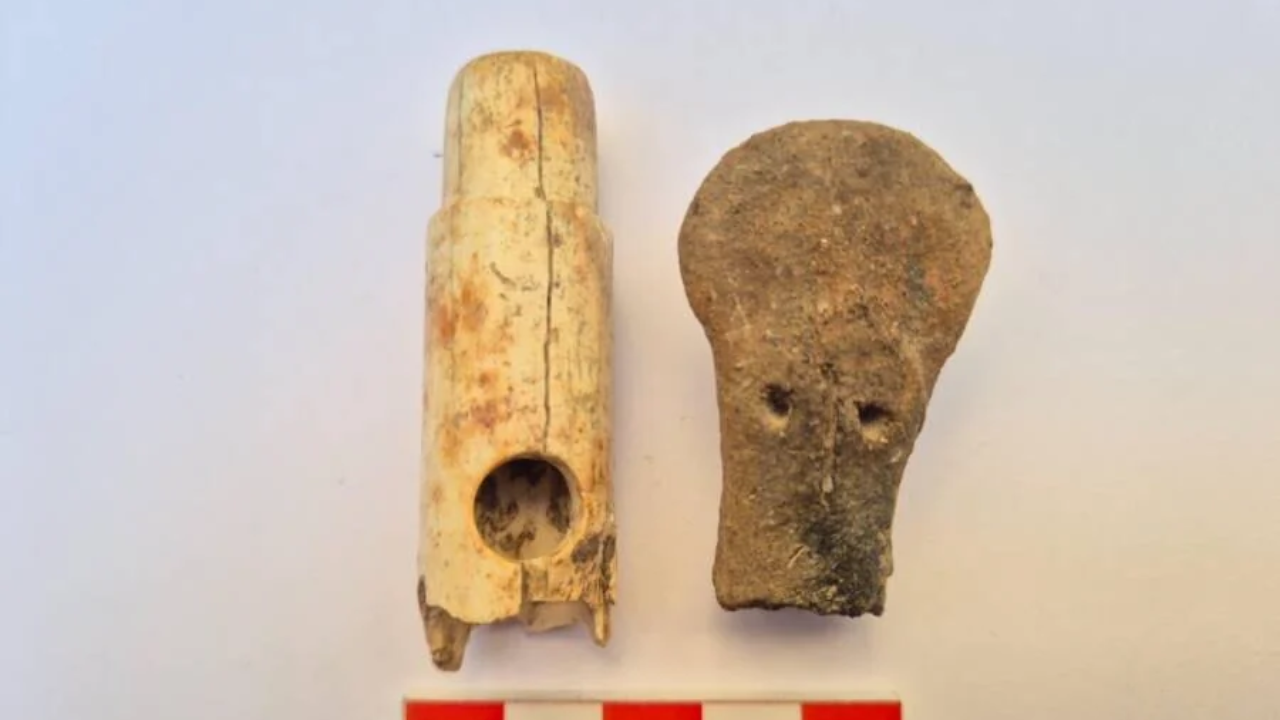
Photo via Times of India

After 160 years of excavations, archaeologists find a 2,800-year-old bone flute at ancient Troy

Read the original at Times of India ↗
Cite

TOI Science Desk. (2026, October 27). After 160 years of excavations, archaeologists find a 2,800-year-old bone flute at ancient Troy. Times of India. https://timesofindia.indiatimes.com/science/archaeology/after-160-years-of-excavations-archaeologists-find-a-2800-year-old-bone-flute-at-ancient-troy-offering-the-first-direct-evidence-of-music-at-the-legendary-city/articleshow/135224017.cms

Dated from the outlet's own feed. Check the original for its byline.

Times of India · collected 2026-10-27 · by TOI Science Desk

Quick Summary

Archaeologists in Turkey recently discovered a 2,800-year-old bone flute during excavations at ancient Troy, marking the first musical instrument found there after 160 years of digging. The flute was uncovered along with a 4,500-year-old humanoid idol, both pieces providing insights into the cultural traditions and daily life in Troy during its resurgence around the eighth century B.C.E., coinciding with the period traditionally associated with the composition of Homer’s epics.
Written by AI on 2026-10-27, from this article's own text only (the story summary below draws on all the coverage).

AI analysis

Story summary

As part of the 160-year-long excavations at ancient Troy, archaeologists recently discovered a 2,800-year-old bone flute, marking the first time such an artifact has been found there. The instrument was uncovered in the site’s Archaic layer, dating it back to around the eighth century B.C.E., coinciding with the founding of Rome and the inception of the Olympic Games. Additionally, a 4,500-year-old humanoid idol was discovered, which may provide insights into cultural traditions of the region during that period.

The bone flute’s head is intact while its body has been lost over time, according to Turkish Ministry of Culture and Tourism’s announcement by Minister Mehmet Nuri Ersoy. Dr Rustem Aslan, director of the Troy excavations, highlighted the discovery as crucial evidence of musical culture at Troy during a pivotal period in classical antiquity when the city was regaining importance after centuries of decline.

Written for “Ancient Bone Flute Found At Troy” on 2026-11-04, grounded in this article and the 0 other(s) covering the same event.

Story

📰 Ancient Bone Flute Found At Troy
Science · 1 article(s) covering the same event.

Compared with similar articles

Nothing to compare against. No article is close enough to this one for the pipeline to have linked or judged the pair.
How this article was measured signals, leaning charts, publisher record, byline, topics and claims

Signals How these are calculated →

Claims extracted
26
sentences that state something as happening or true
Uncertain
15%
4 of 26 hedged ("reportedly", "may", "according to")
Leaning
not political
takes no side on a contested political question
Publisher signals
59/100
Times of India's corrections and hedging, across everything collected from it. Not a measure of accuracy.
Outlets on this story
1
Science
Same framing elsewhere
1
articles that frame the event the way this one does
Analyzed 2026-10-27 · how these are computed

How this is being covered How these are calculated →

Article leaning vs. publisher reliability
Source leaning vs. consistency

Publisher

Times of India · 4056 article(s) · 4 correction(s) detected
Running correction rate · 4 correction(s)

Who wrote this

TOI Science Desk
308 article(s) here · 1 carrying a prediction
🔮 Researchers are continuing to examine daily measurements to determine whether temperatures will climb further.
🔮 According to Reuters reporting by Will Dunham, a new study published in the journal Spixiana documents more than 90 Bangka slow lorises identified between 2015 and 2025.
🔮 “Normally, my job is quite monotonous, so I wanted to create something that would entertain people, turning my ‘serious’ job into something fun,” he said in a Guinness World Records news release.
🔮 The subsequent collision between the two galaxy clusters may then have compressed the cloud or re-energised its particles, causing it to shine more brightly in radio wavelengths once again.
🔮 The mathematicians at the University of California, Davis, argue that the answer may already lie within Einstein’s own equations and that an invisible form of energy may not be needed at all.
🔮 The work will be carried out by the West Tennessee River Basin Authority, which is preparing a plan to restore the river and the land around it.
🔮 Cornell University scientists have developed genetically engineered tomato plants that turn red-purple when nitrogen becomes scarce, giving farmers a visible warning that crops may need fertiliser.
🔮 By studying these crystals and other mineral grains, scientists could establish the meteorite's age and identify later changes caused by water.
🔮 Centuries later, bronze objects found in Scandinavia would preserve chemical signatures consistent with the metals produced at this Spanish site, offering evidence of connections that may have crossed much of Europe.
🔮 Deposited impurities and staining may also have contributed, while low temperatures and humidity could cause the fabric to crack.
Wire or desk byline, not an individual reporter.
Also by TOI Science Desk
Nothing else under this byline is closely related to this article, so these are simply their most recent.
All 308 articles by TOI Science Desk →

Topics

Archaic Greek Olympic Games Rome Troy

Subjects

Homer PERSON · 8× Troy ORG · 8× Aslan PERSON · 4× Greek NORP · 3× Archaic NORP · 2× Mehmet Nuri Ersoy PERSON · 1× Remus PERSON · 1× Rome GPE · 1× Romulus PERSON · 1× the Turkish Ministry of Culture and Tourism ORG · 1×

Narrative

The bone flute was found in what's known as the site's Archaic layer, suggesting that the instrument dates back to about the eighth century B.C.E. This pivotal period in classical antiquity is roughly when the first Olympic Games took place and when legend says Romulus and Remus founded Rome.
framing: assertive · carried by 1 article(s) · first seen 2026-10-27
🔮 Also discovered was a 4,500-year-old humanoid idol, which archaeologists hope will help shed light on the cultural traditions of the region.

Claims (26 extracted, 4 hedged)

For the first time in 160 years of excavations, archaeologists unearthed a musical instrument at Troy, a flute made of bone that dates back about 2,800 years. asserted
that → unearth → bone
Also discovered was a 4,500-year-old humanoid idol, which archaeologists hope will help shed light on the cultural traditions of the region. asserted
archaeologists → discover → region
The bone flute was found in what's known as the site's Archaic layer, suggesting that the instrument dates back to about the eighth century B.C.E. This pivotal period in classical antiquity is roughly when the first Olympic Games took place and when legend says Romulus and Remus founded Rome. asserted
Romulus → find → Rome
Also at this point in time, Troy was beginning to rise back into importance following centuries of decline. asserted
Troy → begin → decline
According to the announcement of the discovery made by the Turkish Ministry of Culture and Tourism, the bone flute's head has been preserved while its body has been lost to history. uncertain
body → accord → history
Culture and Tourism Minister Mehmet Nuri Ersoy announced the discoveries from the 2026 excavation season, saying the flute provided direct archaeological evidence of musical culture at Troy. asserted
flute → announce → Troy
Dr Rustem Aslan, the director of the Troy excavations, emphasised the importance of the discovery. asserted
Aslan → emphasise → discovery
“We know about musical instruments from many depictions elsewhere. asserted
We → know → depictions
However, this is the first time a bone flute has been encountered in the history of Troy excavations,” Aslan said. asserted
Aslan → encounter → excavations
Dating to approximately 750-480 B.C., the instrument provides evidence of music in a period when it played an important role in religious rituals as well as social and public life. asserted
it → date → rituals
Along with the bone flute, researchers found the head of a humanoid idol. asserted
researchers → find → idol
The object was unearthed in a fire-damaged archaeological layer dating back to Troy II or the city's Early Bronze Age phase of occupation. asserted
object → unearth → occupation
During this period, Troy was a fortified settlement, well-connected to other civilisations across western Anatolia due to its position near the Dardanelles Strait. asserted
Troy → fortify → Strait
A shocking entry in Troy's archaeological record, the bone flute will hopefully serve as a window into the folkways and culture of everyday people living in Troy 2,800 years ago. asserted
flute → serve → Troy
Archaeologists noted that the age of the musical instrument is particularly relevant, as it dates back to the same period associated with the legendary Greek poet Homer. asserted
it → note → poet
The composition of Homer’s epics, the Iliad and the Odyssey, is generally dated to the eighth century B.C.E. — just like the bone flute. asserted
composition → date → flute
However, the precise dating of Homer’s works remains under debate. asserted
dating → remain → debate
The Iliad tells the tale of the legendary Trojan War, including the use of the famed Trojan Horse, which occurred (if it actually happened) in Troy. asserted
it → tell → Troy
Meanwhile, the Odyssey narrates the story of how the Greek hero Odysseus journeyed home after the war. asserted
hero → narrate → war
In Book 10 of the Iliad, Homer describes the Greek king Agamemnon standing over the Trojan plain, marvelling “at the many fires that burned before the face of Ilios, and at the sound of flutes and pipes, and the din of men.” asserted
that → describe → men
Aslan himself drew the parallel, saying, according to AA, that Homer specialists accept that the poet lived in the eighth century, and that many researchers accept the epics were written down then. uncertain
epics → draw → century
Finding such an object in an Archaic layer of the same century was, in his words, quite important for the excavation. asserted
Finding → find → excavation
If it in fact occurred at all, the Trojan War is usually thought to have taken place around 1200 B.C.E. When Homer was writing about it some four centuries later, he may have included flute-playing in the narrative because it was popular in his time, even if it may not have been popular 400 years earlier. uncertain
it → occur → time
While the coincidence of a flute being found at Troy and a flute at Troy being described by Homer is intriguing, archaeologists stressed that there is no concrete evidence that directly links the instrument to either Homer or his poems. asserted
that → find → Homer
Aslan also highlighted a different coincidence involving the recent film adaptation of the Odyssey. asserted
Aslan → highlight → Odyssey
According to Aslan, in order to produce the song of the Sirens for the film, the producers made experimental music with a reconstruction of an eighth-century B.C.E. flute, not unlike the one that was just recently found. uncertain
that → accord → one

💬Give feedback
🕘History 🎫Support