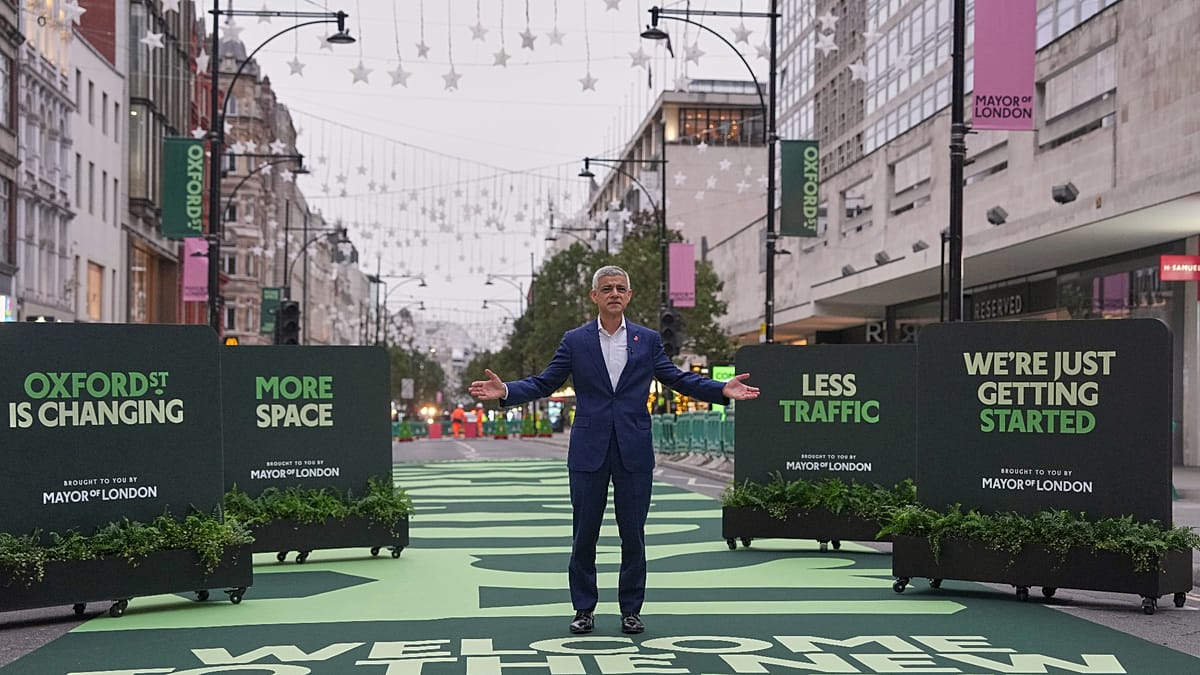
Photo via The Guardian

‘It’s a better experience’: shoppers praise Oxford Street pedestrianisation

Read the original at The Guardian ↗
Cite

Hall, R., & Topham, G. (2026, October 27). ‘It’s a better experience’: shoppers praise Oxford Street pedestrianisation. The Guardian. https://www.theguardian.com/cities/2026/oct/27/shoppers-praise-oxford-street-pedestrianisation

Dated from the outlet's own feed. Check the original for its byline.

The Guardian · collected 2026-10-27 · by Rachel Hall, Gwyn Topham

Quick Summary

London’s Oxford Street has been partially pedestrianized, banning vehicles and allowing only pedestrians from east of Oxford Circus. Shoppers praised the change, noting it provides more space for walking and browsing without the congestion of cars and buses. Mayor Sadiq Khan highlighted this as a "momentous day," with some visitors like Daniel Te calling it an exciting transformation despite potential inconveniences to bus routes. The project aims to enhance shopping experiences during the Christmas period, with broader renovations planned starting in spring 2027.
Written by AI on 2026-10-27, from this article's own text only (the story summary below draws on all the coverage).

AI analysis

Story summary

As of November 2, Oxford Street in central London has seen its first week of pedestrian-only restrictions on a nearly 1km stretch between Orchard Street near Selfridges and Great Portland Street. The ban, initiated by London Mayor Sadiq Khan on October 26, prohibits all wheeled vehicles including cars, buses, taxis, bicycles, e-bikes, and e-scooters in an effort to create a safer and more pedestrian-friendly environment. However, the initiative has faced immediate challenges with hundreds of cyclists from groups like Critical Mass defying the ban, flooding the street on November 2nd despite warnings from city officials. This defiance prompted some cyclists to perform wheelies and other stunts while others played loud music and used flashing lights, causing concerns among shoppers who called for enforcement measures.

Written for “Oxford Street Pedestrianization Chaos” on 2026-11-04, grounded in this article and the 14 other(s) covering the same event.

Story

📰 Oxford Street Pedestrianization Chaos
Crime & Law · 15 article(s) covering the same event. Compare every outlet's account →

Compared with similar articles

This article reads leans left and hedges 12% of its claims. Each row says how that neighbour differs.
Evening Standard
Hedges 1 of 19 claims Outlet record 64/100
Evening Standard
Hedges 3 of 27 claims Outlet record 64/100
Evening Standard
⚖️ Leans left Hedges 5 of 63 claims Outlet record 64/100
Evening Standard
Hedges 1 of 31 claims Outlet record 64/100
Euronews
⚖️ Leans left Hedges 1 of 8 claims Outlet record 60/100
Evening Standard
Hedges 1 of 18 claims Outlet record 64/100
“The articles describe different events: one about facial recognition cameras being installed, and the other about pedestrianization on Oxford Street.”
Evening Standard
Hedges 1 of 37 claims Outlet record 64/100
Evening Standard
Hedges 3 of 16 claims Outlet record 64/100
“Article A describes cyclists riding through Oxford Street shortly after pedestrianisation began, while Article B reports on shoppers' reactions and the initial implementation of the pedestrianisation without mentioning any incidents involving cyclists.”
BBC News
Hedges 0 of 4 claims Outlet record 68/100
Evening Standard
Hedges 1 of 31 claims Outlet record 64/100
How this article was measured signals, leaning charts, publisher record, byline, topics and claims

Signals How these are calculated →

Claims extracted
43
sentences that state something as happening or true
Uncertain
12%
5 of 43 hedged ("reportedly", "may", "according to")
Leaning
Leans left
of the writing, not the subject · beta estimate
Publisher signals
66/100
The Guardian's corrections and hedging, across everything collected from it. Not a measure of accuracy.
Outlets on this story
15
Crime & Law
Same framing elsewhere
1
articles that frame the event the way this one does
Analyzed 2026-10-27 · how these are computed

How this is being covered How these are calculated →

Article leaning vs. publisher reliability
Source leaning vs. consistency

Publisher

The Guardian · 2929 article(s) · 6 correction(s) detected
Running correction rate · 6 correction(s)

Who wrote this

Rachel Hall
9 article(s) here · 1 carrying a prediction
🔮 They will snap and they will crackle, but they may no longer pop, as Kellogg’s has removed rice from its Rice Krispies and Coco Pops cereals due to “changing weather conditions”.
🔮 The report, the culmination of an independent review launched in October 2025 by the Commission for the Future of Counselling and Psychotherapy, argues that counsellors and psychotherapists are an untapped resource that could fill a mental health treatment gap estimated at about 1.8 million people on waiting lists.
🔮 When Patrick Stewart was growing up in the 1940s, he witnessed how, after his father beat his mother, home doctors and ambulance workers would tell her: “You must have done something to provoke him.”
🔮 It may be a wetter Monday morning than London’s mayor would have dreamed of, but Sadiq Khan hailed it a “momentous day”.
🔮 A 1,000-year-old embroidery may be an unusual candidate for a pop culture moment, but young people are seemingly more willing to shell out for tickets for the Bayeux tapestry than spend money on Hollywood blockbusters.
🔮 In 2025, an investigation by the German newspaper Süddeutsche Zeitung found that many animals delivered to Vantara arrived through countries with opaque wildlife trading networks such as the Democratic Republic of the Congo and the United Arab Emirates, raising concerns that endangered species may have been illegally trafficked.
🔮 When Jane* learned that intimate photos of her had been posted on a website without her consent, she expected the police would help her.
🔮 Suzanne Morgan will never forget the day her mother died.
🔮 The group of masked, black-clad vigilantes who blockaded roads in Dover could repeat the disruption unless police step up efforts to stop them, politicians and campaigners have said.
Also by Rachel Hall
Nothing else under this byline is closely related to this article, so these are simply their most recent.
All 9 articles by Rachel Hall →
Gwyn Topham
3 article(s) here · 1 carrying a prediction
🔮 It may be a wetter Monday morning than London’s mayor would have dreamed of, but Sadiq Khan hailed it a “momentous day”.
🔮 In a development that would honour a promise made by Andy Burnham in his Makerfield byelection campaign before entering Downing Street, the planned change, first reported by the Sunday Times, would result in the threshold at which small firms start paying business rates rising from £12,000 to £18,000.
🔮 Now there are further concerns after Microsoft, one of its largest planned customers and expected to have been the anchor tenant, informed the company that it was pulling the plug on its agreement.
Also by Gwyn Topham
Nothing else under this byline is closely related to this article, so these are simply their most recent.

Topics

Guardian Ireland London

Subjects

London GPE · 4× Khan PERSON · 3× Abbas Shigival PERSON · 1× Covid GPE · 1× Daniel Te PERSON · 1× Guardian ORG · 1× Ireland GPE · 1× John Lewis PERSON · 1× Raquel Cox PERSON · 1× Sadiq Khan PERSON · 1×

Narrative

Shoppers who spoke to the Guardian shared their enthusiasm for Khan’s project, revelling in how the extra space to walk the street and browse the shops meant they were no longer crammed so tightly that they jostled one other off the pavement. Daniel Te, who had moved to London from the US in July, was so moved by the scene that he whipped out his sketchpad to memorialise the moment.
framing: assertive · carried by 1 article(s) · first seen 2026-10-27
🔮 It may be a wetter Monday morning than London’s mayor would have dreamed of, but Sadiq Khan hailed it a “momentous day”.

Claims (43 extracted, 5 hedged)

A steady stream of red London buses swing round the last junction before the newly pedestrianised Oxford Street begins. asserted
Street → swing → junction
The streets are crammed with pedestrians, some squabbling over who poked whom with their umbrella first. asserted
who → cram → umbrella
To the west, pedestrians walk freely through the temporary bollards on to a green welcome banner rolled along the tarmac, declaring Oxford Street traffic-free. asserted
Street → walk → tarmac
It may be a wetter Monday morning than London’s mayor would have dreamed of, but Sadiq Khan hailed it a “momentous day”. uncertain
Khan → dream → it
Almost a kilometre of the capital’s most famous shopping street has now been pedestrianised, banishing the buses, bikes, taxis, e-scooters and pedicabs along with private cars. asserted
kilometre → pedestrianise → cars
Shoppers who spoke to the Guardian shared their enthusiasm for Khan’s project, revelling in how the extra space to walk the street and browse the shops meant they were no longer crammed so tightly that they jostled one other off the pavement. Daniel Te, who had moved to London from the US in July, was so moved by the scene that he whipped out his sketchpad to memorialise the moment. asserted
he → speak → moment
I’m trying to capture the sheer mass of people going down the street,” he said, observing that despite the pedestrianisation, most people continued to walk on the pavement. asserted
people → try → pavement
“It’s an entirely new place now, isn’t it?” he said. asserted
he → ’ → ?
“My first impression was I remember getting off the Oxford Circus tube stop and seeing the scramble crossing and all the people walking around, and I was like, ‘wow, that’s really cool.’ asserted
that → remember → crossing
So now to see the whole street become kind of like the scramble crossing is really exciting.” asserted
street → see → crossing
Te added that on a typical day he would avoid the street because it was “too busy”. asserted
it → add → street
“Now there’s more space to walk around, I’m more inclined to come,” he said. asserted
he → ’ → ?
A former city planner, he considered it “a really big achievement when a street becomes pedestrianised”, adding that he would love to see neighbouring streets become car-free. asserted
streets → consider → ?
“Covid taught us a lot about what we can do with our spaces,” he said, noting that although he thought the bus rerouting might make some journeys more inconvenient, “it’s a small price to pay”. uncertain
it → teach → spaces
Raquel Cox, who was on holiday from Ireland, came to the street after watching a news item on the pedestrianisation. asserted
who → come → pedestrianisation
“We couldn’t believe it. asserted
We → believe → it
We said, ‘We have to go there and experience it first-hand’.” asserted
We → say → it
Although she acknowledged there could be negative impacts on the surrounding streets, which will become busier as a result, she felt that as a shopper, “it’s a better experience”. uncertain
it → acknowledge → shopper
After decades of discussion, the closure to traffic has come into effect in time for the busy Christmas shopping period, although the bigger transformation of the street – a £150m project including trees, seating and level “plazas” for events – will start taking shape from spring 2027. asserted
transformation → come → spring
Abbas Shigival, who runs a kiosk selling tourist souvenirs at the start of the pedestrianised section, said it would take time to determine the impact on his business, though he thought the morning had been a little busier than usual. asserted
morning → run → business
“It’s a more pleasant environment,” he said. asserted
he → ’ → ?
“People are happier because they can walk around.” asserted
they → walk → ?
His views were echoed by Khan – whose first jobs were in retail in stores in the street – in a speech at John Lewis on Monday morning. asserted
jobs → echo → morning
The mayor said: “We’ve seen over the last couple of decades this street in decline … asserted
street → say → decline
Pedestrianising the street with great public transport links, more greenery, more seating, will link to a better experience all round.” asserted
Pedestrianising → pedestrianise → experience
The permanent plans will depend on feedback in the first phase and testing, and Khan said London “would be closely monitoring these changes to make sure they are working for everyone”. asserted
they → depend → everyone
He added: “I want this to be a proof of concept – that investing in people rather than traffic leads to better footfall and spend.” asserted
investing → add → footfall
Many of London’s doubledecker buses will now be diverted into neighbouring roads. asserted
Many → divert → roads
Claire Mann, the chief operating officer at Transport for London, said there would still be “plenty of capacity for passengers” and it should not affect reliability. asserted
it → say → reliability
“We’ll be monitoring to see if it does have an impact on ridership – but Bond Street and the Elizabeth Line does give you a way to arrive in style,” she said. asserted
she → monitor → style
Not everyone agrees, however. asserted
everyone → agree → ?
Ben McMullan, a taxi driver, said traffic was “definitely worse on the surrounding streets, and accessibility is a huge problem”, noting that he had “got stuck in areas I wouldn’t have got stuck in before”. asserted
I → say → areas
He had already dropped off several customers that morning who had struggled with no direct access to the street by car, including a mother with a pram and a woman with walking difficulties. asserted
who → drop → difficulties
“I could only get her so far and she was really disappointed,” he said. uncertain
he → get → her
McMullan feared the change might have a negative impact on his business. uncertain
change → fear → business
“Once people realise they can’t get to where they need to go, I think automatically that just shuts them off from getting in the cab,” he said. asserted
he → realise → cab
Jack* was one of many cyclists stopped by security guards over the course of the day as he cycled down the street, on his way home from a construction job. asserted
he → stop → job
I’m not going to listen to no one. asserted
I → go → one
I’m going to ride down this road, whether they like it or not,” he said, adding that an alternative route would make his commute longer. asserted
commute → go → it
“It’s not going to work for me.” He disagreed with pedestrianisation on principle. asserted
He → go → principle
…and 3 more, not listed.

💬Give feedback
🕘History 🎫Support