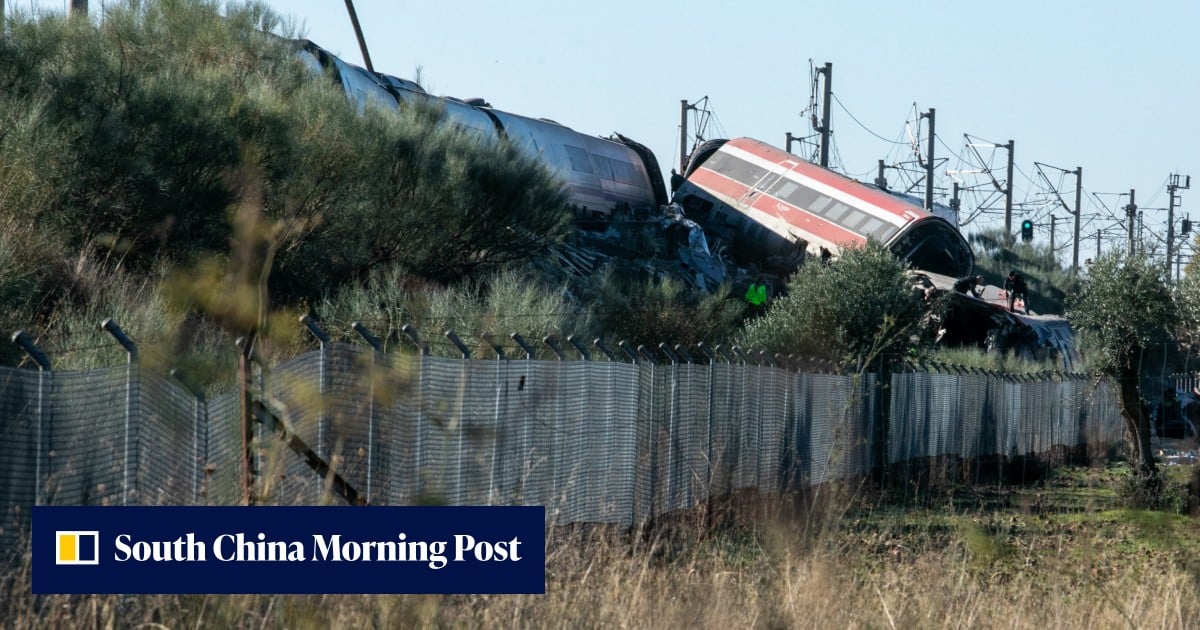
Photo via BBC News

Bloodied, dazed and angry - how passengers' rail journey turned to disaster in Spain

Read the original at BBC News ↗
Cite

Kola, P. (2026, October 28). Bloodied, dazed and angry - how passengers' rail journey turned to disaster in Spain. BBC News. https://www.bbc.co.uk/news/articles/cm9qzd47ng98o?at_medium=RSS&at_campaign=rss

Dated from the outlet's own feed. Check the original for its byline.

BBC News · collected 2026-10-28 · by Paulin Kola

Quick Summary

At around 09:00 local time in Spain, two high-speed trains—one operated by Renfe with 397 passengers and another by Iryo with 147—crashed near Mora and Orgaz, south of Madrid. The collision occurred due to a computer failure in the automatic signaling system that led an employee to order the moving train to proceed despite being warned about congestion ahead, resulting in the rear train crashing into the stationary one. Passengers reported severe injuries including broken bones and smoke inside the wreckage, while some survivors described seeing fatalities outside the trains.
Written by AI on 2026-10-28, from this article's own text only (the story summary below draws on all the coverage).

AI analysis

Story summary

On October 27, 2026, two high-speed trains collided near Toledo province in central Spain, resulting in the deaths of 39 people. The crash occurred on a line connecting Madrid to Seville and involved an AVE train from Renfe and an Iryo train traveling in opposite directions. Emergency services reported that at least three carriages derailed, prompting rail operator Adif to suspend all traffic between Madrid and Andalusia. Authorities are investigating the cause of the accident, with initial reports suggesting it may be due to human error or failures within Spain's high-speed rail system.

Written for “Spain Train Crash Tragedy” on 2026-10-30, grounded in this article and the 94 other(s) covering the same event.

Story

📰 Spain Train Crash Tragedy
World · 95 article(s) covering the same event. Compare every outlet's account →

Compared with similar articles

This article reads unscored and hedges 6% of its claims. Each row says how that neighbour differs.
BBC News
Hedges 2 of 26 claims Outlet record 69/100
New York Post
Hedges 0 of 11 claims Outlet record 66/100
The Hindu
Hedges 0 of 10 claims Outlet record 77/100
NBC News
Hedges 1 of 12 claims Outlet record 60/100
ABC News (US)
Hedges 2 of 5 claims Outlet record 70/100
The Sydney Morning Herald
Hedges 1 of 15 claims Outlet record 61/100
South China Morning Post
Hedges 0 of 5 claims Outlet record 64/100
The Guardian
Hedges 3 of 29 claims Outlet record 66/100
NPR
Hedges 0 of 13 claims Outlet record 60/100
CBC News
Hedges 0 of 14 claims Outlet record 74/100
How this article was measured signals, leaning charts, publisher record, byline, topics and claims

Signals How these are calculated →

Claims extracted
51
sentences that state something as happening or true
Uncertain
6%
3 of 51 hedged ("reportedly", "may", "according to")
Leaning
not political
takes no side on a contested political question
Publisher signals
69/100
BBC News's corrections and hedging, across everything collected from it. Not a measure of accuracy.
Outlets on this story
95
World
Same framing elsewhere
1
articles that frame the event the way this one does
Analyzed 2026-10-28 · how these are computed

How this is being covered How these are calculated →

Article leaning vs. publisher reliability
Source leaning vs. consistency

Publisher

BBC News · 4668 article(s) · 5 correction(s) detected
Running correction rate · 5 correction(s)

Who wrote this

Paulin Kola
11 article(s) here · 1 carrying a prediction
🔮 How could this happen?
🔮 - Published Local curfews may come into force in French towns following a weekend of disorder.
🔮 Every evening, throughout the summer for some 135 days in a row, Albanians in central Tirana would hold pictures of a pink flamingo, calling on Prime Minister Edi Rama - now in his fourth term - to resign.
2026-10-16 · assertive framing · Albanian protests turn violent: What we know
🔮 - Published Top Iranian and US officials have held talks at the UN in New York on a day when the US leader said he could "annihilate" the Islamic Republic if the conflict went unresolved.
🔮 An AI researcher who left Anthropic told the BBC that "if we don't slow down at the current rate of progress, there is a strong chance that we could all die in the immediate future".
🔮 - Published US President Donald Trump says he would offer every adult American a $5,000 (£3,700) payout if Republicans win both chambers of Congress in November's midterm elections – a plan that would cost more than a trillion dollars.
🔮 In the early hours of Friday morning, rescuers heard what they thought could be voices at the Trishuli 3A hydropower site.
🔮 Nine fellow defendants have been sentenced to life imprisonment, while seven have been acquitted. Khalifa's lawyer said she would appeal the death sentence. The verdict was first announced last month.
🔮 "Iran has been notified that any ship or boat placing new mines will be immediately and systematically destroyed," Trump said in a post on his Truth Social platform.
2026-08-26 · assertive framing · Trump says all mines cleared from Strait of Hormuz
Also by Paulin Kola
Nothing else under this byline is closely related to this article, so these are simply their most recent.
All 11 articles by Paulin Kola →

Topics

Iryo Madrid Renfe Seville Spanish

Subjects

Renfe ORG · 5× Spanish NORP · 4× Madrid GPE · 2× Seville GPE · 2× Spain GPE · 2× Iryo ORG · 1× Mora GPE · 1× Onda Cero ORG · 1× Orgaz GPE · 1× Roberto Gómez PERSON · 1×

Narrative

Transport Minister Óscar Puente appeared in front of the cameras to say an employee had ordered the resumption of travel at 08:36 and some 17 minutes later the "truly unbelievable" had happened.
framing: assertive · carried by 1 article(s) · first seen 2026-10-28
🔮 How could this happen?

Claims (51 extracted, 3 hedged)

- Published It was approaching 09:00 (08:00 GMT) and two high-speed trains were travelling south from the Spanish capital, Madrid, to Seville. asserted
trains → publish → Seville
One, run by state-owned operator Renfe had 397 passengers on board. asserted
One → run → board
A reported issue with the automatic signalling system - a computer failure - had forced all trains to halt on the affected stretch. asserted
issue → report → stretch
Then the impossible happened, Spain's transport minister said, as the Renfe train was ordered to proceed in "error". asserted
train → happen → error
It crashed into the back of the other train between municipalities Mora and Orgaz, and about 140km (87 miles) south of Madrid. asserted
It → crash → Madrid
Spanish journalist Roberto Gómez was dozing on the high-speed Renfe train, when the train stopped and an announcement was relayed to passengers that there was congestion on the tracks. asserted
announcement → doze → tracks
The train eventually began to move again, he explained, and then the crash happened. asserted
crash → begin → ?
"The impact was terrible," he told Onda Cero radio. asserted
he → tell → radio
"You can imagine, the carriage is completely destroyed. asserted
carriage → imagine → ?
All the suitcases are all over the wrecked carriage." asserted
suitcases → wreck → carriage
Gómez suffered only minor injuries but described another passenger falling on top of him and sustaining a deep gash on his head. asserted
passenger → suffer → head
"We were able to help people who had suffered severe blows to their chest and ribs," he said. asserted
he → help → chest
In the last carriage of the Renfe train, Miguel Ángel Pérez observed a similar scene. asserted
Pérez → observe → scene
The carriage partially overturned," he told Spanish TV program La Hora de La 1. asserted
he → overturn → program
"Luckily there were few people standing," he said. asserted
he → be → ?
Passengers then jumped out of the carriage through the windows. asserted
Passengers → jump → windows
The train that was hit from behind was one of six to have been ordered to halt at 08:30. asserted
that → hit → 08:30
It was still stationary when the order was given to the Renfe train to proceed. asserted
order → give → train
Transport Minister Óscar Puente appeared in front of the cameras to say an employee had ordered the resumption of travel at 08:36 and some 17 minutes later the "truly unbelievable" had happened. asserted
unbelievable → appear → 08:36
Sebastián Herrero from Seville was on the Iryo train and experienced the crash first hand. asserted
Herrero → experience → crash
He felt a "terrible, terrible impact" and was thrown on to the seats in front of him, he told El Mundo newspaper. asserted
he → feel → newspaper
"After we fell, there were many people with broken noses, broken arms... asserted
we → fall → noses
We started seeing smoke everywhere." asserted
We → start → smoke
Another man, who was not identified, told Reuters news agency: "Everything was overturned. asserted
Everything → identify → agency
Some people were thrown into the air. asserted
people → throw → air
They are very badly injured." asserted
They → injure → ?
Eduarda was also on the stationary train, travelling with her two cats. asserted
Eduarda → travel → cats
She told Cadena Ser radio how the crash had propelled her forwards. asserted
crash → tell → her
Once outside, the chaos hit her. asserted
chaos → hit → her
She heard screams and saw people under the train who she said had died, and a carriage was on fire. asserted
carriage → hear → fire
For Fernando Seco the worst came after he left the train and saw a "horrible scene". asserted
he → come → scene
"There were many injured people, a lot of blood and many dead," he said. asserted
he → be → blood
How could this happen? uncertain
this → happen → ?
Some of the fortunate passengers who escaped injury in the crash began helping others. asserted
who → escape → others
Even injured and bloodied passengers did their best to help. asserted
passengers → injure → best
It was not long before local people arrived, followed by the police and ambulance services of the Guardia Civil. asserted
people → arrive → Civil
"People from neighbouring towns brought water," a volunteer told Reuters. asserted
volunteer → neighbour → Reuters
"We are distributing it, especially to be taken to the accident site where people are in worse condition." asserted
people → distribute → condition
Some residents brought cars to help with the evacuation to the nearby town of Urda, he explained. asserted
he → bring → Urda
Spain was already reeling from the Adamuz high-speed rail disaster outside Córdoba in January, in which 46 people died. asserted
people → reel → which
…and 11 more, not listed.

💬Give feedback
🕘History 🎫Support