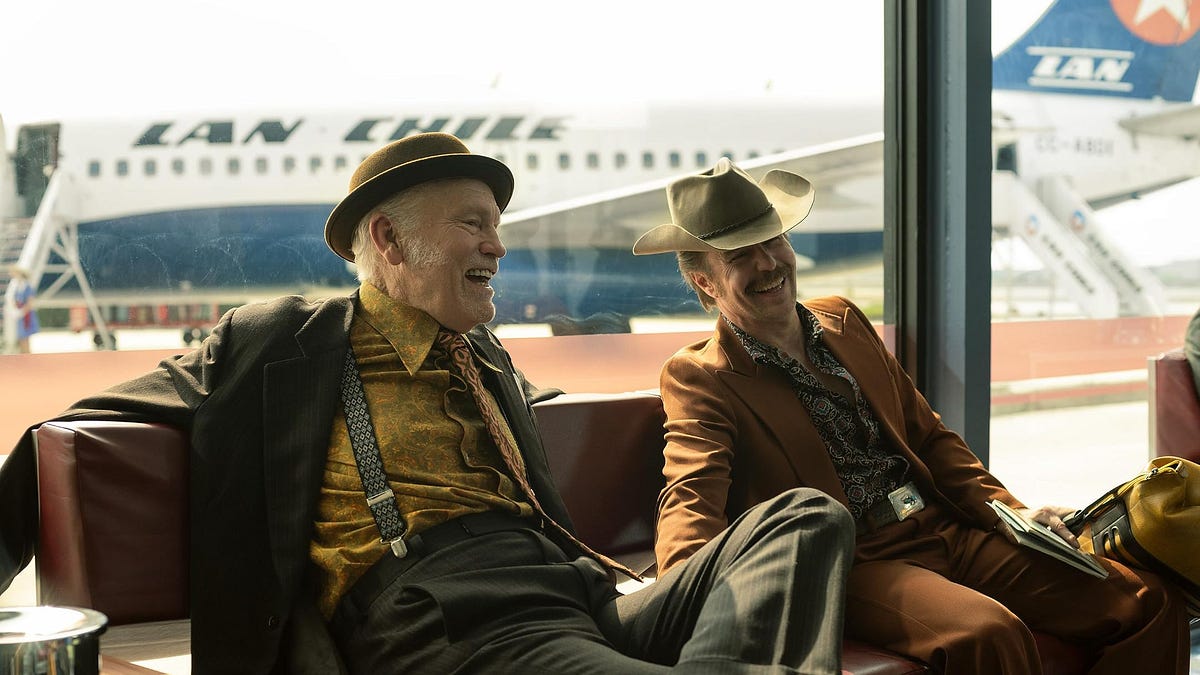
FOR A MOVIE ABOUT a cancer-riddled hitman for the CIA who holds the secret to the Kennedy assassination but can’t remember if he asked his coworker to kill him among the big stone heads of Easter Island, Wild Horse Nine has a surprising number of laugh-out-loud lines.
asserted
Nine → riddle → lines
The riff on democracy turning countries gay, which in turn leads to the development of fine cheeses; the resemblance of various religious totems to dwarves with which sexual congress has yet to be had; a character who exclaims, with something approaching tired exasperation, “Not once did I say ‘Fuck a clown’”: Martin McDonagh knows how to put the comic in darkly comic.
asserted
McDonagh → turn → comic
Of course, anyone who has seen In Bruges, one of the best films of the 2000s, or The Banshees of Inisherin, one of the best films of the 2020s, likely already knows that.
asserted
who → see → that
If you’ve seen those movies, you’ve already got the release date for Wild Horse Nine—with its cast of John Malkovich as the ailing CIA agent, Chris Carlisle; Sam Rockwell as his mentee, Lee Chesterfield; and Steve Buscemi as MJ, their pain-in-the-ass bureau chief out of Chile—circled in your day planner.
asserted
you → see → planner
The plot matters less than the talent.
asserted
plot → matter → talent
Which is good, since there’s not much in the way of plot here.
asserted
Which → ’ → plot
Chris and Lee go to Easter Island in 1973, where Chris hopes to finish his memoir before he asks Lee to kill him, and MJ hopes to learn the location of the rifle that killed JFK, which may or may not be in MJ’s possession.
uncertain
which → go → possession
While there, they run into some Chilean students who may or may not wind up tortured to death in the middle of Santiago’s National Stadium several months hence, once the coup Lee and Chris are plotting takes place, and Lee’s wife (Parker Posey) may or may not be fucking the aforementioned clown.
uncertain
wife → run → clown
Who’s to say?
asserted
Who → say → ?
Wild Horse Nine is, in certain respects, an elliptical film, one moving forward a bit before circling back to its central preoccupation with guilt and regret.
asserted
Nine → move → guilt
It has the sort of script that only works in the hands of skilled chatters, actors with perfect comic timing and the ability to bounce off one another.
asserted
that → have → one
We’re in good hands, as few are better at this sort of thing than Malkovich and Rockwell.
asserted
few → ’re → Malkovich
Malkovich’s sad, droopy eyes undercut the sardonic glee with which he spends much of the movie revealing the CIA’s plans, while Rockwell has mastered the ability of looking confidently befuddled, no easy trick.
asserted
Rockwell → undercut → ability
And it really is a very funny film, albeit one you can never be entirely sure you should be laughing at.
asserted
you → laugh → one
Are we allowed to titter at Lee and Chris’s annoyance at the repeated deployment of the phrase “indigenous,” which feels like a mild anachronism for a movie set in 1973?1 Should we acknowledge the grim truth that Chris is, ultimately, right when he questions the usefulness of marches and instead insists “shooting people changes stuff”?
asserted
he → allow → stuff
Or is that simply the jaundiced view of a man who spent his career changing stuff by shooting people?
Become a Bulwark+ member and join a community that loves great movies, big ideas, spirited arguments, and discovering something new together.
asserted
that → spend → something
MUCH OF WILD HORSE NINE focuses on real-world activities by the CIA around the world, which is why its insistence on veering into conspiratorial tangents about JFK is mildly distracting.
asserted
insistence → focus → JFK
It is very much a movie about the actions of the past weighing on the people of the present.
asserted
It → weigh → present
Fatherland, too, concerns the way the past intersects with the present and how much the sins of the past should impact behavior in the present.
asserted
sins → concern → present
Writer-director Paweł Pawlikowski’s film follows German writer Thomas Mann’s (Hanns Zischler) return to Germany in 1949, where he will receive a Goethe Prize.
asserted
he → follow → Prize
His son, Klaus (August Diehl), is disgusted by the journey; the family fled in 1933, following the rise of Hitler, and he and his sister, Erika (Sandra Hüller), consider Germany to be still riddled with fascists.
asserted
Germany → disgust → fascists
Some of whom remain eager to stay in power.
asserted
Some → remain → power
The most interesting political moments in the film come early on, during a reception, when grandchildren of Richard Wagner ask Mann for his aid in rehabilitating the composer (Mann refuses, despite loving the man’s music) and an actor who cozied up to Göring makes it clear he believes he has a place in the post-Nazi Germany, much to Erika’s chagrin.
asserted
he → come → chagrin
Mann’s own sensibilities are harder to navigate: he says he will accept an identical honor from the Soviet-dominated East Germany, believing the award belongs to a unified nation.
asserted
award → navigate → nation
And his sympathies are clearly with the Communists over the fascists, though this sympathy is strained when, during the trip East, a desperate man barges into his room asking Thomas and Erika to tell the world that the Soviets have been imprisoning political prisoners in Buchenwald.
asserted
Soviets → strain → Buchenwald
To be quite blunt, watching this film, I wish I had a better sense of Mann’s life and work than I do.
asserted
I → watch → life
Pawlikowski does not provide much in the way of background; we are thrown into the drama of the Mann family’s life as if we should be intimately familiar with his work and the conflicts that arose via the push-pull of the totalitarian conflicts of the mid-twentieth century.
asserted
that → provide → century
Though ultimately that doesn’t matter so much, given the intimate nature of the film’s true conflict, that of a father unsure how to relate to his son and the daughter caught between them.
asserted
that → matter → them
Hüller delivers one of the performances of the year as Erika, a character who is vexed by her father’s seeming refusal to care about her brother, his son’s, suicide in the early going.
asserted
who → deliver → going
His apparent unfeelingness leads her to question how much art matters in a world that has just shown that sometimes shooting millions of people is what it takes to “change stuff.”
asserted
it → lead → stuff
Fatherland is the closing chapter in Pawlikowski’s historical trilogy, alongside Ida and Cold War; the latter remains my favorite in the triptych, though all three are imbued with a stark, black-and-white beauty befitting the historical subject matter.
asserted
three → close → matter
Taken together, the three films are a profound meditation on the nature of art in the face of totalitarianism: its uses, its limits, and how it can inform the souls of the individuals who experience—or create—it.
asserted
who → take → it
Google’s N-gram suggests the phrase “indigenous peoples” didn’t really take off until the 1990s, but that’s neither here nor there, I suppose; we should not begrudge McDonagh his annoyances, particularly when we share them.
uncertain
we → suggest → them
 The Aporia