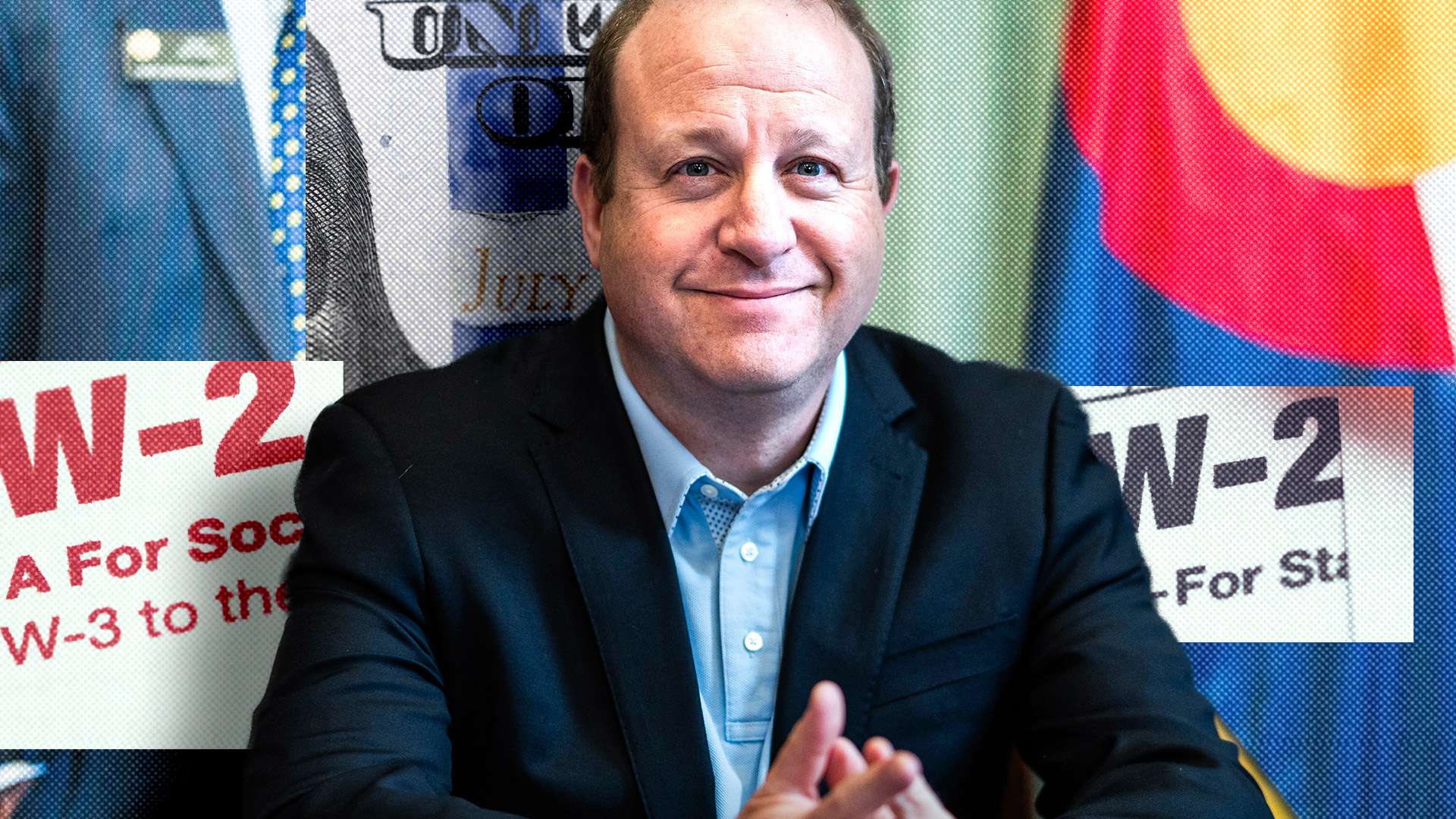
Photo via Reason

Jared Polis Warns Colorado's Progressive Tax Ballot Measure Could 'Cripple' the Economy

Read the original at Reason ↗
Cite

Boehm, E. (2026, October 29). Jared Polis Warns Colorado's Progressive Tax Ballot Measure Could 'Cripple' the Economy. Reason. https://reason.com/2026/10/29/jared-polis-warns-colorados-progressive-tax-ballot-measure-could-cripple-the-economy/

Dated from the outlet's own feed. Check the original for its byline.

Reason · collected 2026-10-29 · by Eric Boehm

Quick Summary

Colorado faces a crucial election with Proposition 136 and Amendment 87 on the ballot. Proposition 136 aims to cap income taxes at 4.4%, maintaining the current flat rate, while Amendment 87 proposes a progressive tax system starting at 7.4% for incomes over $500,000, potentially generating an additional $2–$3 billion annually. Governor Jared Polis warns that adopting Amendment 87 could "cripple" Colorado's economy and reduce job opportunities by making the state less competitive with its neighbors due to higher tax rates.
Written by AI on 2026-11-01, from this article's own text only (the story summary below draws on all the coverage).

AI analysis

Story summary

As of October 29, 2026, Colorado Governor Jared Polis has warned that a ballot measure called Amendment 87 could "cripple" the state's economy if passed in the upcoming election. The measure proposes a progressive income tax system with rates ranging from 3.7% on income up to $25,000 to 8.4% on income over $1 million, generating an estimated additional $2–3 billion annually for the state government. In contrast, Proposition 136 seeks to cap individual and corporate income taxes at the current flat rate of 4.4%. Both measures cannot coexist; Amendment 87 would need to win a majority and receive more votes than Proposition 136 to take effect, as reported by The Denver Post.

Written for “Jared Polis Warns Against Tax Measure” on 2026-11-01, grounded in this article and the 0 other(s) covering the same event.
Why this leaning score
The model judged this article politically coded and scored it -0.45, but none of the 2 quote(s) it offered could be found in the article text, so the score is not published.
Written under an earlier scoring contract, which gave a paragraph rather than checkable quotes. Re-analysing this article replaces it.
Leaning score withheld for article 115271: no verified evidence · logged 2026-11-01

Story

📰 Jared Polis Warns Against Tax Measure
Politics · 1 article(s) covering the same event.

Compared with similar articles

Nothing to compare against. No article is close enough to this one for the pipeline to have linked or judged the pair.
How this article was measured signals, leaning charts, publisher record, byline, topics and claims

Signals How these are calculated →

Claims extracted
33
sentences that state something as happening or true
Uncertain
12%
4 of 33 hedged ("reportedly", "may", "according to")
Leaning
withheld
no quote in the article backed the model's score
Publisher signals
67/100
Reason's corrections and hedging, across everything collected from it. Not a measure of accuracy.
Outlets on this story
1
Politics
Same framing elsewhere
1
articles that frame the event the way this one does
Analyzed 2026-11-01 · how these are computed

How this is being covered How these are calculated →

Article leaning vs. publisher reliability
Source leaning vs. consistency

Publisher

Reason · 1046 article(s) · 4 correction(s) detected
Running correction rate · 4 correction(s)

Who wrote this

Eric Boehm
20 article(s) here · 1 carrying a prediction
🔮 The New York Times reports that Democrats will move quickly on four items that are "consensus items among their members that are basic enough to bypass time-consuming committee consideration and go straight to the floor."
2026-10-30 · mixed framing · What Will Democrats Do?
🔮 Next week's election is a pivotal one for Colorado, as voters will decide a pair of ballot questions that could secure the state's low-tax, small-government reputation—or shatter it.
🔮 Habba will get $50 million over five years to do unspecified work for a company that barely exists, according to The New York Times, while Herrera got a presidential pardon for a 2025 campaign finance charge.
2026-10-22 · assertive framing · The Swamp King
🔮 A proposed "wealth tax" on California's billionaires could backfire and cost the state tens of billions of dollars in the long run.
🔮 America's interminable war with Iran has killed thousands, disrupted commerce that flows through the Strait of Hormuz, and raised prices on the home front. But there may be one silver lining.
🔮 The White House has not said when the purchases will be made, what prices will be paid, or who will be paying (private companies or taxpayers), though the Treasury announced that it would be issuing a "temporary general license to allow the supply of Russian diesel to the global market."
🔮 Instead, Rep. John James (R–Mich.) has introduced a bill that would use some tariff revenue to offset the economic harm being caused by…the tariffs.
🔮 "As of May 2026, USICH had 10 full-time employees and a part-time executive director," the Government Accountability Office (GAO) reported in an audit published last week.
🔮 Pretti's death would quickly become a national news story.
🔮 The Trump administration has touted the recent announcement of a new steel plant in Iowa as proof that the tariffs are working to revitalize American manufacturing—which is only true if you look at the benefits while willfully ignoring the costs.
Also by Eric Boehm
What Will Democrats Do?
2026-10-30 · Reason
The Swamp King
2026-10-22 · Reason
Nothing else under this byline is closely related to this article, so these are simply their most recent.
All 20 articles by Eric Boehm →

Topics

Amendment 87 Coloradans Colorado Proposition 136 the Tax Foundation

Subjects

Colorado GPE · 5× Polis PERSON · 2× Utah GPE · 2× Coloradans NORP · 1× Democrats NORP · 1× Jared Walczak PERSON · 1× The Colorado Democratic Party ORG · 1× The Colorado Sun ORG · 1× the AFL-CIO ORG · 1× the Tax Foundation ORG · 1×

Narrative

"In short, that means Amendment 87 would need to both win majority support from voters and surpass Proposition 136 in total votes to go into effect," explains the Denver Post, which has encouraged residents to vote against both ballot measures.
framing: assertive · carried by 1 article(s) · first seen 2026-11-01
🔮 Next week's election is a pivotal one for Colorado, as voters will decide a pair of ballot questions that could secure the state's low-tax, small-government reputation—or shatter it.

Claims (33 extracted, 4 hedged)

Next week's election is a pivotal one for Colorado, as voters will decide a pair of ballot questions that could secure the state's low-tax, small-government reputation—or shatter it. uncertain
that → decide → it
Confusingly, there is a slim possibility that they decide to do both. asserted
they → be → both
The two competing ballot measures could hardly be more different. uncertain
measures → compete → ?
The first, Proposition 136, would cap individual and corporate income taxes at 4.4 percent—the state's current flat rate. asserted
first → cap → percent
The other, Amendment 87, would rewrite the state's constitution to allow for a progressive income tax. asserted
other → rewrite → tax
It would also set new rates, ranging from 7.4 percent on income over $500,000 to 8.4 percent on income over $1 million. asserted
It → set → million
And it would offer a modest tax cut to the lower end of the income spectrum: Individuals earning less than $100,000 would pay 4.2 percent, while those earning less than $25,000 would pay 3.7 percent. asserted
those → offer → percent
Both advocates and opponents agree that it would generate about $2–3 billion in additional annual revenue for the state government. asserted
it → agree → government
For now, the higher tax rates created by Amendment 87 would only apply to incomes over $500,000. asserted
rates → create → 500,000
Unsurprisingly, supporters of the measure are framing this as an opportunity to make the wealthy "pay their fair share." asserted
wealthy → frame → share
There are two reasons why that argument is a bit deceiving. asserted
argument → be → ?
As Jared Walczak, a senior fellow at the Tax Foundation, points out, "the new rates would be statutory, while the authorization for a graduated-rate tax would be enshrined in the constitution, permitting the legislature to adjust rates later." asserted
authorization → point → rates
Lawmakers would not have to get permission from the voters to make those changes, so Coloradans would be trading away their flat income tax for a new model where income taxes could be hiked by the legislature at any time. uncertain
taxes → have → time
Second, the new rates are not indexed to inflation. asserted
rates → index → inflation
As a result, "a household making $450,000 a year in today's dollars would be moved into a higher tax bracket within eight years if their earnings increased by 3% annually," reports The Colorado Sun, which crunched the numbers. asserted
which → make → numbers
Such "bracket creep" would also push more workers over the $100,000 threshold, nullifying the small tax cut for workers making less than that. asserted
creep → push → that
Politically, the progressive income tax proposal is dividing Democrats. asserted
proposal → divide → Democrats
The Colorado Democratic Party has endorsed Amendment 87 (along with many of its usual allies, like the AFL-CIO and the state's largest teachers union). asserted
Party → endorse → CIO
But Democratic Gov. Jared Polis has called the proposal "a huge blank check to politicians" that will "cripple our economy and reduce jobs." asserted
that → call → jobs
In comments to a Denver TV station, Polis also highlighted how higher taxes in Colorado would make the state less competitive with its neighbors. asserted
state → highlight → neighbors
"Utah has a very similar tax rate to what we have. asserted
we → have → what
If ours is double, we can't compete for businesses," Polis told Denver7. asserted
Polis → compete → Denver7
We will not be able to attract new employers to Colorado if the voters adopt this." asserted
voters → attract → this
If the amendment passes, Colorado would have a significantly higher top income tax rate than any of its neighbors. asserted
Colorado → pass → neighbors
Under Colorado law, Amendment 87 needs 55 percent approval to pass because it attempts to change the state constitution. asserted
it → need → constitution
In contrast, Proposition 136—the one that would cap the income tax rate at 4.4 percent—requires just a simple majority. asserted
that → cap → majority
It is possible, but unlikely, that both could pass. uncertain
both → pass → ?
That would create a conflict, since the state's income tax can't be capped at 4.4 percent and also hiked to more than 7 percent on incomes over $500,000. asserted
tax → create → 500,000
If that happens, the ballot question with the larger share of support would win, per state law. asserted
question → happen → law
"In short, that means Amendment 87 would need to both win majority support from voters and surpass Proposition 136 in total votes to go into effect," explains the Denver Post, which has encouraged residents to vote against both ballot measures. asserted
which → mean → measures
Accordingly, Proposition 136 must win majority support from the voters and surpass Amendment 87 (which needs 55 percent to pass, don't forget) to be implemented. asserted
which → win → percent
It is all a bit confusing, but the outcomes are worth watching. asserted
outcomes → watch → ?
It's now up to the voters to decide if that remains true. asserted
that → decide → voters

💬Give feedback
🕘History 🎫Support