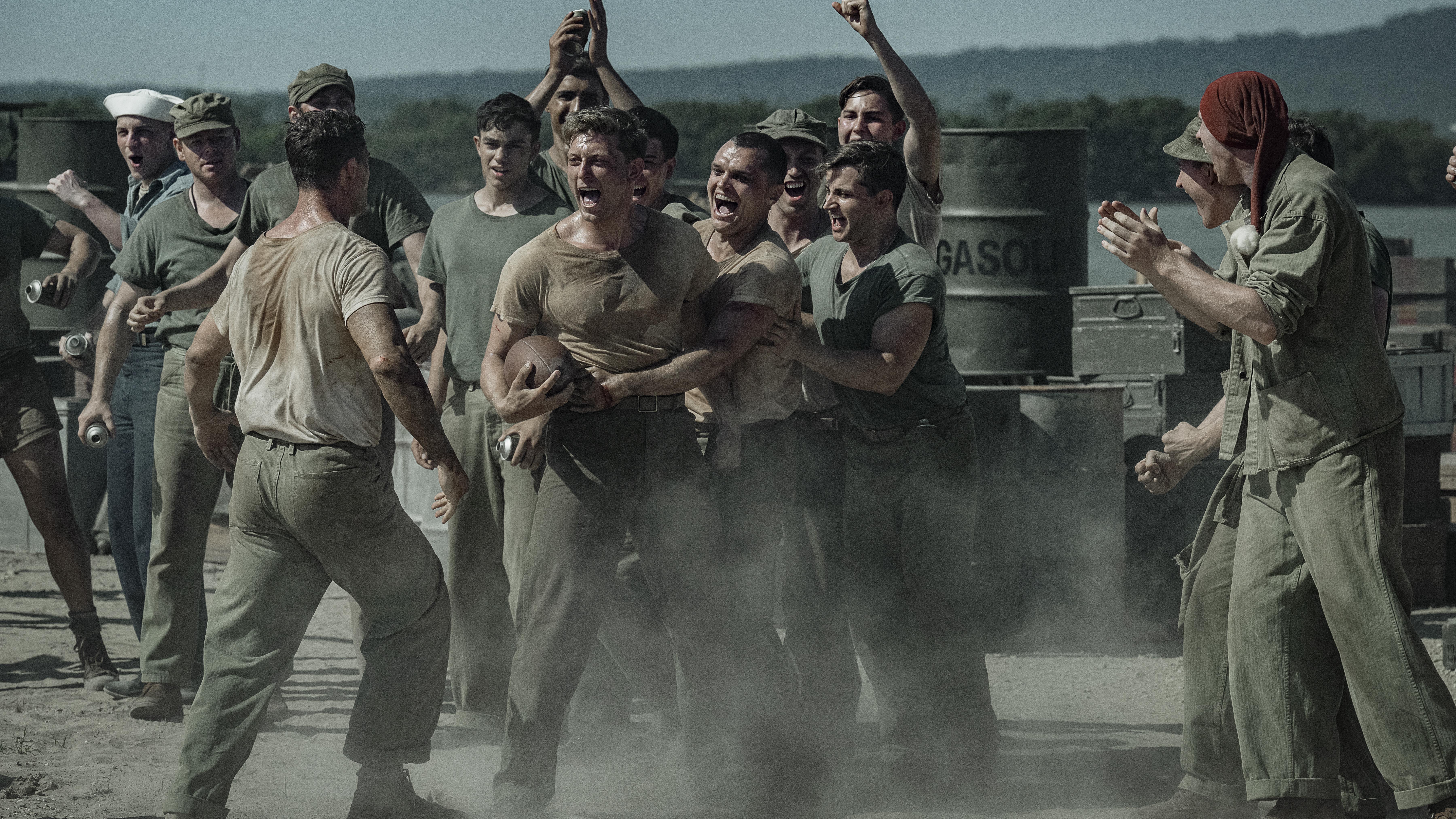
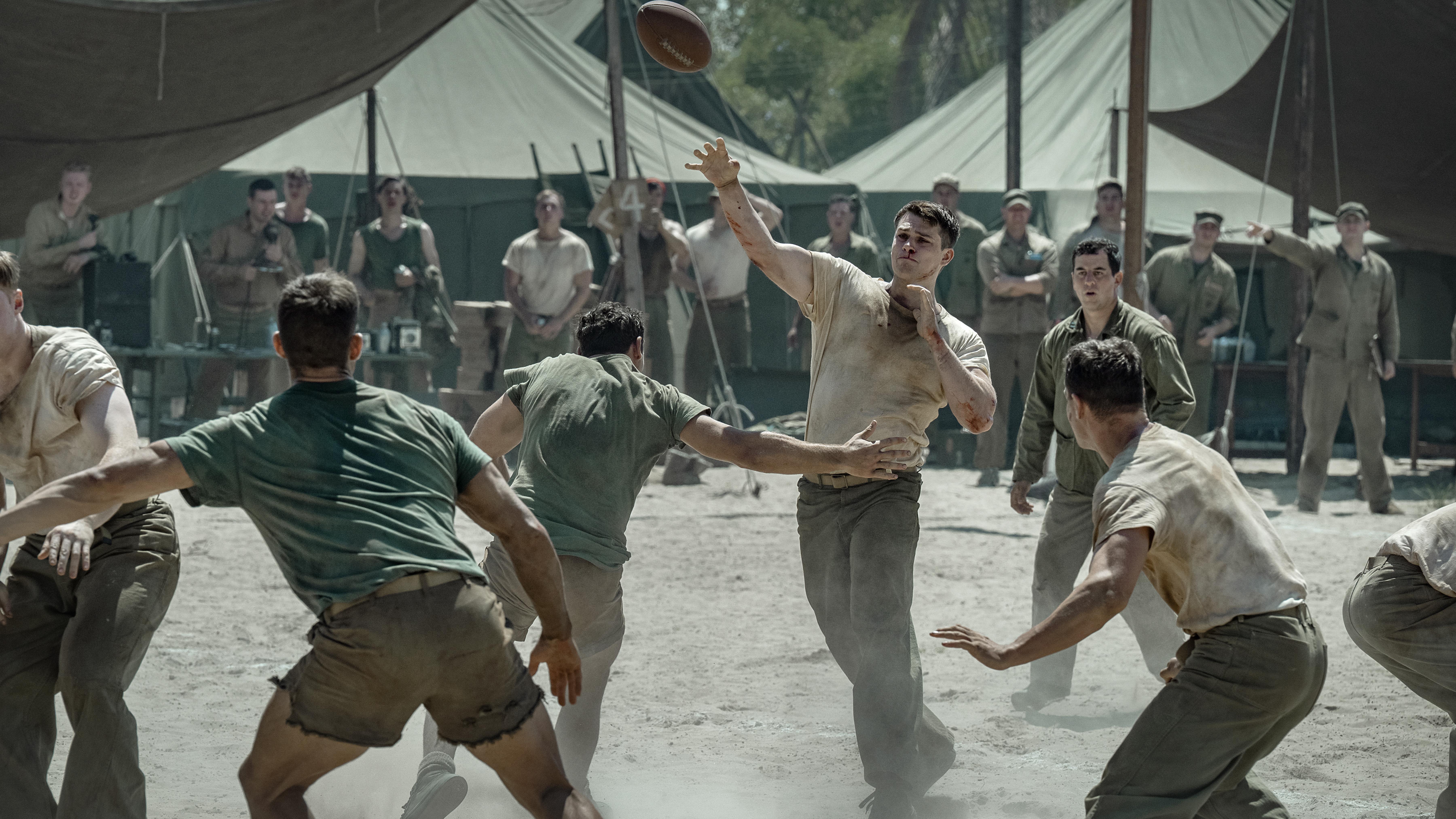
In the wet heat of a Guadalcanal afternoon on Christmas Eve 1944, two regiments of the 6th Marine Division met on a football field of packed earth and broken coral.
asserted
regiments → meet → earth
They had come to settle a question argued over beer: Which of them had the better team?
asserted
Which → come → team
The island where the Pacific War’s first major American offensive was fought had been quiet for nearly two years, a staging ground of tents and supply depots where men trained and waited and swatted at the insects that gave the island’s Armed Forces Radio network its name.
asserted
that → fight → name
The game was a serious to-do: There were printed programs, numbered T-shirts, goalposts the Marines built themselves, and an announcer whose call went out over the Mosquito Network to men on ships and islands across the Pacific.
asserted
call → be → Pacific
At least 1,500 Marines lined the field, some with money on the outcome.
asserted
some → line → outcome
Neither team scored.
asserted
team → score → ?
Three months later, the division sailed for Okinawa, an island on Japan’s doorstep, where 15 of the 65 men who played that day were killed.
asserted
who → sail → doorstep
That game is the short reprieve at the heart of Peter Berg’s The Mosquito Bowl, in select theaters Oct. 30 and arriving Nov. 25 on Netflix.
asserted
game → arrive → Netflix
Directed by Berg, who wrote the screenplay with Mark L. Smith, the film adapts Pulitzer Prize-winning journalist Buzz Bissinger’s book and follows four of those players from the Saturday afternoons when the best of their lives still seemed to lie ahead, through weeks of training that could not prepare them for what came next, to one of the bloodiest battles of World War II.
uncertain
what → direct → II
Nicholas Galitzine plays John McLaughry, alongside Tom Francis as Dave Schreiner, Bill Skarsgård as Bob Bauman, and Ray Nicholson as Tony Butkovich.
asserted
Galitzine → play → Butkovich
Three of those men would die on Okinawa.
asserted
Three → die → Okinawa
The fourth would live to 90.
asserted
fourth → live → 90
The stadiums give way to boot camp, boot camp to the reef at Tarawa, Tarawa to the long crossing toward Okinawa, where the familiar idea of victory becomes a contest with no whistle, no clock, and survival as the only trophy.
asserted
idea → give → trophy
What the film is after, once the pageantry is stripped away, is that moment of recognition: young men who thought they had been sent to win learning what they have really been sent to do.
asserted
they → strip → what
Berg has made films (and a massively popular TV show) about football and films about war.
asserted
Berg → make → war
Here the same young men must do both.
asserted
men → do → both
“They got out there and very quickly found that it wasn’t a game,” Berg tells TIME.
asserted
Berg → get → TIME
“They weren’t really qualified for it, but they were going to do their very best.
asserted
they → qualify → best
The lives before the uniforms
What the four men shared, after Japan attacked Pearl Harbor on Dec. 7, 1941, was an assumption.
asserted
Japan → share → Dec.
Their country had been attacked, and young men like them were expected to go to war.
asserted
men → attack → war
Schreiner, from Lancaster, Wisconsin, had twice been named an All-American in his career with the University of Wisconsin; in 1942 he was named the Big Ten’s most valuable player, and the Detroit Lions drafted him.
asserted
Lions → name → him
The letters he left behind, now at the Wisconsin Historical Society, show a more private side of the star athlete.
asserted
he → leave → athlete
He was engaged to Odette Hendrickson, wrote to her and to his parents constantly and judged himself without mercy.
asserted
He → engage → mercy
“Tightly, tightly woven,” Bissinger says of the man.
asserted
Bissinger → weave → man
Francis found in him a care and a vulnerability that colored everything, and a mind that would not rest.
asserted
that → find → everything
“He overthinks everything, but then as soon as one of his brothers comes to him and isn’t quite there, he just can find a way to be like, ‘I’ve got you,’” the actor says.
asserted
actor → overthink → you
Schreiner had options.
asserted
Schreiner → have → options
“Dave could have gotten out of it because of who he was,” Bissinger says.
uncertain
Bissinger → get → it
“He could have easily been a phys ed instructor somewhere at one of the bases in the United States, and he said, ‘No, I got to go.
uncertain
I → say → States
My friends are going.
asserted
friends → go → ?
I’m just sitting around doing nothing, and I can’t live with that.’”
asserted
I → sit → that
The man who kept Schreiner loose was his teammate Bob Bauman, a tackle from Harvey, Ill. Bauman’s father died when he was a boy, and he grew up holding his family together.
asserted
he → keep → family
“Bob was more happy-go-lucky,” Bissinger says.
asserted
Bissinger → go → ?
When Schreiner tightened up, Bauman’s advice, as the author renders it, came down to a single line: “Dave, don’t overthink, Dave.”
asserted
author → tighten → line
The two enlisted within months of each other and would serve in the same company.
asserted
two → enlist → company
Butkovich was the son of Croatian immigrants who settled in a coal town in central Illinois.
asserted
who → settle → Illinois
He played two seasons at Illinois before the Marines sent him to Purdue, where he rushed for 833 yards in seven games in 1943.
asserted
he → play → 1943
The team went undefeated, but the Marines called him away before the season ended, and he cried in the locker room over having to go.
asserted
he → go → room
The Cleveland Rams made him a first-round pick in 1944, and he kept up a pen-pal correspondence with a 9-year-old fan.
asserted
he → make → fan
“He was really on this high level,” says Nicholson of Butkovich’s stature as a football star.
asserted
Nicholson → say → star
…and 185 more, not listed.
 The Aporia