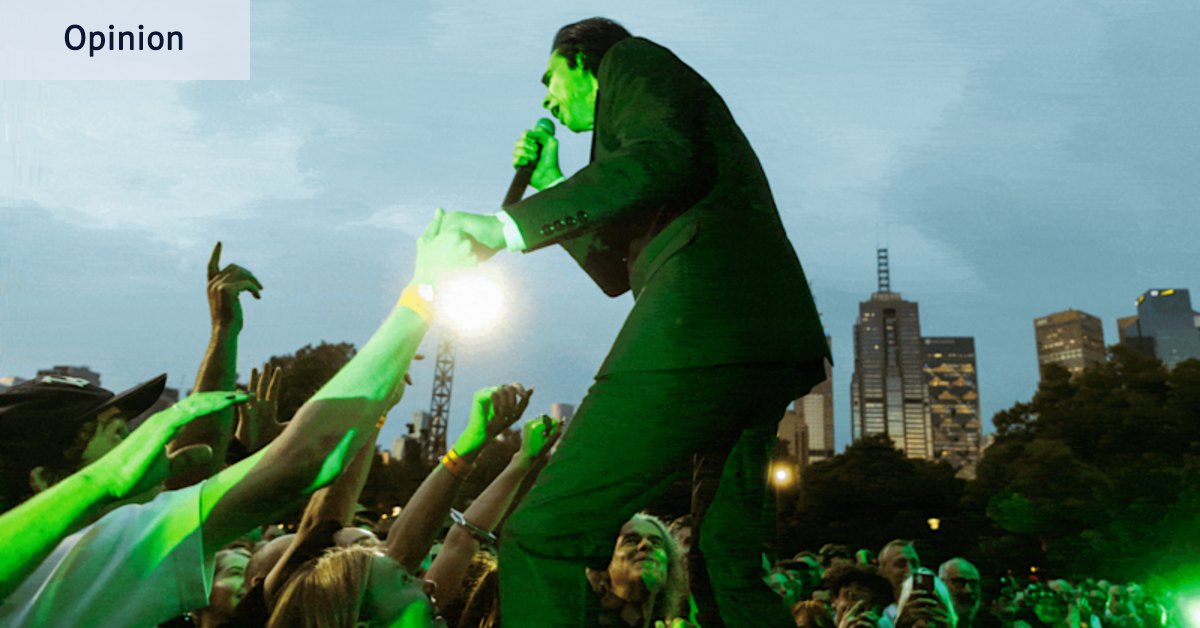
Photo via The Sydney Morning Herald

The beating heart of Melbourne? Its marvellous culture

Read the original at The Sydney Morning Herald ↗
Cite

Quinn, K. (2026, October 30). The beating heart of Melbourne? Its marvellous culture. The Sydney Morning Herald. https://www.smh.com.au/culture/art-and-design/the-beating-heart-of-melbourne-its-marvellous-culture-20261031-p619gy.html?ref=rss&utm_medium=rss&utm_source=rss_feed

Dated from the outlet's own feed. Check the original for its byline.

The Sydney Morning Herald · collected 2026-10-30 · by Karl Quinn

Quick Summary

At The Age’s Melbourne Assembly forum, Karl Quinn, a senior arts writer, delivered a keynote speech debating whether sport or the arts represents the heart of Melbourne. Reflecting on his upbringing in Brisbane during the 1980s where he faced a stark choice between supporting sports and engaging with the arts, Quinn highlighted how he eventually found a place that embraced both worlds—Melbourne. He recounted his experiences and observations from living in London, where sport and culture coexisted more harmoniously than back home. His speech emphasized Melbourne's unique ability to blend these two aspects of life seamlessly.
Written by AI on 2026-11-02, from this article's own text only (the story summary below draws on all the coverage).

AI analysis

Story summary

Senior arts writer Karl Quinn delivered a keynote speech at The Age’s Melbourne Assembly forum on October 30, discussing the rivalry between sports and arts in Melbourne. In his speech, Quinn reflected on his childhood in Brisbane during the 1980s when individuals were either "Team Sport" or "Team Arts," with little room for overlap. He shared personal anecdotes about being an avid reader and model-maker while also enjoying playing sports like rugby league briefly before recognizing his physical limitations.

The forum, moderated by Waleed Aly, aimed to debate the significance of sports versus arts in Melbourne's cultural identity. Quinn highlighted how such a stark divide existed in Brisbane during its politically contentious period under Joh Bjelke-Petersen’s leadership. He emphasized that the city was characterized by extreme masculinity and anti-intellectualism, with private-school connections dominating professional circles through corrupt practices.

Quinn contrasted this divisive environment with Melbourne's current cultural landscape, suggesting a more inclusive approach to both sports and arts as integral components of the city’s beating heart.

Written for “Melbourne's Culture” on 2026-11-02, grounded in this article and the 0 other(s) covering the same event.
Why this leaning score
This article does not take a side on a contested political question, so it has no leaning score. That is an answer rather than a gap: a match report or a rescue can be warmly or critically written without being left or right, and scoring it anyway is how approval of a subject gets recorded as a political position.
No political leaning scored for article 118032 · logged 2026-11-02

Story

📰 Melbourne's Culture
Entertainment · 1 article(s) covering the same event.

Compared with similar articles

Nothing to compare against. No article is close enough to this one for the pipeline to have linked or judged the pair.
How this article was measured signals, leaning charts, publisher record, byline, topics and claims

Signals How these are calculated →

Claims extracted
104
sentences that state something as happening or true
Uncertain
8%
8 of 104 hedged ("reportedly", "may", "according to")
Leaning
not political
takes no side on a contested political question
Publisher signals
61/100
The Sydney Morning Herald's corrections and hedging, across everything collected from it. Not a measure of accuracy.
Outlets on this story
1
Entertainment
Same framing elsewhere
1
articles that frame the event the way this one does
Analyzed 2026-11-02 · how these are computed

How this is being covered How these are calculated →

Article leaning vs. publisher reliability
Source leaning vs. consistency

Publisher

The Sydney Morning Herald · 5845 article(s) · 15 correction(s) detected
Running correction rate · 15 correction(s)

Who wrote this

Karl Quinn
16 article(s) here · 1 carrying a prediction
🔮 She reached out to Fraser, asking if she might be open to a chat.
🔮 A bitter copyright dispute between Amy Taylor, lead singer of Australian rock band Amyl and the Sniffers, and American photographer Jamie Nelson has been settled out of court, with both sides attempting to spin it as a win, though it’s Nelson who will claim the spoils if not the honours.
🔮 So I wondered, could that be me.”
🔮 That was Brisbane in the 1980s, and it was a place I couldn’t wait to get out of.
2026-10-30 · assertive framing · The beating heart of Melbourne? Its marvellous culture
🔮 When Seven snaffled the show from Ten earlier this year, it was widely assumed it would reinstate the show’s former co-host Dr Chris Brown, who left the show in 2023 and joined Seven, and was replaced by Robert Irwin.
🔮 Leading the children’s slate will be a new series of the much-loved Little Lunch, the first new episodes since 2016, and a new show starring former Wiggle Emma Watkins, the scripted series Emma’s Dance Club.
🔮 As he said on stage and again backstage that night in August, he grew up watching TV and the Logies, but never dreaming that a kid who looked like him (which is to say, of Chinese descent) might one day be part of the industry, let alone walk away with its top prize.
2026-10-18 · assertive framing · Sam Pang is the most popular man on TV. Now what?
🔮 Already it is predicted that it will be one of the biggest financial disasters in the business in decades.
🔮 After all, everyone involved with the show swore the third season would be its last, but after all the storylines were wrapped, the irresistible lure of Apple’s fat wads of cash was enough to drag the team out of retirement for a comeback that was about as necessary as Cristiano Ronaldo’s second stint at Manchester United.
2026-10-09 · assertive framing · Was this the end of Ted Lasso? I really hope so
🔮 If the name hadn’t been taken already, Ed Kavalee might well have called his new film Fast and Furious.
Also by Karl Quinn
Nothing else under this byline is closely related to this article, so these are simply their most recent.
All 16 articles by Karl Quinn →

Topics

Age Airfix Brisbane Melbourne Assembly Team Arts

Subjects

Age ORG · 1× Brisbane GPE · 1× Karl Quinn PERSON · 1× Kelli Underwood PERSON · 1× Kelli Underwood’s PERSON · 1× Melbourne Assembly ORG · 1× Quinn PERSON · 1× Roman NORP · 1× Team Arts ORG · 1× Waleed Aly PERSON · 1×

Narrative

That was in the mid-1980s, the peak of Joh Bjelke-Petersen’s corrupt regime, when the battle lines were well and truly drawn: sport and all it represented – extreme blokiness, anti-intellectualism, private-school bonds parlayed from the field to the boardroom via brown paper bags stuffed with cash, and the shady real estate deals they facilitated – was set in direct opposition to the world of culture, or counter-culture, towards which I had increasingly gravitated.
framing: assertive · carried by 1 article(s) · first seen 2026-11-02
🔮 That was Brisbane in the 1980s, and it was a place I couldn’t wait to get out of.
2026-11-02 · The Sydney Morning Herald
The beating heart of Melbourne? Its marvellous culture · assertive framing

Claims (104 extracted, 8 hedged)

Senior arts writer Karl Quinn and sports broadcaster and columnist Kelli Underwood presented the keynote speeches at The Age’s Melbourne Assembly forum, moderated by Waleed Aly, on the topic, “Sport v the Arts: What is the true heart of Melbourne?” asserted
heart → present → Melbourne
Below is an edited excerpt of Quinn’s speech. asserted
excerpt → edit → speech
I grew up in a city where sport versus the arts wasn’t just an abstract topic for debate – it was a genuine life choice. asserted
it → grow → debate
You were either Team Sport or Team Arts, and there was no in-between, and barely any overlap. asserted
You → be → ?
That was Brisbane in the 1980s, and it was a place I couldn’t wait to get out of. asserted
I → wait → 1980s
I was an artsy, book-reading, model-making, role-playing kind of kid; I loved nothing more than curling up in an armchair and reading for days on end during school holidays, or hunching over the dining room table as I drew or painted my Airfix models or built a diorama of a Roman fort under assault from the Celts, my tongue invariably poking out the side of my mouth as I became lost in concentration for hours at a time. asserted
I → love → time
But I also loved sport. asserted
I → love → sport
And I played plenty of it. asserted
I → play → it
I had a brief dabble with rugby league before realising I possessed a neck, which seemed to rule out that particular code. asserted
which → have → code
There was plenty of cricket, athletics, some motocross and BMX – I even have the chipped teeth and scarred legs to prove it – but above all, there was my great and enduring love of soccer. asserted
I → be → soccer
I started playing when I was about 10, and was still playing until a few years ago when I was forced to concede that the mathematics of it all – 90 minutes of joy followed by three days of hobbling around with aching knees, groin and hammies – no longer stacked up. asserted
mathematics → start → knees
There was a period, though, when I didn’t play at all. asserted
I → be → ?
That was in the mid-1980s, the peak of Joh Bjelke-Petersen’s corrupt regime, when the battle lines were well and truly drawn: sport and all it represented – extreme blokiness, anti-intellectualism, private-school bonds parlayed from the field to the boardroom via brown paper bags stuffed with cash, and the shady real estate deals they facilitated – was set in direct opposition to the world of culture, or counter-culture, towards which I had increasingly gravitated. asserted
I → draw → which
One had to pick sides, or leave. asserted
One → have → sides
So I headed to London. asserted
I → head → London
It was there that I first realised sport and the arts actually could co-exist. uncertain
sport → realise → ?
I started playing soccer again with a bunch of people I met at an arthouse cinema. asserted
I → start → cinema
The music scene was full of football-inspired fashion. asserted
scene → inspire → fashion
Artists and writers and filmmakers were unabashed in pronouncing which team they supported. asserted
they → pronounce → team
Looking for an Australian city that might similarly play both sides of the Arts/Sport divide, I chose Melbourne, landing here in the early 1990s, just in time for a recession that would drag on for years. uncertain
that → look → years
I came on a punt (so to speak) and though work was thin on the ground for someone with aspirations to write for a living, I fell in love immediately with the music, the galleries, the theatre, the festivals: St Kilda, Brunswick Street, the Arts Festival, the Writers Festival, the Comedy Festival, the Melbourne International Film Festival, one of the biggest and longest-running in the world. asserted
I → come → world
I loved the cinemas. asserted
I → love → cinemas
And I loved the book stores, too. asserted
I → love → stores
I still loved sport, though. asserted
I → love → sport
I was at the MCG for the cricket World Cup Final in 1992 and again for Australia v Iran and the infamous pitch invasion that cost us qualification for the FIFA World Cup in 1997. asserted
that → cost → 1997
I’ve been there for my share of footy and Boxing Day Tests over the years, and to Marvel and AAMI stadiums and, in the distant past, Princes Park, as well as our ever-expanding tennis precinct for the Australian Open. asserted
I → expand → Open
Hell, I’ve even been to the Formula One grand prix a couple of times – an experience that only served to convince me that no sport has ever been more suited to television than to actually being there. asserted
sport → serve → television
“Wow, did you see that?” asserted
you → see → that
“No, sorry, I blinked.” asserted
I → blink → ?
Sport demands we pick a side. asserted
we → demand → side
The arts, however, strive to find the things that bind us, despite our differences. asserted
that → strive → differences
A city that embraces both, it seems to me, is one that is comfortable acknowledging what makes us unique, what makes us members of particular tribes, and what unites us in a common sense of identity – one that celebrates plurality rather than bows to a monoculture. asserted
that → embrace → monoculture
It’s hard to imagine a more perfect embodiment of that unity than Kylie Minogue’s pre-game show at the AFL grand final last month. asserted
It → ’ → final
It was uniquely Melbourne in its references, it embraced the game and diversity and fun, and it brought sport and music and dance together in a moment of pure, joyous celebration. asserted
it → embrace → celebration
And perhaps best of all, it made Peter V’Landys and our rugby league-playing cousins north of the border jealous as hell. asserted
V’Landys → make → hell
Within a few years of European settlement in 1835 – following a shady transaction orchestrated by John Batman that nonetheless had the virtue of at least acknowledging First Nations custodianship of the land – we had cricket matches and horse racing. asserted
we → follow → matches
Obviously, there was a long and rich cultural tradition before that, full of song and dance and story – and sport, too, with the game of marngrook believed by many to be one of the major influences, alongside Gaelic football, on what would become our Indigenous code. asserted
what → be → football
The Melbourne Cricket Club was founded in 1839, the city’s first debating society was founded in 1841, its first theatre opened in 1842, the first codified Australian rules for footy were agreed upon in 1859, and two years later the National Gallery of Victoria – the nation’s oldest such institution – was established. As this nascent city was building its identity, sport and art were its foundation stones. asserted
sport → found → identity
But let’s not sugarcoat things: so was money. asserted
money → let → things
Sport, and the gambling it spawns, has always been a favoured way for Melburnians to dispose of their income. asserted
Melburnians → spawn → income
…and 64 more, not listed.

💬Give feedback
🕘History 🎫Support