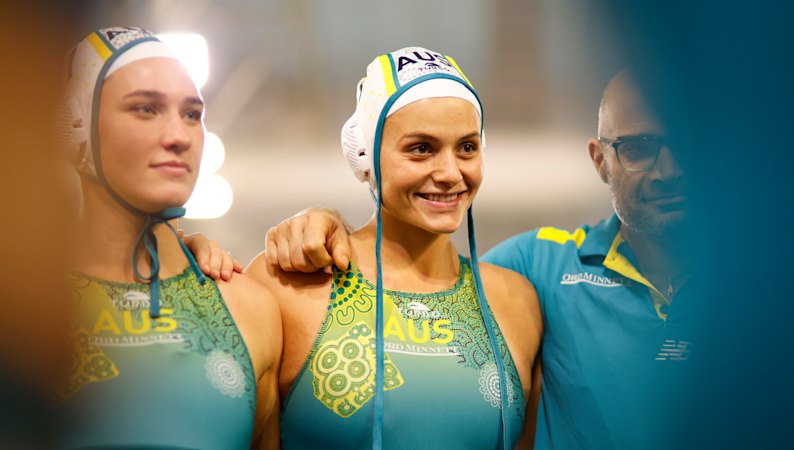
Tenealle Fasala still recalls the heartbreak she felt when four years of relentless work failed to culminate in an Olympic Games berth in Paris.
asserted
years → recall → Paris
But while the rising waterpolo star’s eyes are firmly fixed on Los Angeles in 2028, she fears the escalating costs to compete to render her dream to just that: a dream.
asserted
she → rise → that
“After Paris and not making that team, and feeling that devastation and all the financial hardship that went into it, it was so hard for me to turn around from that and bounce back,” Fasala admits.
asserted
Fasala → make → that
The daughter of Greg Fasala, who claimed silver with the Mean Machine freestyle relay team at the 1984 Games, understands the unseen perseverance needed simply to be in contention for an Olympics spot.
asserted
who → claim → spot
“I loved to take my dad’s medal into school for show and tell, but it never really dwelled on me how big it was,” she says.
“Going through the journey and knowing what it takes, I now have a better understanding of what it means.”
asserted
it → love → what
Plying her trade for the Brisbane Barracudas while juggling her job at STARS hospital, nursing studies and fundraising initiatives, a typical Fasala day will begin at 5am and not end until at least 9.30pm.
“You just get used to it and learn to push through how tired you are, and I think my body is so used to functioning on such little sleep,” she says.
asserted
she → ply → sleep
“It’s more when we have our breaks and your body starts to shut down, and you get sick because you’re working at such an intense level … that’s when you finally have a break, your body doesn’t know how to function.
asserted
body → ’ → break
Daily routine
- 5am: Wake up and go to swimming for her first session of up to two hours
- 8:30am to 4.30pm: Work at STARS hospital in Herston
- 4:30pm to 6pm: Arrive at pool to and cram in nursing degree work
- 6pm to 8:30pm: Waterpolo training
- 8:30pm to 9:30pm: Return home for dinner
The 22-year-old came agonisingly close to featuring for the Stingers at the Paris Games in 2024, featuring in every World Championships and World Cup side for three years, only to be named as a reserve.
asserted
old → wake → reserve
She needed to decide if she would forgo work and study to travel with the team and help prepare, or walk away and focus on life out of the pool.
asserted
she → need → pool
The side claimed a historic silver medal in what was Fasala’s second narrow miss, having also been in the extended squad before the Tokyo Games.
asserted
what → claim → Games
“It was a hard decision deciding whether I should do that as unpaid work, and leave my job and partner and family and support network, to be part of the team to push them so they could do the best they could at the Games.
uncertain
they → decide → Games
“I decided I would regret not being part of that.
asserted
I → decide → that
But that was really tough watching all the games unfold and knowing I helped them get there, but didn’t get the reward at the end.”
asserted
them → watch → end
- Six weeks from Olympic team selection spent either in Canberra or competing overseas for six weeks before the Paris Olympics campaign from late-July.
asserted
weeks → spend → July
Fasala struggled deciding if she wanted to go around for another Olympic cycle, before determining she needed to see through her life’s goal.
asserted
she → struggle → goal
She had already contemplated walking away before the 2019 Junior World Championships due to the $10,000 demands to travel and compete, only for her mum’s boss to cover the finances that she would return off her pay each week for six years.
asserted
she → contemplate → years
Fasala and the Stingers have since won bronze at the 2026 World Cup.
asserted
Fasala → win → Cup
When asked if there was some poetry to dreaming of making the Olympics at the same venue her father stood on the podium 44 years earlier, she pauses for a second.
asserted
she → ask → second
“I literally just got goosebumps.
asserted
I → get → goosebumps
I have thought about it so many times, it would be such a full circle moment,” she gushed.
asserted
she → think → it
Yearly expenses
- Travel: $15,000
- Medical and health expenses: $10,000
- Training and coaching: $6,000
- Gear and equipment: $5,000
- Additional sport preparation and life expenses: $37,000
- Total: $73,000
Helping fund her Olympic quest has been the Aussie Athlete Fund, which celebrated attaining a $1 million milestone by linking with sponsor and ambassador partners to help fund the Olympic journey.
asserted
which → fund → journey
The fund’s founder, Olympic legend Nat Cook, has declared the long-term goal was to distribute $5 million a year to in-need athletes by generating sponsorship and philanthropy partnerships between businesses and athletes.
asserted
goal → declare → businesses
According to Cook, if Australia was to capitalise on the exposure Brisbane 2032 will generate as the Matildas’ 2023 FIFA World Cup campaign did, a deep talent pool of elite prospects was needed.
uncertain
pool → accord → prospects
As it stood, with roughly half of Olympic hopefuls living on an income of around $23,000 a year, she feared a talent drain would diminish those hopes.
asserted
drain → stand → hopes
“How many athletes do we lose?
asserted
we → lose → athletes
The honest answer is: We don’t know because most of the time it’s a quiet exit.
asserted
it → know → time
Athletes don’t make announcements when they leave sport, they simply step away because the numbers no longer add up,” Cook said.
asserted
Cook → make → sport
“We can count the athletes who make it to the podium, but we’ll never be able to measure the medals, performances and stories we never got to see because someone couldn’t afford to stay in the game.”
asserted
someone → count → game
Fasala added: “I know a lot of athletes who have missed out on competitions or training opportunities overseas because they can’t afford it.
asserted
they → add → it
For our athletes to get better, we do have to travel and compete against the best, and we can’t do that if we don’t have the money support.
asserted
we → get → support
“It’s not sustainable to live working two jobs constantly at such a high level, and then be expected to compete at the top and win those medals our country wants us to win.”
asserted
us → ’ → medals
Cook, who won beach volleyball gold in Sydney 2000, went as far as to say in the current climate, she would hesitate to encourage her daughter to pursue many Olympic avenues.
asserted
she → win → avenues
“Sport gave me everything – it gave me lifelong friendships, resilience, purpose and ultimately an Olympic gold medal.
asserted
it → give → friendships
But it also asked a lot, financially and personally,” she said.
asserted
she → ask → lot
“I wouldn’t want my daughter carrying that burden alone.
asserted
daughter → want → burden
If she wanted to pursue elite sport, I’d support her wholeheartedly, and hopefully, I’d be able to teach her a thing or two about fundraising along the way.
asserted
I → want → way
“But the reality is that too many athletes and families are still having to shoulder significant financial pressure just to stay on the pathway.”
asserted
athletes → have → pathway
 The Aporia