Across the country, volunteers are wrapping up trainings to serve as poll monitors on Election Day.
asserted
volunteers → wrap → Day
It’s a longstanding tradition that puts observers on the ground so they can report whether anyone tries to intimidate voters or interfere with their legal rights, or otherwise break the law.
asserted
anyone → ’ → law
But this year, the training has looked a little different.
asserted
training → look → ?
In addition to learning how to respond to typical problems—like if a polling place isn’t wheelchair accessible or doesn’t open on time, or political activists show up with signs—volunteers are prepping for scenarios that would have seemed unfathomable under past administrations: What if ICE shows up at the polls, or the National Guard?
asserted
ICE → learn → polls
the Justice Department’s own poll monitors try to interfere?
asserted
monitors → try → ?
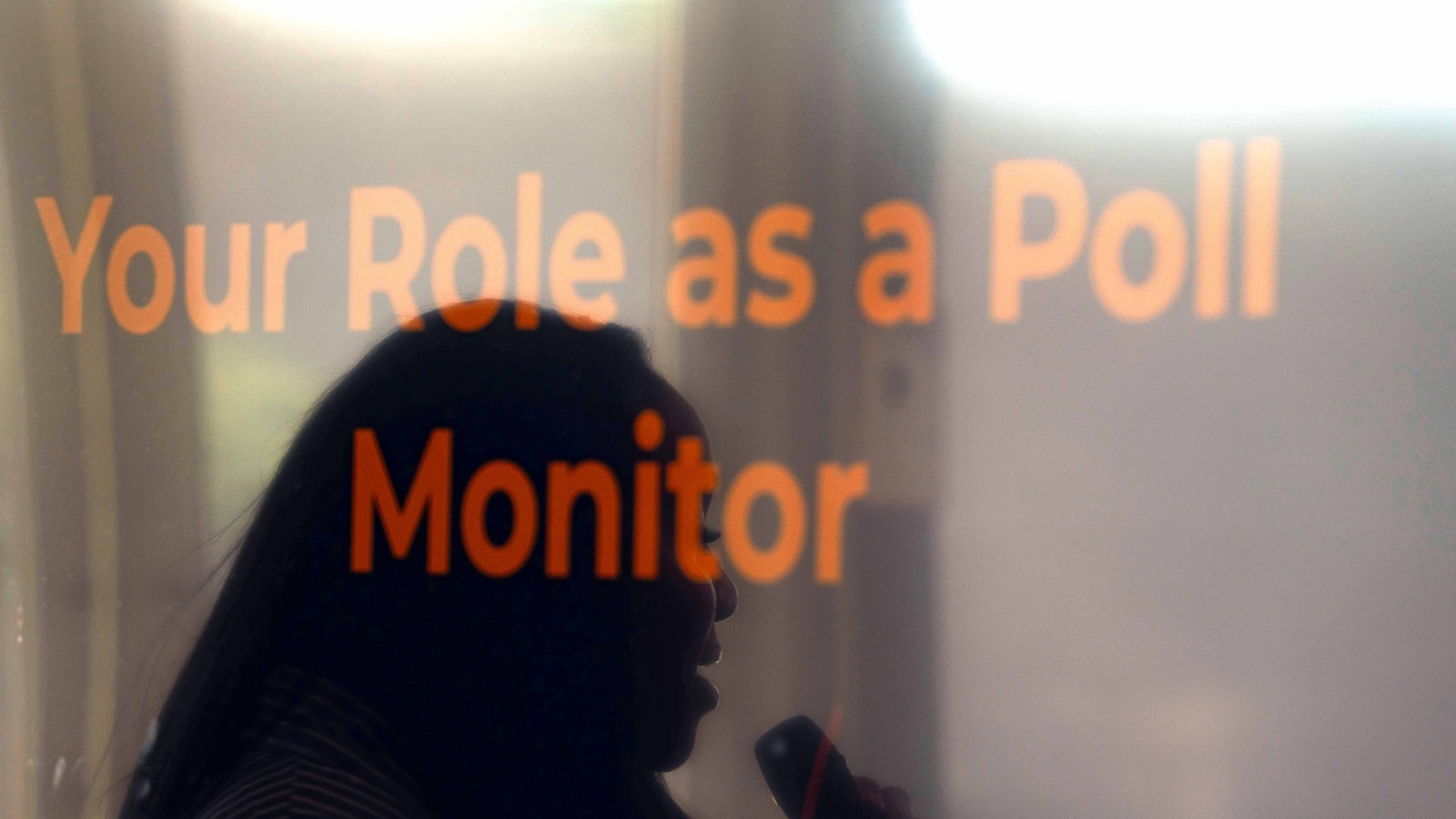
“If you’re nervous, you can retreat to a safe distance, then observe and report,” Buddy Norton, an attorney leading a training in Santa Clara County, California, told a room of about 30 people this week.
asserted
Norton → ’re → people
“I wasn’t surprised—I mean, I read the news,” says Tim, a 70-year-old retired law professor from nearby Alameda County who has volunteered as a poll monitor for about four years, and who attended another virtual training that prepped him on possible ICE encounters.
asserted
that → mean → encounters
It’s against federal law to order armed law enforcement to the polls.
asserted
It → ’ → polls
California—a target of the Trump administration’s latest (unsuccessful) efforts to meddle in the midterms—has a separate law that generally prohibits officers from making arrests within 200 feet of a polling place on Election Day.
asserted
that → meddle → Day
Homeland Security Secretary Markwayne Mullin has said that ICE won’t patrol election sites, and that its officers would only deploy to them to investigate “specific threats.”
asserted
officers → say → threats
Elections experts I spoke with aren’t expecting them to be there.
asserted
them → speak → ?
But a national poll recently found that 40 percent of respondents worry they might be, and state and local officials nationwide, as well as advocacy groups that train poll monitors, are game-planning for this possibility—not to mention any other way the administration may try to interfere with the voting process or discount election results.
“We’re in the expect-the-unexpected mode—preparing for the what ifs,” says Brittany Stonesifer, a program manager at Common Cause, which has trained volunteers in California and other states.
uncertain
which → find → California
“We’re prepared for bad actors, whoever they may be.
uncertain
they → ’re → actors
President Donald Trump has been railing about alleged voter fraud ever since he lost to Joe Biden in 2020, creating widespread concern, particularly given the violent events of January 6, 2021, and Trump’s blanket pardon of the rioters.
asserted
he → rail → rioters
In recent months, his administration has demanded states turn over their voter lists, and has tried—again, unsuccessfully—to alter mail-voting rules.
asserted
states → demand → rules
The Department of Justice recently sued California elections officialas, seeking to prevent them from counting 20,000 ballots the administration claims may belong to noncitizens.
uncertain
administration → sue → noncitizens
In Alaska, the DOJ has sued to preemptively block certification of a Senate race if the Republican candidate loses.
asserted
candidate → sue → race
“For the first time in American history,” the feds have become “an adversary to state and local election officials, rather than a partner and a collaborator,” elections expert David Becker, a former DOJ attorney who now leads the “fiercely nonpartisan” Center for Election Innovation and Research, told me this week.
asserted
who → become → me
In multiple states, ICE agents recently went door-to-door investigating whether immigrants at those addresses were improperly registered to vote, and posted videos of their efforts on social media.
asserted
immigrants → go → media
“It’s a textbook case of voter intimidation,” says Beau Tremitiere, an attorney at the Protect Democracy Project, which sued the administration in partnership with the National Immigration Law Center and San Francisco and Santa Clara counties, to stop the door-knocking.
asserted
which → ’ → knocking
A federal court has ordered the agency to refrain from its efforts, at least until after Election Day.
asserted
court → order → Day
“It’s a state responsibility to register voters and maintain accurate voter lists, not a federal responsibility,” says Eileen Ma of the Asian Law Caucus, which is also training poll monitors in California.
asserted
which → register → California
During the training I attended in Santa Clara County, attorney Norton, calling in over Zoom, told volunteers that National Guard officers had been spotted at a ballot drop box in DC.
asserted
officers → attend → DC
(The Guard later put out a statement saying officers there were directed not to monitor or secure polling locations.)
asserted
officers → put → locations
Giselle Garcia of NorCal Resist, a grassroots group that responds to ICE sightings in Northern California, told me that her team documented six cars of ICE agents outside the Sutter County elections office in October, after early voting had begun.
asserted
voting → respond → October
The county registrar, Donna Johnston, told CBS News that she did not believe the officers were trying to intimidate anyone, and DHS said they had permission from a representative of the elections office to park outside while waiting for a man to exit a courthouse.
asserted
man → tell → courthouse
But a person of color had spotted them and, terrified, called NorCal Resist, Garcia told me, adding that one of the officers got out of his vehicle and taunted her volunteer.
asserted
one → spot → volunteer
At the Common Cause trainings, facilitators teach poll monitors that voter intimidation is a crime regardless of who does it.
asserted
who → teach → it
“It’s not just private actors—it’s also police or state actors or federal agents,” says program manager Stonesifer.
asserted
Stonesifer → ’ → ?
She instructs volunteers to take detailed notes if they see anything inappropriate—documenting which agency an officer is from, if applicable, while maintaining a safe distance—and then report the information to attorneys and other staffers at the group’s headquarters, who can decide how to respond.
asserted
who → instruct → headquarters
Volunteers are also instructed to look out for the DOJ’s poll monitors, who haven’t “been an issue in the past,” she says, “but given everything we’ve seen from this administration, we can’t be fully confident” they’ll follow the rules.
asserted
they → instruct → rules
The administration is deploying about 1,000 monitors across all 50 states, a substantial increase from the 2022 midterms and the 2024 general election, when it sent about 289 and 714 monitors, respectively.
asserted
it → deploy → monitors
This week the DOJ announced that ICE and FBI officers would not be among the monitors, but unarmed officers from the Bureau of Alcohol, Tobacco, Firearms and Explosives and the DEA would be.
asserted
officers → announce → Alcohol
The DOJ’s plan prompted the clerk of Michigan’s Ingham County to give her election workers additional training.
asserted
plan → prompt → training
The feds “can watch the process,” she told The New York Times.
asserted
she → watch → Times
“They can’t touch anything, they can’t ask any questions.”
asserted
they → touch → questions
Tim, the volunteer poll monitor from Alameda County, who was trained by the Asian Law Caucus and asked that I not include his last name for fear he might be doxxed, said he’s not expecting to encounter armed federal agents on Election Day, but he’s glad for the extra prep so he’s ready if he does.
uncertain
he → train → prep
“It’s a little sad and disturbing” that it’s even an issue, he told me.
asserted
he → ’ → me
A more pressing question might be what happens after polls close, when the vote counting begins.
uncertain
counting → happen → ?
In California, Common Cause is also training monitors for that stage of the process, “to look for any ballots that are being mysteriously set aside,” Stonesifer says.
asserted
Stonesifer → train → ballots
…and 11 more, not listed.
 The Aporia