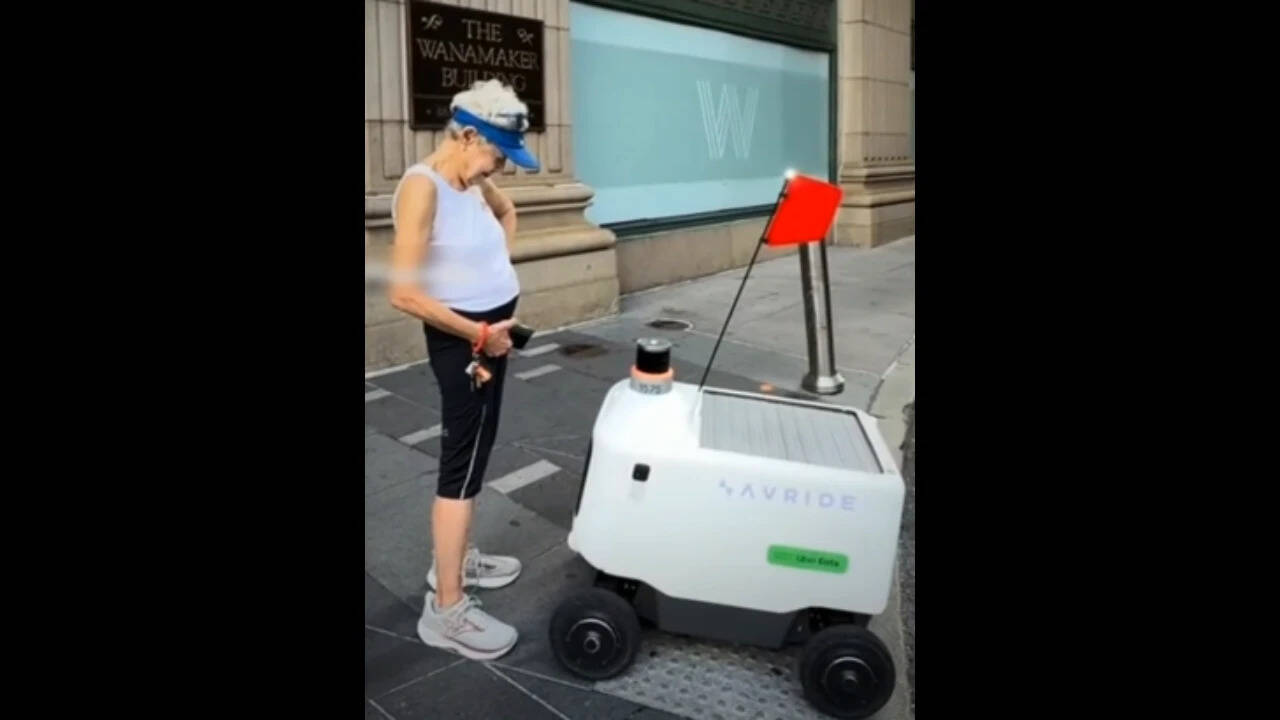
A 78-year-old Philadelphia woman who repeatedly blocks self-driving delivery robots as a form of protest was arrested after allegedly refusing to let an Uber Eats machine pass.
uncertain
machine → block → protest
Carolyn Marvin, a retired University of Pennsylvania communications professor, encountered the robot near the 1200 block of Filbert Street in Center City earlier this month while returning home from a flu shot appointment.
asserted
Marvin → encounter → appointment
Marvin, who told CNN she has spent months deliberately obstructing the machines, stood in its path until a crowd gathered and police were called.
asserted
police → tell → path
Officers responded to the scene after receiving a report of criminal mischief involving a robot, a Philadelphia Police Department spokesperson told The Independent.
asserted
spokesperson → respond → Independent
Marvin allegedly refused repeated orders to move, prompting them to issue her a disorderly conduct citation.
uncertain
Marvin → refuse → citation
“I was under the impression that I had more rights than the robot did,” Marvin told CNN with a laugh.
asserted
Marvin → do → laugh
However, following her arrest, Marvin learned about an unusual legal wrinkle:
Pennsylvania law actually classifies delivery robots as pedestrians.
asserted
law → follow → pedestrians
Under Pennsylvania's Act 106 of 2020, autonomous delivery machines — officially known as personal delivery devices — are granted many of the same rights and responsibilities as pedestrians under the state's Vehicle Code.
asserted
machines → know → Code
That means motorists must yield to them at crosswalks, but the robots must also yield to actual pedestrians and cyclists.
Marvin insists her protests are relatively harmless, saying she only blocks a robot when it is “convenient and possible” and has time to do so.
“I have a life, so I don’t have tons of time to stand in front of robots,” she said, estimating that she might spend 10 to 15 minutes delaying a machine on its route.
uncertain
she → mean → route
The worst consequence, Marvin suggested, is that an office worker’s lunchtime bowl might arrive about 15 minutes late.
uncertain
bowl → suggest → ?
But Marvin says her actions are intended to draw attention to bigger concerns, including delivery workers losing jobs, sidewalk safety and privacy risks from cameras embedded in the machines.
asserted
workers → say → machines
“I also think that I have a First Amendment right to protest the abuses of corporations in public space, in the same public space that the robots are occupying,” she told CNN.
asserted
she → think → CNN
Marvin said she has previously protested for civil rights, abortion rights and Black Lives Matter, as well as against the Vietnam and Gulf wars.
asserted
she → say → wars
She sees her latest campaign as an extension of that activism.
asserted
She → see → activism
“It’s what we need to do to make sure the government hears the will of the people,” she said.
asserted
she → ’ → people
Marvin also says delivery robots have no place on sidewalks, viewing them as another example of technology encroaching on everyday life.
asserted
technology → say → life
“There’s a way in which we’ve surrendered the streets to cars long ago, and I don’t think we should surrender the sidewalks to machines,” she told CNN.
asserted
she → ’ → CNN
“Machines in general encroach on our lives,” she continued.
asserted
she → encroach → lives
“Public space is the most visible place where they’re encroaching on our lives, but they’re going right up the ladder, and lots of people are interested in making that happen.”
asserted
that → encroach → people
Even after her arrest, Marvin isn’t ready to call off her campaign.
asserted
Marvin → call → campaign
Asked whether she plans to continue blocking the robots, Marvin replied: “Oh yeah.”
asserted
Marvin → ask → robots
The Independent has requested comment from Uber Eats.
asserted
Independent → request → Eats
 The Aporia