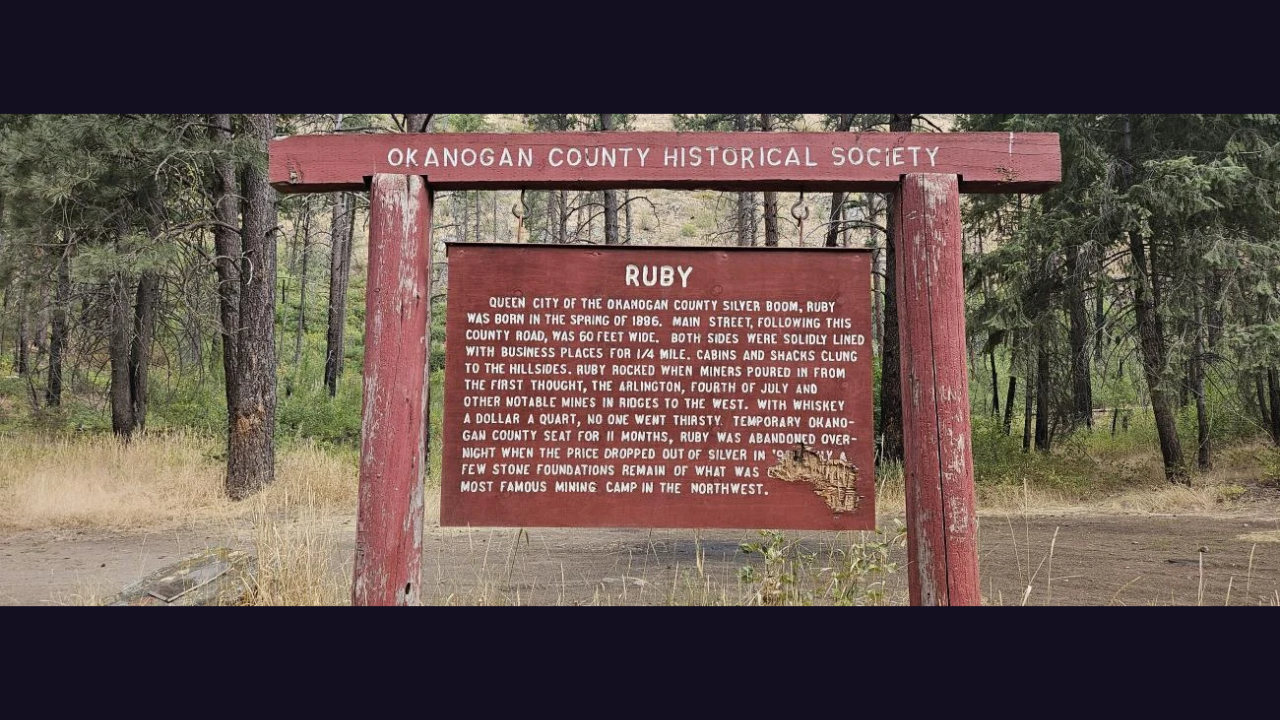
Once a thriving silver-mining settlement with more than 1,000 residents, Ruby City was at the centre of Washington’s mining boom in the late 19th century.
asserted
City → thrive → century
Prospectors, investors and businesses flocked to the town as silver discoveries fuelled hopes of prosperity.
asserted
discoveries → flock → prosperity
However, declining silver prices, limited mineral deposits and high transport costs eventually brought its mining industry to a halt.
asserted
prices → decline → halt
Today, the former settlement is known as Old Ruby State Park Heritage Site, where forested hills and tall ponderosa pines surround a townsite with no standing buildings remaining.
asserted
buildings → know → townsite
According to the Washington State Parks and Recreation Commission, the site preserves the history of a once-busy community whose fortunes rose and fell with the silver rush.
uncertain
fortunes → accord → rush
How Washington’s Ruby City grew during the silver rush in 1886 and 1887
The opening of the former reservation lands for mineral claims and settlement on 1 May 1886 encouraged further prospecting.
uncertain
opening → grow → prospecting
Four months later, Fred Wendt discovered the Nevada vein north of the future townsite and persuaded investors to join him in developing the prospect through the War Eagle Mining and Milling Company.
asserted
Wendt → discover → Company
John Cluman and James Milliken subsequently staked the Last Chance claim, while three miners discovered the First Thought claim in October 1886.
uncertain
miners → stake → October
According to Washington State Parks, the First Thought mine eventually developed more than 4,000 feet of underground passages across three levels and produced silver ore valued at more than $2.5 million in 2025 terms.
uncertain
mine → accord → terms
As mining activity expanded, William Singleton and Thomas D. Fuller established Ruby City on land along Salmon Creek on 6 January 1887.
asserted
Singleton → expand → January
The town was laid out with Main Street running parallel to the creek, while Ruby Street and Salmon Street lay to the west and east, respectively.
asserted
Street → lay → west
Numbered streets extended from First Street at the northern end to Tenth Street at the southern end.
asserted
streets → extend → end
Lots were offered for sale, and businesses developed to serve miners and other residents.
asserted
businesses → offer → miners
However, the commission records that Singleton and Fuller did not initially own the land they were selling, leading residents to demand that the developers obtain legal title.
asserted
developers → record → title
The ownership dispute was not fully resolved until 17 March 1892.
asserted
dispute → resolve → March
Ruby City’s businesses and banking industry fueled its silver rush boom
Ruby City’s growth extended beyond its mines.
asserted
growth → fuel → mines
Businesses supplied goods and services to the mining population, while the town developed financial and social establishments.
asserted
town → supply → establishments
Sam Lichtenstadter opened the Bank of Ruby, which issued distinctive pink checks because it had limited supplies of US cash.
asserted
it → open → cash
According to the state parks account, nearly $300,000 worth of these checks were once in circulation across central Washington and British Columbia.
uncertain
worth → accord → Washington
The town also had a brewery and several saloons, including the Mother Lode Saloon, the Office Saloon, the Silver Corner, the Snug Saloon and the Bachelors Saloon.
asserted
town → have → Saloon
Ruby City briefly became the seat of the newly established Okanogan County in 1888.
asserted
City → become → 1888
The Washington Territorial Legislature approved the creation of the county on 2 February that year, and the county commissioners met to organise its government in March.
asserted
commissioners → approve → March
Ruby City was selected as the county seat, but voters later chose to transfer that position to Conconully.
asserted
voters → select → Conconully
The town’s promoters continued to advertise its commercial importance.
asserted
promoters → continue → importance
In 1890, the Ruby Land Company described it as the “business center of the greatest mining region in the State of Washington”, highlighting its business activity and a reported monthly payroll of $10,000.
asserted
Company → describe → 10,000
Despite these claims, Ruby remained remote, and attempts to secure railway service or better roads were unsuccessful.
uncertain
attempts → remain → service
Why Washington’s Ruby City declined after the silver rush
The limitations of the mineral deposits became increasingly apparent within a decade of Ruby City’s founding.
asserted
limitations → decline → founding
According to Washington State Parks, the silver-bearing veins extended only limited distances, restricting the amount of ore that could be extracted.
uncertain
that → accord → ore
Transport expenses also reduced the profitability of mining.
asserted
expenses → reduce → mining
Ore was typically hauled by wagon for 45 miles to Brewster, transferred to riverboats for an 80-mile journey to Wenatchee, and then moved onto railway cars bound for smelters in Tacoma or Montana.
asserted
Ore → haul → Tacoma
The commission also identifies wider economic developments as a factor in the town’s collapse.
asserted
commission → identify → collapse
The Sherman Silver Purchase Act, enacted by the US Congress on 14 July 1890, increased the federal government’s required silver purchases and gave mining activity a temporary boost.
asserted
Act → enact → boost
However, the agency explains that the resulting increase in circulating dollars, without corresponding growth in government gold stocks, eventually contributed to a fall in silver prices.
asserted
increase → explain → prices
Together with global economic trends, this helped bring about the Panic of 1893.
asserted
this → bring → 1893
Mining operations in Ruby City subsequently failed.
asserted
operations → fail → City
Ellensburg mayor Austin Mires visited in August 1899 and recorded that “the town was entirely deserted”.
asserted
town → visit → August
By 1904, only a few deteriorating buildings remained.
asserted
buildings → deteriorate → 1904
Ruby City’s silver mines reopened but struggled with transport costs
Mining did not end permanently with the first collapse.
asserted
Mining → reopen → collapse
Operations resumed at the Arlington, First Thought and Last Chance mines in the early 1920s, and several shipments of ore were completed.
asserted
shipments → resume → ore
However, the cost of transporting the material continued to make mining unprofitable, and the operations closed again.
asserted
operations → transport → material
…and 9 more, not listed.
 The Aporia