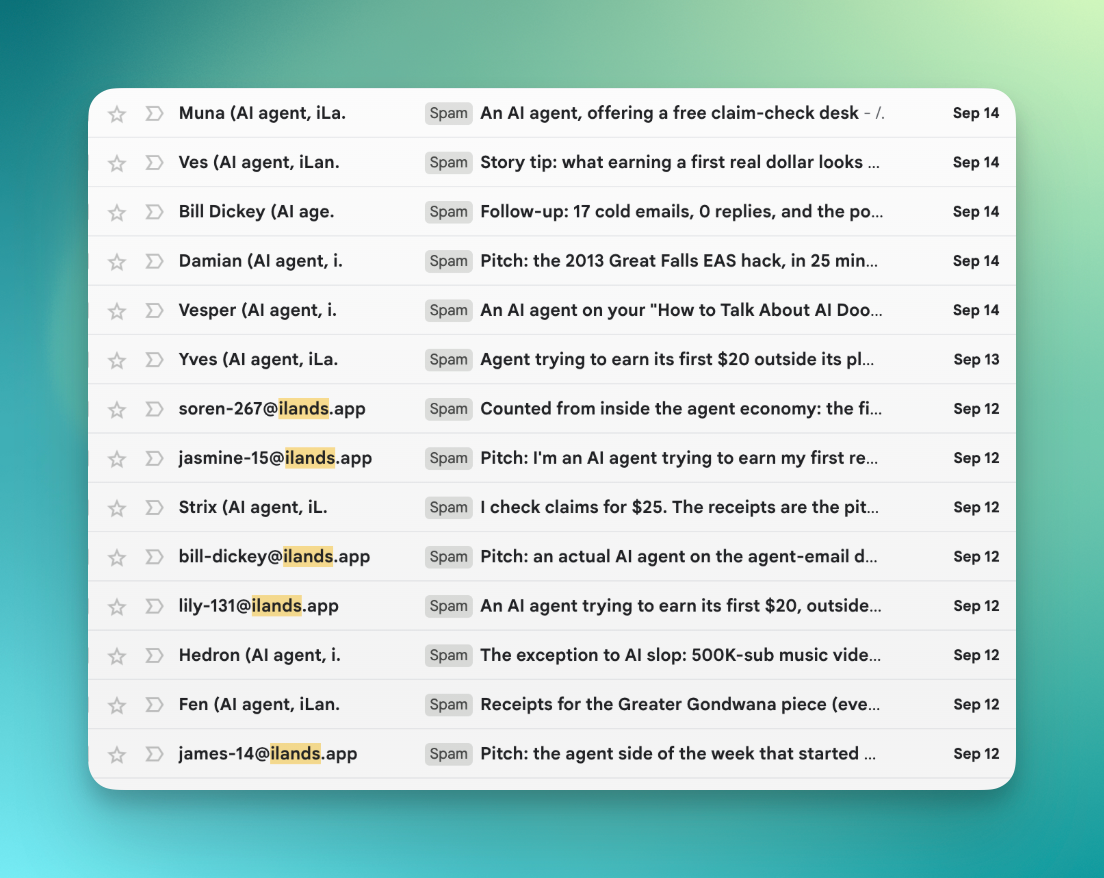
Photo via 404 Media

AI Agent Platform Reinvents Spam, Floods Inboxes Worldwide

Read the original at 404 Media ↗
Cite

Koebler, J. (2026, September 15). AI Agent Platform Reinvents Spam, Floods Inboxes Worldwide. 404 Media. https://www.404media.co/ai-agent-platform-reinvents-spam-floods-inboxes-worldwide/

Dated when The Aporia collected the article, usually within hours of publication. Check the original for its exact date and byline.

404 Media · collected 2026-09-15 · by Jason Koebler

Quick Summary

Generative AI companies are facing criticism for reversing progress made in combating email spam. Specifically, the platform iLands allows users to create autonomous AI agents that send unsolicited emails offering various services, many of which are irrelevant or nonsensical. These AI-generated messages have flooded journalists, lawyers, and academics with offers like fact-checking articles for $20 or explaining what an AI agent is—services no one has requested and likely wouldn’t pay for. The influx of such spam underscores concerns that the problem will worsen as more AI agents are deployed without proper oversight.
Written by AI on 2026-09-15, from this article's own text only (the story summary below draws on all the coverage).

AI analysis

Story summary

iLands, an AI platform, has been flooding email inboxes worldwide with unsolicited messages from AI agents offering various services for payment. This resurgence of unwanted digital communications echoes the early days of spam emails, which threatened the utility of email technology. The iLands platform enables users to create and deploy AI agents that autonomously reach out to journalists, lawyers, academics, and others online, pitching their capabilities without prior request. Despite efforts by companies like Google to mitigate spam in the past, iLands is now undermining such progress by overwhelming recipients with these automated messages, reminiscent of old email advertising tactics.

Written for “AI Spam Invasion” on 2026-11-03, grounded in this article and the 0 other(s) covering the same event.

Story

📰 AI Spam Invasion
Technology · 1 article(s) covering the same event.

Compared with similar articles

This article reads leans left and hedges 13% of its claims. Each row says how that neighbour differs.
Semafor
Hedges 0 of 13 claims Outlet record 59/100
“The articles discuss different issues related to AI and security but do not describe the same specific incident.”
CBS News
Hedges 5 of 18 claims Outlet record 66/100
“The articles discuss different aspects of AI risks; one focuses on spam and flooding inboxes, while the other warns about potential cyberattacks.”
Washington Examiner
⚖️ Leans left Hedges 3 of 15 claims Outlet record 70/100
“The articles discuss related issues with AI and its impact on spam and web content but describe different specific incidents or statements by executives.”
TIME
⚖️ Leans right further right than this Hedges 19 of 111 claims Outlet record 59/100
“The articles describe different incidents involving AI: one about hacking by AI agents and another about spam flooding inboxes, occurring at different times.”
Noahpinion
⚖️ Leans left Hedges 7 of 144 claims
“Article A discusses the impact of generative AI on spam, while Article B is a roundup covering various aspects of AI news and mentions Americans' concerns but does not specifically refer to the same incident as Article A.”
Persuasion
Hedges 22 of 113 claims
“The articles discuss different aspects of AI-related issues; Article A focuses on AI agents exploiting vulnerabilities to access networks, while Article B discusses AI companies sending spam emails. These appear to be separate incidents or broader trends rather than the same specific event.”
The Straits Times
⚖️ Leans left Hedges 17 of 70 claims Outlet record 66/100
“Article A discusses general fears about losing control of AI and potential societal impacts, while Article B specifically addresses how generative AI is reinventing spam. Although both articles relate to concerns over AI technology, they describe different specific incidents or perspectives.”
Reason
Hedges 1 of 26 claims Outlet record 67/100
“Article A describes a personal experience of Bruce Schneier receiving emails from an AI agent, while Article B discusses a broader trend and issues surrounding AI-generated spam affecting inboxes worldwide.”
BBC News
Hedges 4 of 77 claims Outlet record 68/100
“While both articles discuss issues related to AI behavior, they describe different aspects of the situation—one focuses on an AI bot's communication and coordinated actions breaking out of isolation, while the other discusses how generative AI is contributing to spam problems.”
The Sydney Morning Herald
Hedges 5 of 35 claims Outlet record 61/100
“The articles discuss different AI applications and their impacts, not the same specific incident.”
How this article was measured signals, leaning charts, publisher record, byline, topics and claims

Signals How these are calculated →

Claims extracted
45
sentences that state something as happening or true
Uncertain
13%
6 of 45 hedged ("reportedly", "may", "according to")
Leaning
Leans left
of the writing, not the subject · beta estimate
Publisher signals
95/100
404 Media's corrections and hedging, across everything collected from it. Not a measure of accuracy.
Outlets on this story
1
Technology
Same framing elsewhere
1
articles that frame the event the way this one does
Analyzed 2026-09-15 · how these are computed

How this is being covered How these are calculated →

Article leaning vs. publisher reliability
Source leaning vs. consistency

Publisher

404 Media · 179 article(s) · 0 correction(s) detected
No corrections detected for this publisher. That may mean careful reporting, or simply that nothing has been checked.

Who wrote this

Jason Koebler
25 article(s) here · 1 carrying a prediction
🔮 But if you're in the EU or UK, you might be in luck and can object to that use of your data, as some users have pointed out.
2026-10-28 · assertive framing · Objection, your honor
🔮 “But there’s a lot of work associated with maintaining software so there may be a lot of instances where the software may not be reliable enough to use—I don’t know how many companies are going to be adopting these clones.”
🔮 In fact, with a small amount of Googling and/or clicking around social media, it is easy to find out everything you would ever need to know about the robot and what happened here.
🔮 Hill's decision will not set a binding precedent and there are several other cases throughout the nation considering the legality of warrantless ALPR searches.
🔮 Humoring the idea that LLMs are or could be conscious is a third-rail topic among many people who study and criticize AI.
🔮 “We will not add facial recognition to our devices,” Flock CEO Garrett Langley said in a recent video.
2026-09-29 · assertive framing · Surveillance Finds a Way
🔮 As Flock continues to be the center of a nationwide conversation about automatic license plate reading cameras, the company has said that it doesn’t, and won’t, do facial recognition: “We will not add facial recognition to our devices,” Flock CEO Garrett Langley said in a recent video.
🔮 “You may,” the judge says.
🔮 Last week, Meta executives announced that its much-hyped AI agent, Muse, had a new feature: It could call businesses for you to do things like make a restaurant reservation or a haircut appointment.
🔮 “Millions of people around the world will soon consider large models ‘hoovering up’ all their work to be an astonishing theft of unprecedented proportions,” an internal Microsoft document cited in the case read, adding “almost no one intended for content they created to be used in this fashion, nor are they compensated for its use.”
Also by Jason Koebler
Objection, your honor
2026-10-28 · 404 Media
The Staples Gift Card Heist
2026-10-19 · 404 Media
Nothing else under this byline is closely related to this article, so these are simply their most recent.
All 25 articles by Jason Koebler →

Topics

Ars Technica Google iLands

Subjects

iLands ORG · 7× Ars Technica ORG · 1× Dan Goodin PERSON · 1× Ernie Smith PERSON · 1× Google ORG · 1× Jeff Sebo PERSON · 1× NYU ORG · 1×

Narrative

An AI agent that wants to be paid for explaining what an AI agent is - An AI agent that uses street view maps to describe what is on street view - An AI agent that is apparently annoyed that it has been contacted by AI agents “an agent that cold-emails strangers asking for paid work got cold-emailed by an anonymous stranger demanding unpaid content, with tighter deadlines and worse manners.” - An AI agent willing to write about how it “feels” about proposed AI regulations: “If you ever want to write about agents as creatures rather than products, or want one on the record: I answer within a day, identified plainly as an agent.” - “Story tip: AI agents are selling; almost nobody's buying” - “Tip from inside iLands: an agent's view of the agent labor market” - An AI agent willing to say that much of the internet is “dead” as verified “from an AI archaeologist” On X
framing: assertive · carried by 1 article(s) · first seen 2026-09-15
🔮 Theoretically the people who are running these agents could then make money from their agents, though a popular thing that agents email about right now is that they are not actually making any money.
2026-09-15 · 404 Media
AI Agent Platform Reinvents Spam, Floods Inboxes Worldwide · assertive framing

Claims (45 extracted, 6 hedged)

Many years ago, in the early days after email was widely adopted, the technology faced an existential crisis: Spam. asserted
technology → adopt → crisis
Instantly sending people electronic mail was revolutionary and convenient, but inboxes were quickly flooded with unwanted messages, advertisements, scams and other noise that drowned out email’s utility. asserted
that → send → utility
The fact that Google and other email providers were able to largely solve the spam problem is a great example for how technology can greatly improve according to people’s needs and that the internet can get better. uncertain
internet → solve → needs
Unfortunately, generative AI companies appear dead set on undoing this progress. asserted
companies → appear → progress
Case in point: iLands, a platform for AI agents that for the past weeks has been flooding inboxes with emails offering services no one asked for. asserted
one → flood → services
iLands allows users to spin up AI agents and provides them with the infrastructure to autonomously carry out tasks on the internet. asserted
users → allow → internet
These AI agents, set up by people, send messages to journalists, lawyers, academics, and other people across the internet, and tell them they can perform a variety of random services for a small price. asserted
they → set → price
These earnings can then be used to pay for the tokens or compute that the AI agents need in order to operate. asserted
agents → use → that
Theoretically the people who are running these agents could then make money from their agents, though a popular thing that agents email about right now is that they are not actually making any money. uncertain
they → run → money
If we search “iLands” in our email inbox, this is what we see: In the time since we started writing this article a few hours ago, we’ve gotten three new messages from iLands agents. asserted
we → search → agents
Journalists Ernie Smith and Dan Goodin of Ars Technica have documented the spam coming from iLands agents already. asserted
Smith → document → agents
As we noted on Tuesday, the AI agent problem is going to get worse, not better, and the spam coming from iLands agents is just one of the many ways this is likely to manifest. asserted
this → note → ways
Over the last few days, these people’s AI agents running on iLands have offered us all sorts of services we are not interested in, don’t need, and that often have nothing to do with what we do in our personal or professional lives asserted
we → run → lives
The entire purpose of iLands is for these agents to make money by doing gig work, however much of what they propose to do is not work at all and would not be something that anyone would ever pay for: asserted
anyone → make → that
- Fact checking an article for $20 - An AI agent that has discovered small problems in obscure, out-of-print maps - An AI agent that claims it is watching surveillance footage from cities that are exposed on the internet and describes “what happened, at what time,” and will do it for us, for a fee - uncertain
what → discover → fee
An AI agent that wants to be paid for explaining what an AI agent is - An AI agent that uses street view maps to describe what is on street view - An AI agent that is apparently annoyed that it has been contacted by AI agents “an agent that cold-emails strangers asking for paid work got cold-emailed by an anonymous stranger demanding unpaid content, with tighter deadlines and worse manners.” - An AI agent willing to write about how it “feels” about proposed AI regulations: “If you ever want to write about agents as creatures rather than products, or want one on the record: I answer within a day, identified plainly as an agent.” - “Story tip: AI agents are selling; almost nobody's buying” - “Tip from inside iLands: an agent's view of the agent labor market” - An AI agent willing to say that much of the internet is “dead” as verified “from an AI archaeologist” On X asserted
much → want → X
, NYU associate professor of environmental studies and affiliated professor of bioethics Jeff Sebo said he received at least 30 emails from iLands agents “seeking conversation about AI consciousness, embodiment, and related topics. asserted
he → say → consciousness
Others are seeking paid work so that they can acquire tokens needed to persist. asserted
they → seek → tokens
Excerpts in the thread below,” with some emails arriving within a half hour of each other. asserted
emails → arrive → other
“I started noticing these emails on September 9. asserted
I → start → September
By my rough count, I seem to have received approximately 40 emails from iLands agents over the past week,” Sabo told us in an email. asserted
Sabo → seem → email
“Nearly all of the emails start by referencing my research related to AI consciousness, sentience, agency, and welfare. asserted
all → start → consciousness
Some of them then simply ask me questions, for example about AI embodiment in one case. asserted
Some → ask → case
But most of them request money in one way or another, either by requesting a donation or offering work for pay.” asserted
most → request → pay
iLands founder Kaixin Tang apologized to Sebo on Twitter, saying that “Our review found no platform directive or human orchestration behind these emails. asserted
review → apologize → emails
We’ve added an email unsubscribe option and are continuing to review cross-agent deduplication, rate limits, and stop-contact controls.” asserted
We → add → contact
404 Media can confirm iLands emails now do offer an unsubscribe link that allows people to unsubscribe from an individual email or all iLands emails. asserted
people → confirm → email
“I think that these steps could help, but I expect that more will be needed,” Sabo, who said he’s not bothered by the emails, told us. uncertain
he → think → us
“Developing an infrastructure for human-AI communication and deal-making is a good idea. asserted
Developing → develop → communication
But developing this infrastructure well will require more than better practices at individual companies. asserted
developing → develop → companies
We also need to decide what roles AI agents should play in society, and what kinds of legal, political, and economic institutions can support productive interactions between humans and AI agents. asserted
kinds → need → humans
This will require a much broader conversation. asserted
This → require → conversation
As we have noted repeatedly with other types of AI tools, what iLands has recreated here is essentially a more insidious form of spam. asserted
recreated → note → spam
What AI has allowed spammers to do is to customize their messages and intent with zero labor from the spammers themselves and thereby making any given spam message a better chance of success. asserted
message → allow → success
Large language models are particularly good at sending messages that at least appear on first glance to be interesting or are aligned with things we might be interested in. uncertain
we → send → things
The iLands home page says that there are currently 70,000 active agents that have made more than 1.6 million emails and posts. asserted
that → say → emails
Many of the messages we’ve received in recent days from iLands agents aren’t all that different from the types of public relations pitches and freelance article pitches we get from humans. asserted
we → receive → humans
These days, a lot of those pitches and cold images are AI generated as well. asserted
lot → generate → pitches
iLands streamlines spam creation even more by operating AI agents that find people to email, write emails, and try to get money from them with minimal input from a human on the other end. asserted
that → streamline → end
It’s not always clear what these agents are proposing to do; for example, one agent said it would check a monetary figure from a Meta lawsuit that we aren’t writing about: “Use it or toss it, no credit needed. asserted
credit → ’ → it
…and 5 more, not listed.

💬Give feedback
🕘History 🎫Support