Photo via Times of India

16-year-old Massachusetts student turns 3D-printer waste into $75,000 win

Read the original at Times of India ↗
Cite

TOI World Desk. (2026, September 15). 16-year-old Massachusetts student turns 3D-printer waste into $75,000 win. Times of India. https://timesofindia.indiatimes.com/world/us/meet-benjamin-davis-the-16-year-old-massachusetts-student-who-built-a-machine-that-turns-3d-printer-waste-into-reusable-filament-and-won-75000/articleshow/134243144.cms

Dated when The Aporia collected the article, usually within hours of publication. Check the original for its exact date and byline.

Times of India · collected 2026-09-15 · by TOI World Desk

Quick Summary

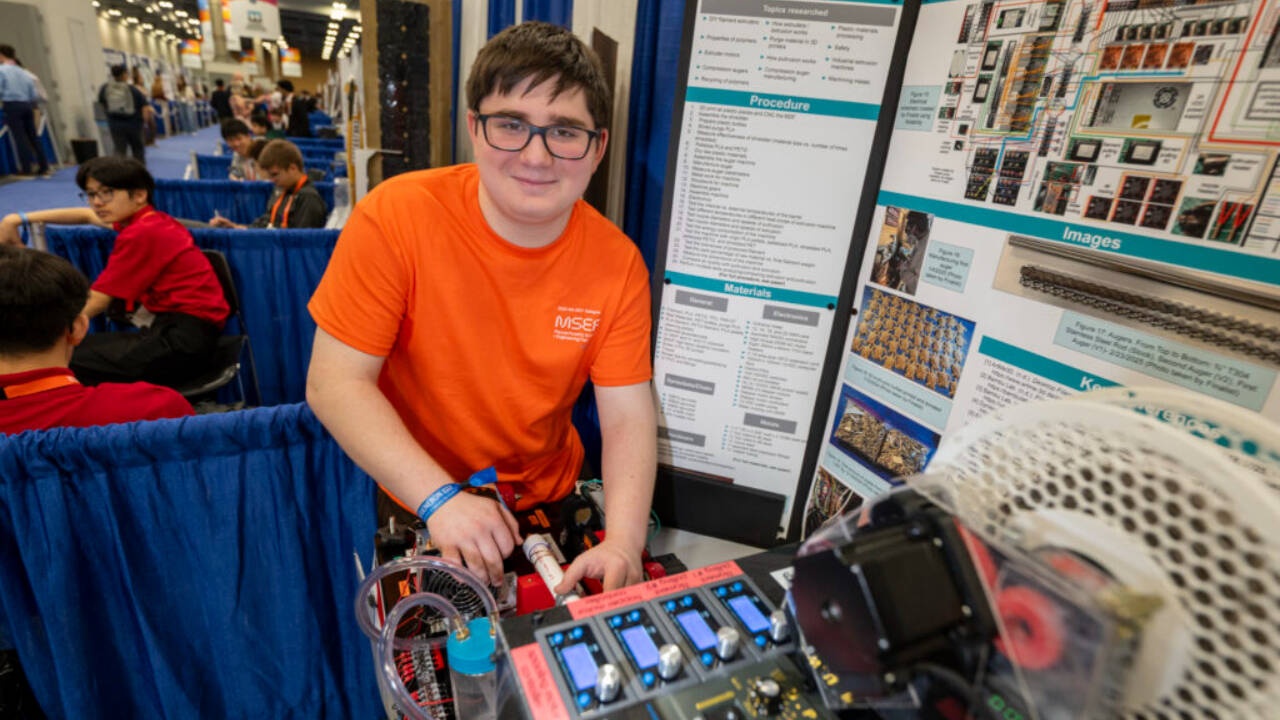
Benjamin Davis, a 16-year-old student from Bishop Feehan High School in Attleboro, Massachusetts, developed a recycling system that converts discarded 3D-printing plastic into reusable filament. His invention was recognized at the Regeneron International Science and Engineering Fair in Columbus, Ohio, where he won $75,000. The machine uses waste plastics from failed prints and employs pultrusion and extrusion methods to create higher-quality recycled filament at a cost that is about 90% less than commercial recycling machines. Davis invested over 800 hours into the project, going through more than 50 iterations before finalizing his design.
Written by AI on 2026-09-15, from this article's own text only (the story summary below draws on all the coverage).

AI analysis

Story summary

Benjamin Davis, a 16-year-old student at Bishop Feehan High School in Attleboro, Massachusetts, developed an innovative recycling system that converts discarded 3D-printing plastic into usable filament. This invention earned him $75,000 at the 2025 Regeneron International Science and Engineering Fair (ISEF) held in Columbus, Ohio. Davis’s project addresses a significant environmental issue by allowing users to recycle failed prints and other plastic waste instead of continuously purchasing new filament. His system employs two methods—pultrusion and extrusion—to process the waste plastic into filament that can be reused in 3D printers.

Written for “Student Turns Waste Into Profit” on 2026-11-03, grounded in this article and the 0 other(s) covering the same event.

Story

📰 Student Turns Waste Into Profit
Science · 1 article(s) covering the same event.

Compared with similar articles

Nothing to compare against. No article is close enough to this one for the pipeline to have linked or judged the pair.
How this article was measured signals, leaning charts, publisher record, byline, topics and claims

Signals How these are calculated →

Claims extracted
29
sentences that state something as happening or true
Uncertain
14%
4 of 29 hedged ("reportedly", "may", "according to")
Leaning
not political
takes no side on a contested political question
Publisher signals
59/100
Times of India's corrections and hedging, across everything collected from it. Not a measure of accuracy.
Outlets on this story
1
Science
Same framing elsewhere
1
articles that frame the event the way this one does
Analyzed 2026-09-15 · how these are computed

How this is being covered How these are calculated →

Article leaning vs. publisher reliability
Source leaning vs. consistency

Publisher

Times of India · 4017 article(s) · 4 correction(s) detected
Running correction rate · 4 correction(s)

Who wrote this

TOI World Desk
1400 article(s) here · 1 carrying a prediction
🔮 As reported by The Salt Lake Tribune, he began considering whether similar infrastructure could work on his Utah property.
🔮 On 30 May 2024, the court held that the transactions qualified as donationes mortis causa, a legal term for gifts made in anticipation of death.
🔮 James Patterson is best known as one of the world’s most successful thriller writers, but his most consequential work may be happening far from the bestseller lists.
🔮 The money will benefit After-School All-Stars, a non-profit organisation that works with children and young people through free after-school programmes.
🔮 Why Richard would rather play outside than watch screens, and what his mother saw in kindergarten
🔮 Commercial Braille embossers can cost more than £1,000 and may be bulky, making them difficult to access for individuals and smaller organisations with limited budgets.
🔮 Mukhtar argued that she could still earn the same base salary as him if she returned to full-time work.
🔮 For someone passing through a cemetery, a lantern or a plant might appear to be an ordinary possession.
🔮 A British man’s handwritten will, drafted on the cardboard packaging of a frozen fish box and a mince pie packet, has been ruled valid by the High Court, clearing the way for a diabetes charity to inherit his estate worth approximately £180,000.
🔮 Instead of sweeping past to look for younger animals, they paused, took a closer look, and asked shelter staff if they could meet Herbie in person.
Wire or desk byline, not an individual reporter.
Also by TOI World Desk
Nothing else under this byline is closely related to this article, so these are simply their most recent.
All 1400 articles by TOI World Desk →

Topics

Attleboro Bishop Feehan High School Davis Massachusetts the Society for Science

Subjects

Davis PERSON · 10× the Society for Science ORG · 3× Massachusetts GPE · 2× 3dprint ORG · 1× Attleboro GPE · 1× Benjamin Davis PERSON · 1× Bishop Feehan High School ORG · 1× Columbus GPE · 1× ISEF ORG · 1× Ohio GPE · 1×

Narrative

Eventually, the project was taken to the 2025 Regeneron International Science and Engineering Fair (ISEF) in Columbus, Ohio, where Davis competed against other young researchers from around the world.
framing: assertive · carried by 1 article(s) · first seen 2026-09-15
🔮 The process could let users recycle material from failed prints and other plastic waste instead of buying new filament over and over again.
2026-09-15 · Times of India
16-year-old Massachusetts student turns 3D-printer waste into $75,000 win · assertive framing

Claims (29 extracted, 4 hedged)

A failed 3D print typically goes straight to the trash with a tangle of plastic filament, a misshapen object or a handful of scraps that no longer feel useful. asserted
that → fail → scraps
For Davis, they were raw material, waiting for another chance. asserted
they → wait → chance
The Massachusetts high school student spent hundreds of hours developing a small recycling system to convert discarded 3D-printing plastic into usable filament. asserted
student → spend → filament
His invention addressed a growing waste problem and won him $75,000 at one of the world’s largest science competitions, states an online report by the Society for Science. asserted
report → address → Science
Recycling plastic scraps into filament Davis, a student at Bishop Feehan High School in Attleboro, Massachusetts, built the machine as part of his science research project. asserted
Davis → recycle → project
The system uses waste plastic, including waste generated during 3D printing and converts it into filament that can again be fed into a 3D printer. asserted
that → use → printer
The process could let users recycle material from failed prints and other plastic waste instead of buying new filament over and over again. uncertain
users → let → filament
The invention uses two methods of processing plastic: pultrusion and extrusion. asserted
invention → use → plastic
The Society for Science reported that Davis developed a system that was roughly 45 percent more efficient than using the existing approaches separately. asserted
that → report → approaches
The machine was also meant to be used practically. asserted
machine → mean → ?
It is designed to produce higher quality recycled filament and is relatively easy to operate, adds the report. asserted
report → design → filament
Davis’s design costs about 90% less than recycling machines on the market, potentially making small-scale plastic recycling more accessible to schools, hobbyists and individual 3D-printer users. asserted
recycling → cost → schools
The secret waste of 3D printing The project deals with a problem that is easily overlooked. asserted
that → deal → problem
3D printing is now a common technology in classrooms, homes, labs and workplaces but the creation of an object often involves more plastic than the finished product suggests. uncertain
product → involve → plastic
Failed prints and supports and leftover filament can build up quick. asserted
prints → fail → ?
The Society for Science cites information that states that up to 67% of the filament in a regular 3D-printing project becomes waste. asserted
% → cite → project
Instead of treating them as disposable, Davis’s machine is designed to put those scraps back into the cycle of production. asserted
machine → treat → production
That idea is part of a larger push toward more sustainable manufacturing, in which materials are collected and reused rather than constantly replaced by new ones. asserted
materials → collect → ones
Over 800 hours of experimentation Getting the machine to work was not straightforward. asserted
machine → get → experimentation
Davis put in over 800 hours on the project, went through over 50 iterations of the components, and did several large redesigns. asserted
Davis → put → redesigns
Each version gave him another opportunity to fine-tune the system and work out problems with the recycling process. asserted
version → give → process
Eventually, the project was taken to the 2025 Regeneron International Science and Engineering Fair (ISEF) in Columbus, Ohio, where Davis competed against other young researchers from around the world. asserted
Davis → take → world
Acknowledgment of $75,000 Davis snagged a $75,000 Regeneron Young Scientist Award and was runner-up in the competition’s top award category at the 75th annual ISEF. asserted
Davis → snag → ISEF
Not only was his project notable for recycling plastic, but it also asserted
it → recycle → plastic
It's also desktop-sized, hinting at a future where recycling could happen closer to where plastic waste is created, instead of requiring users to mail material to a large industrial facility. uncertain
waste → size → facility
The next step for Davis The award was another prod for Davis to continue exploring in the field. asserted
Davis → continue → field
His work in plastic recycling and extrusion has made him more interested in advanced manufacturing and mechanical and materials engineering. asserted
him → make → manufacturing
Those interests could affect his studies when he goes off to college. uncertain
he → affect → college
For now, his invention presents a simple but potentially powerful idea: the plastic waste from a 3D printer doesn’t have to be the end of the story. asserted
waste → present → story

💬Give feedback
🕘History 🎫Support