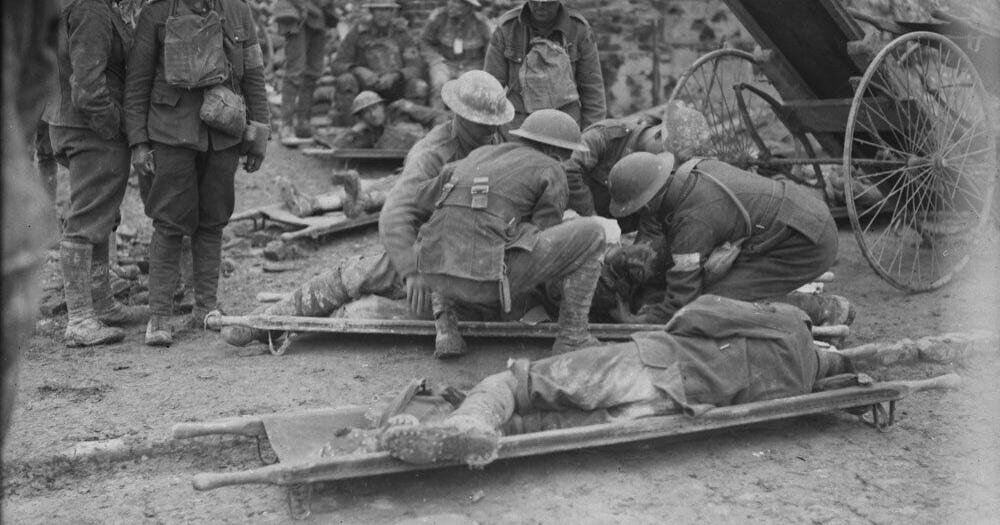
The day after attending a rousing recruiting meeting at the Grand Opera House in Moncton, N.B., on February 1, 1916, 14 volunteers visited the Moncton Barracks to enlist in the 145th Battalion.
asserted
volunteers → attend → Battalion
Two were deemed medically unfit.
asserted
Two → deem → ?
Another was sent home when it was discovered he was underage at 15.
asserted
he → send → 15
The remaining 11 swore an oath to defend his majesty against all enemies.
asserted
11 → remain → enemies
Among that day’s recruits, Clifford Robinson Oulton fibbed about his age on his attestation papers, then crossed the muddy Petitcodiac River back to his home in Bridgedale and told his mother, stepfather and sisters that he was bound for war in Europe.
asserted
he → fib → Europe
No one questioned the youngster’s decision to enlist.
asserted
one → question → decision
“They could have stopped it,” Oulton’s great-nephew, Jamie Heffer, 59, says now.
uncertain
nephew → stop → it
“How does a 14-year-old end up in France?”
asserted
old → end → France
The question has haunted Heffer for ages.
asserted
question → haunt → ages
Clifford Robinson Oulton’s time in uniform would make him the answer to a dark trivia question: According to the Commonwealth War Graves Commission, he was the youngest Canadian serviceman to sacrifice his life for the cause in the First World War.
uncertain
he → make → War
With the minimum enlistment age at 18, recruiting officers in Moncton were instructed to watch for adolescents attempting to answer the call of duty.
asserted
officers → recruit → duty
Officers of the 145th Battalion, in which Oulton had signed up, complained publicly about the number of youngsters attempting to enlist and the financial cost to the battalion when they were discharged.
asserted
they → sign → battalion
An estimated 20,000 underage soldiers enlisted in the Canadian Expeditionary Force during the First World War.
asserted
soldiers → estimate → War
If discovered before going overseas, they were sent home.
asserted
they → discover → ?
If found out in Europe, they’d either be returned to Canada or placed in noncombat outfits like the Canadian Forestry Battalion or in special units formed to handle underage enlistees, including the Young Soldiers Battalion, which provided military training and education.
asserted
which → find → training
So how did Oulton slip through?
asserted
Oulton → slip → ?
Heffer, now mayor of Morris-Turnberry in Ontario’s Huron County, grew up with a black-and-white portrait of Private Oulton prominently displayed on the mantelpiece of his childhood home.
asserted
Heffer → grow → home
Asked if he thought Oulton could pass for 18, Heffer is adamant: “Absolutely not.”
uncertain
Heffer → ask → 18
He struggles to understand how the youngster duped recruitment officers.
asserted
youngster → struggle → officers
His great-uncle Clifford, born in 1901, was the fifth of six children of Dora and George Oulton.
asserted
uncle → bear → Oulton
He was named after barrister Clifford W. Robinson, an associate of his father’s, the future mayor of Moncton, premier of New Brunswick and senator.
asserted
He → name → Brunswick
Clifford’s older brother Frank died of consumption in 1909.
asserted
brother → die → 1909
Records indicate Clifford was an above-average student at Bridgedale Public School.
asserted
Clifford → indicate → School
Heffer says the family appears not to have struggled financially, telling the Star, “They weren’t at the worst end of society.”
asserted
They → say → society
The 1911 census bears that out.
asserted
census → bear → that
A male servant lived in the family residence, which boasted a telephone, a rare utility in rural New Brunswick at the time.
asserted
which → live → time
George Oulton operated a farm in addition to working in the boiler shop at the Intercolonial Railway until his untimely death in April 1912.
asserted
Oulton → operate → April
His widow received a sizable inheritance.
asserted
widow → receive → inheritance
Heffer was unaware before the Star told him that eight months later, the Oulton household took a turn when Heffer’s great-grandmother Dora wed John Hyslop, the man previously listed on the census as a servant 17 years her senior, on New Year’s Eve.
asserted
Dora → tell → Eve
Hyslop, twice widowed, had seven adult children.
asserted
Hyslop → widow → children
Changing family dynamics may have contributed to Oulton’s decision to enlist.
uncertain
dynamics → change → decision
Wilmot, John Hyslop’s youngest child from his first marriage, enlisted in October 1915.
asserted
Wilmot → enlist → October
The day after Clifford Oulton enlisted, in an inexplicable move, his stepbrother William, the married father of four, visited the barracks, claimed to be 34 instead of his actual age of 41, and enlisted in the same battalion as Clifford.
asserted
William → enlist → Clifford
Before departing for training camp in Valcartier, Que., family and friends lauded Clifford and William at a soiree and presented them with matching rings engraved with their battalion number.
asserted
family → depart → number
In Oulton’s official portrait, still displayed in his great-nephew’s home today, the private’s hand is positioned to draw the viewer’s eye to the commemorative piece of jewellery.
asserted
hand → display → jewellery
“I often wondered about the peculiar placement of his hand showing the ring finger,” Heffer explains.
asserted
Heffer → wonder → finger
On a separate occasion, Dora gave her son a wristwatch.
asserted
Dora → give → wristwatch
At the end of August, 41-year-old William Hyslop was deemed medically unfit and discharged from the 145th.
asserted
Hyslop → deem → 145th
Then, eight days before Oulton boarded the troopship S.S. Tuscania, a telegram arrived stating that his stepbrother Wilmot Hyslop had died at the First Battle of the Somme.
asserted
stepbrother → board → Somme
Arriving in England in October 1916, Oulton transferred to the 9th Reserve Battalion and was in France by month’s end.
asserted
Oulton → arrive → end
…and 18 more, not listed.
 The Aporia