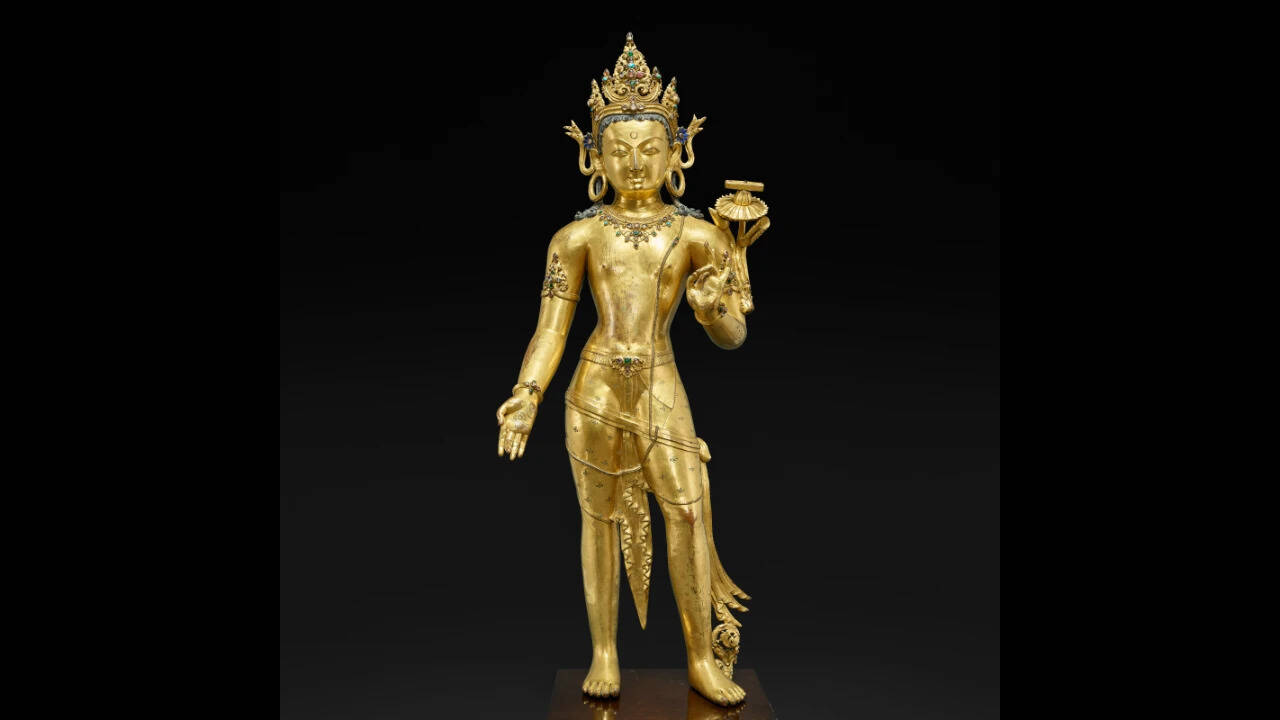
Standing nearly a metre tall, this gilded copper figure of Manjushri, the Bodhisattva of Transcendent Wisdom, is a remarkable example of the artistic excellence of the Kathmandu Valley.
asserted
figure → stand → Valley
Created by Newar artisans at a time when Nepal was emerging as one of the most important centres of Buddhist art, the sculpture has travelled across continents and collections over the centuries.
asserted
sculpture → create → centuries
Now in 2026, it is making headlines once again, selling for approximately ₹166 crore at auction and setting a record for Himalayan gilt-bronze art.
asserted
it → make → art
But what makes this sculpture worth such an extraordinary sum is not just its age, size or the gold that covers its surface.
asserted
that → make → surface
It is a rare surviving example of a sculptural tradition that helped shape Buddhist art across the Himalayas and beyond.
asserted
that → survive → Himalayas
The artistry of Newar craftsmanship
The 93cm sculpture depicts Manjushri, a bodhisattva associated with wisdom and enlightenment in Buddhist tradition.
asserted
sculpture → depict → tradition
He is identified by the Prajnaparamita Sutra, the Buddhist scripture representing transcendent wisdom, placed upon a flowering lotus at his shoulder.
asserted
He → identify → shoulder
The figure is dressed in elaborate jewellery, including necklaces, armlets, bracelets and a sacred thread, all carefully detailed against the smooth, gilded copper surface.
asserted
all → dress → surface
Look closely at the sculpture's remarkable proportions: the elongated body, slender waist, gently curved hips and flowing silhouette give it an almost weightless appearance, despite its imposing size.
asserted
body → look → size
The complex 3 bend pose, called tribhanga, creates an impression of movement, rendering the figure less an inanimate object and more a living form, moving like poetry in front of us.
asserted
figure → call → us
Its gilt surface used to shimmer in the flickering light of temple lamps, giving the bodhisattva an almost ethereal quality.
asserted
surface → use → quality
These characteristics are the hallmark of the Newar school of sculpture, a tradition that was built by the Newar artisans of the Kathmandu Valley of Nepal.
asserted
that → build → Nepal
These craftsmen are revered as some of the best metalworkers of the Buddhist world from the 9-12th centuries.
asserted
craftsmen → revere → centuries
They were also adept at the subtle art of mercury gilding, which gave the sculptures their brilliant golden finish.
asserted
which → give → finish
What set Newar craftsmanship apart, however, was its ability to fuse the classical ideals of Indian art with a distinctly Nepalese sense of proportion, ornamentation and form.
asserted
set → set → proportion
Their sculptures often showed Buddhist deities as young princely figures, adorned with elaborate jewellery but with a clear spiritual presence.
asserted
sculptures → show → presence
Of course, the Manjushri showcases their craftsmanship beautifully.
asserted
Manjushri → showcase → craftsmanship
How Nepalese artisans influenced Buddhist art across Asia
The importance of Newar craftsmanship is not just limited to Nepal.
asserted
importance → influence → Nepal
Geographically positioned between the Buddhist centres of northern India and Tibet, the Kathmandu Valley became an important centre for preserving and developing Buddhist artistic traditions.
asserted
Valley → position → traditions
Between the 10th and 12th centuries, Tibet experienced a renewed expansion of Buddhist institutions, a period known as the Later Diffusion of Buddhism.
asserted
Tibet → experience → Buddhism
The construction and restoration of monasteries created a growing demand for sacred sculptures, and Nepalese artisans were particularly well placed to fulfil it.
asserted
artisans → create → it
Their ability to produce monumental gilt-copper figures made their work highly sought after by Tibetan patrons.
asserted
work → produce → patrons
But this exchange was not just about completed sculptures moving across the Himalayas.
asserted
exchange → complete → Himalayas
Newar craftsmen also went to Tibet, teaching local artists their skills in metal casting, gilding and sculptural proportions.
asserted
craftsmen → go → casting
These techniques were eventually incorporated into Tibetan art, creating a shared visual language strongly influenced by Nepalese aesthetics.
asserted
techniques → incorporate → aesthetics
The influence eventually reached the imperial courts of China.
asserted
influence → reach → China
Anige, a celebrated Nepalese artist, in fact, worked under the patronage of the Yuan dynasty in the 13th century.
asserted
Anige → work → century
He and the artists associated with him helped establish a Himalayan-inspired style of Buddhist art at the Mongol court.
asserted
He → associate → court
Its influence continued through the Yuan, Ming and Qing dynasties, particularly in the proportions, jewellery and refined modelling of sculptures made for Tibetan Buddhist patrons.
asserted
influence → continue → patrons
A rare sculpture with an extraordinary history
The Manjushri's importance is also reflected in the relatively small number of comparable sculptures that have survived.
asserted
that → reflect → sculptures
Some Nepalese-style monumental bodhisattvas remain in important Tibetan religious institutions, including Sera Monastery, the Potala Palace, Jokhang Temple and Shalu Monastery.
asserted
bodhisattvas → remain → Monastery
Others are preserved in international museums, including the British Museum, the Victoria and Albert Museum and the Norton Simon Museum of Art in California.
asserted
Others → preserve → California
While smaller Nepalese gilt-copper figures can be found in museum collections and monastery treasuries, few retain the combination of monumental proportions, intricate detailing and exceptional craftsmanship seen in this Manjushri.
asserted
few → find → Manjushri
According to Christie's, the sculpture belonged to the George Ortiz Collection in Geneva by 2002, before passing through an important private collection in New York and the Asian art dealership Carlton Rochell Asian Art in 2017.
uncertain
sculpture → accord → 2017
It later entered a private Asian collection.
asserted
It → enter → collection
It was also exhibited at the Art Institute of Chicago in 2003 and at the Zhiguan Museum of Fine Art in Beijing in 2018, bringing the centuries-old work before international audiences.
asserted
It → exhibit → audiences
On 30 October 2026, the sculpture went under the hammer at Christie's Hong Kong as part of Awakening Wisdom: Masterpieces of Buddhist Art from a Private Asian Collection.
asserted
sculpture → go → Collection
It sold for HK$137.35 million, approximately Rs 166 crore, setting a world auction record for a Himalayan gilt-bronze sculpture.
asserted
It → sell → sculpture
It was produced nearly 9 centuries ago, an era when Nepalese artists contributed to the visual vocabulary of Buddhist art in Tibet and China.
asserted
artists → produce → Tibet
Much more than an expensive antiquity, its survival, remarkable craftsmanship and journey through international collections make it much more than an expensive antiquity.
asserted
it → make → antiquity
…and 1 more, not listed.
 The Aporia