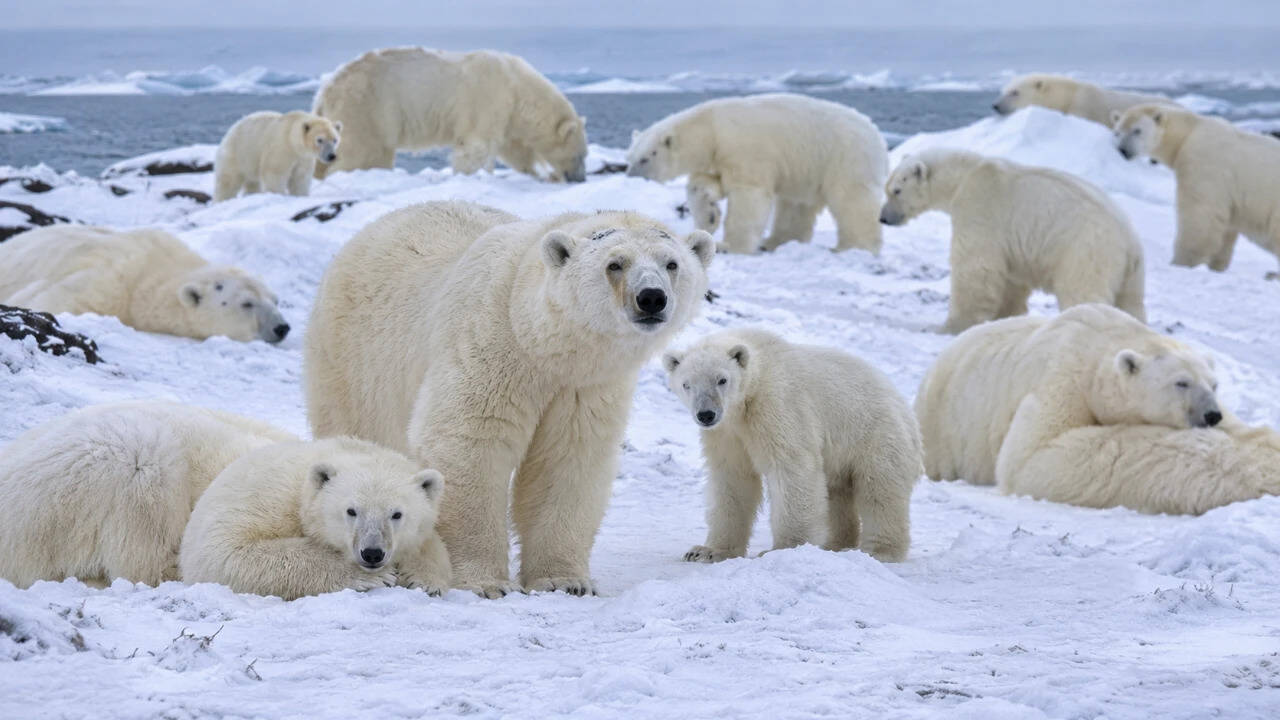
Hundreds of polar bears are expected to gather near the Canadian town of Churchill in Manitoba as temperatures fall and the animals wait for Hudson Bay to freeze.
asserted
Bay → expect → Manitoba
To prevent dangerous encounters between the bears and local residents, conservationists are testing noisy drones that can guide the animals away from populated areas.
asserted
that → prevent → areas
They are also developing an artificial intelligence (AI)-powered warning system to detect approaching bears and installing electric fencing at a waste facility that attracts animals searching for food.
asserted
that → develop → food
The work is being carried out by Polar Bears International (PBI), a conservation organisation working to protect polar bears and Arctic sea ice, according to report by Global News.
uncertain
work → carry → News
Churchill, often called the polar bear capital of the world, sees increased bear activity around this time every year.
asserted
Churchill → call → time
As temperatures drop, the animals move towards the coast and wait for sea ice to form.
asserted
ice → drop → coast
Once Hudson Bay freezes, they can return to the ice to hunt seals and other prey.
asserted
they → freeze → seals
However, climate change has made this annual movement more difficult.
asserted
movement → make → ?
According to PBI, Hudson Bay now takes approximately one month longer to freeze than it did historically because of sea ice loss.
uncertain
it → accord → loss
This means polar bears spend more time on land, increasing the chances of coming into contact with people.
asserted
bears → mean → people
Noisy drones help move polar bears
One of the projects being tested in Churchill involves drones that use noise to encourage polar bears to move away from areas where they could encounter people.
uncertain
they → help → people
PBI is working with Brigham Young University (BYU) in Utah on the research.
asserted
PBI → work → research
The team is examining whether drones can provide an affordable, non-lethal method of managing encounters between bears and humans.
asserted
drones → examine → bears
Kyle Garrett, a master's student at BYU who is working in Churchill, told Global News that the drone is slightly larger than an average model.
asserted
drone → work → model
Researchers fly it towards a bear, using the sound it produces to encourage the animal to move in a particular direction.
asserted
it → fly → direction
If researchers want the bear to change direction, they adjust the drone's position.
asserted
they → want → position
This allows them to guide its movement without physically approaching it.
asserted
them → allow → it
Garrett said the team's work so far suggests that drones can be effective in moving bears.
uncertain
drones → say → bears
AI-powered cameras to warn residents
Another project focuses on detecting polar bears before they come too close to people.
asserted
they → power → people
The system, called Bear-vision, is being tested at Churchill's waste facility.
asserted
system → call → facility
It combines radar and cameras to detect movement in the surrounding Arctic landscape and identify animals nearby.
asserted
It → combine → animals
The technology is being developed to recognise polar bears and send alerts when one is detected.
asserted
one → develop → alerts
Data collected during the trials will help train the system to identify the animals and monitor their movements.
asserted
Data → collect → movements
PBI described the idea as similar to a home security camera, saying, "Imagine a doorbell camera that tells you if a polar bear is outside."
asserted
bear → describe → you
Such warnings could help residents and workers avoid unexpected encounters with bears.
uncertain
residents → help → bears
The waste facility was selected because garbage can attract polar bears looking for food.
asserted
garbage → select → food
According to Sky News, a fire in 2024 destroyed the site, which subsequently attracted bears searching for food.
uncertain
which → accord → food
Electric fencing is also being installed at the facility as part of efforts to prevent the animals from entering dangerous areas.
asserted
fencing → instal → areas
Beyond drones and cameras, researchers are testing other deterrents, including ultrasonic sound, conductive materials and a new odour-based bear spray formula.
asserted
researchers → test → sound
Climate change increasing encounters
asserted
change → increase → encounters
The conservation efforts come amid concerns about the long-term survival of polar bears in western Hudson Bay.
asserted
efforts → come → Bay
According to PBI, the region's polar bear subpopulation has declined by almost half since 1979.
uncertain
subpopulation → accord → 1979
The organisation links the decline to climate-driven sea ice loss and fewer female bears becoming pregnant.
asserted
bears → link → loss
Sea ice is important because polar bears depend on it to hunt.
asserted
bears → depend → it
When freezing is delayed, the animals must remain on land longer before returning to their hunting grounds.
asserted
animals → delay → grounds
Geoff York, PBI's vice-president for science and policy, told Global News that falling temperatures signal to the bears that it is time to return towards the coast.
asserted
it → tell → coast
This seasonal movement brings more animals into the Churchill area.
asserted
movement → bring → area
The organisation is marking Polar Bear Week during the first seven days of November, coinciding with the annual gathering.
asserted
organisation → mark → gathering
Krista Wright, PBI's executive director, told Sky News that the organisation has worked with Churchill residents for decades to improve coexistence between humans and polar bears.
asserted
organisation → tell → humans
"We're experiencing first-hand how co-existence is becoming part of everyday life in more places," she said.
asserted
she → experience → places
 The Aporia