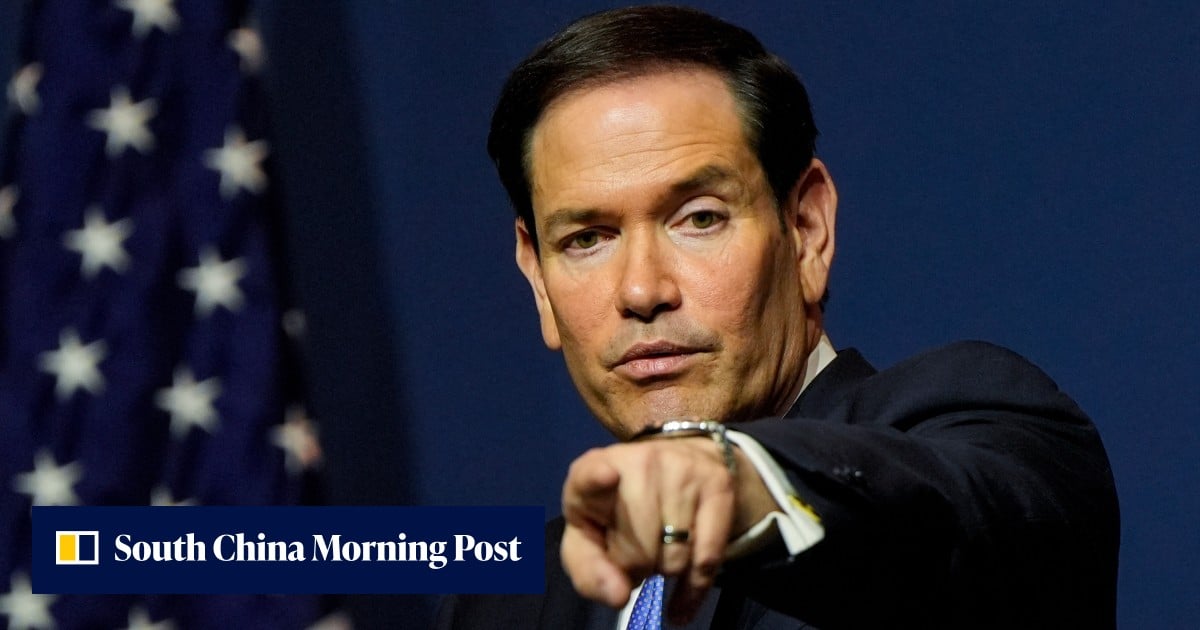
Photo via South China Morning Post

OpenAI executive urges caution in China-US AI talks, warns of distillation threats

Read the original at South China Morning Post ↗
Cite

Quaggin, L., & Seth, N. (2026, November 3). OpenAI executive urges caution in China-US AI talks, warns of distillation threats. South China Morning Post. https://www.scmp.com/news/us/article/3373052/openai-executive-urges-caution-china-us-ai-talks-warns-distillation-threats

Dated from the outlet's own feed. Check the original for its byline.

South China Morning Post · collected 2026-11-03 · by Lucy Quaggin, Nayan Seth

Quick Summary

Caroline Zier, an executive from OpenAI, emphasized the need for cautious dialogue between the United States and China regarding artificial intelligence during a talk at the Hudson Institute on Monday. She stressed that both countries should be aware of potential risks in sharing information due to differing understandings of AI dangers and cautioned about possible threats from Chinese distillation attacks targeting U.S. technology.
Written by AI on 2026-11-04, from this article's own text only (the story summary below draws on all the coverage).

AI analysis

Story summary

On November 3, 2026, Caroline Zier, OpenAI's deputy lead for national security, urged caution during upcoming China-US AI talks in Beijing. Speaking at the Hudson Institute, she advised Washington to be "clear-eyed" and "aware" about information sharing with China, citing potential risks from alleged Chinese distillation attacks on US technology. Despite supporting dialogue with Beijing, Zier highlighted concerns over mutual understanding of AI security threats.

Written for “OpenAI Executive Warns on AI Talks” on 2026-11-04, grounded in this article and the 0 other(s) covering the same event.
Why this leaning score
The model judged this article politically coded and scored it -0.30, but none of the 1 quote(s) it offered could be found in the article text, so the score is not published.
Written under an earlier scoring contract, which gave a paragraph rather than checkable quotes. Re-analysing this article replaces it.
Leaning score withheld for article 124409: no verified evidence · logged 2026-11-04

Story

📰 OpenAI Executive Warns on AI Talks
Politics · 1 article(s) covering the same event.

Compared with similar articles

This article reads unscored and hedges 0% of its claims. Each row says how that neighbour differs.
The Straits Times
⚖️ Leans left Hedges 2 of 26 claims Outlet record 66/100
“The articles describe different actions by OpenAI: one about caution in AI talks with China and warnings, the other about efforts to prevent election disinformation using AI.”
How this article was measured signals, leaning charts, publisher record, byline, topics and claims

Signals How these are calculated →

Claims extracted
3
sentences that state something as happening or true
Uncertain
0%
0 of 3 hedged ("reportedly", "may", "according to")
Leaning
withheld
no quote in the article backed the model's score
Publisher signals
62/100
South China Morning Post's corrections and hedging, across everything collected from it. Not a measure of accuracy.
Outlets on this story
1
Politics
Same framing elsewhere
1
articles that frame the event the way this one does
Analyzed 2026-11-04 · how these are computed

How this is being covered How these are calculated →

Article leaning vs. publisher reliability
Source leaning vs. consistency

Publisher

South China Morning Post · 3707 article(s) · 8 correction(s) detected
Running correction rate · 8 correction(s)

Who wrote this

Lucy Quaggin
15 article(s) here · 0 carrying a prediction
🔮 How a Democratic-controlled Congress could reshape US policy on China
🔮 Does that address these problems of what I would call a conflicted co-dependency?
🔮 The notice said that using the company’s products “may result in the transfer of sensitive data to the PRC if used by US government employees or vendors”, adding that the models “themselves may contain malware or other security vulnerabilities”.
🔮 The remarks come two days before Chinese President Xi Jinping is set to arrive in Washington to meet with US President Donald Trump for a closely watched summit where AI is expected to be on the agenda after the two countries agreed to establish a dialogue on the technology a day earlier.
Also by Lucy Quaggin
Nothing else under this byline is closely related to this article, so these are simply their most recent.
All 15 articles by Lucy Quaggin →
Nayan Seth
26 article(s) here · 0 carrying a prediction
🔮 President Donald Trump is scheduled to visit the Philippines for this year’s Association of Southeast Asian Nations summit before travelling to the November 18-19 Apec event, where he will meet his Chinese counterpart Xi Jinping for the third time this year.
🔮 Will China travel hurt US students’ careers?
🔮 ExclusiveUS-China negotiators race to nail down concrete deals as Shenzhen Apec looms Progress made in investment and trade talks ahead of Xi and Trump meeting, but complexities remain, multiple sources said Multiple sources told the South China Morning Post that intense negotiations would continue in coming weeks, with Washington and Beijing still facing hurdles to finalising a complex package of institutional frameworks and economic agreements.
🔮 ‘China already has spies’ at US AI labs, claims ex-Anthropic researcher Jacob Coxon alleges Beijing can close any technological gap with the US as it has ways to ‘steal our progress at any time and catch up’ “Right now, if we just stopped, they would try and catch up.
🔮 US accuses mainland China of targeting Taiwan leader’s family in surveillance case FBI says US citizen Zhang Wanying filmed William Lai Ching-te’s son’s home and vehicles in Seattle before trying to fly to Shanghai The FBI accused her of surveilling the Taiwanese leader’s son and his family in Seattle last year, filming their home and vehicles and sharing the footage with handlers in China.
🔮 Greer says no specific timeline set for enforcing US-China Board of Trade United States Trade Representative confirms recommendations must go through a legal process before implementation of new economic initiative Speaking on the sidelines of the Group of 20 Trade Ministers’ meeting in Milwaukee, Wisconsin, Greer said the tariff reductions under the mechanism were “a policy outcome” and that the recommendations would have to go through a legal process before implementation.
🔮 Deliverables on trade Both sides also finalised the Board of Trade mechanism and are set to announce non-sensitive sectors and products capped at US$30 billion each for tariff reduction.
🔮 ExclusiveFissures over US investments stall plans for Chinese business leaders to join Xi visit With the window for travel narrowing by the hour, uncertainty surrounds the inclusion of corporate leaders in China’s delegation The window for travel is narrowing by the hour for these Chinese business leaders, with Xi expected to arrive in Washington by Wednesday. The investment forum was one of the deliverables from Xi and his US counterpart Donald Trump’s last summit in Beijing in May, which has since stalled.
🔮 Last week, the South China Morning Post reported that Washington and Beijing would fold AI discussions into a broader economic meeting.
🔮 ExclusiveUS weighs delaying Taiwan arms sales until after Apec and G20 summits Sources say the decision is expected to be a compromise between Donald Trump, Washington’s China hawks and Taipei’s lobbyists One source said Trump was considering various options to postpone the signing of Taiwan arms sales, but the final outcome would be a “compromise between him, the China hawks and Taiwan’s lobbyists”. “President Trump has considered delaying the [Taiwan] arms sales decision till end 2028 or January 2029, that is, towards the end of his current term.
Also by Nayan Seth
Nothing else under this byline is closely related to this article, so these are simply their most recent.
All 26 articles by Nayan Seth →

Topics

Beijing China Chinese OpenAI Washington

Subjects

OpenAI ORG · 3× Beijing GPE · 2× Caroline Zier PERSON · 2× China GPE · 1× Chinese NORP · 1× Washington GPE · 1× the Hudson Institute ORG · 1×

Narrative

A top OpenAI executive said on Monday that Washington needs to be “clear-eyed” and “aware” about sharing information with Beijing during coming talks on artificial intelligence (AI), while also warning about the threat posed by alleged Chinese distillation attacks.
framing: assertive · carried by 1 article(s) · first seen 2026-11-04
2026-11-04 · South China Morning Post
OpenAI executive urges caution in China-US AI talks, warns of distillation threats · assertive framing

Claims (3 extracted, 0 hedged)

OpenAI executive urges caution in China-US AI talks, warns of distillation threats Caroline Zier backs dialogue with Beijing but questions shared understanding of AI risks and warns of threats to US technology asserted
Zier → urge → technology
A top OpenAI executive said on Monday that Washington needs to be “clear-eyed” and “aware” about sharing information with Beijing during coming talks on artificial intelligence (AI), while also warning about the threat posed by alleged Chinese distillation attacks. asserted
Washington → say → attacks
Be very aware of what information you are able to expect in return for what you are sharing, and start to build a foundation,” said Caroline Zier, OpenAI’s deputy lead for national security, during a discussion at the Hudson Institute. asserted
Zier → expect → Institute
💬Give feedback
🕘History 🎫Support