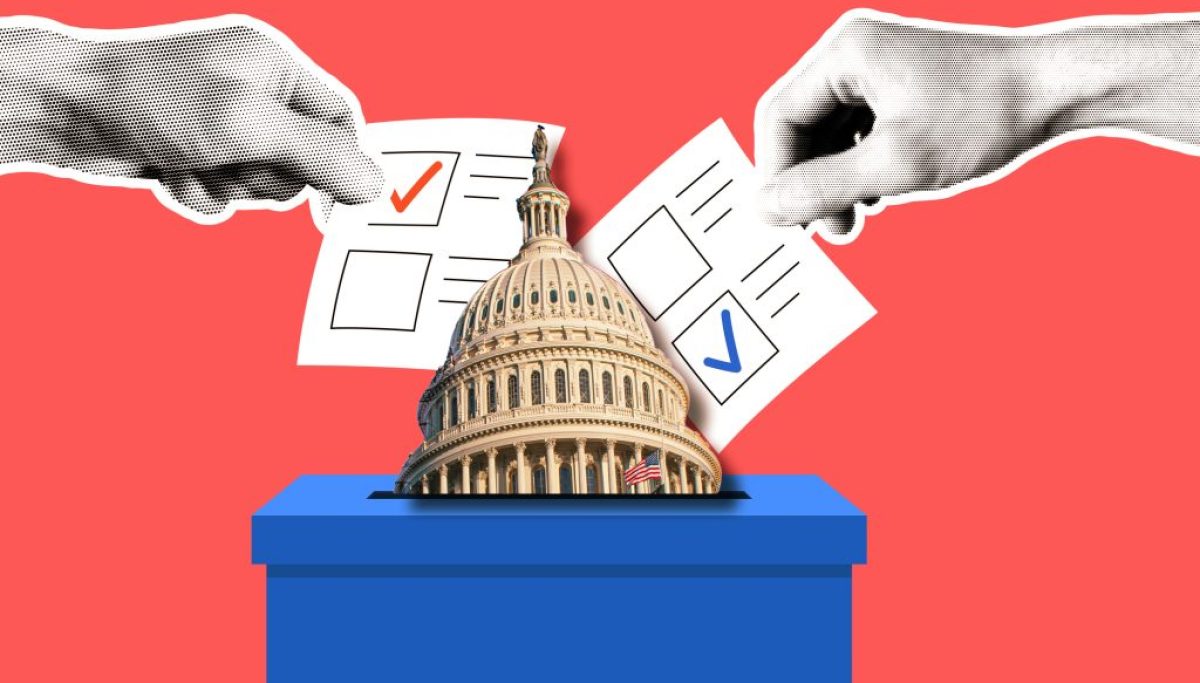
Photo via The Guardian

Democrats aim to retake Senate from Republicans as Americans go to polls

Read the original at The Guardian ↗
Cite

Washington, C. S. i. (2026, November 4). Democrats aim to retake Senate from Republicans as Americans go to polls. The Guardian. https://www.theguardian.com/us-news/2026/nov/03/democrats-senate-midterm-elections-results

Dated from the outlet's own feed. Check the original for its byline.

The Guardian · collected 2026-11-04 · by Chris Stein in Washington

Quick Summary

Democrats are attempting to regain control of the US Senate from Republicans during the midterm elections, hoping that voter dissatisfaction with President Donald Trump will help them secure at least four additional seats needed for a majority. Key races include traditionally red states like Texas and Kansas where Democratic candidates now see opportunities due to declining approval ratings for Trump, who faces criticism over economic issues and foreign policy decisions.Republicans are campaigning vigorously in battleground states they usually win to defend their 53-seat Senate majority.
Written by AI on 2026-11-04, from this article's own text only (the story summary below draws on all the coverage).

AI analysis

Story summary

As of November 4, 2026, Democrats won control of both chambers of Congress in the U.S. midterms, marking a significant defeat for Republicans and President Donald Trump's handpicked candidates. The election results led to historic defeats with Democrats flipping Senate seats in states like Iowa, Kansas, Maine, North Carolina, Ohio, South Carolina, and Texas. This outcome positioned New Yorkers Chuck Schumer and Hakeem Jeffries to lead the Senate and House respectively, signaling a shift in political power. Trump's staunch base expressed disbelief at the results, with MAGA influencers questioning how this was possible despite Trump's efforts to support Republican candidates across the country. The Democrats' victory is seen as a rebuke of Trump’s presidency, branding him a "lame duck" president.

Written for “Midterm Elections Blue Wave” on 2026-11-04, grounded in this article and the 99 other(s) covering the same event.

Story

📰 Midterm Elections Blue Wave
Politics · 100 article(s) covering the same event. Compare every outlet's account →

Compared with similar articles

This article reads leans left and hedges 10% of its claims. Each row says how that neighbour differs.
NPR
⚖️ Leans left Hedges 3 of 28 claims Outlet record 60/100
The Guardian
⚖️ Leans strongly left further left than this Hedges 4 of 26 claims Outlet record 66/100
Semafor
⚖️ Leans left Hedges 3 of 25 claims Outlet record 59/100
Fox News
⚖️ Leans strongly left further left than this Hedges 2 of 13 claims Outlet record 68/100
NBC News
⚖️ Leans left Hedges 1 of 25 claims Outlet record 78/100
“The articles discuss different aspects of the midterm elections: one focuses on the House of Representatives, while the other highlights the Senate races.”
Washington Examiner
Hedges 0 of 3 claims Outlet record 69/100
“The articles describe the overall context and expectations for the Senate elections on Election Day but do not focus on a single specific incident or outcome occurring at a particular time.”
The Independent
⚖️ Leans left Hedges 2 of 84 claims Outlet record 59/100
“Article A discusses the context leading up to the election, while Article B reports on actual results and early voting during the election day.”
Times of India
⚖️ Leans left Hedges 3 of 28 claims Outlet record 59/100
“The articles cover different days of the election coverage with distinct updates and results, indicating they are reporting on separate parts of the ongoing election rather than a single incident.”
The Guardian
⚖️ Leans left Hedges 7 of 57 claims Outlet record 66/100
NPR
Hedges 0 of 4 claims Outlet record 60/100
“The articles discuss different aspects of the midterm elections, with Article A focusing on Senate races and Article B on Democrats' prospects for winning control of the House.”
How this article was measured signals, leaning charts, publisher record, byline, topics and claims

Signals How these are calculated →

Claims extracted
20
sentences that state something as happening or true
Uncertain
10%
2 of 20 hedged ("reportedly", "may", "according to")
Leaning
Leans left
of the writing, not the subject · beta estimate
Publisher signals
66/100
The Guardian's corrections and hedging, across everything collected from it. Not a measure of accuracy.
Outlets on this story
100
Politics
Same framing elsewhere
1
articles that frame the event the way this one does
Analyzed 2026-11-04 · how these are computed

How this is being covered How these are calculated →

Article leaning vs. publisher reliability
Source leaning vs. consistency

Publisher

The Guardian · 2021 article(s) · 6 correction(s) detected
Running correction rate · 6 correction(s)

Who wrote this

Chris Stein in Washington
6 article(s) here · 1 carrying a prediction
🔮 Republicans are defending their majority in the US Senate against resurgent Democrats, who believe voters’ dissatisfaction with Donald Trump will put them back in control of Congress’ upper chamber just two years after being driven into the minority.
🔮 The billionaire Michael Bloomberg will spend $80m to help Democratic candidates in the midterm elections, US media reported on Tuesday, a significant infusion of cash for a party that has recently struggled with fundraising as it seeks to win control of Congress.
🔮 The New York Times article published on Wednesday is based on text messages and interviews with nine former employees of Peltola, who served in the House of Representatives from 2022 till the beginning of last year and is now set to face Republican senator Dan Sullivan in the 3 November midterm elections.
🔮 All are expected to win their seats in the midterms, as their districts are heavily Democratic.
🔮 An attorney, Kyl won election to the US House in 1986 then the Senate in 1994, where he would serve three terms.
Also by Chris Stein in Washington
Nothing else under this byline is closely related to this article, so these are simply their most recent.
All 6 articles by Chris Stein in Washington →

Topics

Congress Democrats Republican Republicans Senate

Subjects

Democrats NORP · 8× Trump PERSON · 7× Republican NORP · 6× Senate ORG · 6× Democratic NORP · 3× Alaska GPE · 2× Congress ORG · 2× Kansas GPE · 2× Republicans NORP · 2× Texas GPE · 2×

Narrative

At the outset of his presidency, it appeared difficult to believe that the minority party would have much of a shot of regaining control in the midterms – most senators set to face re-election represented solidly red or blue states, giving Democrats few offensive opportunities.
framing: assertive · carried by 1 article(s) · first seen 2026-11-04
🔮 Republicans are defending their majority in the US Senate against resurgent Democrats, who believe voters’ dissatisfaction with Donald Trump will put them back in control of Congress’ upper chamber just two years after being driven into the minority.
2026-11-04 · The Guardian
Democrats aim to retake Senate from Republicans as Americans go to polls · assertive framing

Claims (20 extracted, 2 hedged)

Republicans are defending their majority in the US Senate against resurgent Democrats, who believe voters’ dissatisfaction with Donald Trump will put them back in control of Congress’ upper chamber just two years after being driven into the minority. asserted
dissatisfaction → defend → minority
The first race results have begun trickling in, with the Associated Press calling the Virginia Senate election for Democratic incumbent Mark Warner, who was expected to win. asserted
who → begin → Warner
Polls in the midterm elections had opened earlier in the day in all 50 states and Washington DC, after millions of people voted early or sent in ballots by mail. asserted
millions → open → mail
Democrats lost their majority in the Senate in 2024, when voters re-elected Trump and gave his Republican allies 53 seats in Congress’ upper chamber. asserted
voters → lose → chamber
The party must win at least four seats to regain control, which would give them a potent tool against Trump for the final two years of his presidency. asserted
which → win → presidency
Not only could they block the president’s bills and issue subpoenas to investigate his administration, but they could also reject his nominees to the federal judiciary – including the supreme court. uncertain
they → block → court
At the outset of his presidency, it appeared difficult to believe that the minority party would have much of a shot of regaining control in the midterms – most senators set to face re-election represented solidly red or blue states, giving Democrats few offensive opportunities. asserted
senators → appear → opportunities
But Trump’s approval ratings have fallen sharply since his inauguration, fueled by dissatisfaction over his handling of the economy, and the all-important cost of living. asserted
ratings → fall → living
His decision to attack Iran has also proven unpopular with voters, as has his hardline implementation of enforcing immigration law. asserted
implementation → attack → law
To flip the Senate, Democrats initially named as their best bets races in Maine – the only state that voted for Kamala Harris and had a Republican incumbent on the ballot – North Carolina, Ohio and Alaska. asserted
that → flip → ballot
As sentiment towards Trump worsened, the party believed their candidates had a shot at winning in Texas, Kansas, Iowa and South Carolina – all red states Trump won by double digits. asserted
Trump → worsen → digits
In a sign of Republican concern that a “blue wave” could sweep their Senate majority away just two years after it was created, Trump has spent the final weeks before the midterm campaigning in places like Kansas, South Carolina, and Texas, where his party usually romps to victory. uncertain
party → sweep → victory
Republicans have their own targets, namely Democrats attempting to defend seats they hold in states that had broken for Trump two years ago, or that backed Harris only by slim margins. asserted
that → have → margins
This group includes Georgia, Michigan, New Hampshire and Minnesota. asserted
group → include → Georgia
A poll by the New York Times and Siena University published Sunday found Democrats leading in five battleground states surveyed, and statistically tied in a sixth. asserted
Democrats → publish → sixth
But other surveys have found Republican candidates ahead, while some Democrats vying for important seats have been dealing with drama and scandal in the closing days of the race. asserted
Democrats → find → race
Last week, the New York Times reported that Alaska Senate candidate Mary Peltola’s campaign collaborated with Democratic operatives to recruit a candidate with nearly the same name as her opponent, the incumbent Republican Dan Sullivan. asserted
campaign → report → opponent
The state’s governor has ordered a criminal investigation into the allegation, while the US Department of Justice filed a suit to block the election’s certification if Sullivan loses, though a federal judge recently dismissed it. asserted
judge → order → it
In Michigan, tensions between Democratic Senate nominee Abdul El-Sayed and congresswoman Haley Stevens, who he defeated in the primary, erupted into open conflict after she endorsed his Republican opponent, Mike Rogers. asserted
she → defeat → opponent
Stevens said she objected to El-Sayed’s stance on an advertisement by an outside group that blamed the rising cost of living on US support for Israel, but Democrats accused the four-term congresswoman of “betrayal”. asserted
Democrats → say → betrayal

💬Give feedback
🕘History 🎫Support