Photo via Reason

How Did Republicans Lose This Badly? Voters Turned Against Trump's Tariffs.

Read the original at Reason ↗
Cite

Boehm, E. (2026, November 4). How Did Republicans Lose This Badly? Voters Turned Against Trump's Tariffs. Reason. https://reason.com/2026/11/04/how-did-republicans-lose-this-badly-voters-turned-against-trumps-tariffs/

Dated from the outlet's own feed. Check the original for its byline.

Reason · collected 2026-11-04 · by Eric Boehm

Quick Summary

Voters overwhelmingly rejected President Donald Trump and Republican policies in recent midterm elections, delivering one of the most lopsided results since 1974. According to an NBC News exit poll, only 21% of voters believed tariffs had helped the national economy, while 60% said they caused harm. This outcome contradicts the belief that tariffs are politically advantageous, revealing them as both economically and politically detrimental for Trump's supporters.
Written by AI on 2026-11-04, from this article's own text only (the story summary below draws on all the coverage).

AI analysis

Story summary

As of November 5, 2026, Democrats won control of both the House and the Senate in the U.S. midterm elections, marking a significant shift from the Republican majority previously holding power. The outcome is seen as a rejection of President Donald Trump's policies, including his war with Iran which contributed to rising gas prices and inflation. In Texas, Senator Ted Cruz called the results a “Watergate-level repudiation” of the GOP and warned that Democrats could push radical agendas harmful to states like Texas if not resisted strongly. The election results have also led to celebrations among American expatriates in London, with many viewing it as a sigh of relief for potential policy reversals on issues such as tariffs affecting countries like the UK.

Written for “US Midterm Election Results” on 2026-11-05, grounded in this article and the 608 other(s) covering the same event.

Story

📰 US Midterm Election Results
Politics · 609 article(s) covering the same event. Compare every outlet's account →

Compared with similar articles

This article reads leans left and hedges 24% of its claims. Each row says how that neighbour differs.
Fox News
⚖️ Leans right further right than this Hedges 6 of 45 claims Outlet record 68/100
The Free Press
⚖️ Leans strongly left further left than this Hedges 0 of 23 claims Outlet record 97/100
The Guardian
⚖️ Leans strongly left further left than this Hedges 4 of 49 claims Outlet record 66/100
Semafor
Hedges 0 of 4 claims Outlet record 59/100
Reason
⚖️ Leans left Hedges 0 of 21 claims Outlet record 67/100
The Sydney Morning Herald
⚖️ Leans left Hedges 3 of 38 claims Outlet record 61/100
The Free Press
⚖️ Leans strongly right further right than this Hedges 1 of 8 claims Outlet record 97/100
Global News
⚖️ Leans strongly left further left than this Hedges 3 of 50 claims Outlet record 63/100
Semafor
Hedges 0 of 4 claims Outlet record 59/100
Daily Mail
⚖️ Leans strongly left further left than this Hedges 3 of 65 claims Outlet record 69/100
“The articles discuss different aspects and perspectives of the midterm election results but do not describe the exact same incident or moment in time.”
How this article was measured signals, leaning charts, publisher record, byline, topics and claims

Signals How these are calculated →

Claims extracted
25
sentences that state something as happening or true
Uncertain
24%
6 of 25 hedged ("reportedly", "may", "according to")
Leaning
Leans left
of the writing, not the subject · beta estimate
Publisher signals
67/100
Reason's corrections and hedging, across everything collected from it. Not a measure of accuracy.
Outlets on this story
609
Politics
Same framing elsewhere
1
articles that frame the event the way this one does
Analyzed 2026-11-04 · how these are computed

How this is being covered How these are calculated →

Article leaning vs. publisher reliability
Source leaning vs. consistency

Publisher

Reason · 1146 article(s) · 4 correction(s) detected
Running correction rate · 4 correction(s)

Who wrote this

Eric Boehm
24 article(s) here · 1 carrying a prediction
🔮 There is an oft-repeated political cliché that says tariffs are bad economics but good politics—the logic being: They might be costly, but they allow politicians to look like they are prioritizing domestic jobs and workers over foreign trade.
🔮 His influence over American politics will only wane from here, and both his party and the country will likely be better off as a result.
🔮 As he campaigned on behalf of Rep. Ashley Hinson (R–Iowa) on Sunday, President Donald Trump boasted that he could have "won the Vietnam War in a week."
🔮 An underappreciated facet of the controversy that has rocked the Alaska Senate race: Voting reforms adopted by the state in 2020 will likely blunt the effectiveness of an apparent Democratic scheme to place a second candidate named Dan Sullivan on the ballot.
🔮 The New York Times reports that Democrats will move quickly on four items that are "consensus items among their members that are basic enough to bypass time-consuming committee consideration and go straight to the floor."
2026-10-30 · mixed framing · What Will Democrats Do?
🔮 Next week's election is a pivotal one for Colorado, as voters will decide a pair of ballot questions that could secure the state's low-tax, small-government reputation—or shatter it.
🔮 Habba will get $50 million over five years to do unspecified work for a company that barely exists, according to The New York Times, while Herrera got a presidential pardon for a 2025 campaign finance charge.
2026-10-22 · assertive framing · The Swamp King
🔮 A proposed "wealth tax" on California's billionaires could backfire and cost the state tens of billions of dollars in the long run.
🔮 America's interminable war with Iran has killed thousands, disrupted commerce that flows through the Strait of Hormuz, and raised prices on the home front. But there may be one silver lining.
🔮 The White House has not said when the purchases will be made, what prices will be paid, or who will be paying (private companies or taxpayers), though the Treasury announced that it would be issuing a "temporary general license to allow the supply of Russian diesel to the global market."
Also by Eric Boehm
What Will Democrats Do?
2026-10-30 · Reason
Nothing else under this byline is closely related to this article, so these are simply their most recent.
All 24 articles by Eric Boehm →

Topics

GOP Republicans The New York Times post-Watergate the Republican Party

Subjects

Trump PERSON · 8× Americans NORP · 2× GOP ORG · 2× Donald Trump PERSON · 1× J.D. Vance PERSON · 1× Republicans NORP · 1× The New York Times ORG · 1× Trump administration ORG · 1× Vance PERSON · 1× the Republican Party ORG · 1×

Narrative

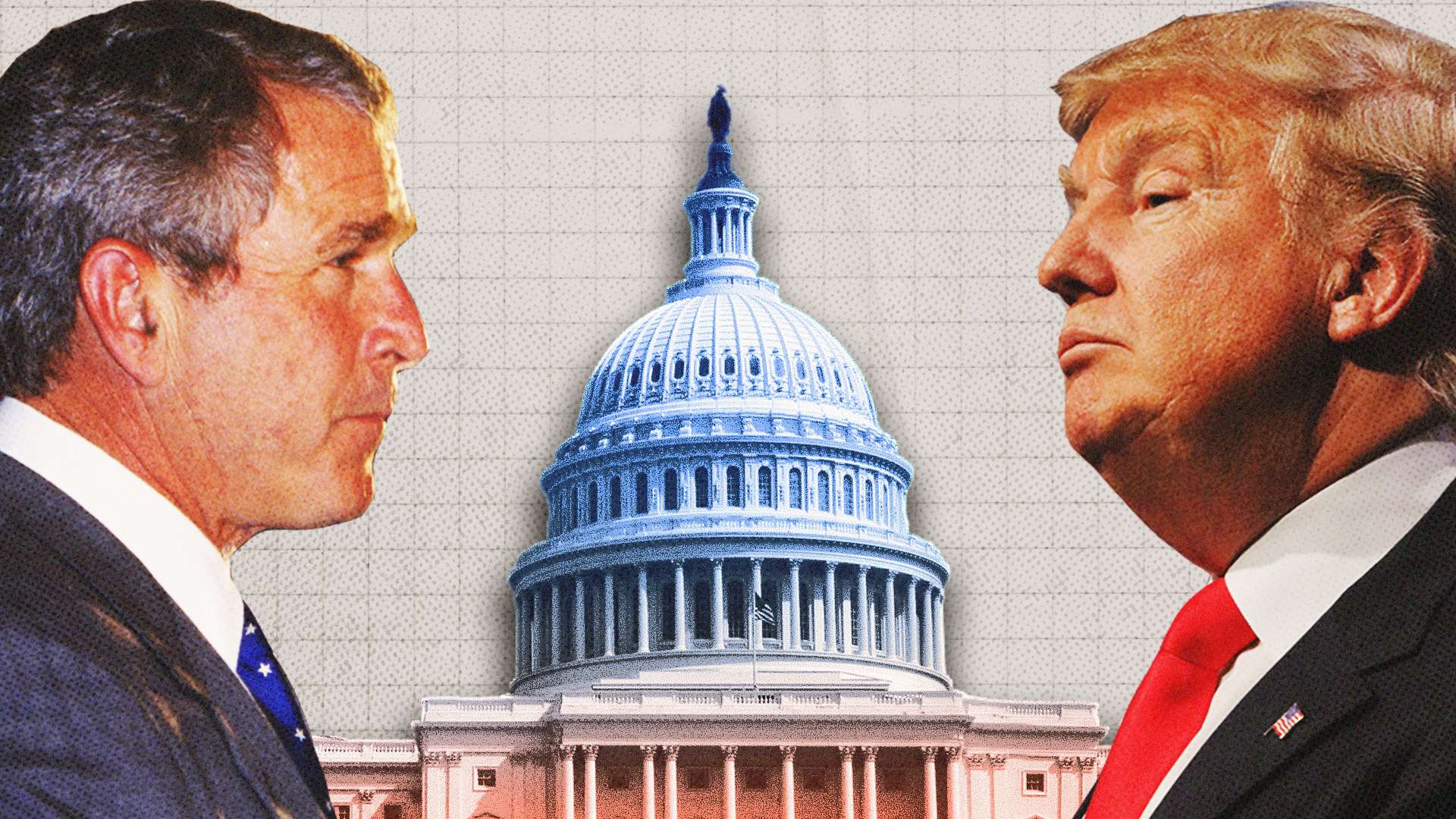
Voters turned decisively against President Donald Trump and Republicans in Tuesday's elections, delivering a historic beatdown that was the most lopsided midterm result since the post-Watergate wipeout of 1974.
framing: mixed · carried by 1 article(s) · first seen 2026-11-04
🔮 There is an oft-repeated political cliché that says tariffs are bad economics but good politics—the logic being: They might be costly, but they allow politicians to look like they are prioritizing domestic jobs and workers over foreign trade.

Claims (25 extracted, 6 hedged)

There is an oft-repeated political cliché that says tariffs are bad economics but good politics—the logic being: They might be costly, but they allow politicians to look like they are prioritizing domestic jobs and workers over foreign trade. uncertain
they → be → trade
That line turned out to be only half right. asserted
line → turn → ?
Voters turned decisively against President Donald Trump and Republicans in Tuesday's elections, delivering a historic beatdown that was the most lopsided midterm result since the post-Watergate wipeout of 1974. asserted
that → turn → 1974
The results are so overwhelming that it's probably not accurate to blame any singular issue for the GOP's meltdown. asserted
it → blame → meltdown
Vice President J.D. Vance and others in the Republican Party are reportedly trying to pin the blame for this result entirely on the war. uncertain
Vance → try → war
"The reason we lost is the war," Vance told The New York Times on Wednesday—conveniently pinning all the blame on the one major Trump administration decision that he's questioned. asserted
he → lose → that
They have become the signature economic policy for the entire populist movement that has sprung up around Trump. asserted
that → become → Trump
The president promised a "golden age," and allies like Oren Cass and Peter Navarro promised a realignment that would bring working-class voters into the GOP for good. asserted
that → promise → good
So how do Americans view this tentpole policy of the populist right? asserted
Americans → view → right
According to an NBC News exit poll of midterm voters, just 21 percent said the tariffs had helped the national economy. uncertain
tariffs → accord → economy
Even fewer voters, just 14 percent, said the tariffs had helped their local economies. asserted
tariffs → say → economies
Meanwhile, more than 60 percent said the tariffs had caused harm. asserted
tariffs → say → harm
The short version: It turns out that tariffs are bad economics and bad politics. asserted
tariffs → turn → ?
For years, we've documented how Trump's tariffs have raised prices, harmed businesses, disrupted supply chains, and more. asserted
tariffs → document → chains
One study found that the tariffs were as painful to American manufacturing as an additional 8.7 percent corporate tax would have been. asserted
tax → find → manufacturing
It's also worth remembering that the tariffs have failed to achieve their primary policy aim as well: America's trade deficit last month hit the highest level since March 2025. asserted
deficit → remember → March
Tariffs made everything more expensive and didn't provide much in return. asserted
everything → make → return
Trump has talked for years about how the tariffs would generate tons of money for the government—as if that's a good thing. asserted
that → talk → government
Those claims were wildly exaggerated, even before the Supreme Court forced the Trump administration to refund a significant amount of the tariffs because they had been unlawfully imposed. uncertain
they → force → tariffs
Politically, the tariffs have been a drag on Trump's approval rating since the moment he stood on the White House lawn to declare "Liberation Day." asserted
he → stand → Day
The trends that led to a Democratic landslide on Tuesday night began in April 2025, when Trump very publicly promised to raise taxes on Americans. asserted
Trump → lead → Americans
Who could have known that was a mistake? uncertain
that → know → ?
There's another political cliché that says you never want to be on the wrong side of a 60–30 issue—meaning that candidates shouldn't prioritize niche interests over what the majority favors. asserted
majority → be → what
Trump just found himself on the wrong side of a 60–20 issue. asserted
Trump → find → issue
If you're wondering how the Democrats could have pulled off such a stunning landslide last night, that's a good place to start. uncertain
that → wonder → landslide

💬Give feedback · no sign-in needed

No sign-in needed for now. Your note is sent without a name, so it cannot be answered.

🕘History 🎫Support