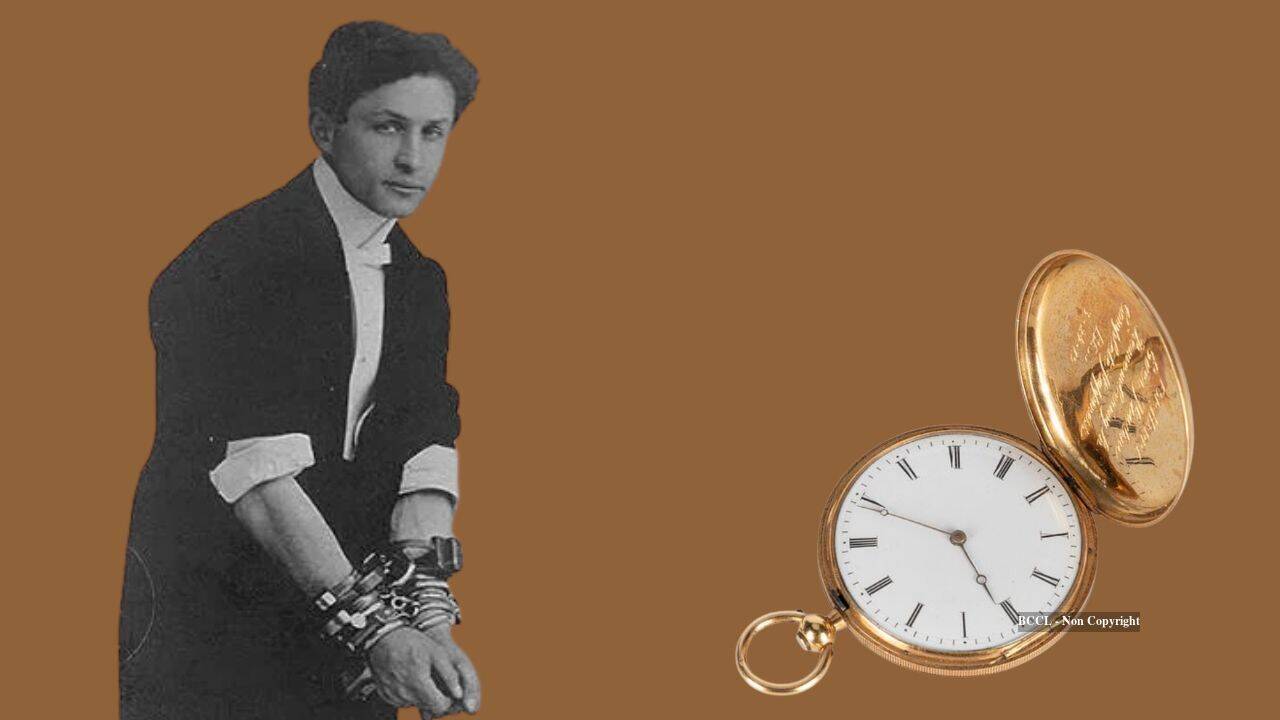
Harry Houdini was famous for escaping locked boxes, handcuffs and seemingly impossible restraints, but one of the most personal objects connected to him carried a secret hidden in plain sight.
asserted
one → escape → sight
In 1910, his wife Beatrice, known as Bess, gave him a gold-filled pocket watch engraved with what appeared to be a simple birthday message.
asserted
what → know → watch
More than a century later, Potter & Potter Auctions sold the watch for $204,000, far above its $20,000 to $40,000 estimate, as per their website.
asserted
Auctions → sell → website
At first glance, it reads like an affectionate note from Bess to her husband.
asserted
it → read → husband
But the first letters of the central words spell “EHRICH,” the birth name Houdini was born with as Erik Weisz.
asserted
Houdini → spell → Weisz
That small act of concealment, combined with the watch’s direct link to Houdini and Bess, helped turn a 19th-century timepiece into one of the most sought-after Houdini artefacts ever offered at auction.
asserted
act → combine → auction
A gift with a hidden name
The watch was presented to Houdini by Bess on his 36th birthday in 1910.
asserted
watch → present → 1910
Engraved inside the hunting case are the words: “For Harry / Ever Houdini / Remembering In / Complete Happiness / BESS / 3/24/10.”
asserted
words → engrave → Happiness
The message looks like a romantic dedication, but the capitalised first letters of the middle words form a private code: E, H, R, I, C and H.
asserted
letters → look → code
Together, those letters spell “Ehrich,” the name Houdini used before he became the world-famous escape artist.
asserted
he → spell → Ehrich
The engraving gives the watch a double identity.
asserted
engraving → give → identity
Privately, it preserves the name he carried before fame transformed him into “Houdini.”
asserted
fame → preserve → Houdini
Potter & Potter described the object as a 19th-century French gold-filled cylinder pocket watch with an attractively engraved hunting case.
asserted
Potter → describe → case
It measures roughly 1 11/16 inches across and comes with its winding key.
asserted
It → measure → key
The auction house noted that the mechanism is in working condition but needs servicing, while the watch remains in near-fine condition with only tiny signs of handling.
asserted
watch → note → handling
A birthday in Australia
The gift carries historical weight beyond its inscription.
asserted
gift → carry → inscription
Bess gave Houdini the watch while the couple were touring Australia, just six days after he made a historic flight at Diggers Rest.
asserted
he → give → Rest
That flight made Houdini the first person to pilot an aeroplane in Australia, adding a major achievement to a career already built on daring public performances.
asserted
Houdini → make → performances
The date engraved in the watch, March 24, 1910, is also significant.
asserted
date → engrave → watch
Houdini often gave April 6 as his birthday and signed autographs with that date, telling his brother Hardeen that it was the birthday recognised by his mother.
asserted
it → give → mother
According to the auction listing, however, his true birthday was March 24, the date Bess chose to engrave inside the case.
uncertain
Bess → accord → case
That detail makes the watch more than a collectible.
asserted
watch → make → collectible
It is a private record of Houdini’s real birth date, preserved by the person who knew him most intimately.
asserted
who → preserve → him
A closer look at the watchPhoto credit: potterauctions.com
Why collectors paid so much
Houdini memorabilia attracts strong interest because his life combined showmanship, mystery and personal reinvention.
asserted
life → pay → showmanship
He was born Erik Weisz in Budapest in 1874, later changed his name to Harry Houdini, and built a global reputation as an escape artist, magician, aviator, author and investigator of spiritualist claims.
uncertain
He → bear → claims
An object connected directly to both his public persona and his private identity naturally commands attention.
asserted
object → connect → attention
The watch also has an unusually clear provenance.
asserted
watch → have → provenance
After Houdini’s death in 1926, it was owned by the noted mentalist and magician Joseph Dunninger.
asserted
it → own → mentalist
It later passed to collector Raphael Ellenbogen and then to Kevin Connolly.
asserted
It → pass → Connolly
Ellenbogen’s account of the watch and its acquisition was published in Magicol in May 1988, giving collectors a documented history of the object.
uncertain
account → publish → object
That chain of ownership matters in the auction market.
asserted
chain → matter → market
A Houdini-linked artefact is valuable, but one that can be traced through respected magicians and collectors is far more credible.
asserted
that → link → magicians
The watch’s story, condition and inscription together made it a centrepiece of Potter & Potter’s “Houdini Returns: The Centennial Auction,” held on October 31, 2026.
asserted
it → make → October
The auction result
The watch was listed as Lot 20 with an estimate of $20,000 to $40,000.
asserted
watch → list → 40,000
It attracted 13 bids before selling for $204,000, a price that includes the buyer’s premium.
asserted
that → attract → premium
That result is more than five times the high estimate and demonstrates how competitive the market for authenticated Houdini material has become.
asserted
market → demonstrate → material
Auction results like this reflect more than scarcity.
asserted
results → reflect → more
The watch is small, personal and tied to a specific moment in Houdini’s life.
asserted
watch → tie → life
It was not a stage prop used in a famous escape, but a private gift from Bess that carried a hidden reference to the name he left behind.
asserted
he → use → name
For collectors, that intimacy is often what turns an object into a trophy.
asserted
what → turn → trophy
…and 9 more, not listed.
 The Aporia