Andy Burnham’s pledge to seek a “structured dialogue” with former colonies to help shape Britain’s first formal state apology for slavery marks the UK’s first tentative step down a path the Netherlands set out on five years ago.
asserted
Netherlands → seek → path
The prime minister’s attempts to initiate a historic shift alongside the royal family – whose customary expressions of “profound personal sorrow”, falling short of an apology, was repeated by King Charles this week – echo a process begun by the Dutch state in 2021.
asserted
expressions → initiate → 2021
As London weighs its words, while firmly ruling out any support for reparations, the Dutch experience may provide a preview: in the Netherlands, apologising did not draw a line under the past for everyone, and prompted a political backlash, disillusion among many descendants, and a row over what justice really means.
uncertain
justice → weigh → what
That is not to say it was not the right thing to do.
asserted
it → say → ?
You could feel the sincerity,” said Linda Nooitmeer, the then chair of the National Institute for the Study of Dutch Slavery and its Legacy (NiNsee).
uncertain
Nooitmeer → feel → Slavery
It was about “restoring the humanity of the ancestors”, because a key historical element had been “the dehumanisation of people of African descent”, she said.
asserted
she → restore → descent
“But when it comes to real change, the rights of people of African descent, we have another issue.”
asserted
we → come → issue
Merchants of the so-called Dutch Golden Age trafficked an estimated 600,000 enslaved Africans across the Atlantic to brutal plantations in Suriname and Curaçao, as well as between 660,000 and 1 million across the Indian Ocean and East Indies.
asserted
Merchants → call → Ocean
By the 1770s, slavery-derived wealth generated more than 10% of the GDP of the province of Holland.
asserted
wealth → derive → Holland
Even the crown was enriched: Willems III, IV and IV made what equates to €545m (£465m) in modern money from the trade between 1675 and 1770 alone.
asserted
what → enrich → 1675
The Netherlands was among the last European colonial powers to outlaw the practice, legally abolishing it in Suriname and the Dutch Caribbean on 1 July 1863, 30 years after Britain and 15 after France.
asserted
Netherlands → outlaw → France
The actual end – freedom – came in 1873.
asserted
end → come → 1873
Afro-Surinamese and Afro-Caribbean community campaigners started demanding accountability in the 1980s.
asserted
campaigners → start → 1980s
NiNsee was founded in 2002, and slavery entered the school curriculum in 2006.
asserted
slavery → found → 2006
The political trigger came in 2020, with the wave of protests that followed George Floyd’s murder in the US.
asserted
that → come → US
If many had tried to ignore Dutch history, said the activist Patrick Mathurin at the time, “through our activism, we forced them to look”.
asserted
we → try → them
On 1 July 2021, Amsterdam’s mayor, Femke Halsema, broke ranks during the annual Dutch Keti Koti (“breaking the chains”) commemorations marking the anniversary of abolition, delivering a direct apology on behalf of the municipality.
Amsterdam’s involvement, Halsema said, had been “direct, worldwide, large-scale, multifaceted and protracted”, and the city’s immense past wealth and commercial legacy were “indivisible from persistent racism that still festers”.
Amsterdam’s apology was followed by those of Rotterdam, Utrecht and The Hague, and by the Dutch central bank.
asserted
apology → break → bank
The then prime minister, Mark Rutte, who had insisted as late as 2020 that a national apology would only “polarise society”, began to waver.
asserted
apology → insist → society
In December 2022, Rutte delivered a landmark speech at the Dutch National Archives recognising slavery as a “crime against humanity” and admitting the Dutch state had “enabled, encouraged, and profited from slavery” for more than 250 years.
asserted
state → deliver → years
“Today, on behalf of the Dutch government, I apologise for the past actions of the Dutch state: posthumously to all enslaved people worldwide who suffered from those actions, to their daughters and sons, and to all their descendants down to the present day,” he said.
asserted
he → apologise → day
Six months later, on 1 July 2023, in Amsterdam’s Oosterpark, King Willem-Alexander also asked forgiveness: “As your king, and as a member of the government, I make this apology myself.
asserted
I → ask → apology
And I feel the weight of the words in my heart and my soul.
asserted
I → feel → heart
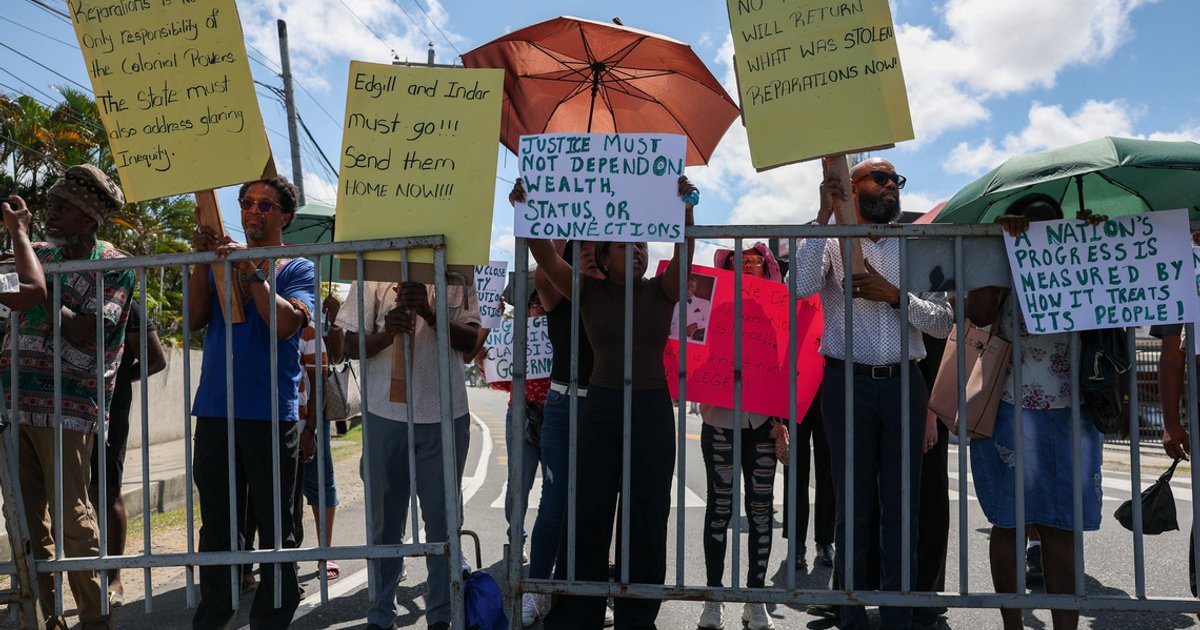
Afterwards, however, there was anger among activists, advocacy groups and descendants, who criticised Rutte’s apology in particular as hasty, paternalistic and made without real consultation.
asserted
who → be → consultation
Roy Kaikusi Groenberg, of the Honour and Recovery Foundation, called the prime minister’s declaration a “neocolonial belch”.
asserted
Groenberg → call → declaration
Caribbean intellectuals pointed out the obvious and painful irony of European politicians dictating the terms and timing of reconciliation.
asserted
politicians → point → reconciliation
While the Dutch government explicitly ruled out direct financial reparations to individuals or former colonies, it did back its apology with a €200m fund and an initial commitment towards a National Slavery Museum.
asserted
it → rule → Museum
The money was divided between state-led educational and awareness programmes, such as overhauling school curriculums, funding historical research and preserving colonial heritage, and social initiatives and community grants to grassroots groups.
asserted
money → divide → groups
Nooitmeer, who has since set up Deeeni, a grassroots organisation focusing on economic initiatives in the African-origin community, said at the time there was a danger of apologies becoming the “mirrors and crystals of the 21st century”.
asserted
apologies → set → century
Mirrors and crystals, she noted, were the symbolic, empty trinkets with which enslaved people were once bought and sold.
asserted
people → note → which
“Slavery was an economic system,” she says now.
asserted
she → say → ?
“If you say all this was wrong, when are you ready to talk about the economic side: reparations in the broader sense?”
asserted
you → say → sense
Community ownership of the whole process “was completely lacking”, she said.
asserted
she → lack → process
While apologies might be made, “as long as the community is excluded from the decision-making process, the old mechanisms of inequality simply remain”.
uncertain
mechanisms → make → inequality
A key lesson from the Dutch experience, Nooitmeer said, was that people of African descent today need some kind of “agency over what reparations should look like – and when they are considered sufficient”.
asserted
they → say → what
The Netherlands also witnessed a conservative political backlash.
asserted
Netherlands → witness → backlash
In 2021, only 31% of the Dutch public said they supported the idea of a national apology for slavery, said Sjoerd van Heck of Ipsos I&O, while 55% opposed it.
asserted
% → say → it
The numbers converged somewhat, reaching 38% in favour and 49% opposed in 2022 and, after the Rutte and Willem-Alexander apologies, 40% for versus 46% against, Van Heck said, but added: “It’s clear that the subject remained one that sharply divided the population.”
That was grist to the mill for Geert Wilders, who, like Europe’s other populist far-right leaders, has long ridiculed state apologies for past wrongs and pledged to rewrite school textbooks to emphasise their nation’s achievements.
asserted
who → converge → achievements
His Freedom party (PVV) won a shock victory in 2023 elections.
asserted
party → win → elections
The National Slavery Museum, conceived with Surinamese, Caribbean and Dutch community participation and backed by €80m from Amsterdam city hall and the national government, is due to open in 2030.
asserted
Museum → conceive → 2030
But for Britain, the Dutch experience suggests that state apologies, while plainly welcome, may prove not so much a neat final settlement with colonial history as the opening of a new and almost certainly contested phase of reckoning.
uncertain
apologies → suggest → reckoning
 The Aporia