Photo via The Guardian

Australians are yet to see the benefits of AI and datacentres – and US midterms show they could be political kryptonite

Read the original at The Guardian ↗
Cite

Butler, J. (2026, November 5). Australians are yet to see the benefits of AI and datacentres – and US midterms show they could be political kryptonite. The Guardian. https://www.theguardian.com/australia-news/2026/nov/06/ai-datacentre-boom-could-be-political-kryptonite-australia

Dated from the outlet's own feed. Check the original for its byline.

The Guardian · collected 2026-11-05 · by Josh Butler

Quick Summary

The Reserve Bank of Australia recently warned that investments in AI and datacenters are contributing to inflationary pressures, coinciding with the US midterm elections where such issues have become politically contentious. The article questions when Australians will see benefits from these technological advancements, noting concerns over job displacement and economic strain, especially as the RBA raises interest rates to combat inflation. Deloitte Access Economics reports a significant increase in datacenter investments, raising further questions about the economic and social impacts of this trend.
Written by AI on 2026-11-05, from this article's own text only (the story summary below draws on all the coverage).

AI analysis

Story summary

As of November 5, 2026, Australians have yet to see significant benefits from the AI and datacentre boom, despite concerns over job displacement and environmental impacts. The Reserve Bank of Australia (RBA) recently raised interest rates to an 18-year high due to inflationary pressures caused by datacentres. Prime Minister Anthony Albanese's government faces challenges in attracting AI investment while addressing voter skepticism, as evidenced by the US midterm election results where datacentre projects faced political opposition. The RBA's governor Michele Bullock emphasized that current economic adjustments are necessary to prevent worse consequences later, highlighting the need for clearer communication about long-term benefits and alternative inflation management strategies.

Written for “US Midterms And AI Policy” on 2026-11-05, grounded in this article and the 0 other(s) covering the same event.
Why this leaning score
The article's own words the score was based on. Each is quoted verbatim and was checked against the article text before being stored, so you can find it in the original.
Reading Leans left (beta estimate) Confidence high
Leaning: leans left for article 131745 (high confidence, 3 verified quotes) · logged 2026-11-05

Story

📰 US Midterms And AI Policy
Politics · 1 article(s) covering the same event.

Compared with similar articles

This article reads leans left and hedges 15% of its claims. Each row says how that neighbour differs.
The Guardian
⚖️ Leans left Hedges 3 of 42 claims Outlet record 66/100
“Article A focuses on local discontent in Grayndler due to an AI proposal affecting creatives, while Article B discusses broader concerns about AI and datacentres' impact on the Australian economy and workforce.”
The Sydney Morning Herald
⚖️ Leans strongly left further left than this Hedges 2 of 28 claims Outlet record 61/100
“The articles discuss different aspects of AI and copyright issues in Australia without describing the same specific incident.”
The Sydney Morning Herald
Hedges 2 of 7 claims Outlet record 61/100
“The articles cover different topics and timelines within Australia's news, with Article A focusing on a Qantas data breach and political trust issues, while Article B discusses AI, datacenters, and economic impacts.”
The Sydney Morning Herald
Hedges 2 of 25 claims Outlet record 61/100
“The articles discuss different aspects of AI impact and datacenters in Australia without clearly describing the same specific incident or occurrence.”
Semafor
⚖️ Leans left Hedges 2 of 3 claims Outlet record 59/100
“The articles discuss different aspects of opposition and concerns regarding data centers in different countries (US and Australia) and do not describe a single specific incident.”
BBC News
Hedges 10 of 37 claims Outlet record 66/100
“The articles discuss different aspects of AI data centers and their impacts; one focuses on UK emissions goals undermined by a new deal, while the other addresses Australia's lack of benefits from AI and datacenters.”
South China Morning Post
Hedges 1 of 3 claims Outlet record 62/100
“The articles discuss different aspects of AI and its impacts globally, with Article A focusing on financiers' concerns at a Hong Kong summit and Article B addressing Australian-specific issues and the US midterms.”
The Sydney Morning Herald
⚖️ Leans left Hedges 0 of 20 claims Outlet record 61/100
“The articles discuss different aspects of AI and data center development in Australia; one focuses on a parliamentary inquiry about planning controls, while the other addresses broader economic and social impacts.”
Semafor
⚖️ Leans left Hedges 0 of 34 claims Outlet record 59/100
“The articles discuss AI and data centers but cover different aspects: one focuses on US midterm election results related to AI regulation, while the other discusses Australia's perspective on AI impacts and economic concerns.”
Washington Examiner
⚖️ Leans right further right than this Hedges 0 of 5 claims Outlet record 69/100
“The articles discuss different aspects of the impact of data centers and AI, with Article A focusing on Australia's economic concerns and potential downsides, while Article B addresses reactions to US midterm election results.”
How this article was measured signals, leaning charts, publisher record, byline, topics and claims

Signals How these are calculated →

Claims extracted
39
sentences that state something as happening or true
Uncertain
15%
6 of 39 hedged ("reportedly", "may", "according to")
Leaning
Leans left
of the writing, not the subject · beta estimate
Publisher signals
66/100
The Guardian's corrections and hedging, across everything collected from it. Not a measure of accuracy.
Outlets on this story
1
Politics
Same framing elsewhere
1
articles that frame the event the way this one does
Analyzed 2026-11-05 · how these are computed

How this is being covered How these are calculated →

Article leaning vs. publisher reliability
Source leaning vs. consistency

Publisher

The Guardian · 3025 article(s) · 6 correction(s) detected
Running correction rate · 6 correction(s)

Who wrote this

Josh Butler
23 article(s) here · 1 carrying a prediction
🔮 When will Australia see the benefits of the AI and datacentre boom?
🔮 About one in five reported they sometimes had to go without medicine or healthcare, could not afford to heat or cool their homes, or had to ask friends or family to borrow money.
🔮 Just 12% of voters in October’s poll said they regularly wagered on horse races and would bet on Tuesday’s Melbourne Cup, down 5 points from 2025.
🔮 Altering copyright law to allow AI companies to scrape music, books and journalism could trigger a constitutional breach, Coalition senators and the recording industry have warned, as they raise new fears it could open Australia to massive legal action and compensation claims from rights holders worldwide.
🔮 The secretary of the defence department approved a senior official’s controversial idea to tell a Senate hearing that footage of public servants giving evidence should not be shared on social media because it could invite online bullying and raise national security concerns.
🔮 The digital duty of care bill passed the House of Representatives on Wednesday and will be debated by the Senate in coming weeks.
🔮 But Australians are still not convinced One Nation or the Coalition would do a better job than the current government, with Labor still the most trusted party on the economy and managing the country.
🔮 Security agencies will review safety precautions for MPs’ homes and offices after numerous federal politicians told police and Asio in safety briefings that they were worried about widening threats after the alleged attack on Helen Haines.
🔮 At his first speech to the national press club on Wednesday, he said he wasn’t launching a bid for prime minister – no matter how much some people might like the softly spoken senator to have more say in federal politics.
🔮 Whether you agree with her or you don’t on issues, you would be proud to see how she approaches issues in the Parliament; with compassion, with rigour, everything that you would want from a politician.”
Also by Josh Butler
Nothing else under this byline is closely related to this article, so these are simply their most recent.
All 23 articles by Josh Butler →

Topics

Albanese Australia Australian RBA the Reserve Bank’s

Subjects

Bullock PERSON · 4× RBA ORG · 4× Australia GPE · 3× Deloitte ORG · 3× Albanese NORP · 1× Australian NORP · 1× Deloitte Access Economics ORG · 1× Labor ORG · 1× Michele Bullock PERSON · 1× the Reserve Bank’s ORG · 1×

Narrative

So far, all we’ve seen is the possibility of changes to copyright which would hurt Australian creatives, special rules about power and water use, and the threat of mass displacement or replacement of workers, with the trade-off being a mere 10% chance of human extinction.
framing: assertive · carried by 1 article(s) · first seen 2026-11-05
🔮 When will Australia see the benefits of the AI and datacentre boom?

Claims (39 extracted, 6 hedged)

When will Australia see the benefits of the AI and datacentre boom? asserted
Australia → see → boom
So far, all we’ve seen is the possibility of changes to copyright which would hurt Australian creatives, special rules about power and water use, and the threat of mass displacement or replacement of workers, with the trade-off being a mere 10% chance of human extinction. asserted
off → see → extinction
Now add the Reserve Bank’s assessment this week that datacentres were part of growing “inflationary pressures” when lifting interest rates to an 18-year high. asserted
datacentres → add → high
Warnings about looming negatives have been coming for months, but even the RBA has no idea when to expect the positives. asserted
RBA → loom → positives
And, as the results of the US midterms show us, datacentres are becoming political kryptonite for voters not sold on the AI boom, meaning the Albanese government should tread carefully. asserted
government → show → boom
As Labor mulls its long-awaited plan to attract AI investment, this week’s RBA decision demands politicians better explain what the benefits of this rollout will be, and why it is worth the (hopefully short-term) pain. asserted
it → mull → rollout
It also requires the government to consider other inflation responses, beyond the RBA. asserted
It → require → RBA
The governor, Michele Bullock, warned “some pain now will prevent even worse pain” in the future. asserted
pain → warn → future
But why should ordinary workers endure pain that is not of their own making? asserted
that → endure → making
Some of the richest companies in the world are helping heat the economy to such an extent that Bullock flagged it in her opening remarks, just moments after pointing to global oil prices, low productivity and expectations of prolonged inflation. asserted
Bullock → help → inflation
“Parts of demand have also been stronger than expected. asserted
Parts → expect → demand
In particular, investment has been much stronger than expected, including due to datacentre-related investment. asserted
investment → expect → investment
This has added to inflationary pressures by adding to demand at a time when the domestic economy is already capacity constrained,” Bullock said. asserted
Bullock → add → time
The RBA’s statement of monetary policy highlighted that “AI-related investment is driving rapid growth in prices for technology-related goods” in its second paragraph. asserted
investment → highlight → paragraph
But asked when AI would start having a “positive impact on inflation”, Bullock shrugged “your guess is as good as mine”. asserted
guess → ask → mine
She said “if productivity improves dramatically because of AI” – “if”, not “when” – then we would see faster growth, but also warned it could increase the “neutral interest rate”. “So if people think that productivity improvements will help to lower inflation and keep interest rates low, that’s not necessarily the case,” Bullock said. uncertain
Bullock → say → rates
Even the nation’s chief economic wonk is hazy on when the benefits start flowing. asserted
benefits → start → ?
These aren’t nimby arguments against datacentres or luddite concerns about technological growth; there are serious economic questions to be considered here, and social ones already being examined worldwide. asserted
These → be → growth
Deloitte Access Economics on Thursday reported Australia’s $1.39tn investment pipeline included 37 datacentres worth $141bn – a 36% increase in a year. asserted
pipeline → report → year
Deloitte director, Sheraan Underwood, said the datacentre boom was “competing directly with housing and infrastructure for workers and materials”, and that Australia had “less room to absorb” the investment surge thanks to high inflation. asserted
Australia → say → inflation
Deloitte reported “the economic dividend may take time”, predicting “substantial” construction gains but that the “direct economic payoff” wouldn’t be as big. uncertain
payoff → report → gains
The technology fit-out is largely imported goods and few workers are needed to actually staff the facilities. asserted
workers → import → facilities
Of course the datacentre boom will support AI takeup, greater automation and productivity, but Deloitte warned: “Construction demand and inflation pressures are arriving now, while the productivity dividend may come much later.” uncertain
dividend → support → takeup
In the wake of RBA warnings about demand, much media focus has naturally turned to government spending. asserted
focus → turn → spending
Press gallery pundits have zeroed in, particularly, on green subsidies and home batteries; the shadow energy minister, Dan Tehan, blasted a “blowout” from a budgeted $2.3bn to $8.5bn. asserted
minister → zero → 8.5bn
That’s $6.2bn more than budgeted. asserted
That → ’ → ?
If everything is on the table for savings, as Labor has said, shouldn’t we consider the benefits of untrammelled investment in AI factories before we start slashing social programs achieving good? asserted
we → say → good
Politico recently reported polling showing half of Americans oppose datacentres near their homes; NBC exit polls found 56% of voters said AI and datacentres were “crucial” or “major” factors in the midterms. asserted
AI → report → midterms
Datacentres were also literally on the ballot in dozens of towns, with public votes overwhelmingly won by proposals to restrict construction, according to vote trackers. uncertain
votes → win → trackers
The Australian backlash is much smaller, but growing. asserted
backlash → grow → ?
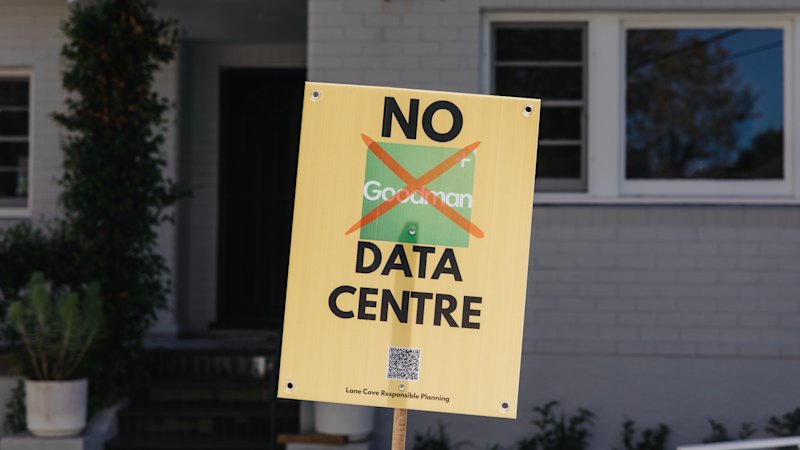
Community groups are organising and protesting. asserted
groups → organise → ?
Labor should not overlook bubbling voter unease. asserted
Labor → overlook → unease
Beyond leaving it to the “blunt instrument” of monetary policy for the RBA to smash the economy, there are other options Labor could consider. uncertain
Labor → leave → economy
They are novel, but the times demand novel solutions. asserted
times → demand → solutions
Senator David Pocock has proposed a Senate committee to investigate “alternatives” to monetary policy, suggesting options including “temporary, progressive” changes to income tax or superannuation. asserted
Pocock → propose → tax
Independent economist Saul Eslake has said a small rise in superannuation rates, from even 12 to 13%, would take some money out of workers’ pockets and help curb spending. asserted
rise → say → spending
Pocock, again, suggested taxes on windfall profits and gas exports to take more cash out of the economy. uncertain
Pocock → suggest → economy
Of course we need new AI and datacentre investment, particularly as the government looks for a magic bullet to end stagnant productivity. asserted
government → need → productivity
But the government has so far struggled to make the case for how this new technology will benefit ordinary Australians, who are left with a feeling of uncertainty and a hole in their back pocket. asserted
who → struggle → pocket

💬Give feedback · no sign-in needed

No sign-in needed for now. Your note is sent without a name, so it cannot be answered.

🕘History 🎫Support